Tag: art

  • Seeping Sculptures

    Seeping Sculptures

    Drips, blobs, and squishes – that’s how artist Dan Lam describes her recent series of sculptures. The pieces are a mix of polyurethane foam, resin, and acrylic, decorated in bold gradients of neon color. I love the fluidity of each piece, as well as the decorative piping of spikes on many of them. (As a matter of fact, they remind me of this work.) Check out more of Lam’s work on her website and Instagram feed. (Image credit: D. Lam; via Colossal)

  • The Naruto Whirlpools

    The Naruto Whirlpools

    Enormous whirlpools are not simply the work of overactive imaginations. There are several spots in the world, including Japan’s Naruto Strait, that regularly see these spectacular vortices.

    Naruto’s whirlpools are formed through the interaction of tidal currents with the local topography. Spring tides funneled through the vee-shaped strait can reach speeds of 20 kph as they rush between the Pacific Ocean and the Inland Sea. Below the surface, there’s also a deep depression that helps bring the tides together in such a way that it generates vortices 20 meters in diameter.

    In normal times, the whirlpools are a significant tourist attraction during the springtime. Travelers can view them from tour boats, helicopters, and from the Onaruto Bridge. (Image credits: whirlpools – Mainichi/N. Yamada, Discover Tokushima; artwork: Hiroshige; via Mainichi; submitted by Alan M.)

  • Featured Video Play Icon

    Building Ferrofluid Sculptures

    Eric Mesplé is an artist, but he’s also a blacksmith, welder, programmer, engineer, and innovator. Many of his sculptures feature ferrofluids, magnetic liquid whose movement is driven by electromagnets Mesplé designs and builds himself. In this video from Wired, we get a behind-the-scenes look at some of his work, and to me, one of the big takeaways is just how clearly science, engineering, and technology are married to art in Mesplé’s work. I imagine this is true of many of today’s artists! (Video credit: Wired)

  • Featured Video Play Icon

    “Dendrite Fractals”

    In this short film from the Chemical Bouillon team, dark ink drops spread in dendritic fractal patterns after being deposited on an unknown transparent liquid. Although the patterns look similar to those of the Saffman-Taylor instability, I suspect what we see here is actually driven by surface tension and not viscosity.

    The authors describe the ink they used as a “special old” “tree ink,” which — putting on my fountain pen aficionado hat — probably means some variety of iron gall ink. These inks draw on chemicals extracted from trees and other plants to create a permanent, waterproof ink. They tend to be highly acidic, which could play a role in the pattern formation seen here. (Video and image credit: Chemical Bouillon)

  • Featured Video Play Icon

    “The Other Side”

    “The Other Side” is a short film imagining fluids on the other side of people’s eyes. The fast-paced editing makes this one feel rather different from Thomas Blanchard’s other films, which often take the time to linger on the mixing of soaps, inks, and paints that form the bulk of the imagery. There are hints of ferrofluids here, too, but like much of the action, if you blink you’ll miss it.

    Strange as it may sound, there’s actually a strong connection between eyes and fluid dynamics, whether you’re considering the optimal length for eyelashes, the way a tear film coats the eye, or how vision changes in microgravity. (Image and video credit: T. Blanchard)

  • Happy Valentine’s Day!

    Happy Valentine’s Day!

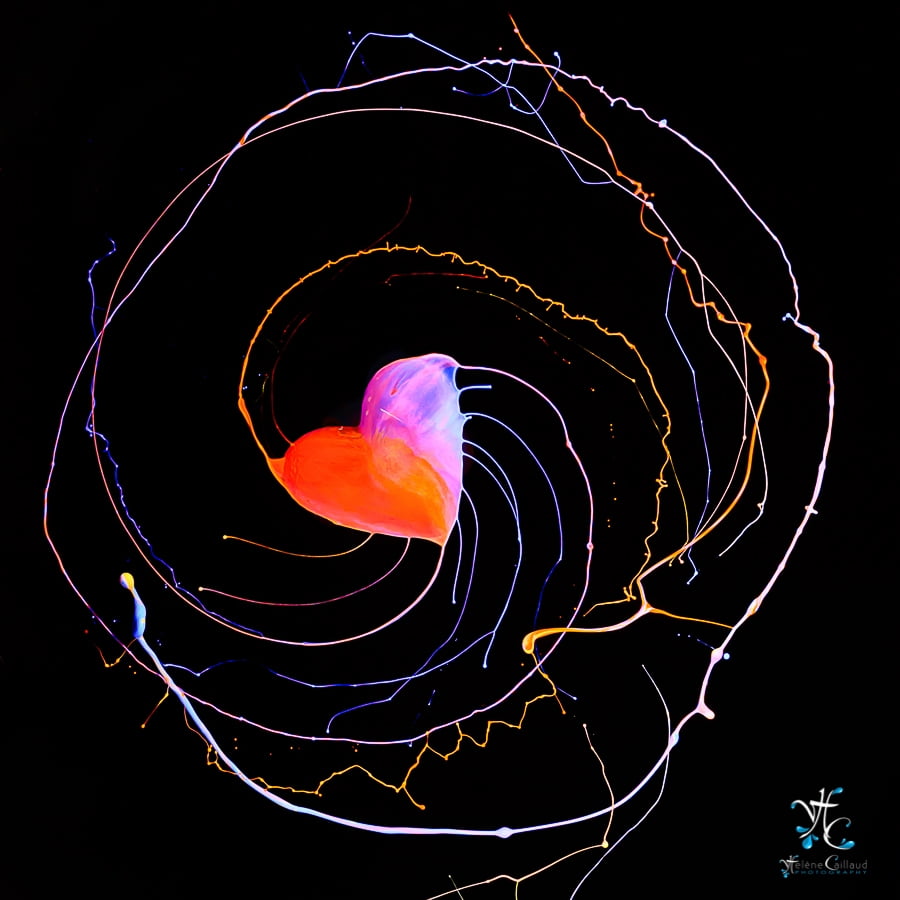
    To make this heart, photographer Helene Caillaud flung paint off a tool attached to a drill bit, much like Fabian Oefner did in his “Black Hole” series. Caillaud, however, tweaked the set-up to create distinctive shapes at the center of her images, with centrifugal force creating the beautiful filaments spiraling outward. It’s a neat effect and a fitting way to celebrate Valentine’s Day here on FYFD! (Image credit: H. Caillaud)

  • Featured Video Play Icon

    “Otherworld, Vol. 1”

    Roman De Giuli’s “Otherworld, Volume 1” is a beautiful exploration of color and flow. Glittery particulates act as tracers in the flow, reminiscent of the way rheoscopic fluids do. In many sequences, the glitter lends a sense of texture to the flow. Without context, I cannot say whether those are true flow features, but they certainly remind me of instabilities like Tollmien-Schlichting waves. (Image and video credit: R. De Giuli)

  • Twirling Liquids

    Twirling Liquids

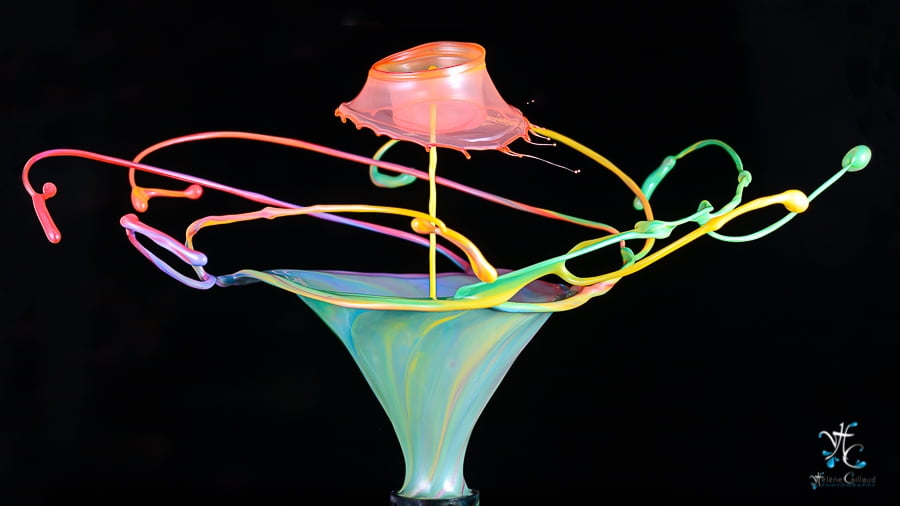
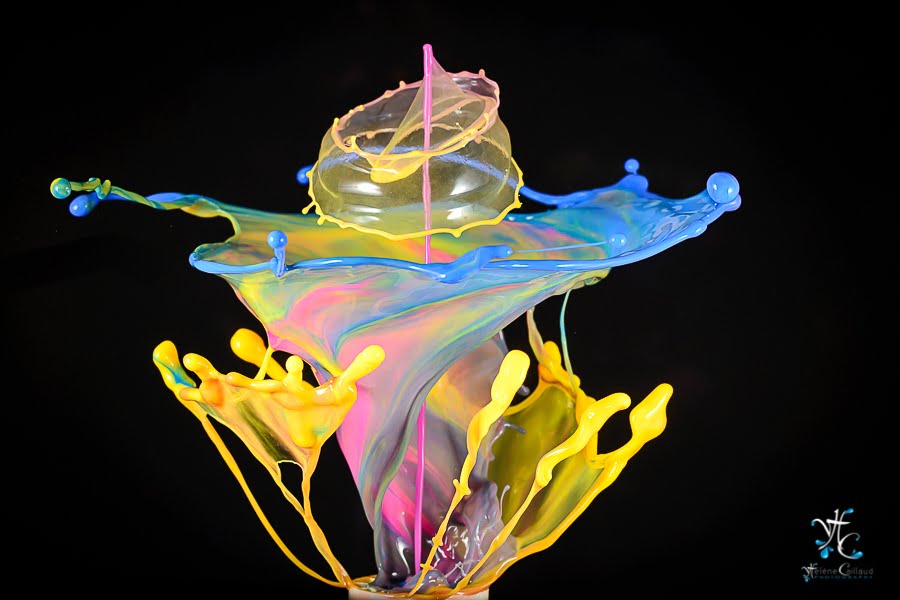
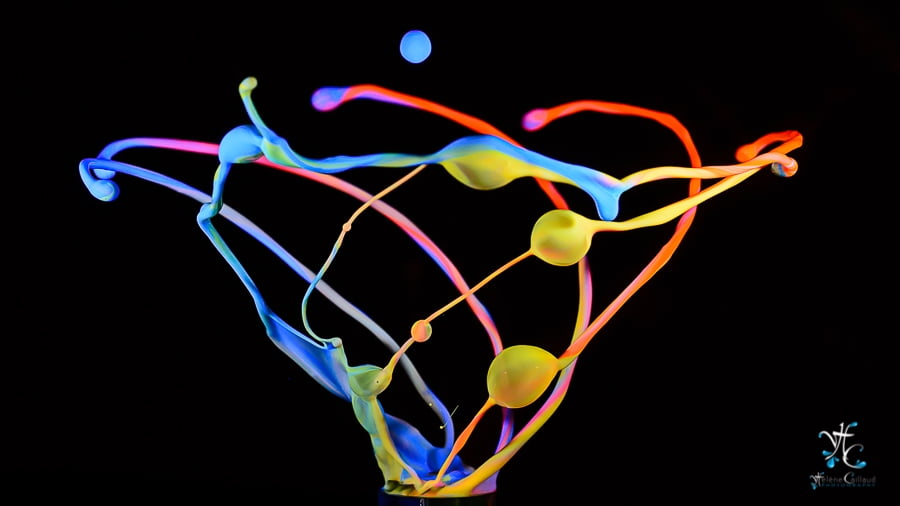
    What do you get when you spin a splash? I expect the result is a lot like these whirling fluid structures captured by photographer Hélène Caillaud. I love the fantastical shapes she creates as sheets and filaments are flung outward. These liquid sculptures look like everything from the perfect martini glass to the skirts of a flamenco dancer. Check out the full gallery of images, and be sure to look around at Caillaud’s other stunning liquid art while you’re there. (Images credit: H. Caillaud)

  • Featured Video Play Icon

    Envisioning Chemical Patterns

    One of the most beautiful chemical reactions is the Belousov–Zhabotinsky reaction, and it’s the subject of the latest video from Beauty of Science. Known colloquially as the BZ reaction, it begins as growing spots of color that turn into rings and chaotic spirals as the chemical reaction progresses.

    Mathematically, the BZ reaction is a type of reaction-diffusion system, meaning that the patterns we see depend both on the speed of local chemical reactions and the time necessary for chemical reagents to move (or diffuse) throughout the dish. Although the diffusion in these systems can simply be the random wandering of molecules, fluid dynamics also plays a role. Variations in chemical concentration between different regions of the reaction drive fluid flows that continue to feed the pattern-making until all the reagents are consumed. (Image and video credit: Beauty of Science; via PetaPixel; submitted by clogwog)

  • Featured Video Play Icon

    “Magic Fluids”

    In his short film, “Magic Fluids,” Roman De Giuli uses cyan, magenta, and yellow paints to generate a rainbow of macro colors. All the fluid motion you see is a practical effect, painstakingly created by layering paints and flow mediums of different densities. Like in Siqueiros’ “accidental painting” technique, the less dense paints will eventually rise through the upper layers and spread. De Giuli uses the effect for its motion, but the same physics is key for many artists who use acrylic pouring to paint. (Video and image credit: R. De Giuli)