
The birth of icebergs from a glacier is known as calving. Although it’s extremely common for chunks of ice to break off a glacier’s terminus, the process is not well understood. In large calving events like the one shown above, the breakaway is preceded by the formation of a crack or crevasse in the main body of the glacier. How quickly that crack grows depends on many factors, including the presence (and temperature) of water in the crack, the topology of the underlying rock, and friction between the glacier and ground beneath. Once the crack is large enough that the glacier can’t support the weight of the ice at the terminus, the ice will break off, generating new icebergs and, potentially, large waves. (Image credit: T. James et al., source)
Search results for: “waves”
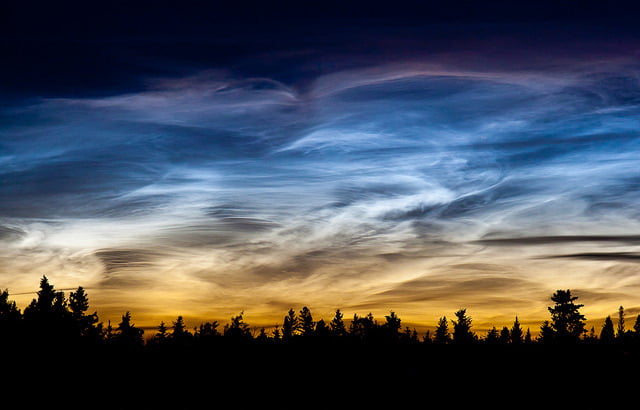
Night Shine
Noctilucent – literally night-shining – clouds are a phenomenon unique to high latitudes during the summer months. Too dim and sparse to see in daylight, these clouds shine at night because their altitude of around 80 km allows them to catch sunlight long after dusk has fallen at the surface. They form when temperatures in the summer mesosphere drop to nearly -150 degrees Celsius, driven by perturbations that can originate in lower layers of the atmosphere on the opposite side of the Earth. Complex interactions and feedback between atmospheric waves, buoyancy, and Coriolis effect circulate those disturbances in such a way that the summer mesosphere can reach temperatures colder than any other place on Earth. Those frigid temperatures allow clouds to form even in this dry region near the edge of space. (Image credit: S. Stephens; see also: B. Karlsson and T. Shepard)

The Coexistence of Order and Chaos
One of the great challenges in fluid dynamics is understanding how order gives way to chaos. Initially smooth and laminar flows often become disordered and turbulent. This video explores that transition in a new way using sound. Here’s what’s going on.

The first segment of the video shows a flat surface covered in small particles that can be moved by the flow. Initially, that flow is moving in right to left, then it reverses directions. The main flow continues switching back and forth in direction. This reversal tends to provoke unstable behaviors, like the Tollmien-Schlichting waves called out at 0:53. Typically, these perturbations in the flow start out extremely small and are difficult or even impossible to see by eye. So researchers take photos of the particles you see here and analyze them digitally. In particular, they are looking for subtle patterns in the flow, like a tendency for particles to clump together with a consistent spacing, or wavelength, between them. Normally, researchers would study these patterns using graphs known as spectra, but that’s where this video does something different.
Instead of representing these subtle patterns graphically, the researchers transformed those spectra into sound. They mapped the visual data to four octaves of C-major, which means that you can now hear the turbulence. When the audio track shifts from a pure note to an unsteady warble, you’re hearing the subtle disturbances in the flow, even when they’re too small for your eye to pick out.
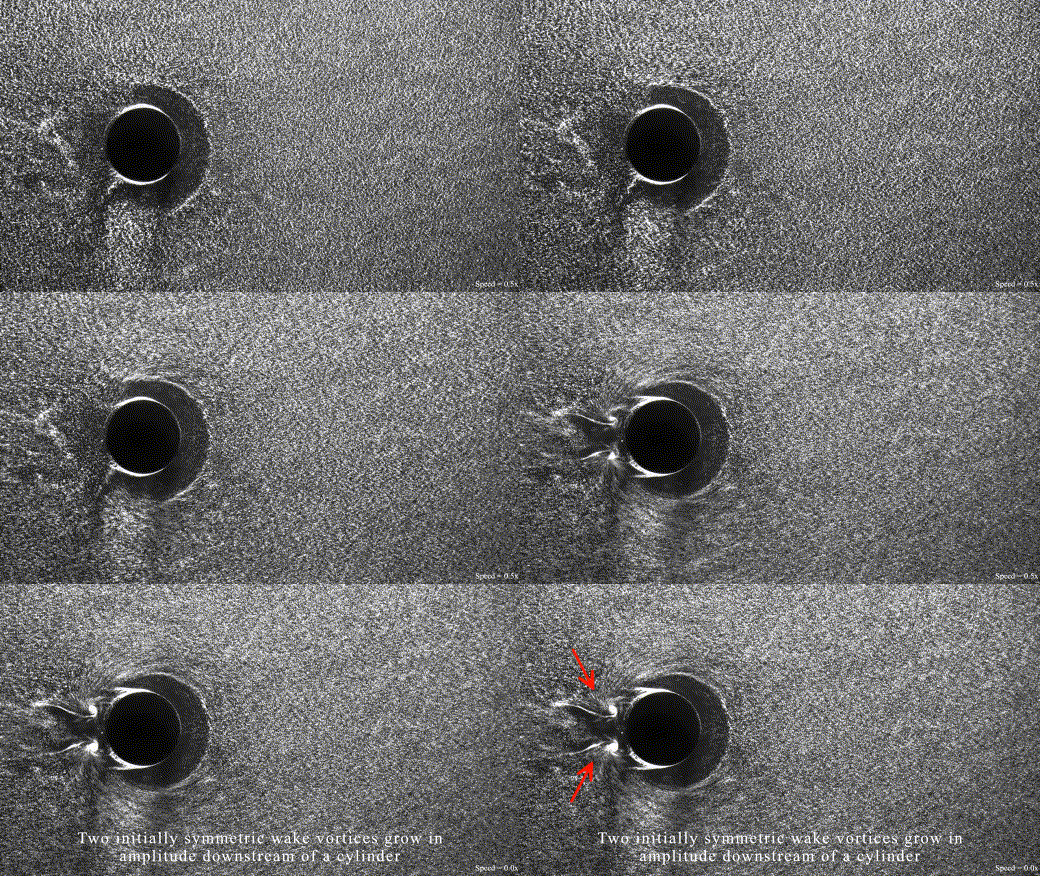
The last part of the video takes this technique and applies it to another flow. We again see a flat plate, but now it has a roughness element, like a tiny hockey puck, stuck to it. As the flow starts, we see and hear vortices form behind the roughness. Then a horseshoe-shaped vortex forms upstream of it. Aside from the area right around the roughness, this flow is still laminar. But then turbulence spreads from upstream, its fingers stretching left until it envelops the roughness element and its wake, making the music waver. (Video and image credit: P. Branson et al.)

Using Air to Break Up Jets


One method of breaking a liquid into droplets, or atomizing it, uses a slow liquid jet surrounded by an annulus of fast-moving gas. The gas along the outside of the liquid shears it, creating waves that the wind blowing past can amplify. This draws the liquid into thin ligaments that then break into droplets. This is a popular technique in rocket engines, where cryogenic liquid fuels often need to be atomized for efficient combustion. When things aren’t working exactly right, however, the liquid jet may start flapping instead of breaking up. In this case, the jet will swing back and forth, but only part of it will atomize. For a rocket engine, this would mean slower and less efficient combustion – never desirable outcomes! (Image credit: A. Delon et al.)
Sandy Wrinkles


Water flowing back and forth over sand quickly forms a field of dune-like wrinkles. On the upstream side, the flow is a little faster, and it picks up grains of sand. When the flow slows on the downstream side of a bump, the sand gets deposited. In this way, small bumps in the sand continue growing larger. A similar process between wind and sand forms enormous dunes here on Earth and on Mars. These smaller water-driven wrinkles are very common in tidal areas and in sandy creeks. They can even build up and break down such that they create periodic waves that surge down the stream. (Image and video credit: amàco et al.)
Mimicking Hurricanes


Hurricanes are a frequent and potentially deadly occurrence for many parts of the world. Although forecasting models have improved, there is still a lot about the physics of these storms that we don’t fully understand, in part because getting direct measurements from the real thing is so difficult and hazardous. Researchers at the University of Miami have instead built their own hurricane generator, capable of sustained 200 mph winds – strong enough to create Category 5 hurricane conditions. In this facility, they can study details of the storm up close, allowing them to distinguish effects from the scale of large waves down to the physics of the sea spray. Learn more and see the facility in action in the Science Friday video below. (Video credit: L. Groskin/Science Friday; image credits: L. Groskin/Science Friday, University of Miami, SUSTAIN Lab; submitted by Guillaume D.)

Riding Across Water

Humans may not be fast enough to run across water, but we’ve found other ways to conquer the waves. It’s even possible (though definitely not recommended) to ride across stretches of water on a dirt bike. To do so, you have to keep the bike (hydro)planing, and to understand what that means, let’s take a moment to talk about boats.
At low speeds, boats stay afloat based on buoyancy, a force that depends on how much water they displace. But when moving at high speeds, modern speedboats lift mostly out of the water and skim the surface instead. At this point, it’s hydrodynamic lift that keeps the boat above the surface and we say that the boat is planing. Calculating that hydrodynamic lift is fairly complicated and depends on many factors – for those who are interested, check out some of David Savitsky’s papers – but, generally speaking, going faster gives you more lift.
This brings us back to the dirt bike. There’s nothing particularly hydrodynamic about a dirt bike. It’s not shaped to provide hydrodynamic lift, but it does come with a high power-to-weight ratio. It’s this ability to create pure speed, and a rider’s keen sense for holding the bike at the right angle, that enables pros to cross open water. Needless to say, this is the kind of stunt that could end really badly, so don’t try it yourself. (Image credits: C. Alessandrelli, source; EnduroTripster, source; via Digg; submitted by 1307phaezr)

Wave Clouds
Stripe-like wave clouds can often form downstream of mountains. This satellite image shows such clouds in the South Pacific where rocky mountains jut 600 meters (2,000 ft) above the sea. This disrupts air flowing east by forcing it to move up and over the island topography. The air does not simply settle back down on the other side, though. It must come back into equilibrium with its surroundings in terms of density and temperature. While doing so it will travel up and down along a wavy path. As it reaches the crest of the wave, humid air cooling condenses and forms a cloud. At troughs, the air warms and the condensation disappears. This creates the stripey cloud pattern in the mountain’s wake, which fades out as the atmospheric gravity waves die out. (Image credit: NASA/J. Schmaltz; via NASA Earth Observatory)

Visualizing Acoustic Levitation
The schlieren photographic technique is often used to visualize shock waves and other strong but invisible flows. But a sensitive set-up can show much weaker changes in density and pressure. Here, schlieren is used to show the standing sound wave used in ultrasonic levitation. By placing the glass plate at precisely the right distance relative to a speaker, you can reflect the sound wave back on itself in a standing wave, seen here as light and dark bands. The light bands mark the high-pressure nodes, where the pressure generated by the sound waves is large enough to counteract the force of gravity on small styrofoam balls. This allows them to levitate but only in the thin bands seen in the schlieren. Move the plate and the standing wave will be disrupted, causing the bands to fade out and the balls to fall. (Video and image credit: Harvard Natural Sciences Lecture Demonstrations)
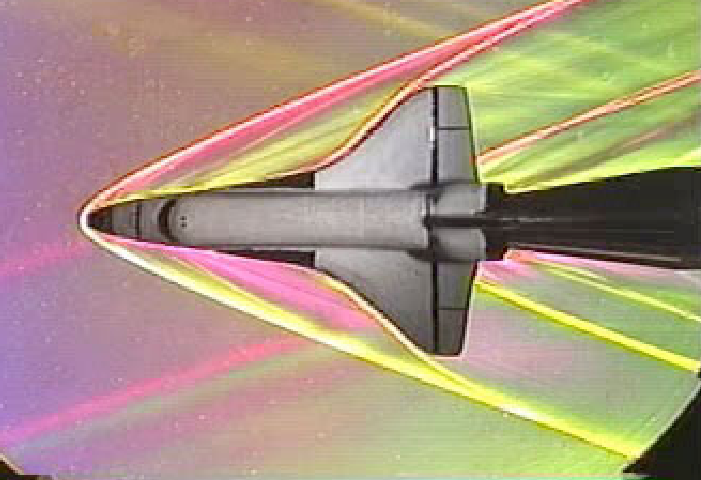
Space Shuttle Sonic Booms
The Space Shuttle had a famous double sonic boom when passing overhead during re-entry. This schlieren flow visualization of a model shuttle at Mach 3 reveals the source of the sound: the fore and aft shock waves on the vehicle. The nose of the shuttle generates the strongest shock wave since it is the first part of the vehicle the flow interacts with. This initial shock wave turns the flow outward and around the shuttle. The second boom comes from the back of the shuttle and serves to turn the flow back in to fill the wake behind the shuttle. (The actual shock wave would look a little different than this one because there’s no sting holding the shuttle like there is with the model.) The other major shock wave comes from the shuttle’s wings, but, at least for this Mach number, the wing shock wave merges with the bow shock, making the two indistinguishable. (Image credit: G. Settles, source)