Search results for: “waves”

  • “Skimming the Waves”

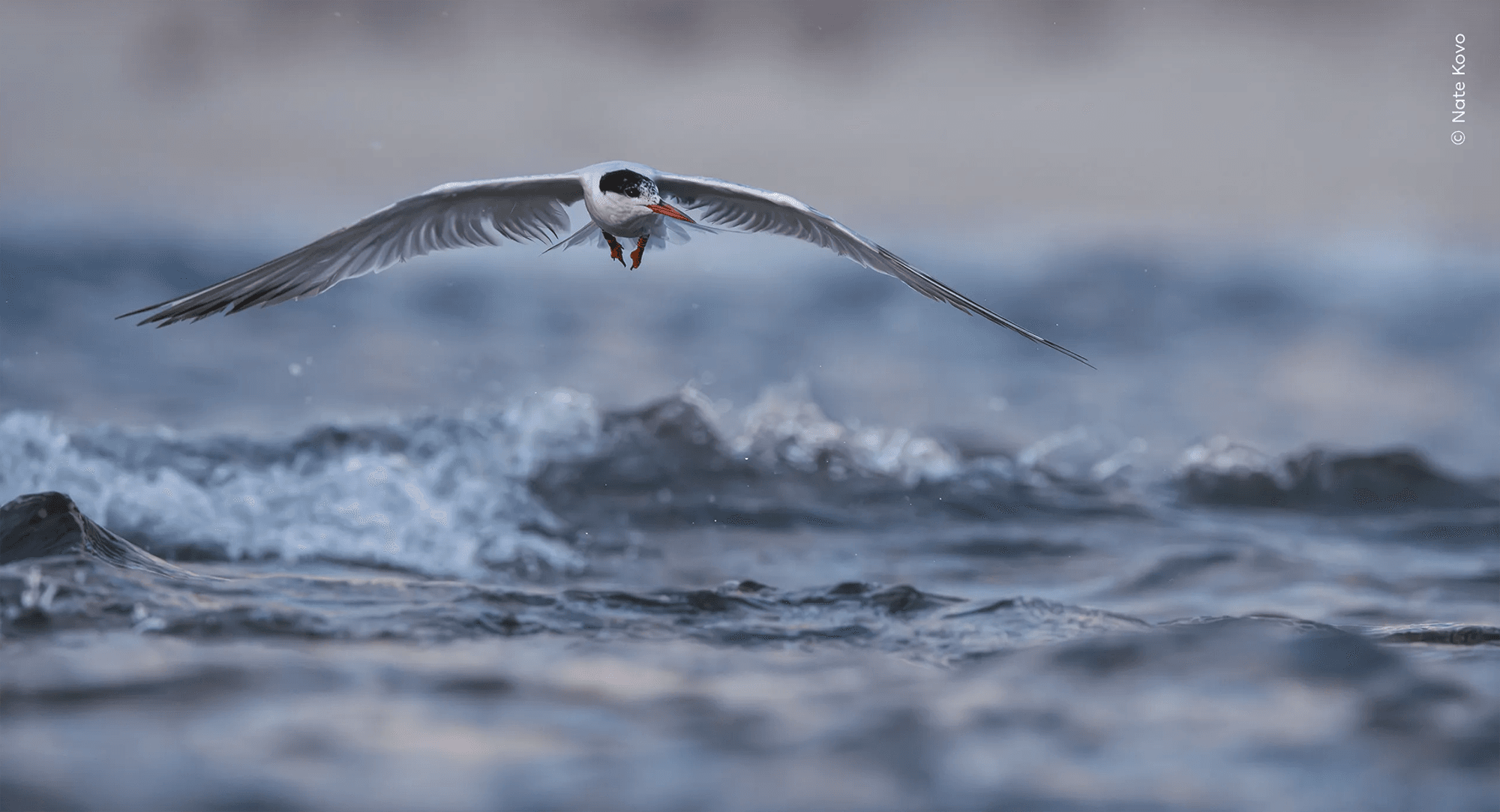
    “Skimming the Waves”

    Common terns are gregarious sea birds that cruise low over the water to fish. When they spot prey, they will dip down to grab a fish from the surface, or they will fold their wings to plunge-dive to depths of half a meter. Compared to gannets and boobies, these are slower, shallower dives that involve less impact risk. Presumably the birds’ choice of dive height reflects the typical swim depth of their preferred fish. (Image credit: N. Kovo/WPOTY; via Colossal)

    Fediverse Reactions
  • Featured Video Play Icon

    Revealing Gravity Waves

    Severe weather — like thunderstorms, tornadoes, and hurricanes — can push air upward into a higher layer of the atmosphere and trigger gravity waves. Aboard the International Space Station (ISS), the Atmospheric Waves Experiment (AWE) instrument captures these waves by looking for variations in the brightness of Earth’s airglow (above). Recently, when Hurricane Helene hit the southeastern United States, AWE caught a series of gravity waves some 55 miles up, pushed by the storm (below). It’s incredible to see these long-ranging ripples spreading far beyond the heart of the storm. (Video credits: NASA Goddard and Utah State University)

  • Waves Break Up Floating Rafts

    Waves Break Up Floating Rafts

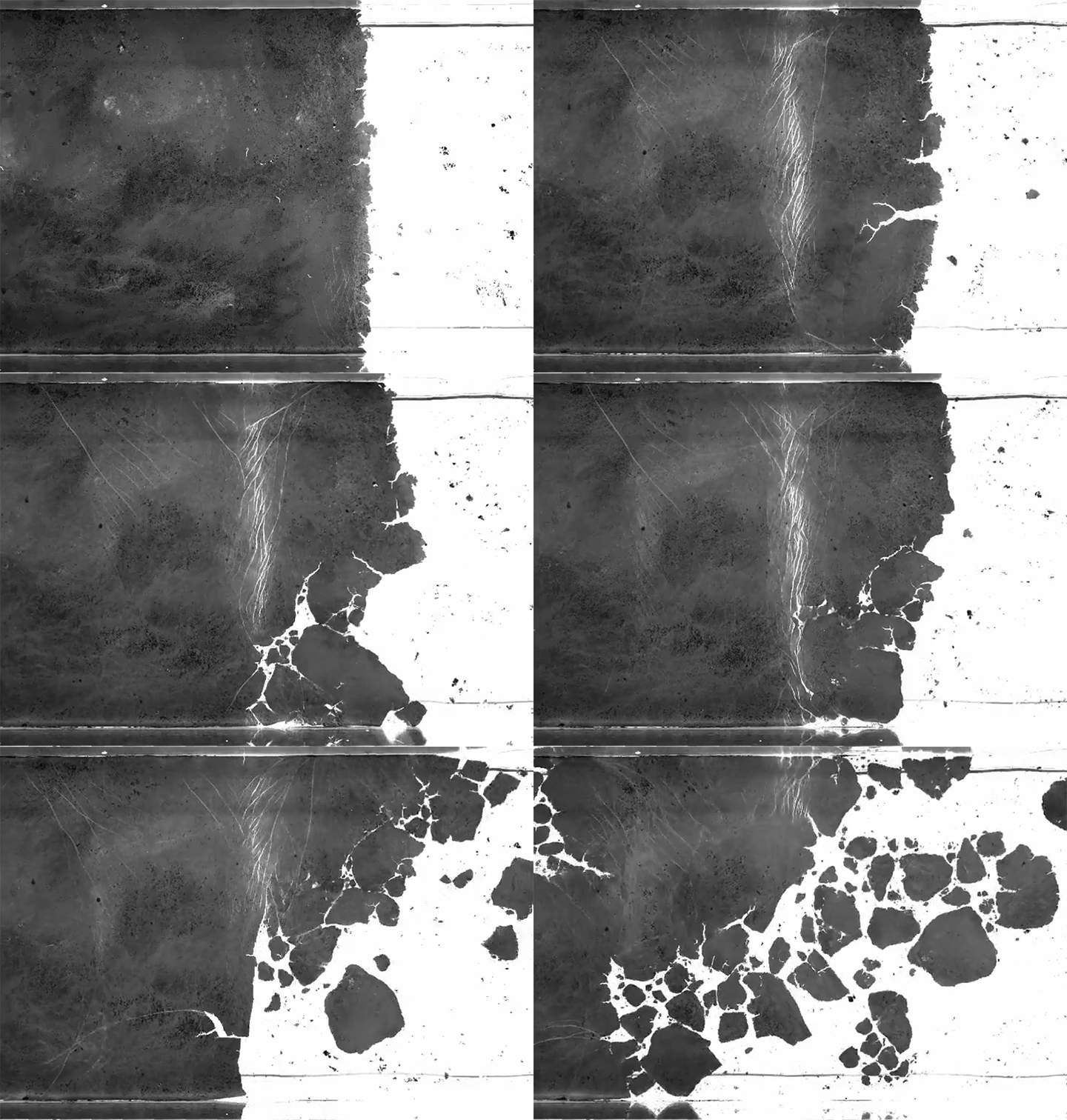
    Small particles can float on a liquid, held together as a raft through capillary action. But those rafts — like the tea skin below — break up when waves jostle them. In this study, researchers looked at how standing waves broke up a raft of graphite powder. Although the raft’s break-up resembles fields of sea ice breaking apart, the researchers found that different mechanisms were responsible. In their experiment, waves pushed and pulled horizontally at the raft, causing it to fracture. But that push-and-pull is negligible in sea ice, where sheets instead break from the up-and-down motion of waves vertically bending the ice. Nevertheless, the new insights are valuable for various biofilms and some ice floes. (Image and research credit: L. Saddier et al.; via APS Physics)

    The skin atop a cup of tea breaks up into polygons after stirring with a spoon.
    The skin atop a cup of tea breaks up into polygons after stirring with a spoon. Although the effect resembles sea ice breakup, the specific wave mechanism differs.
  • The Crashing Waves of French Polynesia

    The Crashing Waves of French Polynesia

    Surfer and photographer Tim McKenna lives in the village of Teahupo’o on Tahiti’s southeastern coast. The area’s shallow coral reef system creates some of the world’s biggest barreling waves, which attract surfers from around the world. McKenna captures the majestic power of these surges in these black-and-white photographs; you can find more of his work on his website and Instagram. (Image credit: T. McKenna; via Colossal)

  • Waves Lap on Titan’s Shores

    Waves Lap on Titan’s Shores

    Titan, one of Saturn’s moons, is the only other planetary body known to have liquid lakes, rivers, and seas at its surface. Whether those bodies — made up of hydrocarbons rather than water, like here on Earth — have waves is a matter of ongoing debate. What data we have from visiting spacecraft is inconclusive. So a group of researchers decided to look for the effects of wave action instead.

    Beginning with a model of flooded areas similar to Titan’s, the team simulated a coastline’s erosion assuming three different situations: 1) no coastal erosion, 2) erosion from waves, and 3) uniform erosion through dissolution. Each set of conditions resulted in a very different final coastline. But, of the three, the wave-eroded coast was most similar to those seen on Titan. That’s a good indicator that, even if our spacecraft couldn’t see waves on Titan, they’re likely there. (Image credit: ESA; research credit: R. Palermo et al.; via Gizmodo)

  • Star-Birthing Shock Waves

    Star-Birthing Shock Waves

    Although the space between stars is empty by terrestrial standards, it’s not devoid of matter. There’s a scattering of cold gas and dust, pocked by areas known as prestellar cores with densities of a few thousand particles per cubic centimeter. This is just enough matter to help gravity eventually win its tug of war with the forces that would drive molecules apart.

    When shock waves pass through these regions — whether thrown off a dying star or a newly birthed one — they compress the material, kickstarting the process of stellar formation. Passing shock waves can also shake loose molecules stuck to the dust, providing key tracer elements that astronomers can use to visualize shock waves and the areas they affect. To learn more, see this article over at Physics Today. (Image credit: NASA/ESA/CSA/STSCI/K. Pontoppidan/A. Pagan; see also Physics Today)

  • Calming the Waves

    Calming the Waves

    Wave action can be a major source of erosion along riverbanks and shorelines. But in a recent study, scientists were able to perfectly absorb incoming waves to create a downstream region with calm, wave-free waters.

    Experimental data shows that waves approaching from the left interact with the resonant chambers and get perfectly absorbed, leaving the water on the right side still.
    Experimental data shows that waves approaching from the left interact with the resonant chambers and get perfectly absorbed, leaving the water on the right side still.

    The group began with a narrow channel that waves could move down. They added two small, side-by-side cavities perpendicular to the channel; as waves travel down the channel, they resonate with the cavities, which reflect and transmit their own waves back into the channel. With the right tuning to the size and spacing of the cavities, the team was able to make the cavities’ waves perfectly cancel the channel’s waves. The group demonstrated this absorption theoretically, numerically, and experimentally.

    Currently, they’ve only managed perfect absorption with a single wave frequency, but an array of cavities should be able to absorb a range of incoming waves. The authors hope their work will one day help protect coastal structures and prevent erosion by countering incoming waves. (Image and research credit: L-P. Euvé et al.; via APS Physics)

  • Predicting Heat Waves

    Predicting Heat Waves

    The United States, Europe, and Russia have all seen deadly, record-breaking heat waves in recent years, largely in areas that are ill-equipped for sustained high temperatures. A new paper presents a theory that predicts how hot these heat waves can get and what mechanism ultimately breaks the hot streak.

    Heat waves start when an area of high-pressure air forms over land, with an anticyclone circulating around it. Air at the center of the zone warms and rises, and if the anticylone can’t move, temperatures will just keep rising. Despite the heat, there is still moisture in the rising air of a heat wave. The authors found that if that moist air can reach an altitude where the atmospheric pressure is 500 hPa (a typical altitude of 5-7 km), then the maximum daily temperature will stop rising. At that altitude, the moist air can condense into rain, and, even if that rain evaporates before reaching the ground, it is enough to cool temperatures.

    The key variable in the theory is the atmospheric temperature at 500 hPa, something that meteorological models are able to predict well up to three weeks in advance. That means this theory should enable meteorologists to give advanced warning of high temperatures, helping communities prepare. (Image credit: T. Baginski; research credit: Y. Zhang and W. Boos; via APS Physics)

  • Featured Video Play Icon

    Surfactants and Waves

    In the ocean, waves often curl over and trap air, becoming plunging breakers. How do surfactants like soap or oil affect this process? That’s the question behind this video, where researchers visualize breaking waves with differing amounts of added surfactant. In the case of pure water, the wave forms a smooth jet that curls over and traps air when the wave breaks. As more and more surfactant gets added, the shape of that jet and cavity change. In one case, they become irregular. In another, they disappear entirely, and with the most surfactant added, the wave suddenly looks just like the water-only case.

    The key to these behaviors, it turns out, is not how much surfactant there is, but how much the concentration of surfactant varies along the length of the wave. When there are significant changes in the surfactant concentration along the wave, local Marangoni flows try to even out the surface tension, causing the wave to break up in an irregular fashion. (Image and video credit: M. Erinin et al.)

  • Beneath the Waves

    Beneath the Waves

    Surfing looks entirely different from below the wave. Photographer Ben Thouard captures his images by freediving and observing what goes on overhead. Whether the surfers nearby ride a barrel roll or bail into the churn, the results are incredible. You can find more of Thouard’s artwork on his website and Instagram. (Image credit: B. Thouard; via Oceanographic Magazine)