Search results for: “waves”

  • Waves in Liquid Crystals

    Waves in Liquid Crystals

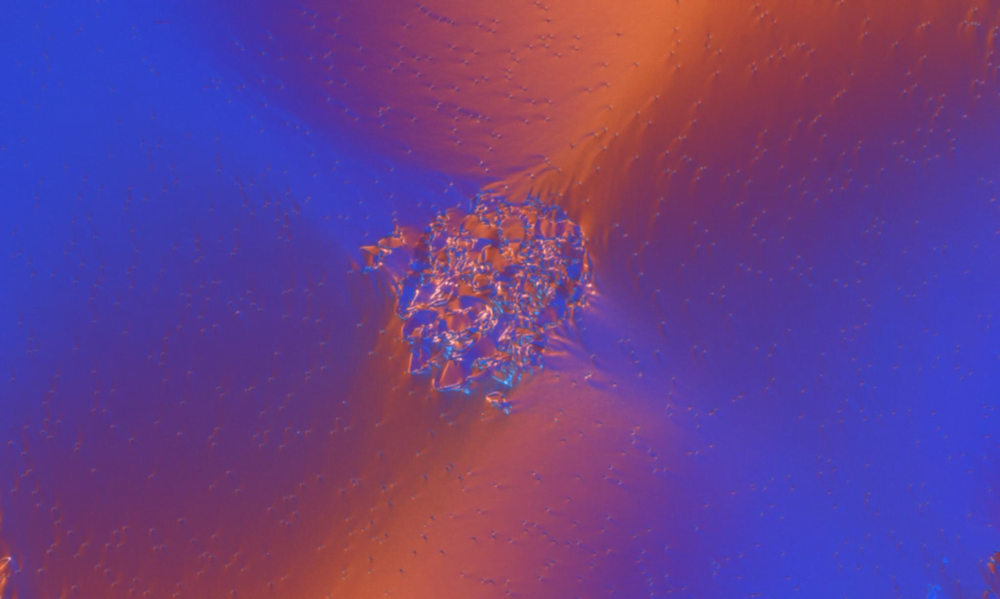
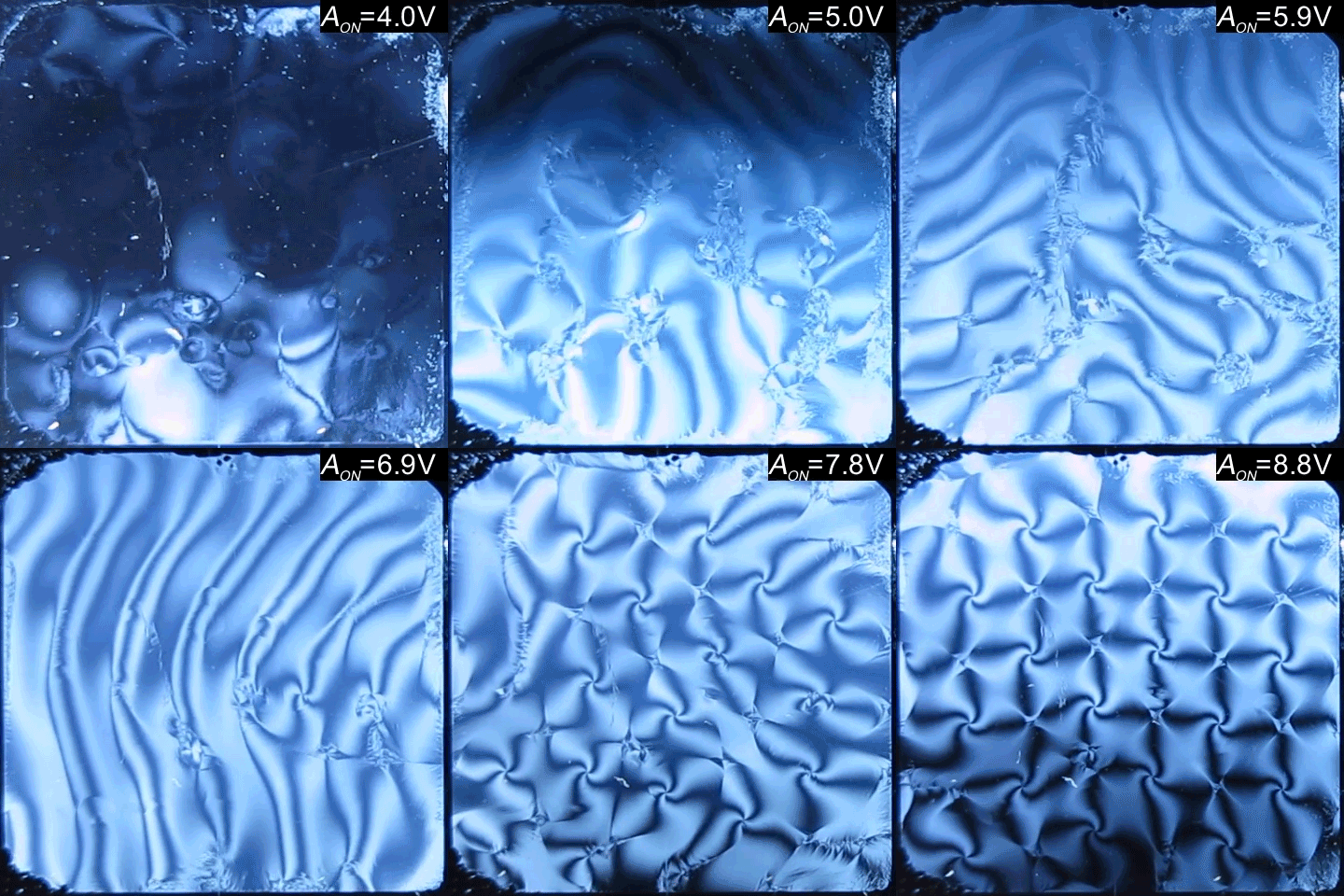
    Liquid crystals are now ubiquitous in displays, but scientists are still discovering new properties for this state of matter. Here, a team explores nematic liquid crystals, whose rod-like shape rotates in three dimensions as they apply a voltage. The layer of liquid crystals is held between polarizing filters, creating regions of light and dark that depend on the liquid crystals’ orientations.

    Traveling waves and other wave patterns form in this liquid crystal as the voltage applied to it increases.
    Traveling waves and other wave patterns form in this liquid crystal as the voltage applied to it increases.

    As the researchers increase the voltage, traveling waves form. With higher voltages, the waves appear to slow a stop. The slowing waves result from the molecules tilting far from a vertical orientation, which makes it harder for individual molecules to rotate since they experience greater resistance from their neighbors. (Image, video, and research credit: V. Panov et al.; via APS Physics)

  • Featured Video Play Icon

    Classifying Waves

    In a lab, researchers create their waves in a long, clear-sided tank, where they can observe how the waves form, travel, and interact. To generate the wave, they use a plate, attached to a piston. Push the water at one end, and a wave forms. The type of wave that forms depends on both the velocity and the stroke length of the piston, as shown in this video. By mapping out these two variables, researchers can observe all different sorts of waves, from peaceful solitary waves to wild, plunging breakers. (Image and video credit: W. Sarlin et al.)

  • Featured Video Play Icon

    Pumping With Faraday Waves

    Vibrate a liquid pool vertically, and it will form a pattern of standing waves known as Faraday waves. Here, researchers confine those waves to a narrow ring similar in size to the wave. The confinement causes a type of secondary flow — a streaming flow — beneath the water surface. As a result, the wave pattern rotates around the ring. The applications of this rotation are pretty neat. As the team demonstrates, it can drive complex fluid networks and even create a pump! (Image and video credit: J. Guan et al.)

  • Beautiful Waves

    Beautiful Waves

    Australian photographer Ray Collins captures some of the most impressively dynamic photographs of ocean waves I’ve ever seen. The textures of the water range from glassy smooth to scaled to violent sprays of droplets. You can easily get lost in every image. For more, check out his website and Instagram. (Image credits: R. Collins; via Colossal)

  • Stunning Waves

    Stunning Waves

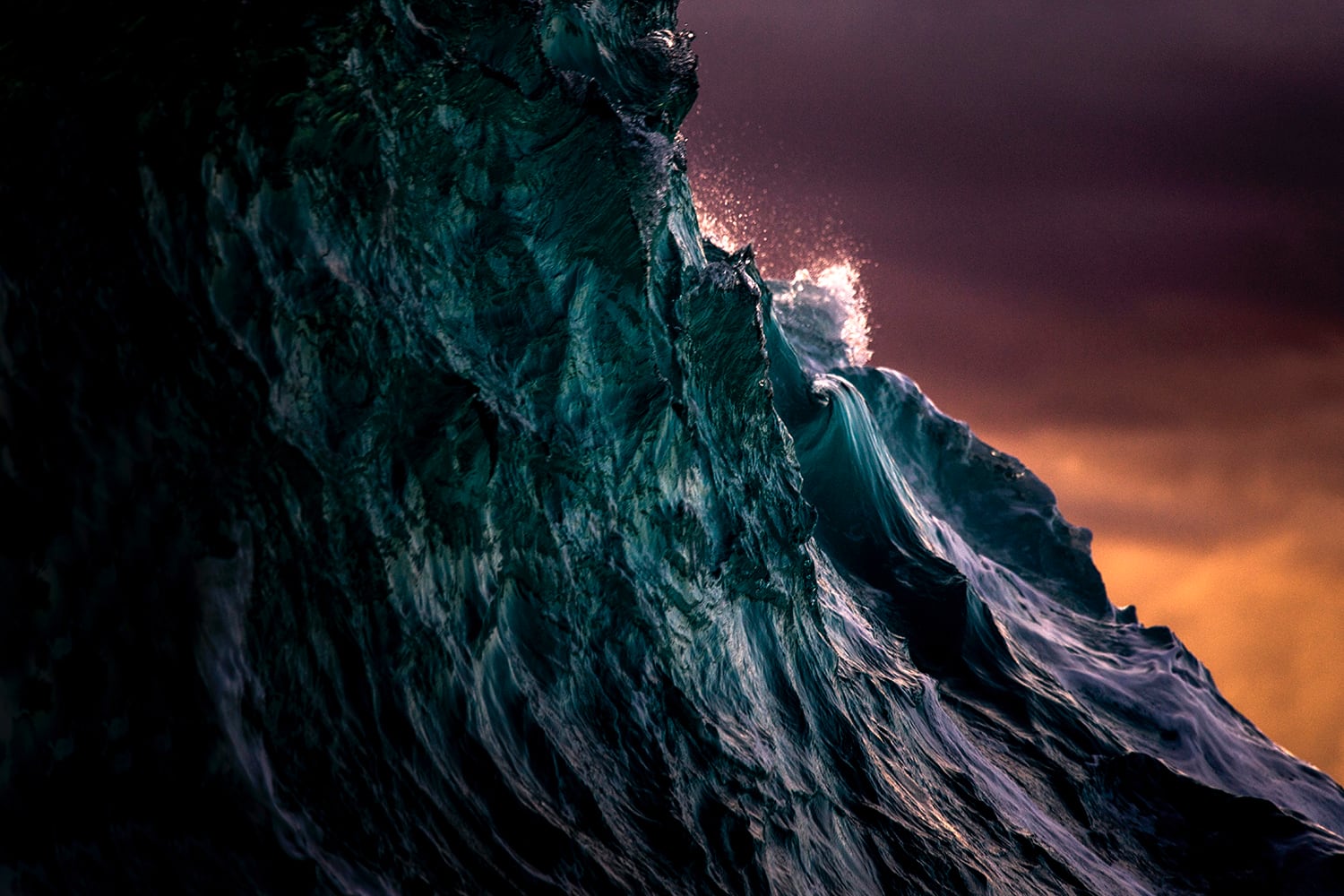
    Photographer Lloyd Meudell captures breathtaking images of ocean waves off his home shores of New South Wales. The waveforms and lighting combine to create infinite variety in shape and texture. Some waves look like towering mountain landscapes; some look like glass sculptures. Every one of them draws you into the ocean’s power. (Image credit: L. Meudell; via Bored Panda)

  • Rotating Waves of Grains

    Rotating Waves of Grains

    Rotating drums are a popular way to explore granular dynamics. Here, researchers fill a cylinder (seen below) with heavy grains and a low-viscosity fluid, then rotate the mixture about a horizontal axis. This sets up a contest between centrifugal forces and gravitational forces on the grains. At the right rotation rates, the grains form annular rings around the outside of the cylinder, where they rotate at a different speed than the fluid. This difference in speed between the two layers can trigger a Kelvin-Helmholtz instability and cause waves along the interface between the grains and the fluid, as seen in the examples above. (Image and research credit: V. Dyakova and D. Polezhaev; top image adapted by N. Sharp)

    Image of the experimental apparatus when not rotating.
  • Rocked By Waves

    Rocked By Waves

    This astronaut photo shows the Isles of Scilly off the Cornish coast. The pale turquoise waters mark shallow reefs and shoals between the islands while blues reveal deeper waters surrounding the isles. The sun angle is perfect for highlighting the complex wave patterns caused by the winds and tides. Look closely and you’ll see swells intersecting one another and even diffracting around the smaller islets. (Image credit: NASA; via NASA Earth Observatory)