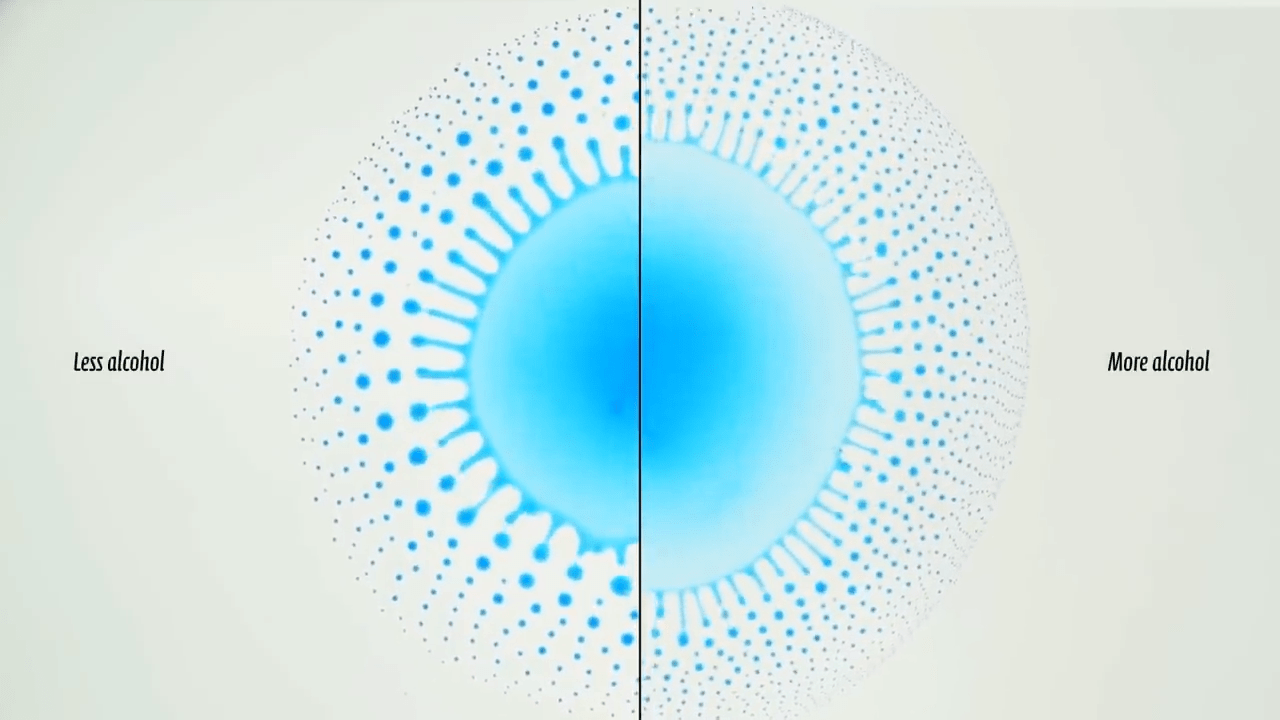
A few years ago, researchers described how an alcohol-water droplet atop an oil bath could pull itself apart through surface tension forces. Dubbed Marangoni bursting, this phenomena has shown up several times since. Here, researchers explore a twist on the behavior by adding surfactants to see how they affect the bursting phenomenon. (Video and image credit: K. Wu and H. Stone; via GFM)
Adding dye to a flow is a common technique for visualization. After all, many flows in fluids like air and water are invisible to our bare eyes. But for some classes of flows — especially those driven by variations in surface tension — adding dye can have unforeseen effects. A recent study shows how true this is for bursting Marangoni droplets, where evaporation and alcohol concentration can pull a water-alcohol droplet apart.
As more dye is added to the experiment, the daughter droplets grow larger and more ligaments form. In the first three images, a dashed black line has been added to show the location of the droplet rim.
Without dye, it’s nearly impossible to see the phenomenon since the refractive indices of the two component liquids are so close. But the researchers found that, as they added more methyl blue dye, it did more than increase the contrast in the flow. It changed the flow, making the droplets larger and creating ligaments between them. They believe that the dye’s own surface tension creates local gradients that alter the flow. It’s a reminder that experimentalists have to be careful to consider how our efforts to measure and observe a flow can change it. (Image credit: top – The Lutetium Project, bottom – C. Seyfert and A. Marin with modification; research credit: C. Seyfert and A. Marin)
Marangoni bursting takes place in alcohol-water droplets; as the alcohol evaporates, surface tension changes across the liquid surface, generating a flow that tears the original drop into smaller droplets. Here researchers add a twist to the experiment using PMMA, an additive that dissolves well in alcohol but poorly in water. As the alcohol evaporates, the PMMA precipitates back out of the water-rich droplet, forming yarn-like strands. (Image and video credit: C. Seyfert and A. Marin)


![Black and white image of a film pulled outward and breaking into droplets. Text reads, "The [0.05%] surfactant renders the ejected droplets prone to 'popping'."](https://fyfluiddynamics.com/wp-content/uploads/surfburst2.png "Black and white image of a film pulled outward and breaking into droplets. Text reads, \"The [0.05%] surfactant renders the ejected droplets prone to 'popping'.\"")
![Black and white image of a film pulled outward and spreading in unevenly. Text reads, "When surfactant concentration is further increased [to 1%], drop spreading resumes."](https://fyfluiddynamics.com/wp-content/uploads/surfburst3.png "Black and white image of a film pulled outward and spreading in unevenly. Text reads, \"When surfactant concentration is further increased [to 1%], drop spreading resumes.\"")