Search results for: “vorticity”

  • Black Holes in a Blender

    Black Holes in a Blender

    Massive black holes drag and warp the spacetime around them in extreme ways. Observing these effects firsthand is practically impossible, so physicists look for laboratory-sized analogs that behave similarly. Fluids offer one such avenue, since fluid dynamics mimics gravity if the fluid viscosity is low enough. To chase that near-zero viscosity, experimentalists turned to superfluid helium, a version of liquid helium near absolute zero that flows with virtually no viscosity. At these temperatures, vorticity in the helium shows up as quantized vortices. Normally, these tiny individual vortices repel one another, but a spinning propeller — much like the blades of a blender — draws tens of thousands of these vortices together into a giant quantum vortex.

    Here superfluid helium whirls in a quantum vortex.
    Here superfluid helium whirls in a quantum vortex.

    With that much concentrated vorticity, the team saw interactions between waves and the vortex surface that directly mirrored those seen in black holes. In particular, they detail bound states and black-hole-like ringdown phenomena. Now that the apparatus is up and running, they hope to delve deeper into the mechanics of their faux-black holes. (Image credit: L. Solidoro; research credit: P. Švančara et al.; via Physics World)

  • Bubble Trails – Straight or Wonky?

    Bubble Trails – Straight or Wonky?

    Watch the bubbles rising in a glass of champagne and you’ll see them form tiny straight lines, with each bubble following its predecessor. But in a carbonated soda, the bubbles rise all over the place, each following its own zig-zaggy line. Why the difference? A recent study points out the culprits: bubble size and surfactants.

    As bubble size increases from left to right, the bubble trail straightens.
    As bubble size increases from left to right, the bubble trail straightens.

    Looking at a variety of beverage scenarios, researchers found that both a bubble’s size and its surfactant concentration affected what sort of path it followed. For clean (surfactant-free) bubbles, small bubbles take a winding path, but bigger ones move in a straight line. Simulations show that bubbles can only form a straight path if they produce enough vorticity on their surface. Small bubbles just can’t deform enough to do that.

    For bubbles of the same size, increasing the surfactant on the bubbles straightens their path.
    For bubbles of the same size, increasing the surfactants on the bubbles straightens their path.

    When surfactants get added, though, the story changes. For bubbles of a set size, adding surfactants made their paths straighter. This was due, the team found, to a bump in vorticity provided by the stabilizing effect of the surfactants. Champagne, they concluded, has straight bubble paths despite its tiny bubbles because of the drink’s high number of flavorful surfactants. (Image credit: top – D. Cook, experiments – O. Atasi et al.; research credit: O. Atasi et al.; via APS Physics)

  • How Squall Lines Form

    How Squall Lines Form

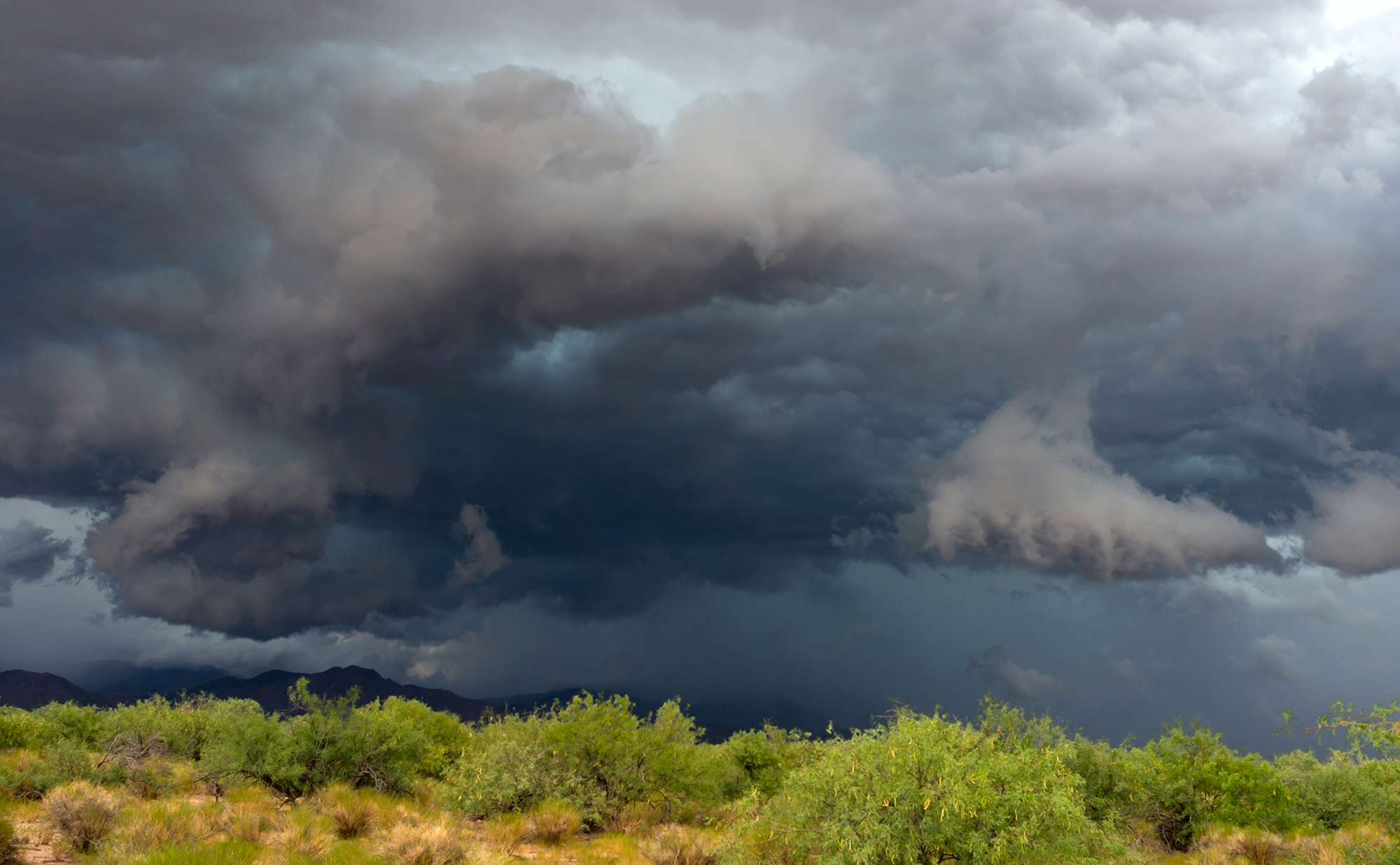
    Summertime in the middle U.S. means thunderstorms, many of which can form long lines of storms known as squall lines. Complex convective dynamics feed such storms. Here is an illustration of one part of a squall’s lifecycle:

    Illustration of squall line formation.
    As rain falls and evaporates, it fuels the formation of a cold pool of air below the cloud. Incoming wind (gray arrows) blocks the cold pool from spreading. In turn, the cold pool acts as a ramp that redirects this warm, moist air upward. The vertical variation in wind speed (wind shear, shown with pink arrows) creates a positive vorticity. Together with the negative vorticity in the cold pool, this induces a vorticity dipole that lifts air and moisture, feeding the growing line of storms.

    As it falls, rain evaporates, cooling air near the ground and forming a cold pool. If incoming winds block the cold pool from spreading, the pool will act instead as a ramp that redirects the wind upward, carrying any warmth and moisture up into the storm cloud. Wind shear — a vertical variation in wind strength with altitude — creates positve vorticity that opposes the negative vorticity inherent to the cold pool. Together these two regions of opposing vorticity lift more air and moisture into the squall, generating more clouds and more rainfall. (Image credit: top – J. Witkowski, illustration – C. Muller and S. Abramian; see also C. Muller and S. Abramian)

  • Sea Sponge Hydrodynamics

    Sea Sponge Hydrodynamics

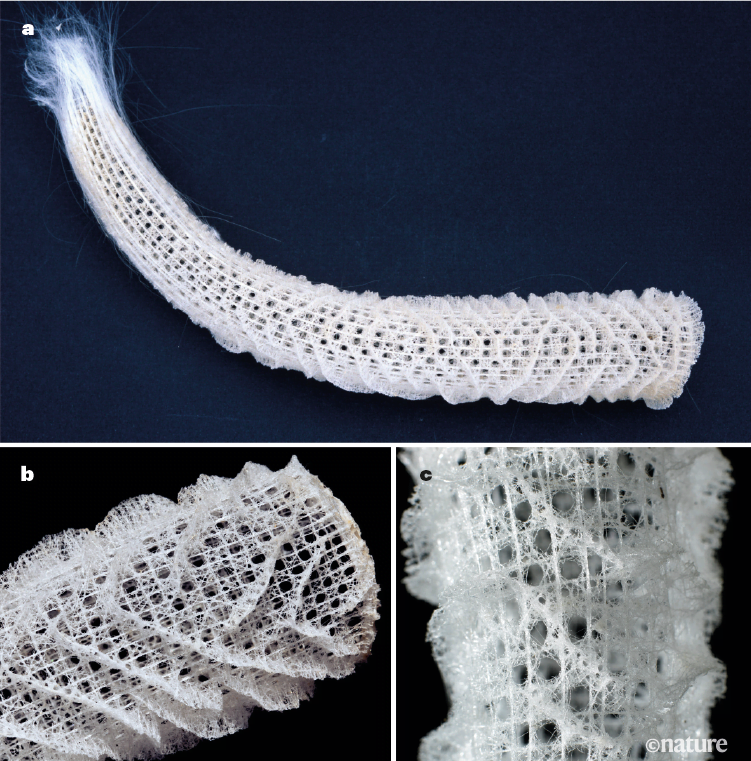
    The Venus’s flower basket is a sea sponge that lives at depths of 100-1000 meters. Its intricate latticework skeleton has long fascinated engineers for its structural mechanics, but a new study shows that the sponge’s shape benefits it hydrodynamically as well.

    The sea sponge’s skeleton is predominantly cylindrical, with tiny gaps that allow water to flow through it and helical ridges alongside its outer surface to strengthen it against the deep-sea currents surrounding it. Through detailed numerical simulations, researchers found that both of these features — the holes and the ridges — serve fluid mechanical purposes for the sponge. The porous holes of the sea sponge drastically reduce flow in the sponge’s wake (third image), which provides major drag reduction for the sea sponge. That drag reduction makes it easier for the sponge to stay rooted to the ocean floor.

    The helical ridges, on the other hand, create low-speed vortices within the sea-sponge’s body cavity (second image). Such vortices increase the time water spends inside the sponge, likely helping it to filter-feed more efficiently. The additional vorticity comes at the cost of slightly increased drag but not enough to outweigh the savings from its porosity. (Image and research credit: G. Falcucci et al.; via Nature; submitted by Kam-Yung Soh)

  • Tokyo 2020: Baseball Aerodynamics

    Tokyo 2020: Baseball Aerodynamics

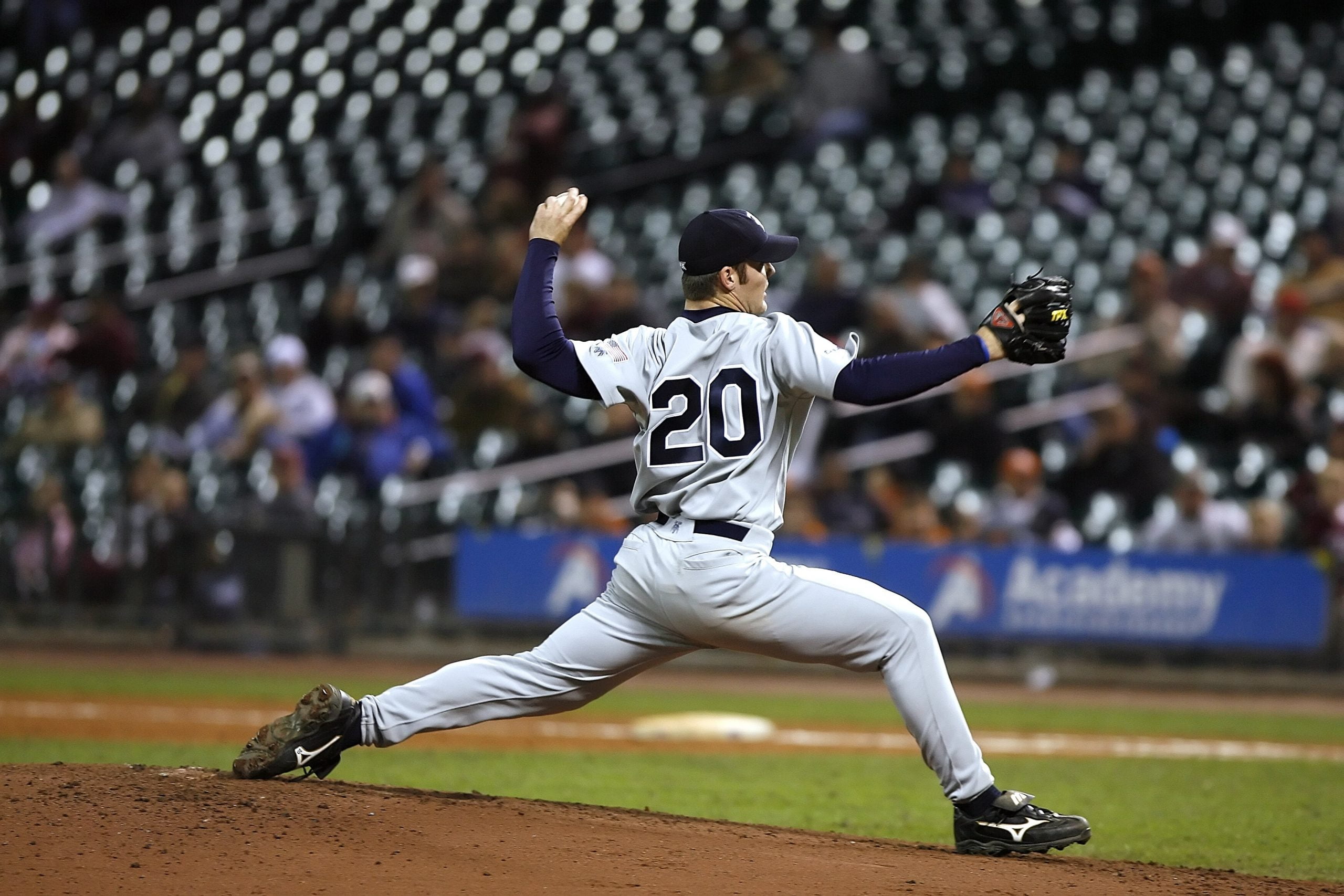
    For a long time, people thought baseball aerodynamics were simply a competition between gravity and the Magnus effect caused when a ball is spinning. But the seams of a baseball are so prominent that they, too, have a role to play. Here’s a baseline image of flow around a non-spinning baseball:

    An non-spinning baseball with a straight, unaltered wake.

    As in our previous post on golf, the colors indicate the direction of vorticity but don’t matter much to us here. What’s important is that the wake behind the ball is straight, indicating that there is no additional force beyond gravity and drag acting on the ball. Contrast this to the spinning baseball below:

    Flow around a baseball spinning clockwise.

    This ball is spinning in a clockwise motion, which causes flow to separate from the ball earlier on the advancing (bottom) side and later on the retreating (top) side. As a result, the wake is tilted downward. This indicates an upward force on the ball, caused by the Magnus effect.

    But what if the seams fall in a place where they affect the flow? Here’s another baseball that’s not spinning:

    Flow around a non-spinning baseball with a seam-shifted wake caused by early separation on the top surface of the baseball.

    Notice that seam sitting just past the widest point on the top of the baseball. Flow around that wide point (called the shoulder) is very sensitive to disturbances essentially because the boundary layer is just barely hanging on to the ball. The blue arrow marks where the boundary layer separates from the ball on the top, which takes place earlier than the flow separation on the bottom, marked by the red arrow. As a result, the wake of the ball is tilted upward, indicating a downward force on the ball. The researchers who first proved this effect call it a seam-shifted wake, and it turns out to be a very common effect in baseball. They’ve got a great blog dedicated to baseball aerodynamics where you can learn tons more if you’re interested. (Image credit: top – Pixabay, others – B. Smith; research credit: B. Smith; see also Baseball Aerodynamics)

    Today wraps up our Olympic coverage, but if you missed our earlier posts, you can find them all here.

  • Tokyo 2020: Visualizing the Magnus Effect in Golf

    Tokyo 2020: Visualizing the Magnus Effect in Golf

    Golf returned to the Olympics in 2016 in Rio and is back for the Tokyo edition. Golf balls — with their turbulence-promoting dimples — are a perennial favorite for aerodynamics explanations because, counterintuitively, a dimpled golf ball flies farther than a smooth one. But today we’re going to focus on a different aspect of golf aerodynamics, namely, what happens when a golf ball is spinning. Here’s an animation showing the difference between flow around a non-spinning golf ball and flow around a golf ball spinning at 3180 rpm. Both balls are moving to the left at 30 m/s.

    Animation toggling between a non-spinning and spinning golf ball moving at 30 m/s.

    The colors in this image indicate the direction of vorticity (which is unimportant for us at the moment). What matters are the blue and red arrows, which mark where flow is leaving the surface of the golf ball, in other words, where the wake begins. For the non-spinning golf ball, flow leaves the ball at the same streamwise position on both sides of the ball. This gives a symmetric wake that is neither tilted upward nor downward.

    On the spinning ball, though, the blue arrow on top of the ball moves backward, indicating that separation occurs later. On the lower surface, the red arrow moves forward, so separation happens earlier. These shifts cause the golf ball’s wake to tilt downward, which — by Newton’s Third Law — tells us that the ball is experiencing an upward force. This is known as the Magnus effect, and it plays a big role in soccer, volleyball, tennis, and any other sports with spinning balls.

    It’s also possible, under the right circumstances, to get a reverse Magnus effect. For more on that, check out this video and Smith’s analysis. (Image credit: top – M. Spiske, others – N. Sakib and B. Smith; research credit: N. Sakib and B. Smith, pdf)

    We’re celebrating the Olympics with sports-themed fluid dynamics. Learn how surface roughness affects a volleyball serve, see the wingtip vortices of sail boats, and find out how to optimize rowing oars. And don’t forget to come back next week for more!

  • Breaking the Euler Equations

    Breaking the Euler Equations

    Mathematicians like to break things. Or, more exactly, they like to know when the equations we use to describe physics break down. One popular target in fluid mechanics are the Euler equations, which describe the motion of frictionless, incompressible flows. Mathematicians have been on the hunt for centuries for situations where these equations predict singularities, points where the velocity or vorticity of a fluid change infinitely quickly. Since that can’t happen in reality (at least as far as we understand it), these singularities indicate weaknesses in our mathematical description and may help uncover fundamental flaws in our understanding.

    Despite centuries of effort, the Euler equations withstood mathematical assault… until recently. Since 2013, a series of mathematicians have been successfully chipping away at the Euler equations’ seeming perfection with a series of scenarios that seem to lead to singularities. One is similar to stirring a cup of tea, except that you stir the upper part of the cup in one direction and the bottom half in the opposite. As the flow develops, a singularity occurs where the secondary flows of these two stirring motions collide. For more, check out these two articles over at Quanta. (Image credit: L. Fotios; see also Quanta Magazine 1, 2)

  • Reader Question: Cross Sea

    Reader Question: Cross Sea

    Reader Matt G asks:

    [What’s] going on here?

    Why’s the pattern square? Just a special case of waves traveling in different directions, and this photo happened to catch some at right angles to one another?

    You’re not far off, Matt! This is an example of cross sea, where wave trains moving in different directions meet. Like most ocean waves, these waves originated from wind moving over the water. As the wind blows, it transfers energy to the water, disturbing what would otherwise be a smooth surface and setting up a series of waves. Oftentimes, these waves can outlast the wind that generates them and travel over long distances of open water as a swell.

    Cross seas occur when two of these wave systems collide at oblique angles. They’re most obvious in shallow waters like those seen here, where the depth makes their criss-cross pattern clearer. Another name for them is square waves, and although the pattern isn’t a perfect square, it’s usually fairly close. If the waves aren’t separated by a large angle, they’re more likely to merge than to create this sort of pattern.

    Neat as cross seas look, they’re quite dangerous, both to ships and swimmers. Ships are built to tackle waves head-on and don’t fare well when they’re forced to take waves from the side. For swimmers, the danger is a little different. Cross seas create intense vorticity under the surface and can generate stronger than usual riptides that sweep the unwary out to sea. (Image credit: M. Griffon)

  • Waterspouts

    Waterspouts

    Despite their ominous appearance, these waterspouts – like most of their kind – are fair-weather phenomena unrelated to tornadoes. They can form when cold, dry air moves over warm waters. As warm, moist air rises from the water’s surface, air is drawn in from the surroundings to replace it. Any vorticity in that air comes with it, growing stronger as it gets pulls in, thanks to conservation of angular momentum. That action creates the waterspout, which becomes visible when the warm, humid air cools enough to condense and form a cloud wall. (Image credit: R. Giudici; via EPOD)

  • Ice Cream Vortex

    [original media no longer available]

    Here’s a fun demonstration of vorticity: sticking an ice cream cone in a bathtub vortex. Now, before someone points out that this is clearly a sink, not a bathtub, the term “bathtub vortex” actually has a standard scientific usage; it’s used to describe a vortex that forms when water drains out a small hole in a larger container.

    Vortices like this have a surprisingly complex flow structure. Although there is some flow dragged into the vortex near the surface, flow visualization shows that most of the flow actually occurs along the bottom of the container. Fluid there gets dragged along the surface, then sucked upward near the center of the vortex, and finally gets pulled down the drain.

    So what’s going on here? As long as the ice cream cone stays balanced inside the center of the vortex, it spins with the fluid due to viscous drag. When it’s unbalanced – like when it precesses too far or throws a chunk of cone off –  I suspect the bottom of the cone is encountering that area of upwelling, which tips the cone completely. The surface flow then pulls it back into the center of the vortex, allowing it to right itself. (Video credit: Cheesemadoodles; research credit: A. Anderson et al.; submitted by randumblrposts and eclecticca)