In nature, birds and other flying animals often use unsteady flow effects to enhance the lift their wings generate. When a wing sits at a high angle of attack, it stalls; the flow separates from the upper surface, and its lift force is suddenly lost. If, on the other hand, that wing is in motion and pitching upward, lift is maintained to a much higher angle of attack. The reason for this is shown in the flow visualization above. This montage shows a rectangular plate pitching upwards. Flow is left to right. Each row represents a specific angle of attack and each column shows a different spanwise location on the plate. As the plate pitches upward, a vortex forms and grows on the leading edge of the plate. Eventually, the leading-edge vortex separates, but not until a much higher angle of attack than the plate could sustain statically. This effect allows birds to maintain lift during perching maneuvers and is also key to helicopter rotor dynamics. (Image credit: K. Granlund et al.)
Search results for: “vortex”

Hydraulic Bumps
If you’ve ever noticed the circular jump in your kitchen sink when you turn on the faucet, you’re familiar with what a jet does when it plunges into a horizontal layer of liquid. If the liquid is deep enough, the jet will perturb the surface into a circular depression, as in Figure (a) above. As the flow rate increases, a recirculating vortex ring and hydraulic bump forms (Figure b photo and flow schematic). At a critical flow rate, the bump will become unstable and form polygons instead of circles. At even larger flow rates, the system will shift toward a hydraulic jump, with a larger change in fluid elevation. Like bumps, these jumps can also appear in a variety of shapes. (Image credit: M. Labousse and J. W. M. Bush)

Oil Flow Viz
Fluorescent oil sprayed onto a model in the NASA Langley 14 by 22-Foot Subsonic Wind Tunnel glows under ultraviolet light. Airflow over the model pulls the initially even coat of oil into patterns dependent on the air’s path. The air accelerates around the curved leading edge of the model, curling up into a strong lifting vortex similar to that seen on a delta wing. At the joint where the wings separate from the body those lifting vortices appear to form strong recirculation zones, as evidenced by the spiral patterns in the oil. Dark patches, like those downstream of the engines could be caused by an uneven application of oil or by areas of turbulent flow, which has larger shear stress at the wall than laminar flow and thus applies more force to move the oil away. Be sure to check out NASA’s page for high-resolution versions of the photo. (Photo credit: NASA Langley/Preston Martin; via PopSci)

Ig Nobel Fluids: Shower Curtain Science
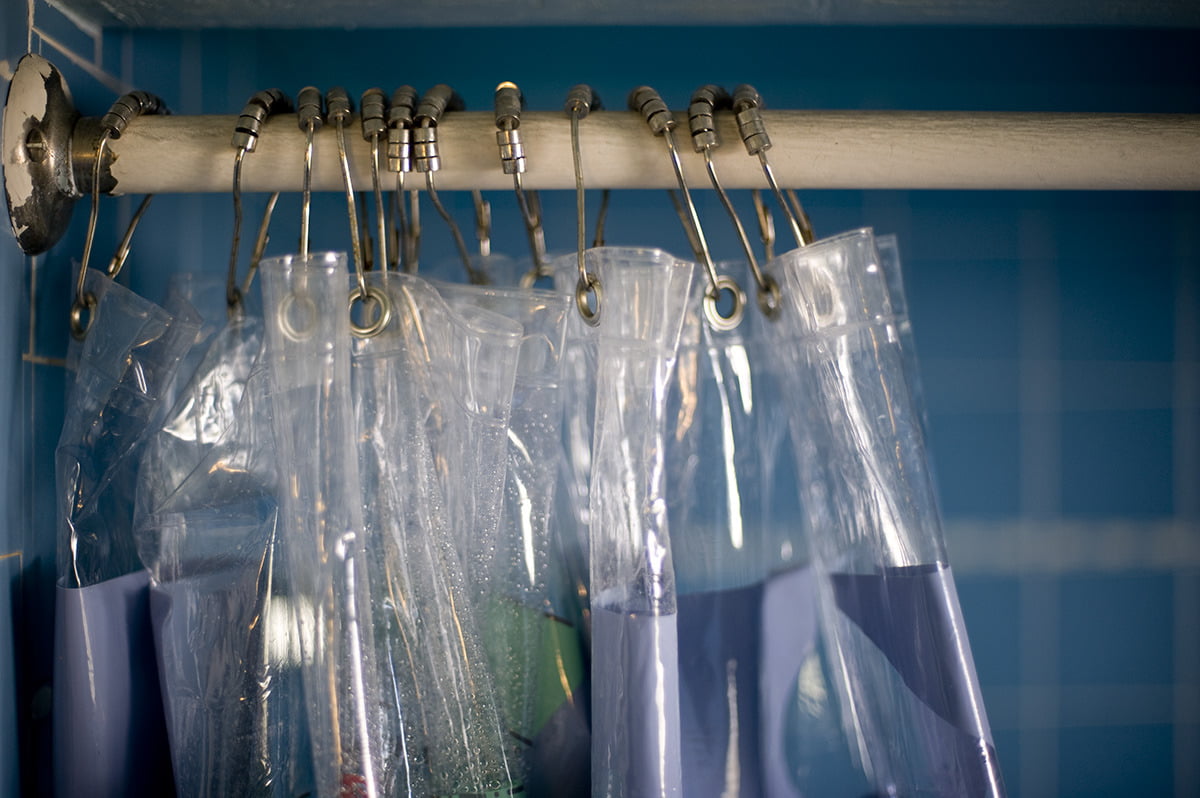
Nearly everyone has faced the frustration of a shower curtain billowing inwards to stick to one’s leg. Various explanations have been offered to explain the effect, but David Schmidt won the 2001 Ig Nobel Prize in Physics for a numerical simulation suggesting that the spray of droplets from the shower head drives a horizontal vortex whose axis of rotation is perpendicular to the shower curtain. Since vortices have a low-pressure region in their core, this weak shower vortex has the power to suck a light curtain inward, much to the chagrin of the shower’s occupant. Of course, a heavier or weighted shower curtain will help avoid the effect. This post is part of a series on fluids-related Ig Nobel Prizes. (Photo credit: W. Taylor; research credit: D. Schmidt)

Rebounding Off Dry Ice
Droplet rebound is frequently associated with superhydrophobic surfaces but can also be generated by very large temperature differences. For very hot substrates, a thin layer of the drop vaporizes on contact via the Leidenfrost effect and helps a drop rebound by preventing it from wetting the surface. This video shows almost the opposite: a water droplet hitting solid carbon dioxide (-79 degrees C). Upon contact, the solid carbon dioxide sublimates, creating a thin layer of gas that separates the droplet from the surface. You can also see the vortex ring that accompanies the drop’s impact. Water vapor near the carbon dioxide surface has condensed into tiny airborne droplets that act as tracer particles that reveal the vortex’s formation and the rebounding droplet’s wake. (Video credit: C. Antonini et al.; Research paper)

Flow Over a Delta Wing
Fluorescent dye illuminated by laser light shows the formation and structure of vortices on a delta wing. A vortex rolls up along each leading edge, helping to generate lift on the triangular wing. As the vortices leave the wing, their structure becomes even more complicated, full of lacy wisps of vorticity that interact. Note how, by the right side of the photo, the vortices are beginning to draw closer together. This is an early part of the large-wavelength Crow instability. Much further downstream, the two vortices will reconnect and break down into a series of large rings. (Photo credit: G. Miller and C. Williamson)

Fluids Round-up – 27 July 2013
Fluids round-up time! Here are our latest fluidsy links from around the web:
- Science@NASA explains how to use capillary action to drink one’s coffee in microgravity. (via io9)
- Nature is not exactly a quiet place. Here are a couple of things you probably haven’t heard: icebergs breaking up and running aground and the “seismic scream” preceding a volcanic eruption.
- Mars Curiosity’s work indicates that Mars once had a thick atmosphere but lost it about 4 billion years ago, possibly to the solar wind after losing its magnetic field.
- Check out this great looped surfing footage for a different perspective on waves (submitted by joteefox)
- io9 offers a primer on the Mach number. It’s worth noting that, for a(n ideal) gas, the speed of sound depends only absolute temperature and composition.
- Disney has designed a device called Aireal that uses vortex rings to provide haptic feedback. (submitted by vincent)
- Ever come across mammatus clouds before? Their distinctive shape is a result of forming from sinking air rather than rising air like most other clouds. (via io9)
(Photo credit: T. Thai)
Reminder: This weekend is your final chance to take the reader survey! Thank you to everyone who has taken a couple minutes to share their thoughts.

Soap Film Butterfly
Originally posted: 14 Jan 2011 This gorgeous butterfly-like double spiral roll takes place on a horizontal soap film. The foil (seen top center) inserted in the film flaps back and forth. Each time the foil changes direction a vortex forms at the tip and gets advected away. The vortices stretch and distort in the roll, but if you look at the photograph closely, you’ll see the tiny shed vortices persisting throughout the roll structure. The bright colors that make this flow visible are due to interference patterns related to the local thickness of the film. (Photo credit: T. Schnipper et al.)
Reminder: If you haven’t already, please fill out our reader survey and help us improve FYFD!

Flow Around a Complex Airfoil
Flow around an airfoil with a leading-edge slat is visualized above. At this Reynolds number, alternating periodic vortices are shed in its wake. Understanding how multi-element airfoils and control surfaces affect local flow is important in controlling aircraft aerodynamics. When multiple instabilities interact–like those in the wing’s boundary layer interacting with the wake’s–it can generate disturbances that are problematic in flight. Being able to predict and avoid such behavior is important for safe aircraft. (Photo credit: S. Makiya et al.)

Meeting the Wall
Even something as simple as a falling sphere meeting a wall is composed of beautiful fluid motion. In Figure 1 above, we see side-view images of a sphere at low Reynolds number falling toward a wall over several time. Initially an axisymmetric vortex ring is visible in the sphere’s wake; when the sphere touches the wall, secondary vortices form and the wake vortex moves down and out along the wall in an axisymmetric fashion (Figure 2, top view). At higher Reynolds numbers, like those in Figure 3, this axisymmetric spreading of the vortex ring develops an instability and ultimately breaks down. (Photo credit: T. Leweke et al.)