When a viscoelastic non-Newtonian fluid is stirred, it climbs up the stirring rod. This behavior is known as the Weissenberg effect and results from the polymers in the fluid getting tangled and bunched due to the stirring. You may have noticed this effect in the kitchen when beating egg whites. In this video, researchers explore the effect using rodless stirring. The first example in the video shows a viscous Newtonian fluid being stirred. The stirring action creates a concave shape in the glycerin-air interface, and dye injection shows a toroidal vortex formed over the stirrer. Fluid near the center of the vortex is pulled downward and circulates out to the sides. In contrast, the viscoelastic fluid bulges outward when stirred. Dye visualization reveals fluid being pulled up the center into the bulge. It then travels outward, forming a mushroom-cap-like shape before sinking down the outside. This is also a toroidal vortex, but it rotates opposite the direction of the Newtonian one. Exactly how the polymers create this change in flow behavior is a matter of active research. (Video credit: E. Soto et al.)
Search results for: “vortex”

Growing Turbulence
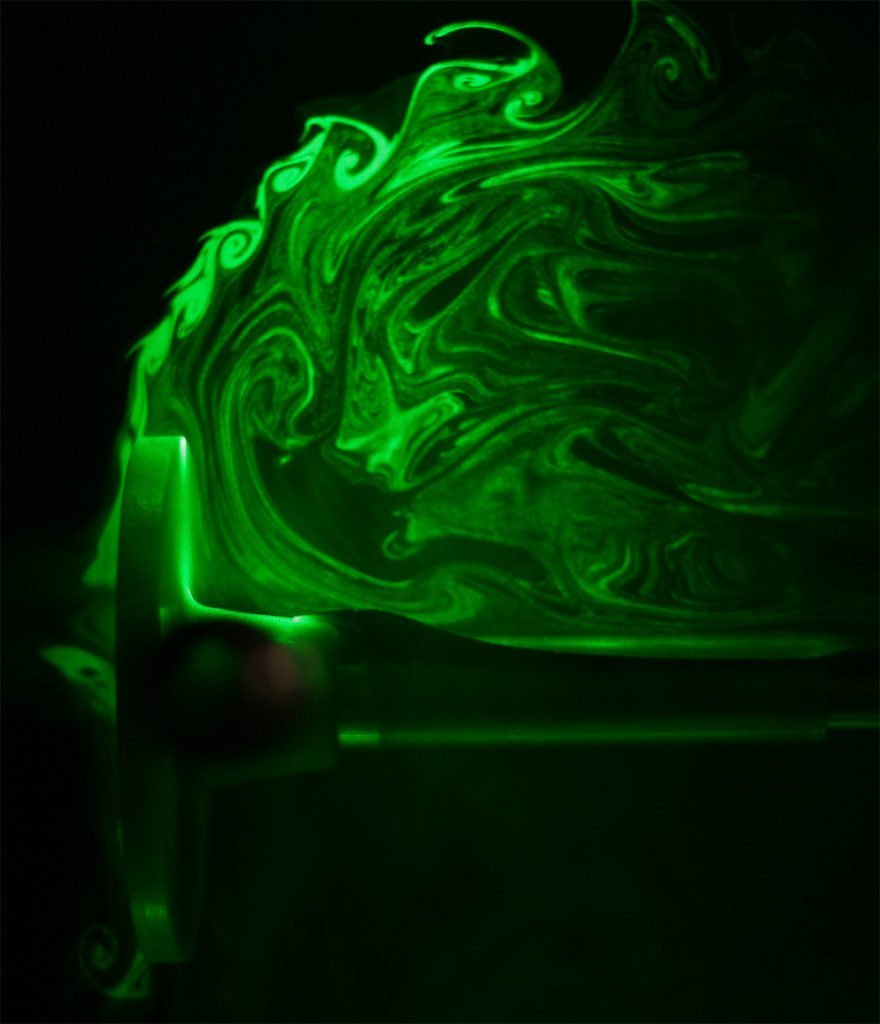
Flow patterns can change dramatically as fluid speed and Reynolds number increase. These visualizations show flow moving from left to right around a circular plunger. The lower Reynolds number flow is on the left, with a large, well-formed, singular vortex spinning off the plunger’s shoulder. The image on the right is from a higher Reynolds number and higher freestream speed. Now the instantaneous flow field is more complicated, with a string of small vortices extending from the plunger and a larger and messier area of recirculation behind the plunger. In general, increasing the Reynolds number of a flow makes it more turbulent, generating a larger range of length scales in the flow and increasing its complexity. (Image credit: S. O’Halloran)

“Demersal”

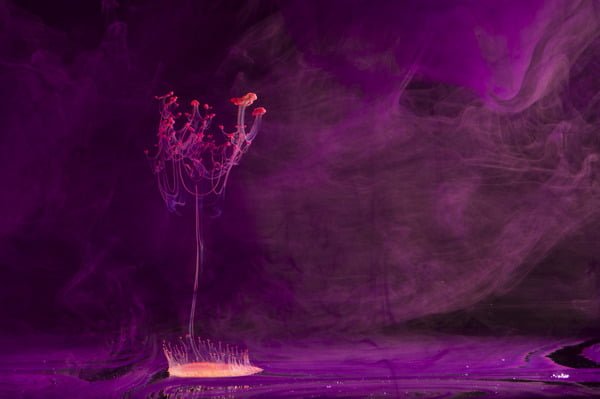
The ethereal shapes of inks and paints falling through water make fascinating subjects. Here the ink appears to rise because the photographs are upside-down. The fluid forms mushroom-like plumes and little vortex rings. The strands that split apart into tiny lace-like fingers are an example of the Rayleigh-Taylor instability, which occurs when a denser fluid sinks into a less dense one. Similar fingering can occur on much grander scales, as well, like in the Crab Nebula. These images come from photographer Luka Klikovac’s “Demersal” series. (Photo credit: L. Klikovac)

Cylinder Wakes
A simple cylinder in a steady flow creates a beautiful wake pattern known as a von Karman vortex street. The image above shows several examples of this pattern. Flow is from bottom to top, and the Reynolds number is increasing from left to right. In the experiment, this increasing Reynolds number corresponds to increasing the flow velocity because the cylinder size, fluid, and temperature were all fixed. As the Reynolds number first increases, the cylinder begins to shed vortices. The vortices alternate the side of the cylinder from which they are shed as well as alternating in their sense of rotation (clockwise or counterclockwise). Further increasing the Reynolds number increases the complexity of the wake, with more and more vortices being shed. The vortex street is a beautiful example of how fluid behavior is similar across a range of scales from the laboratory to our planet’s atmosphere. (Image credit: Z. Trávníček et. al)

Knotting Vortices
Knots have long fascinated humans, appearing in art for thousands of years and generating entire fields of study. Until recently, however, the idea of a knotted fluid was purely theoretical. To knot fluids, researchers used 3D printing to create twisted hydrofoil shapes. When towed through water, fluid travels around the shape and spins up at the trailing edge, creating a knotted vortex ring. The knotted vortices were captured with 3D imaging, allowing scientists to observe how they evolve. So far the knots they’ve created have all been unstable, deforming until two vortex lines approach one another. Upon contact, the vortices disconnect and reconnect with one another, unraveling the knot. Intriguingly, these vortex reconnections seem remarkably similar to the vortex reconnections observed between quantized vortices in superfluids. (Video credit: D. Kleckner et al.)

Sochi 2014: Bobsledding
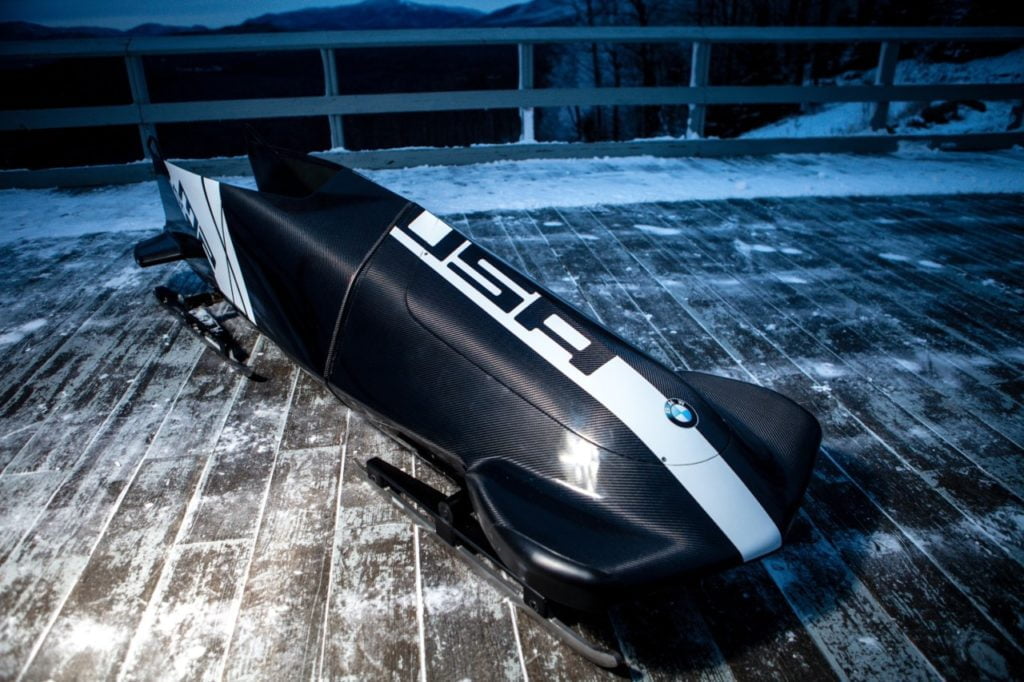


Today bobsledding is an sport rife with modern technology and design techniques. In recent years, companies better known for their expertise in automobiles and Formula 1 racing have become players with BMW designing American sleds, McLaren making the UK sleds, and Ferrari providing for the Italian team. Like many winter gravity sports, contenders can be separated by as little as hundredths of a second. This makes aerodynamics a serious concern, but the variability of the sled’s position and orientation over a run makes realistically simulating the aerodynamics, either in a wind tunnel or computationally, extremely difficult. Additionally, the sport’s governing body restricts a sled’s dimensions, weight, shape, and other details; for example, bobsleds are not allowed to use vortex generators that would help maintain attached flow and reduce drag. Instead, designers try to shave drag elsewhere, in the shaping of the sled’s nose or by tweaking the back end of the sled to reduce the drag-inducing wake. Even the shape of the driver’s helmet is aerodynamically significant. (Image credits: Exa Corp, Getty Images, BMW)
FYFD is celebrating #Sochi2014 by looking at fluid dynamics in winter sports. Check out our previous posts on how skiers glide, the US speedskating suit controversy, and why ice is slippery.
Happy Valentine’s Day!
What can you do with a 7 x 7 grid of miniature vortex cannons? Why, make floating vortex hearts, of course. Happy Valentine’s Day from FYFD! (Video credit: D. Schulze/bitsbeauty; via Colossal)
Vibrations from Vortices
Vortex shedding frequently happens in the wakes of non-streamlined bodies as a result of flow around the obstacle. Newton’s third law states that forces come in equal and opposite pairs, meaning that the vortex shedding behind an obstacle is accompanied by a force on the obstacle. For a fixed cylinder, this is not always apparent, but for a pendulum, like the ones demonstrated in this video, this vortex-induced vibration causes significant motion. This same effect can make traffic lights and industrial chimneys sway. You’ve likely experienced it yourself as well, if while swimming you’ve ever spread your fingers underwater and spun in place. Try it sometime with your arm out and you’ll feel the vortices make your arm vibrate up and down as you spin. (Video credit: Harvard Natural Sciences Lecture Demonstrations)

Snow Rollers

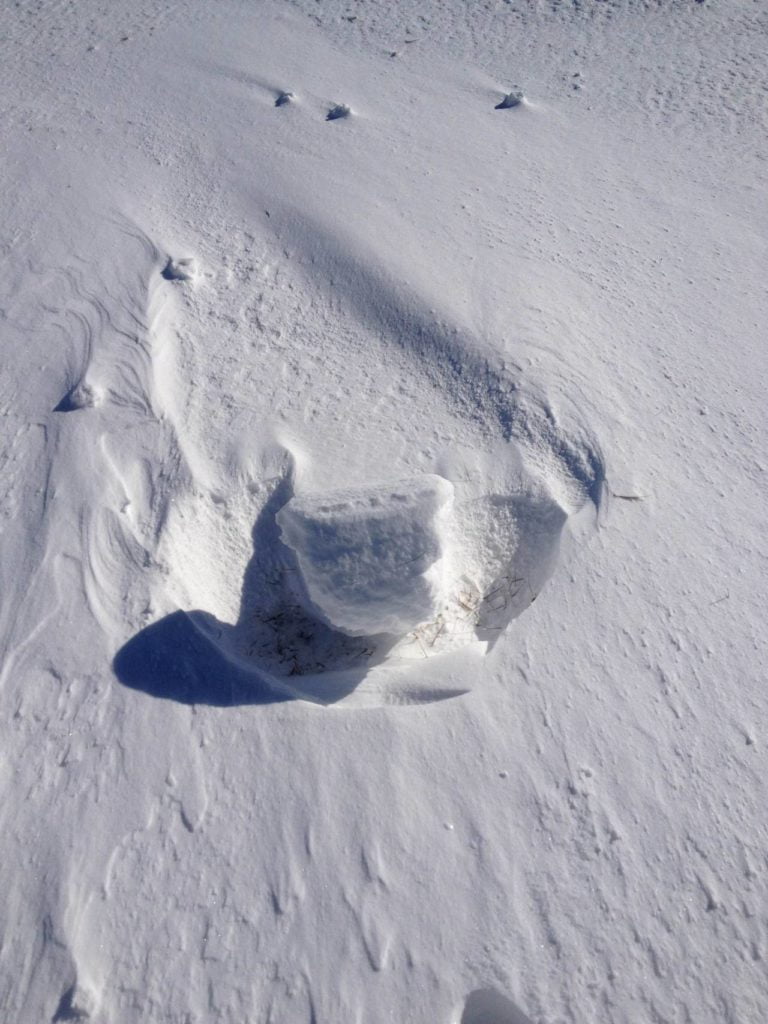
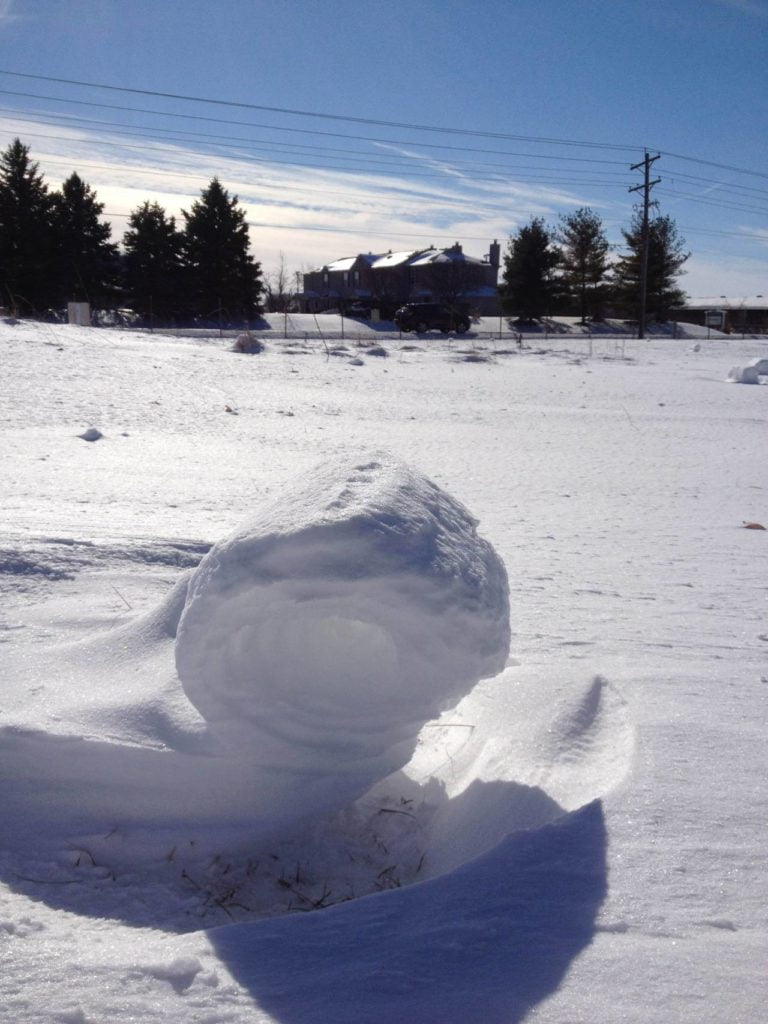


Snow rollers are nature’s snowballs, formed when high winds roll a chunk of snow along the surface, allowing it to accumulate more and more material. They occur relatively rarely because their appearance is the culmination of several specific meteorological factors. To form rollers, the ground needs to be icy, with a layer of loose, wet snow above the ice. And, of course, it needs to be windy enough to move the snow without being so windy that snow breaks up. In the photos above, the snow roller got too large for the wind to continue moving it, but the wind didn’t stop blowing. Instead, the snow roller became an obstacle to the flow and a horseshoe vortex formed at its base. The spinning of the vortex dug out the trench in front of and along the sides of the snow roller. This same effect is often seen on the windward side of trees in winter. (Photo credit and submission: S. Benton)
Fluids Round-up – 11 January 2014
It’s a big fluids round-up today, so let’s get right to it.
- Over at txchnologist, there’s a great article on controlling combustion instabilities in rocket engines with sound.
- Quanta Magazine asks if knot theory can help unravel turbulence. (submitted by iamaponyrocket)
- SciAm takes a look at how FIFA finally got their aerodynamics right so that their video game football (soccer) balls fly correctly.
- The Smithsonian considers an important question: can you fry foods in space?
- The Navy unveiled a fantastic new facility for simulating ocean waves (via J. Ouellette)
- At SciAm, there’s a nice explanation of the polar vortex and its effects on recent freezing weather. For additional background, check out this excerpt from a presentation by meteorology professor Jennifer Francis. (via Nicholas Travers)
- Cold weather also brings a host of new viral videos; NatGeo explains some of the science behind instant snow, ice fog, and frozen bubbles. See also: our own explanation of the instant snow phenomenon.
- io9 looks at the physics of knuckleballs.
- Over at Wired, Rhett Allain questions whether dwarves should stand in floating barrels. Also on the subject of The Hobbit, here’s an analysis of fire-breathing in dragons.
- At SciAm, Kyle Hill explains how inertia lets one pour a drink toward the sky.
- SciAm reports on a manufacturing process for superhydrophobic paper.
- I don’t know what banking has to do with a pool of non-Newtonian fluids, but this Malaysian ad sure makes it look fun. (via physicsphysics and jmlinhart)
- Wired has a great write-up on the mantis shrimp, which kills its prey with cavitation.
- io9 tackles explaining one of the most vexing brain teasers in fluid dynamics, the Feynman sprinkler.
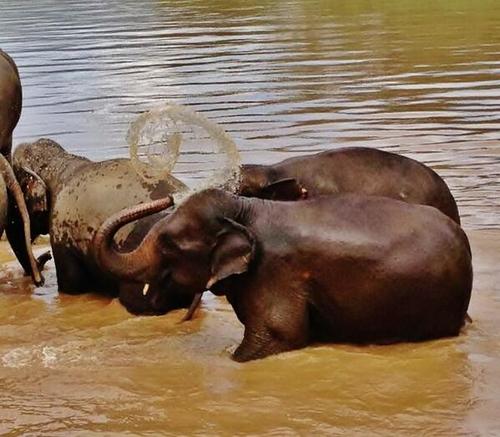
- Finally, today’s lead image comes from our friends at Think Elephants, who study elephant intelligence over in Thailand and occasionally capture the animals’ mastery of fluid dynamics. Be sure to check them out and follow them on Twitter and Facebook.
(Photo credit: Think Elephants International/R. Shoer)
