
This photo from the Mars Reconnaissance Orbiter stares almost straight down a dust devil on Mars. Like their earthbound brethren, Martian dust devils form when the surface is heated by the sun, causing warm air to rise. The rising air causes a low pressure area that the surrounding air flows into. Any rotational motion of the air intensifies as it is entrained. This is a consequence of conservation of angular momentum. Just as a spinning ice skater spins faster when he pulls his arms in, the vorticity of the inward-flowing air increases, forming a vortex. In addition to dust devils, this same physical mechanism applies to waterspouts and fire tornadoes, although the heating source for those is different. (Photo credit: NASA; via APOD)
Search results for: “vortex”

Below a Surfer’s Wave
From below a plunging breaking wave–the classic surfer’s wave–looks like a giant vortex tube. Smaller rib vortices, the rings around the main vortex in the photo above, can form where there are variations along the breaking wave. As the wave rolls on, it stretches the vorticity variations along the wave’s span. When stretched, vortices spin up and intensify; this is a result of conservation of angular momentum. Check out more amazing photos of waves in Ray Collins’ portfolio. (Photo credit: R. Collins; via The Inertia)
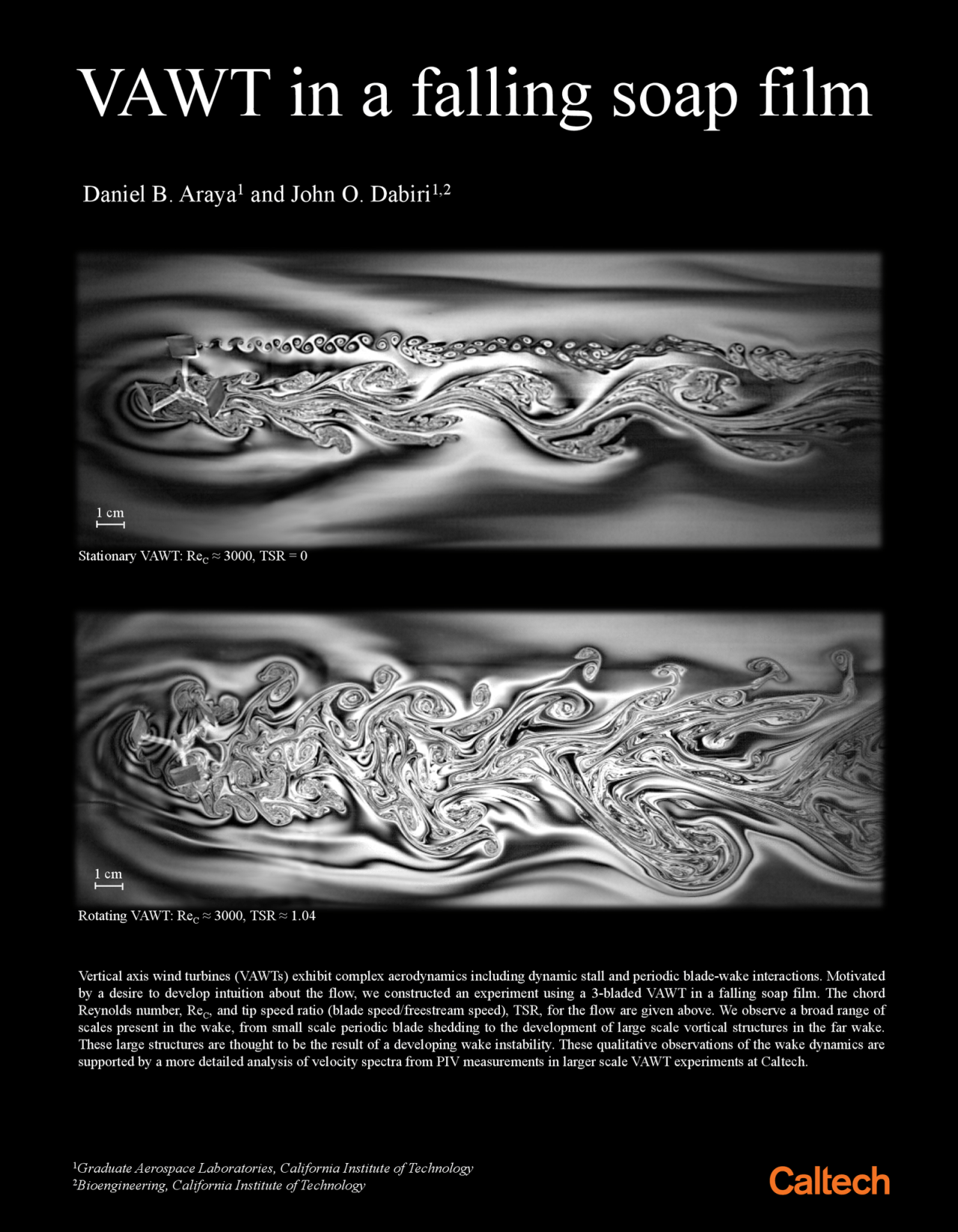
Vertical-Axis Wind Turbines
Vertical-axis wind turbines (VAWT) are an alternative to traditional wind turbine designs. Unlike their more common cousins, VAWTs rotate about a vertical axis and are omni-directional, meaning that they do not have to be pointed into the wind to produce power. While their size allows VAWTs to be packed much closer to one another than traditional turbines, a clear understanding of the flow around the turbines is needed in order to place the turbines for effective and efficient operation. The images above show the complicated and turbulent wake of a three-bladed VAWT when stationary (top) or rotating (bottom). The flow is visualized using a gravity-driven soap film (flowing left to right in the images) pierced by a model VAWT (seen at the left). The wakes contain many scales from simple, periodically-shed vortices off a blade to very large-scale vortical structures forming downstream of the turbine. This work originally appeared as a poster in the Gallery of Fluid Motion at the 2014 APS DFD Annual Meeting. (Image credit: D. Araya and J. Dabiri)
Turbine Blade Separation
[original media no longer available]
Maintaining consistent air flow along the contours of an object is key to aerodynamic efficiency. When air flow separates or forms a recirculation zone, the drag increases and efficiency drops. On wind turbine blades, flow often separates on the root end of the blade near its attachment point. This behavior is apparent in the video above at 0:34. The tufts in the foreground on the turning blade flap and flutter with no clear pattern because the air flow has separated from the surface. In the subsequent clip, a line of vortex generators has been attached near the leading edge of the blade. These structures–also commonly seen on airplanes–trail vortices behind them, mixing the flow and generating a turbulent boundary layer which is better able to resist flow separation. The effect on the flow is clear from the tufts, most of which now point in a consistent direction with little to no fluttering, indicating that the air flow has remained attached. (Video credit: Smart Blade Gmbh/Technische Universität Berlin)
(Source: /)
Crow Instability
Behind airplanes in flight, water vapor from the engine exhaust will sometimes condense in the wingtip vortices, thereby forming visible contrails. The two initially parallel vortex lines are unstable and any small perturbation to them–a slight crosswind, for example–will cause an instability known as the Crow instability. The contrails become wavy, with the amplitude of the wave growing exponentially in time due to interactions between the two vortices. Eventually, the vortex lines can touch and pinch off into vortex rings. The effect is also quite noticeable when smoke generators are used on a plane, and there are some great examples in this air show video between 3:41:00 and 3:44:00. (Video credit: M. Landy-Gyebnar; h/t to Urs)
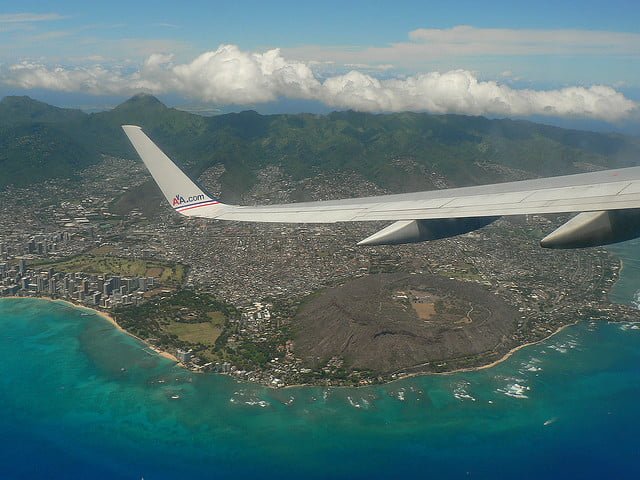
Reader Question: Winglets
Reader tvargo writes:
First off… love your blog! I know very little about physics, but love reading about it. Could you potentially explain what the little upturned ends of wings do? looking on wikipedia is see this: “There are several types of wingtip devices, and although they function in different manners, the intended effect is always to reduce the aircraft’s drag by partial recovery of the tip vortex energy.” huh?
Thanks! That’s a great question. Winglets are very common, especially on commercial airliners. To understand what they do, it’s helpful to first think about a winglet-less airplane wing. Each section of the wing produces lift. For a uniform, infinite wing, the lift produced at each spanwise location would be the same. In reality, though, wings are finite and wingtip vortices at their ends distort the flow. The vortices’ upward flow around the ends of the wing reduces the lift produced at the wing’s outermost sections, making the finite wing less efficient (though obviously more practical) than an infinite wing.
Adding a winglet modifies the end conditions, both by redirecting the wingtip vortices away from the underside of the wing and by reducing the strength of the vortex. Both actions cause the winglet-equipped wing to produce more lift near the outboard ends than a wing without winglets.
But why, you might ask, does the Wikipedia explanation talk about reducing drag? Since a finite wing produces less lift than an infinite one, finite wings must be flown at a higher angle of attack to produce equivalent lift. Increasing the angle of attack also increases drag on the wing. (If you’ve ever stuck a tilted hand out a car window at speed, then you’re familiar with this effect.) Because the winglet recovers some of the lift that would otherwise be lost, it allows the wing to be flown at a lower angle of attack, thereby reducing the drag. Thus, overall, adding winglets improves a wing’s efficiency. (Photo credit: C. Castro)

Hummingbird Hovering
The hummingbird has long been admired for its ability to hover in flight. The key to this behavior is the bird’s capability to produce lift on both its downstroke and its upstroke. The animation above shows a simulation of hovering hummingbird. The kinematics of the bird’s flapping–the figure-8 motion and the twist of the wings through each cycle–are based on high-speed video of actual hummingbirds. These data were then used to construct a digital model of a hummingbird, about which scientists simulated airflow. About 70% of the lift each cycle is generated by the downstroke, much of it coming from the leading-edge vortex that develops on the wing. The remainder of the lift is creating during the upstroke as the bird pulls its wings back. During this part of the cycle, the flexible hummingbird twists its wings to a very high angle of attack, which is necessary to generate and maintain a leading-edge vortex on the upstroke. The full-scale animation is here. (Image credit: J. Song et al.; via Wired; submitted by averagegrdy)

Typhoon Neoguri
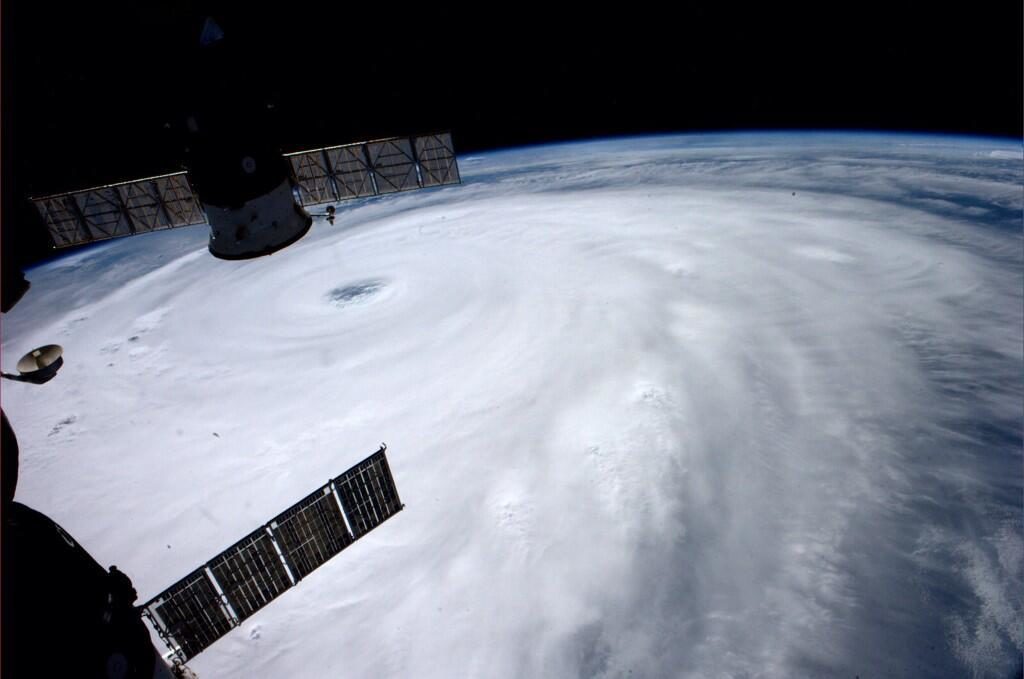
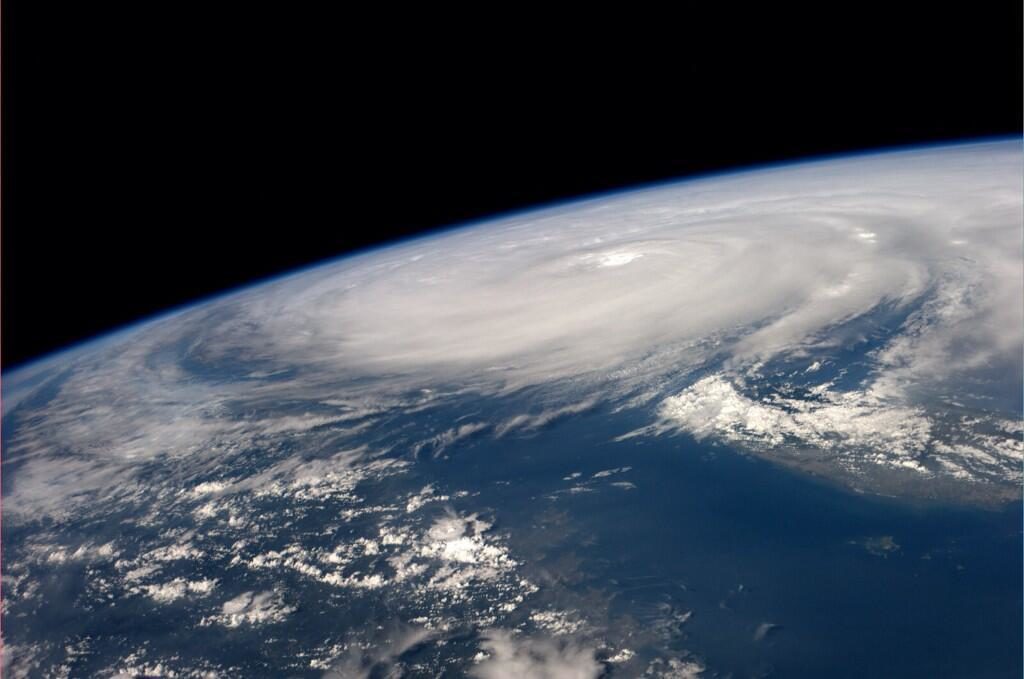


Astronaut Reid Wiseman has been posting photos of Typhoon Neoguri in his Twitter feed this week. From our perspective on the ground, it’s easy to forget how three-dimensional the typhoons and hurricanes in our atmosphere are. But Wiseman’s photos capture the depth in the storm, especially the depression of the eye. From the top, the typhoon looks much like a vortex in a bathtub, or what’s more formally known as a free surface vortex. To understand why a vortex dips in the middle, imagine a container of water on a rotating plate. As the water is spun, its interface with the air takes on a paraboloid shape. Two external forces are acting on the fluid: gravity in the downward direction and a centrifugal force in the radial direction. The free surface of the fluid adopts a shape that is always perpendicular to the combination of these two forces. This ensures that the pressure along the free surface is a constant. (Photo credits: R. Wiseman 1,2,3)

Waterspouts
Waterspouts are commonly thought of as tornadoes over water, but this is only partially true. Some waterspouts do begin as tornadoes, but waterspouts are more commonly non-tornadic or fair-weather in origin. These non-tornadic waterspouts form when cold, dry air moves over warm water. As the warm, moist air rises, entrainment and conservation of angular momentum cause the air nearby to begin rotating. The spout does not actually suck water up from the surface. Instead, the humid rising air cools and the water vapor condenses, forming the cloud wall of the spout. Waterspouts are typically very short-lived and last 5 to 10 minutes before the inflowing air cools and the vortex weakens and dissipates. (Photo credit: U.S. Navy/K. Wasson)
Blood Flow Simulations
Though we may not often consider it, our bodies are full of fluid dynamics. Blood flow is a prime example, and, in this video, researchers describe their simulations of flow through the left side of the heart. Beginning with 3D medical imaging of a patient’s heart, they construct a computational domain – a meshed virtual heart that imitates the shape and movements of the real heart. Then, after solving the governing equations with an additional model for turbulence, the researchers can observe flow inside a beating heart. Each cycle consists of two phases. In the first, oxygenated blood fills the ventricle from the atrium. This injection of fresh blood generates a vortex ring. Near the end of this phase, the blood mixes strongly and appears to be mildly turbulent. In the second phase, the ventricle contracts, ejecting the blood out into the body and drawing freshly oxygenated blood into the atrium. (Video credit: C. Chnafa et al.)
.svg)
.svg)
