Search results for: “vortex”

  • Granular Instabilities

    Granular Instabilities

    Granular mixtures show surprising similarities to fluids, even though their underlying physics differ. The latest example of this is a Rayleigh-Taylor-like instability that occurs when heavy particles sit atop lighter ones. By combining vertical vibration and an upward gas flow, researchers found that the lighter particles form fingers and bubbles that seep up between the heavier grains (upper left). Visually, it looks remarkably similar to a lava lamp or other Rayleigh-Taylor-driven instability (upper right).

    But the physics behind the two are distinctly different. In the fluid, buoyancy drives the instability while surface tension acts as a stabilizing force. There’s no surface tension in a granular material, though. Instead, the drag force from gas flowing upward provides the vertical impetus while friction between the grains – essentially an effective viscosity – replaces surface tension as a stabilizing influence.

    The similarities don’t stop there, though. When the researchers tested a “bubble” of heavy grains suspended in lighter ones (lower left), they found that, instead of sinking, the granular bubble split in two and drifted downward on a diagonal. Eventually, those daughter bubbles also split. Again, visually, this looks a lot like what happens to a drop of ink or food coloring falling through water (lower right), but the physics aren’t the same at all. 

    In the fluid, the breakup happens when a falling vortex ring splits. In the granular example, gas moving upward tends to channel around the heavy grains because they’re harder to move through. Eventually, this builds up a solidified region under the bubble. When the heavy grains can’t move directly down, they split and sink through the surrounding suspended particles until they build up another jammed area and have to split again. (Image credits: granular RTI – C. McLaren et al.; RTI simulation – M. Stock; bag instability – D. Zillis; research credit: C. McLaren et al.; submitted by Kam-Yung Soh)

  • Tornado from a Drone

    Tornado from a Drone

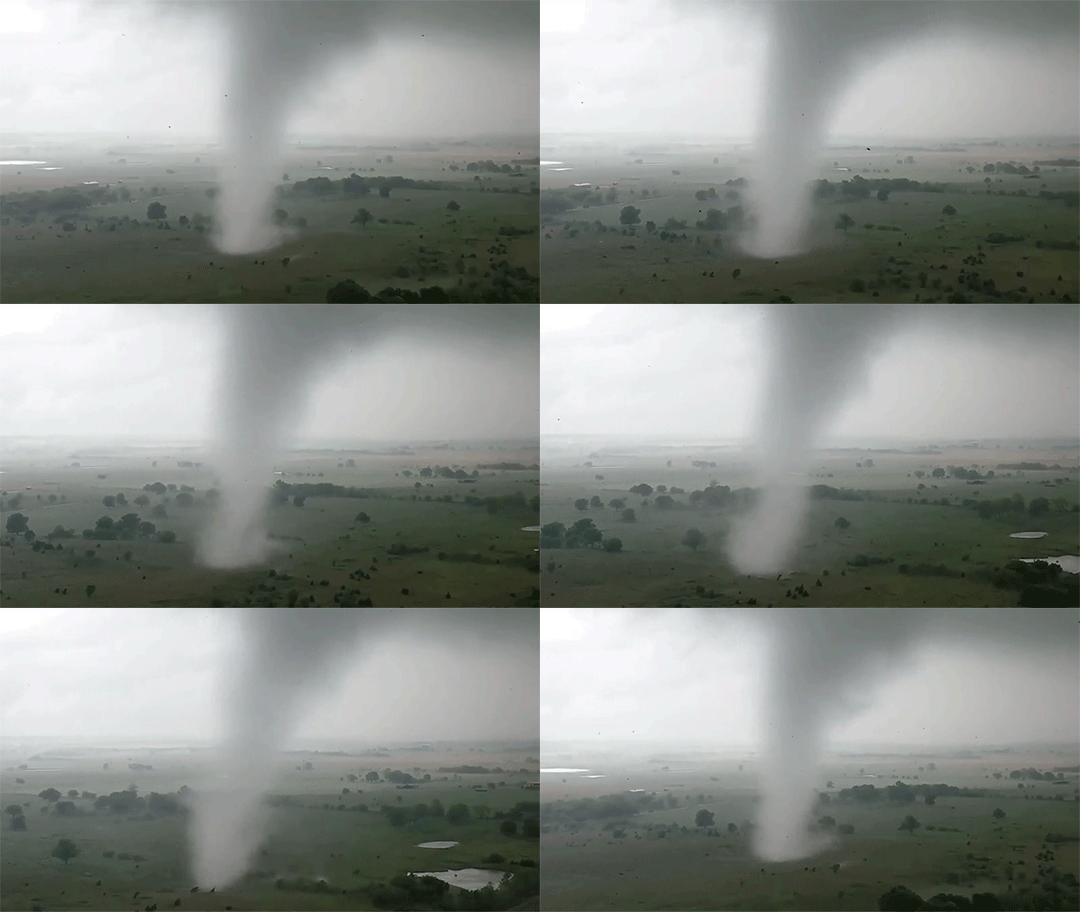
    One of the challenges in studying tornadoes is being in the right place at the right time. In that regard, storm chaser Brandon Clement hit the jackpot earlier this week when he captured this footage of a tornado near Sulphur, Oklahoma from his drone. He was able to follow the twister for several minutes until it apparently dissipated.

    Scientists are still uncertain exactly how tornadoes form, but they’ve learned to recognize the key ingredients. A strong variation of wind speed with altitude can create a horizontally-oriented vortex, which a localized updraft of warm, moist air can lift and rotate to vertical, birthing a tornado. These storms most commonly occur in the central U.S. and Canada during springtime, and researchers are actively pursing new ways to predict and track tornadoes, including microphone arrays capable of locating them before they fully form. (Image and video credit: B. Clement; via Earther)

  • Vibrating in the Flow

    Vibrating in the Flow

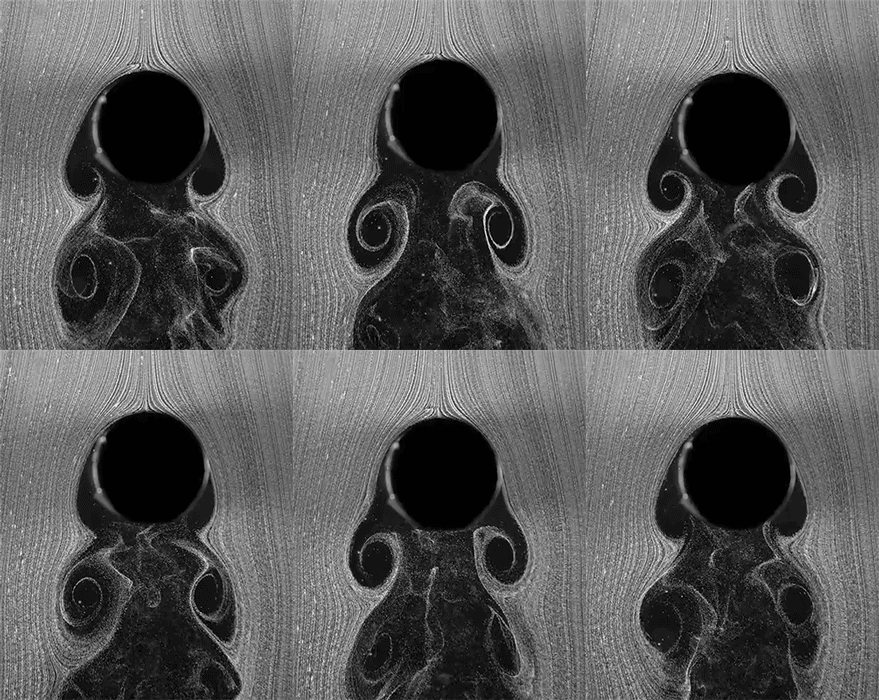
    Objects can obviously affect flows, but that’s not a one-way street. Flows can also affect objects, even ones as simple a circular cylinder. If you live somewhere with traffic lights mounted to a horizontal bar, you’ve probably seen this. On a windy day, the beam holding the traffic lights will oscillate up and down. This is an example of vortex-induced vibration, a coupling between the flow structures formed by an object and the motion of the object itself. With cylinders, engineers have mostly studied a situation like the traffic light – one where the motion of the cylinder is perpendicular to the direction of the flow. 

    But it’s also possible to get vortex-induced vibration in the same direction as the flow. That’s what you see visualized in the images above. Notice how the oscillation of the cylinders is inline with the flow direction. As with the crossflow version of vortex-induced vibration, this inline example has several wake forms that vary based on flow conditions. (Image and research credit: T. Gurian et al.)

  • Paddling

    Paddling

    When I lived in New England, I often spent summers paddling around a lake in either a kayak or canoe. Every stroke was an opportunity to stare down into the dark water and watch how the flow curled around my oar. Here you see a bit of what that looks like from underwater.

    The animation above shows a flat plate – twice as tall as it is wide – submerged about 20 mm below the surface and accelerated steadily from rest. As it starts moving, there’s a clear vortex ring formed and shed behind it. You can also see how the plate distorts the free surface into large depressions. Both of these cause extra drag on the plate. Eventually, though, the plate reaches a steady state.

    All together, what you see here is a good representation of what’s going on when a rower first begins to accelerate their boat from rest. Hydrodynamically speaking, the best way to do that isn’t to dig in with a deep stroke. It’s to use a series of short, relatively shallow strokes to get the boat up to speed. This takes advantage of the efficiency of drag generation during acceleration to get the boat to its cruising speed quickly. (Image and research credit: E. Grift et al.)

  • Enormous Ice Disk

    Enormous Ice Disk

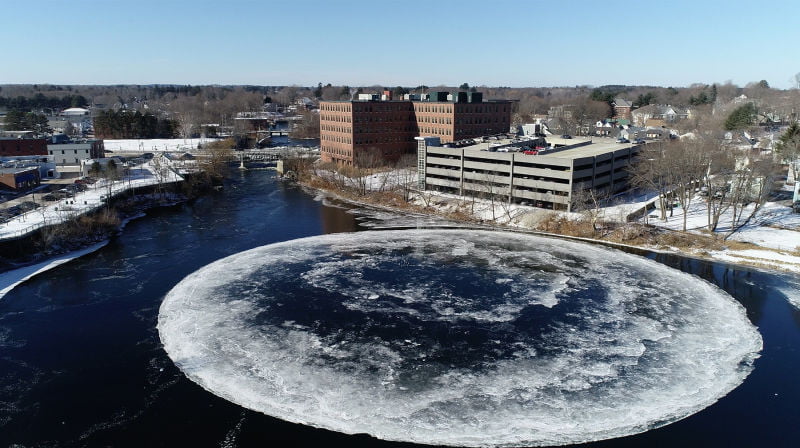
    We’ve seen spinning ice disks before, but this month Westbrook, Maine has developed the largest one I’ve ever seen. A research paper from 2016 indicates that this seemingly alien formation spins due to an oddity of water. Water is at its densest around 4 degrees Celsius, so as the ice of the disk melts in the warmer waters of the river, it sinks. That downward plume sets up a vortex in the water beneath the disk. And as the water spins, it drags the ice with it, causing the disk’s rotation. The warmer the water is, the faster the disk spins. (Image credit: T. Radel/City of Westbrook; research credit: S. Dorbolo et al.; via Gizmodo; submitted by jpshoer)

  • The Best of FYFD 2018

    The Best of FYFD 2018

    2018 was a busy year for me with over 40 days of business travel, 10 invited talks, and a whole slew of new YouTube videos on top of regular FYFD posts. But now it’s time for the traditional look back at the top 10 FYFD posts of 2018, according to you:

    1. Swimming so easy a dead fish can do it
    2. The wall of lava lamps that helps secure the Internet
    3. Jellyfish versus vortex ring
    4. Crushing crayons in a hydraulic press shows off the sharkskin instability
    5. Vortex ring from an exploding meteor
    6. Starburst patterns form when avalanching materials size separate 
    7. Kelp change shape depending on their currents
    8. The creepy hydraulics of a spider’s gait
    9. Pneumatically-driven, 3D-printed plants of the future
    10. Exothermic chemistry visualized in infrared

    This year’s list is an interesting mix – some biology, vortex rings, non-Newtonian and granular physics; it’s a good list for some of the more unexpected sides of fluid dynamics. 

    If you’d like to see more great posts like these, please remember that FYFD is primarily supported by readers like you. You can help support the site by becoming a patron, making a one-time donation, or buying some merch. Happy New Year!

    (Image credits: fish – D. Beal et al.; lava lamps – T. Scott; vortex ring – V. de Valles; crayons – Hydraulic Press Channel; meteor – P. Horálek; rotating drum – I. Zuriguel et al.; kelp – J. Hildering; spider – R. Miller; hydrophytes – N. Hone; chemistry – Beauty of Science)

  • Inside a Heart

    Inside a Heart

    You may not give it much thought, but there is important fluid dynamics happening inside you every moment of every day, especially inside your heart. Of the four chambers of the heart, the left ventricle has the thickest walls, reflecting its important task: pumping oxygenated blood throughout the body. In a healthy heart (top of poster; click here for the full-size version), a vortex ring and trailing jet fill the ventricle when the mitral valve opens. Then the ventricle contracts and pumps blood out the aortic valve and into the rest of the body.

    But for individuals with a leaking aortic valve (bottom of poster), things look different. Blood leaks back through the aortic valve at the same time that the mitral valve opens to allow freshly oxygenated blood back in. The two inflows disrupt mixing in the chamber, and, instead of pumping fully-oxygenated blood into the body, the left ventricle has to struggle to pump a less-oxygenated mixture into the body. (Image credit: G. Di Labbio et al.)

    ETA: (Research paper: G. Di Labbio et al., arXiv)

  • What Drives Droplets

    What Drives Droplets

    There’s been a lot of interest recently in what goes on inside droplets made up of more than one fluid as they evaporate. This can be entertaining with liquids like whiskey or ouzo, but it has practical applications in ink-jet printing and manufacturing as well. And a new experiment suggests that we’ve been fundamentally wrong about what drives the flow inside these drops.

    As these drops evaporate, a donut-shaped recirculating vortex forms inside them, as seem in the cutaway views above. Conventional wisdom says that vortex is driven by surface tension. Evaporation of components like alcohol is more efficient at the edges of the drop, and as the alcohol evaporates, it creates a higher surface tension at the drop’s edge than at its peak. Marangoni forces then pull fluid down toward the edges, creating the vortex. That explanation is  consistent with observations of a sessile drop sitting on top of a surface (left side of images).

    But those observations are also consistent with another explanation: evaporating ethanol makes the local density higher, so alcohol-rich parts of the drop rise toward the peak while alcohol-poor regions sink. This difference in density would also create a flow pattern consistent with observations. So which is the real driver, surface tension or gravity?

    To find out, researchers flipped the drop upside-down (right side of images). When hanging, the preferred flow direction due to surface tension doesn’t change; flow should still go from the deepest point on the drop toward the edge. But gravity is swapped; alcohol-rich areas should be found near the edge and attachment points of the drop because buoyancy drives them there. And that is exactly what’s observed. The flow direction inside the hanging droplet is consistent with the direction prescribed by buoyancy-driven flow, thereby upending conventional wisdom. It turns out that gravity, not surface tension, is the major driver of internal flow in these multi-component droplets! (Image and research credit: A. Edwards et al.; via APS Physics; submitted by Kam-Yung Soh)

  • Featured Video Play Icon

    The Tacoma Narrows Bridge

    One of the most dramatic and famous engineering failures of the twentieth century is also one of the most complicated: the collapse of the Tacoma Narrows Bridge. This early suspension bridge earned the name “Galloping Gurtie” from construction workers while it was still being built because its flexibility made it prone to moving up and down under even relatively light winds. That vertical motion was due to vortex-induced vibration. As the wind blew, it shed vortices off the downstream side of the bridge. These vortices alternated, coming off the top and then bottom of the bridge deck. The resulting forces made the bridge shift up and down.

    That wasn’t the bridge’s ultimate downfall, though. Shortly before it collapsed, the bridge stopped flexing up and down and instead twisted back and forth. This was a clear sign that the bridge had moved into aeroelastic flutter. In this situation, you get a feedback loop between the bridge’s aerodynamics and its structural dynamics. When the wind twists the bridge deck to a positive angle of attack, it will try to continue forcing the bridge to twist that direction. The internal forces of the bridge will try to twist it back, but when that happens, it can overshoot and end up at a negative angle of attack. At that point, the wind tries to push it further that direction and internal forces twist it back, overshooting the other way. This back-and-forth can create a dangerous feedback loop where the twisting of the bridge keeps getting worse and worse. In fact, that’s exactly what happened – right up until the bridge collapsed rather than twisting any more. (Video and image credit: Practical Engineering)

  • Swirls of Color

    Swirls of Color

    These beautiful swirls show the wake downstream of a thin plate. Here water is flowing from left to right and dye introduced on the plate (upstream and unseen in the photo) curls up into vortices. The vortices in the top row rotate clockwise, while the vortices along the bottom rotate anti-clockwise. This pattern of alternating vortices is extremely common in the wakes of objects and is known as a von Karman vortex street. Similar patterns are seen in soap films, behind cylinders, in the wakes of islands, and behind spaceships.  (Image credit: ONERA, archived here)