Dispersing seeds is a challenge when you’re stuck in one spot, but plants have evolved all sorts of mechanisms for it. Some rely on animals to carry their offspring away, others create their own vortex rings. The hairyflower wild petunia turns its fruit into a catapult. As the fruit dries out, layers inside it shrink, building up strain that bends the fruit outward. Once a raindrop strikes it, the pod bursts open, flinging out around twenty tiny, spinning, disk-shaped seeds. That spin is important for flight. The best-launched seeds may spin as quickly as 1600 times in a second, which helps stabilize them in a vertical orientation that minimizes their frontal area and reduces their drag. Researchers found that these vertically spinning seeds have almost half the drag force of a spherical seed of equal volume and density. That means the hairyflower wild petunia is able to spread its seeds much further without a larger investment in seed growth. (Image and research credit: E. Cooper et al., source; via NYTimes; submitted by Kam-Yung Soh)
Search results for: “vortex”

Catching Particles with Sound
Acoustic levitation traps particles using specially shaped sound waves, but, thus far, it’s only been useful for small particles. One common method of trapping forms the sound waves into a vortex-like shape. Particles in one of these acoustic vortices will spin rapidly, become unstable, and get ejected from the vortex if they’re larger than about half the wavelength of sound used. Recently, though, researchers have stabilized much larger particles by trapping them between two acoustic vortices with opposite spins. The researchers alternate between the two vortices so that each can counteract the other in order to hold the particle in the center of the trap. The new technique has enabled them to trap particles up to 4 times larger than those in previous experiments. (Image and research credit: A. Marzo et al., source; via Science)

Nautilus Swimming
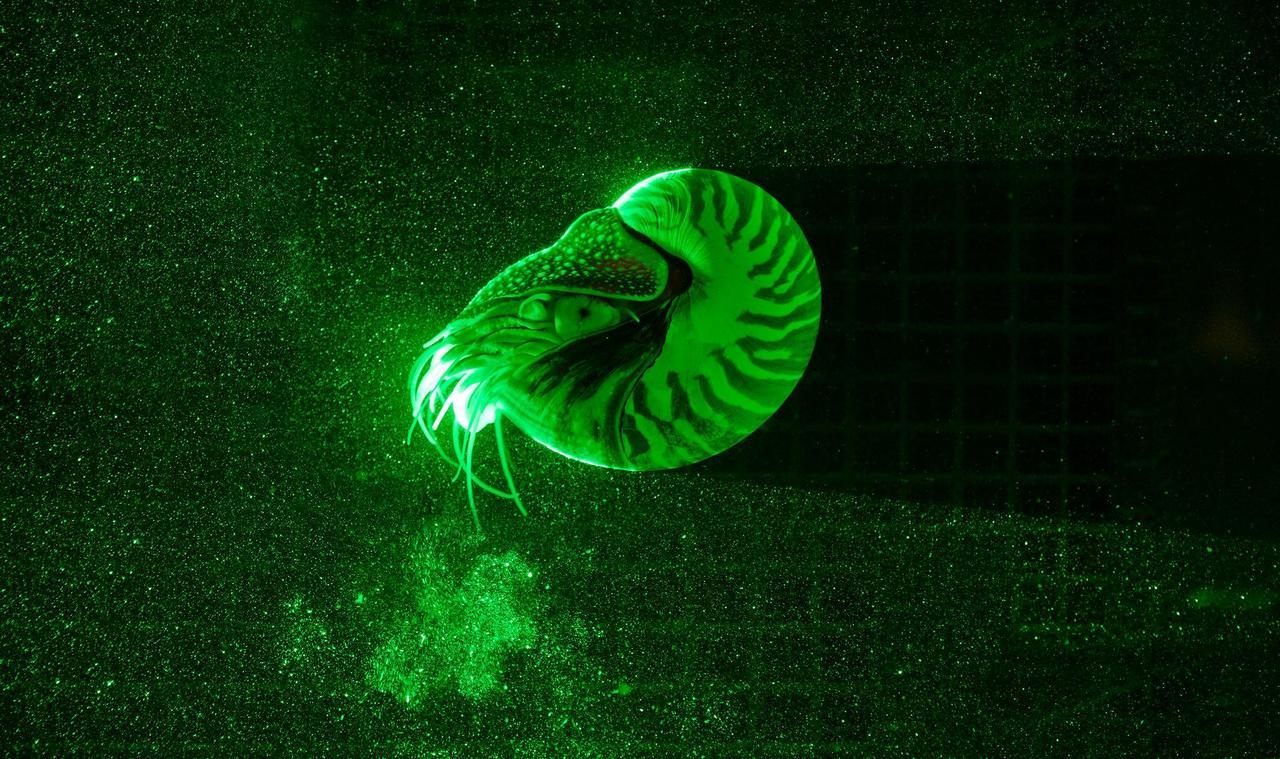
The shellbound chambered nautilus is a champion of underwater jet propulsion. It can eke out efficiencies as high as 75%, far outclassing other jet-based swimmers like squid, salps, and jellyfish. That high efficiency is especially important for the nautilus, which spends a great deal of time at depths where the oxygen needed to fuel movement is in short supply. To get around, the nautilus draws water in through an enlarged orifice, then squirts it out little by little. Its this asymmetry between drawing in and expending that keeps efficiency high. By releasing a jet slower and at lower speeds, the nautilus is able to reduce wasteful losses to friction and thereby keep the efficiency high. The drawback is that the nautilus swims relatively slowly at an average of around 8 centimeters–less than one body length–per second. (Image credit: Simon and Simon Photography/University of Leeds; research credit: T. Neil and G. Askew; via NYTimes; submitted by Kam-Yung Soh)
Caught in a Whirl
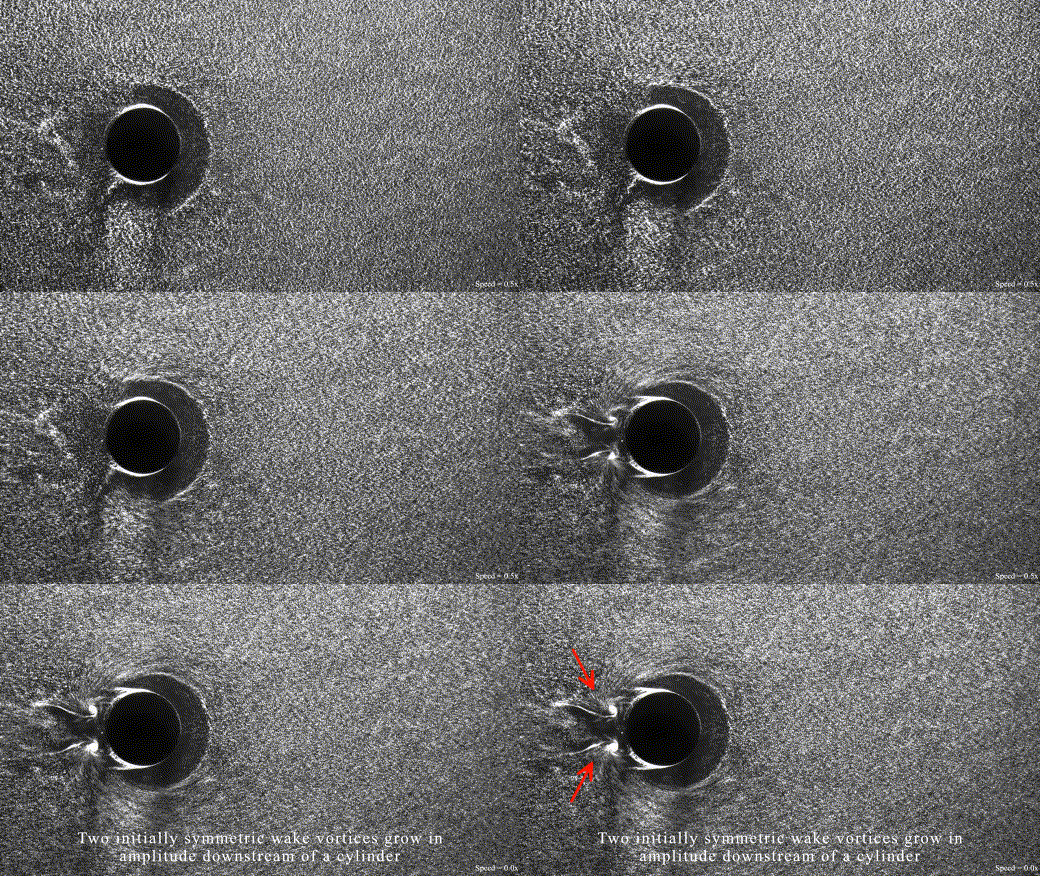
Vortex rings may look relatively calm, but they are concentrated regions of intensely spinning flow, as this poor jellyfish demonstrates. The rings form when a high-speed fluid gets pushed suddenly (and briefly) into a slower fluid. In the case of this bubble ring, a burst of air is pushed by a diver into relatively still water. The vorticity caused by the two areas of fluid trying to move past one another forms the ring. Like a spinning ice skater who pulls his arms inward, the narrow core of the vortex spins fast due to the conservation of angular momentum. Meanwhile, the bubble ring moves upward due to its buoyancy, pulling nearby water in as it goes. This catches the hapless jellyfish (who relies on vortex rings itself) and gives it quite a spin. But. don’t worry, the photographer confirmed that the jelly was okay after its ride. (Video credit: V. de Valles; via Ashlyn N.)

Modons
The spin of the Earth creates myriad eddies in our oceans, most of which move slowly westward at a speed dependent on their latitude. You can see many in the animation above as green and red rings slowly marching to the left. According to theory, it’s possible for two of these eddies to combine to become more than the sum of their parts; under the right conditions, the two conjoined eddies could become a modon, which, like a vortex ring, is capable of traveling far faster than its parental eddies. Despite the theory, however, no one had ever observed a modon in nature.
A new paper uses satellite imagery to identify nine modons in different locations around the world. One is shown above. Watch the eastern coast of Australia carefully, and you’ll see a modon form. It moves much faster than its surroundings, first southward toward Tasmania, then quickly eastward toward New Zealand. Thin black circles mark the two eddies that make up the modon. The strength and speed of these features makes them capable of pulling significant water mass with them. This suggests that they may play a role in ocean life, transporting water of different temperatures and nutrient content into regions it would not otherwise reach. (Image and research credit: C. Hughes and P. Miller; via Gizmodo)

PyeongChang 2018: Bobsleigh
In bobsleigh, two- and four-person teams compete across four runs down an ice track. The shortest cumulative time wins, and since typical runs are separated by hundredths of a second, teams look for any advantage that helps them shave time. The size, weight, and components of a sled are restricted by federation rules; for example, teams cannot use vortex generators to improve their aerodynamics. Instead bobsledders work with companies like BMW, McLaren, and Ferrari to engineer their sleds. Both computational fluid dynamics and wind tunnel tests with the actual team in the sled are used to make each sled as aerodynamic as possible. (Image credit: IOC, Gillette World Sports, source)

“Moving Creates Vortices and Vortices Create Movement”
A new interactive installation by the Japanese art collective teamLab uses the movement of visitors to drive vortex motion. Entitled “Moving Creates Vortices and Vortices Create Movement,” the installation uses projectors in a mirror room to create the sensation of an infinite, indoor ocean that’s constantly churned by the paths visitors take. In the absence of motion, the room slowly fades to darkness. The installation is currently in the National Gallery of Victoria in Melbourne, Australia, and will be open until April 15th, 2018. (Image credit: teamLab; via Colossal; submitted by jshoer)
P.S. – Winter Olympic coverage will start on Monday, February 12th! – Nicole

In the Eye of a Hurricane
Although eyes are common at the center of large-scale cyclones, scientists are only now beginning to understand how they form. Since real-world cyclogenesis is complicated by many competing effects, researchers look at simplified model systems first. A typical one uses a shallow, rotating cylindrical domain in which heat rises from below. The rotation provides a Coriolis force, which shapes the flow. In particular, it causes a boundary layer along the lower surface of the domain, creating a thin region where the flow moves radially inward. (Its opposite forms at the upper surface of the domain, sending flow radiating outward.) Like an ice skater spinning, the flow’s vorticity intensifies as it approaches the central axis of rotation. When the conditions are right, this intensely swirling boundary layer flow lifts up into the main flow, forming an eyewall. The eye itself, it turns out, is merely a reaction to the eyewall’s formation. (Image credit: S. Cristoforetti/ESA; research credit: L. Oruba et al.)

The Best of FYFD 2017
2017 was a busy, busy year here at FYFD, but a lot of that happened behind the scenes with multiple collaborations that were months in the planning. You’ll start to see the results of those collaborations here in January, starting this Friday. I’m really excited for you all to see what I’ve been up to!
In the meantime, we’ll take our traditional look back at the top 10 FYFD posts of 2017, according to you:
1. Cinemagraph of a breaking wave
2. Visualizing radiation in a cloud chamber
3. Fire ants as a fluid
4. The water music of Vanuatu
5. How hummingbirds drink nectar
6. When vortex rings collide
7. How water balloons can bounce off a bed of nails
8. Spinning ice disks form on freezing rivers
9. A hot-tub-sized fluidized bed
10. The physics of fluidized bedsLots of crazy, cool stuff in there! Special congrats to The Splash Lab for making the top 10 two years in a row. Stay tuned in 2018 for more exciting fluid dynamical developments, and if you’d like to help support FYFD, remember that you can always become a patron, make a one-time donation, or purchase some merch!
(Image credits: R. Collins / J. Maria; Cloudylabs; Vox/Georgia Tech; R. Hurd et al.; A. Varma; A. Lawrence; T. Hecksher et al.; K. Messer; M. Rober; R. Cheng)

Liquid Sunbursts
Liquid sunbursts and swirling aquatic roses abound in photographer Mark Mawson’s work. Images like these are created from dropping ink into water and photographing it as it diffuses. For the roses, the tank is additionally stirred or spinning to create the vortex-like appearance. Check out his website for more striking images, including more billowing ink, some great splashes and beautiful turbulent mixing between coffee and milk. (Image credit: M. Mawson; submitted by clogwog)