Search results for: “vortex”

  • Stall with Pitching Foils

    Stall with Pitching Foils

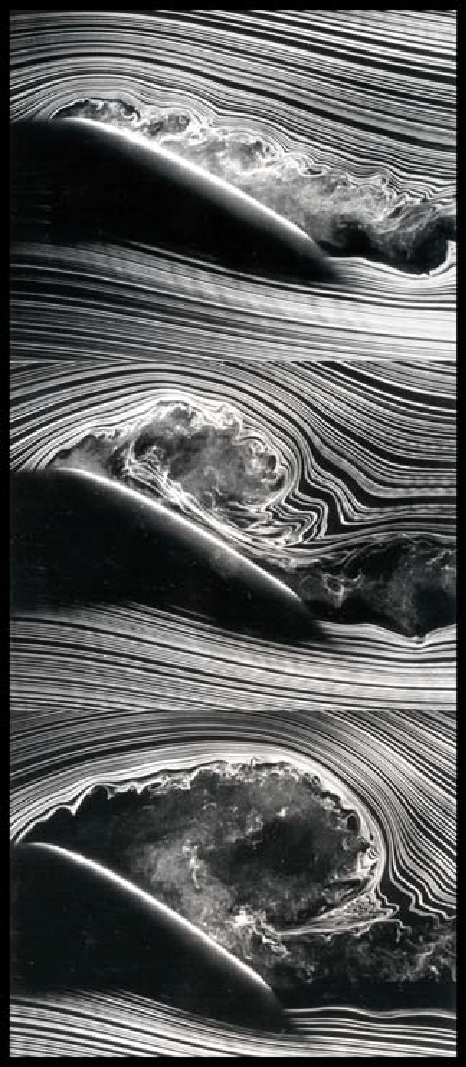
    For a fixed-wing aircraft, stall – the point where airflow around the wing separates and lift is lost – is an enemy. It’s the precursor to a stomach-turning freefall for the airplane and its contents. But the story is rather different when the wing is actively pitching through these high angles of attack. In this case, you get what’s known as dynamic stall, illustrated in three consecutive snapshots above.

    In the top image, the flow has clearly separated from the upper surface of the wing, but this isn’t a cause for panic. As the middle image shows, there’s a vortex that’s formed in that separated region and it’s moving backward along the wing as the angle of attack continues to increase. That vortex causes a strong low-pressure region on the upper surface of the wing, allowing it to maintain lift.

    In the final image, the vortex is leaving the wing, taking its low-pressure zone with it. This is the point where the pitching wing loses its lift, but if the vortex’s departure is immediately followed by a pitch down to lower angles of attack, the aircraft will recover lift and carry on. (Image credit: S. Schreck and M. Robinson, source)

  • Phytoplankton Swirl

    View this post on Instagram

    Every summer, phytoplankton spread across the northern basins of the North Atlantic and Arctic Oceans, with blooms spanning hundreds and sometimes thousands of kilometers. One of our Earth-observing satellites captured this natural-color image of striking swirls of green seawater rich with blooms of phytoplankton whirling in the Gulf of Finland, a section of the Baltic Sea. Note how the phytoplankton trace the edges of a vortex; it is possible that this ocean whirlpool is pumping up nutrients from the depths. Credit: NASA/U. S. Geological Survey/ Joshua Stevens/Lauren Dauphin #nasa #science #vortex #phytoplankton #earth #landsat #picoftheday #finland #earthview #views #satellite #lava #balticSea #beautiful #blooms

    A post shared by NASA (@nasa) on

    During the warm summer months, phytoplankton blooms pop up in waters around the world. This natural-color satellite image shows a bloom in the Gulf of Finland. The tiny phytoplankton serve as tracker particles for the flow, revealing large-scale features like the spectacular vortex in the center of this image. The presence of the phytoplankton here suggests that this vortex could be pumping nutrients up from the deep. 

    Researchers also use particles for flow visualization. This can be as simple as adding small, neutrally buoyant particles, illuminating smoke, or even using natural snowfall to see what’s happening in the flow. (Image credit: NASA/USGS/J. Stevens/L. Dauphin)

  • How Mantas Filter But Never Clog

    How Mantas Filter But Never Clog

    Manta rays spend much of their time leisurely cruising through the water with their meter-wide mouths open. As they swim, they filter plankton, which makes up most of their diet, from the water. And they do so without ever clogging. 

    The inside of the manta’s mouth is lined with gill rakers (upper right), a series of comb-like teeth. When flow hits the leading edge of these (bottom), it creates a vortex that accelerates any particles caught in the flow. They essentially ricochet along the top of the gill rakers, getting led straight into the manta’s digestive system – while excess water gets deflected between the gill rakers and back out the manta’s gills. To drive this, all the manta has to do is swim; with the right flow speed, the shape of the gill rakers handles all the filtration with no additional effort. (Image credit: manta ray – G. Flood; gill rakers – M. Paig-Tran; flow vis – R. Divi et al., source; research credit: M. Paig-Tran et al.; via The Atlantic; submitted by Kam-Yung Soh)

  • Exploding Meteors

    Exploding Meteors

    During the recent Perseid shower, photographer Petr Horálek caught an awesome timelapse of an exploding meteor and the vortex ring it created. This is a type of persistent train left when meteors pass through the upper atmosphere. The exact physics are not well understood because such events are difficult to observe; catching them at all is basically just happenstance. But one interpretation is that we’re seeing trails of plasma left by the ionization of parts of the meteor. When the meteor hits the upper atmosphere, there’s an extremely strong hypersonic shock wave. The jump in temperature across that shock wave is enough to pull atoms apart, creating a plasma. The train left by this meteor’s demise was faintly visible even an hour after the fireball. (Image credit: P. Horálek, video version; via APOD; submitted by Andrea S.)

  • Antibubbles

    Antibubbles

    Antibubbles are peculiar and ephemeral creations. A bubble typically encloses a gas within a thin layer of fluid. As the name suggests, an antibubble does the opposite: it’s a thin film of gas enclosing a liquid droplet within a larger background liquid. That thin gas film makes antibubbles extremely delicate. Disturb it at all – as the thinning jet at the top of the animation above does – and that film will break apart, much like a soap bubble. To see more antibubble action, check out some of our previous entries, including antibubbles in a vortex and a simple way to create antibubbles.  (Image credit: C. Kalelkar and S. Phansalkar, source)

  • The Sensitivity of a Seal’s Whiskers

    The Sensitivity of a Seal’s Whiskers

    Harbor seals and their brethren have a superpower that lets them track their prey even without sight or sound. It’s their whiskers, which are sensitive enough to follow the trail left by a single fish thirty seconds earlier. The secret to the whisker’s sensitivity lies in its shape. Instead of a uniform, circular cross-section, the seal’s whisker is oval-shaped and its width varies along the length in a wavy pattern. So unlike a straight cylinder, which vibrates when towed through water, the seal’s whiskers are unperturbed by their own movement. They shed only weak vortices and do not vibrate as a result.

    But, if you expose the whiskers to any external turbulence, like the vortices trailing a fish, the whisker ‘slaloms’ back-and-forth in time with the wake. That motion gets transmitted to the nerves in the seal’s cheek, carrying potential information about both the size and speed of the wake’s originator. Researchers hope similar bio-inspired whiskers could help underwater vehicles track schools of fish or locate underwater drilling leaks. (Image credit: M. Richter; video credit: MIT; research credit: H. Beem and M. Triantafyllou; via the Economist; submitted by Russ A. and Kam-Yung Soh)

  • The Swimming of a Dead Fish

    The Swimming of a Dead Fish

    When I was a child, my father would take me trout fishing, and I spent hours marveling from the riverbank at the trouts’ ability to, seemingly effortlessly, hold their position in the fast-moving water. As it turns out, those trout really were swimming effortlessly, in a manner demonstrated above. The fish you see here swimming behind the obstacle is dead. There’s nothing powering it, except the energy its flexible body can extract from the flow around it.

    The obstacle sheds a wake of alternating vortices into the flow, and when the fish is properly positioned in that wake, the vortices themselves flex the fish’s body such that its head and its tail point in different directions. Under just the right conditions, there’s actually a resonance between the vortices and the fish’s body that generates enough thrust to overcome the fish’s drag. This means the fish can actually swim upstream without expending any energy of its own! The researchers came across this entirely by accident, and one of the questions that remains is how the trout is able to sense its surroundings well enough to intentionally take advantage of the effect. (Image and research credit: D. Beal et al.; via PhysicsBuzz; submitted by Kam-Yung Soh)

  • Flying Backwards

    Flying Backwards

    Spend a summer afternoon floating in a kayak and chances are you’ll see some impressive aerial acrobatics from dragonflies. One of the dragonfly’s superpowers is its ability to fly backwards, which helps it evade predators and take-off from almost any orientation. To do this, the dragonfly rotates its body so that it is nearly vertical, thereby changing the direction it generates lift. In engineering terms, this is “force-vectoring,” similar to the techniques used by helicopters and vertical-take-off jets. 

    Scientists found that backwards-flying dragonflies could generate forces two to three times their body weight, in part due to the strong leading-edge vortices (bottom image) formed on the forewings. They also found that the hind wings are timed so that their lift is enhanced by catching the trailing vortex of the first pair of wings. Engineers hope to use what they’re learning from insect flight to build more capable flying robots. (Image and research credit: A. Bode-Oke et al., source; via Science)

  • Star Wars Aerodynamics

    Star Wars Aerodynamics

    Science fiction is not always known for hewing to scientific fact, so it will probably come as little surprise that Star Wars’ ships have terrible aerodynamics. But it’s nevertheless fun to see EC Henry’s analysis of drag coefficients of various Rebel and Imperial ships and just how poorly they fare against our own designs.

    Drag coefficients really only give a tiny piece of the story, though. We don’t know what speed Henry is testing the ships at, and we get no information about properties like lift or lift-to-drag ratio, which can be even more important than just the drag when it comes to evaluating an aircraft.

    There are some intriguing hints about other aerodynamic properties in the clips of flow around an X-wing and TIE fighter, though. Notice that the wake of both ships meanders back and forth. This is an indication of vortex shedding, and it means that both spacecraft would tend to be buffeted from side-to-side when flying in an atmosphere. Either the ships would need some kind of active control to counter those forces, or pilots would need iron constitutions to operate under those conditions! (Video and image credit: EC Henry)

    [original video no longer available]

  • Featured Video Play Icon

    The Coexistence of Order and Chaos

    One of the great challenges in fluid dynamics is understanding how order gives way to chaos. Initially smooth and laminar flows often become disordered and turbulent. This video explores that transition in a new way using sound. Here’s what’s going on.

    The first segment of the video shows a flat surface covered in small particles that can be moved by the flow. Initially, that flow is moving in right to left, then it reverses directions. The main flow continues switching back and forth in direction. This reversal tends to provoke unstable behaviors, like the Tollmien-Schlichting waves called out at 0:53. Typically, these perturbations in the flow start out extremely small and are difficult or even impossible to see by eye. So researchers take photos of the particles you see here and analyze them digitally. In particular, they are looking for subtle patterns in the flow, like a tendency for particles to clump together with a consistent spacing, or wavelength, between them. Normally, researchers would study these patterns using graphs known as spectra, but that’s where this video does something different.

    Instead of representing these subtle patterns graphically, the researchers transformed those spectra into sound. They mapped the visual data to four octaves of C-major, which means that you can now hear the turbulence. When the audio track shifts from a pure note to an unsteady warble, you’re hearing the subtle disturbances in the flow, even when they’re too small for your eye to pick out.

    The last part of the video takes this technique and applies it to another flow. We again see a flat plate, but now it has a roughness element, like a tiny hockey puck, stuck to it. As the flow starts, we see and hear vortices form behind the roughness. Then a horseshoe-shaped vortex forms upstream of it. Aside from the area right around the roughness, this flow is still laminar. But then turbulence spreads from upstream, its fingers stretching left until it envelops the roughness element and its wake, making the music waver. (Video and image credit: P. Branson et al.)