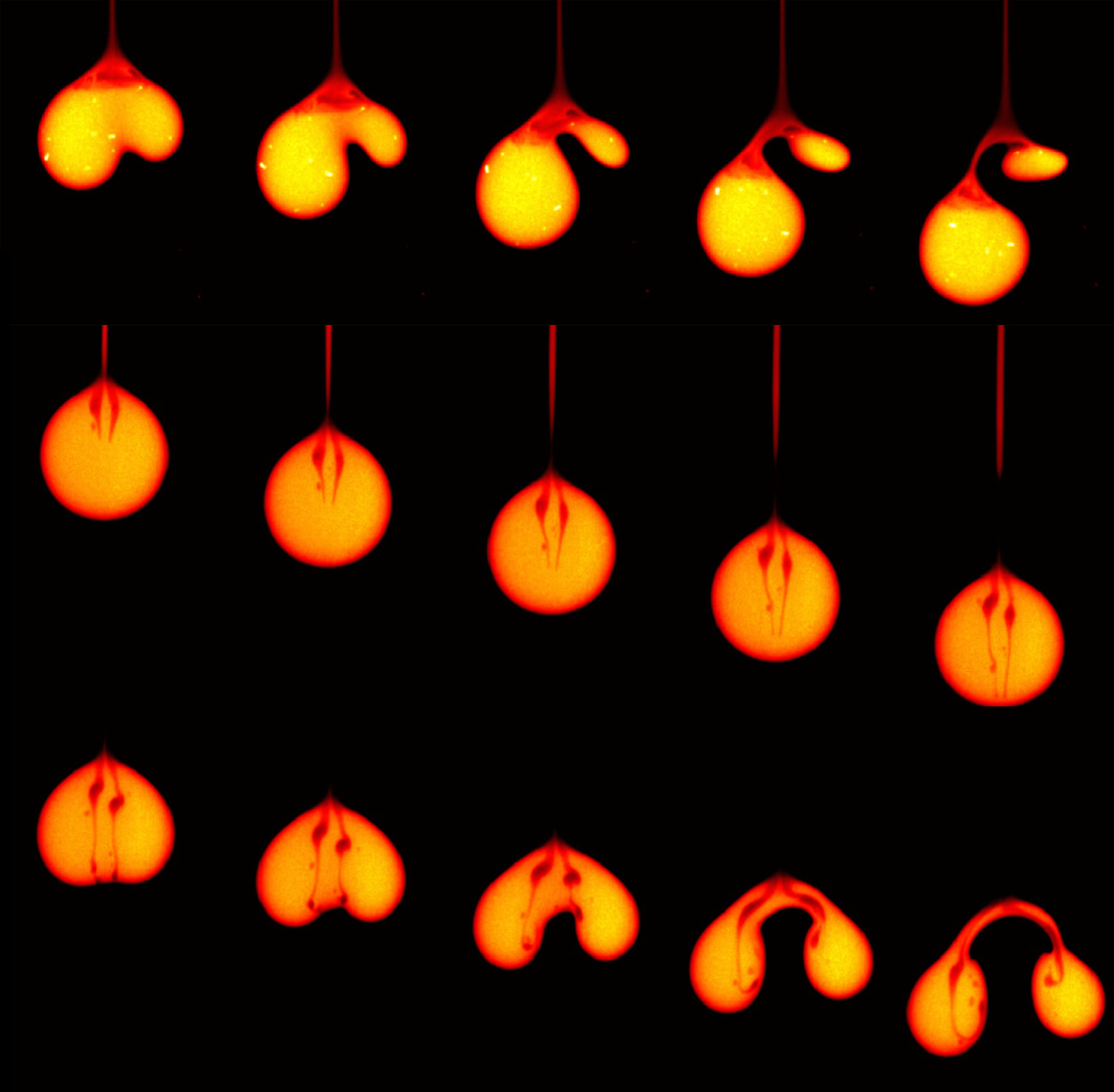
When pulled, viscous liquids stretch into ligaments that thin and then break into droplets. In this video, researchers investigate how these ligaments break up, depending on their composition. The initial views show the break-up of a water-glycerol ligament (Image 1) and an oil ligament (Image 2). By placing a water droplet inside oil, the researchers got quite different results, including oil-encapsulated droplets (Image 3). The technique could be useful for making compound droplets, even with more than two components. (Image and video credit: V. Thiévenaz and A. Sauret)
Search results for: “viscous”

The Bubbly Escape
Sometimes experiments don’t work as planned and, instead of answers, they lead to more questions. In this video, we see an experiment looking at an air bubble trapped beneath a cone. It’s the same situation you get by holding a mug upside-down in a sink full of water but with inclined walls. As the cone moves downward, it squeezes the trapped air bubble. A film of air gets pushed along the walls of the cone, eventually forming finger-like bubbles that wrap around the edge of the cone and get entrained into the vortex ring outside the cone.
Clearly, there is some kind of instability that drives the air bubble to form these fingers rather than spreading uniformly. But the big question is which one? Is this a density-driven Rayleigh-Taylor instability caused by air getting pushed into water? Or is it a Saffman-Taylor instability causes by the less viscous air forcing its way into the more viscous water? What do you think? (Image and submission credit: U. Jain)


Falling Pancake Drops
Despite their round appearance, the droplets you see here are actually shaped like little pancakes. They’re sandwiched inside a Hele-Shaw cell, essentially two plates with a viscous fluid between them. As these droplets fall through the cell, some remain steady and rounded (Image 1), while others experience instabilities (Images 2 and 3). By varying the ratio of the ambient fluid’s viscosity relative to the drop, the authors found two different kinds of breakup. In the first type (Image 2), droplet breakup occurred due to perturbations inside the drop itself. In the second type (Image 3), the viscosity of the ambient fluid is closer to that of the drop and intrusions of the ambient fluid into the drop break it apart. (Image and research credit: C. Toupoint et al.)

Hagfish Slime
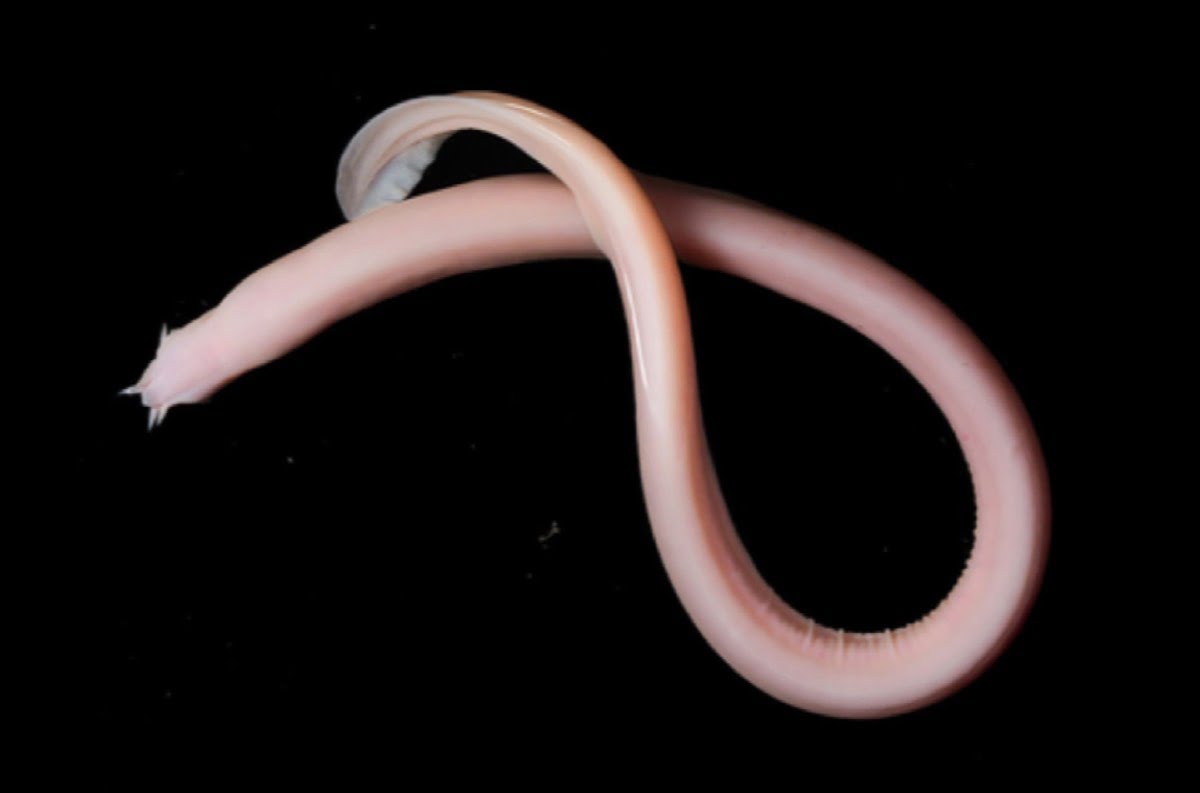
The eel-like hagfish is a superpowered escape artist, thanks to its slime. When threatened, the hagfish releases long protein-rich threads that, when combined with turbulent sea water, unravel to form large volumes of viscoelastic slime that clog the gills of its predators. A new study shows that larger hagfish produce longer and thicker threads in their slime, enabling them to escape larger predators than their smaller brethren can.
The properties of hagfish slime are tuned for defense. When stretched, the long protein threads resist, making the slime more viscous. Since most fish use suction methods to catch prey, that means a predator attacking a hagfish will quickly exacerbate its slimy problems. But the hagfish itself can easily escape its slime by tying itself in a knot. The threads inside the slime collapse when sheared, so the knot-tying of the hagfish slips the slime right off. (Image credit: T. Winegard; research credit: Y. Zeng et al.; via Ars Technica; submitted by Kam-Yung Soh)

Paint Spinning
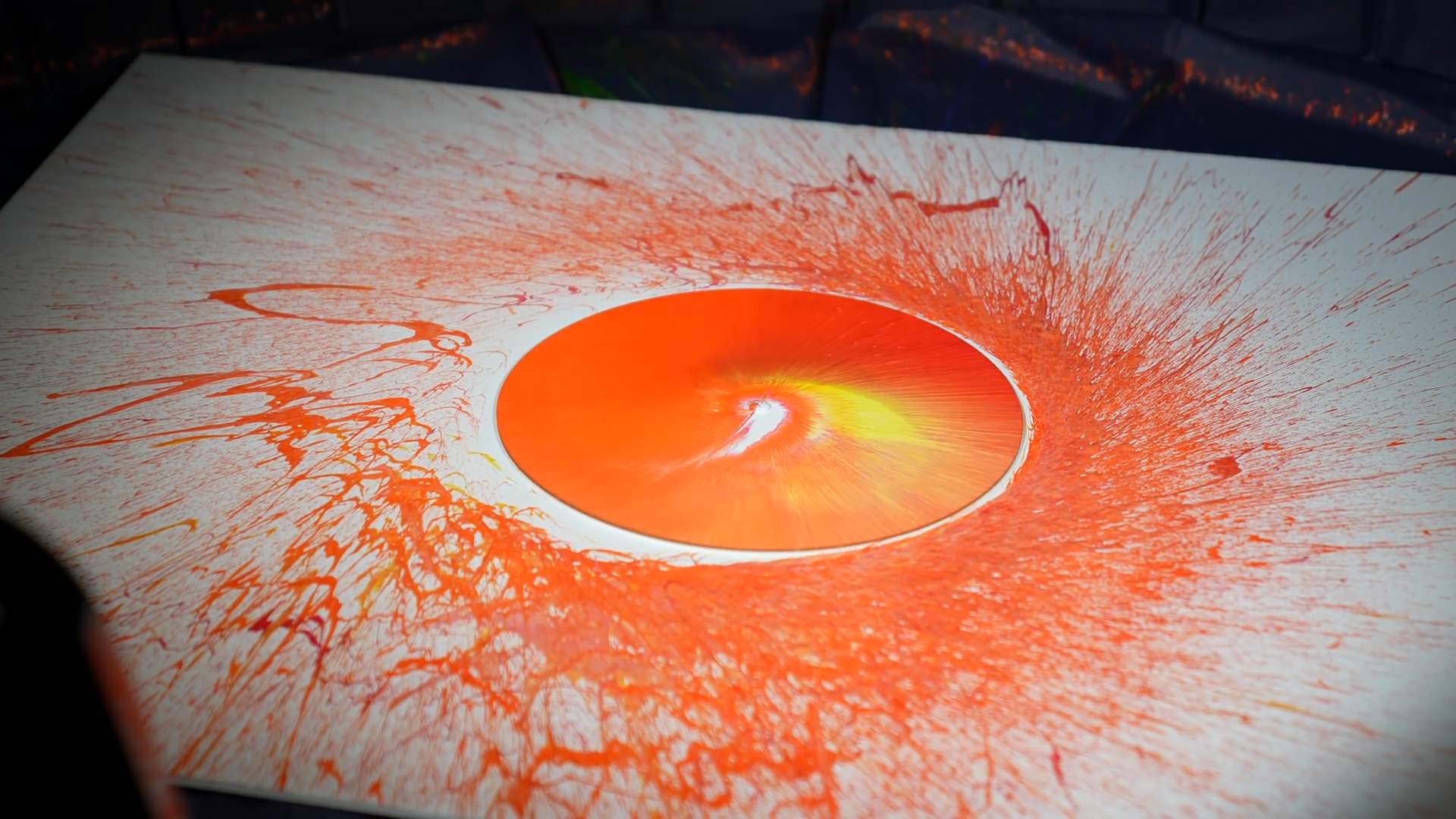
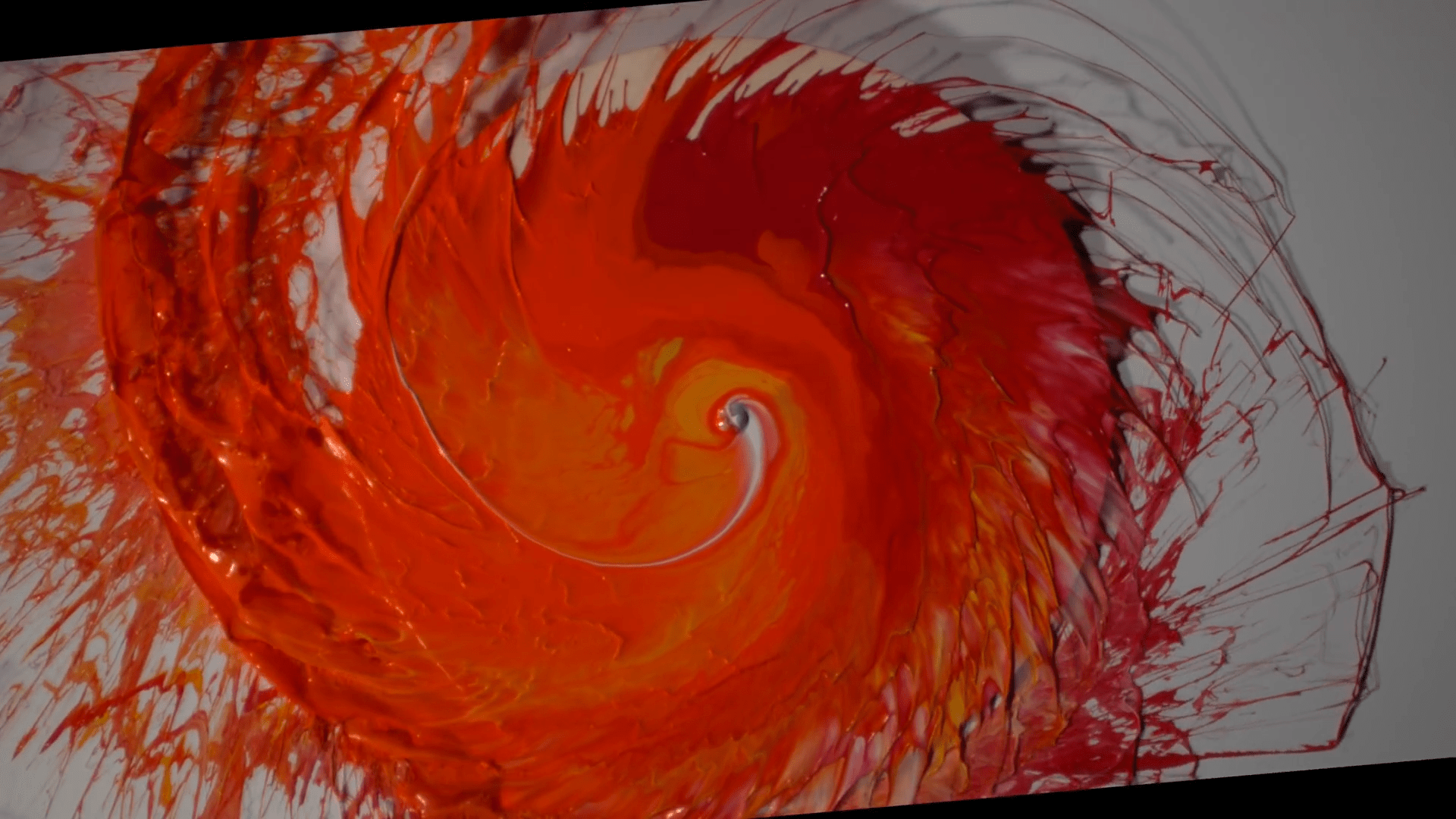
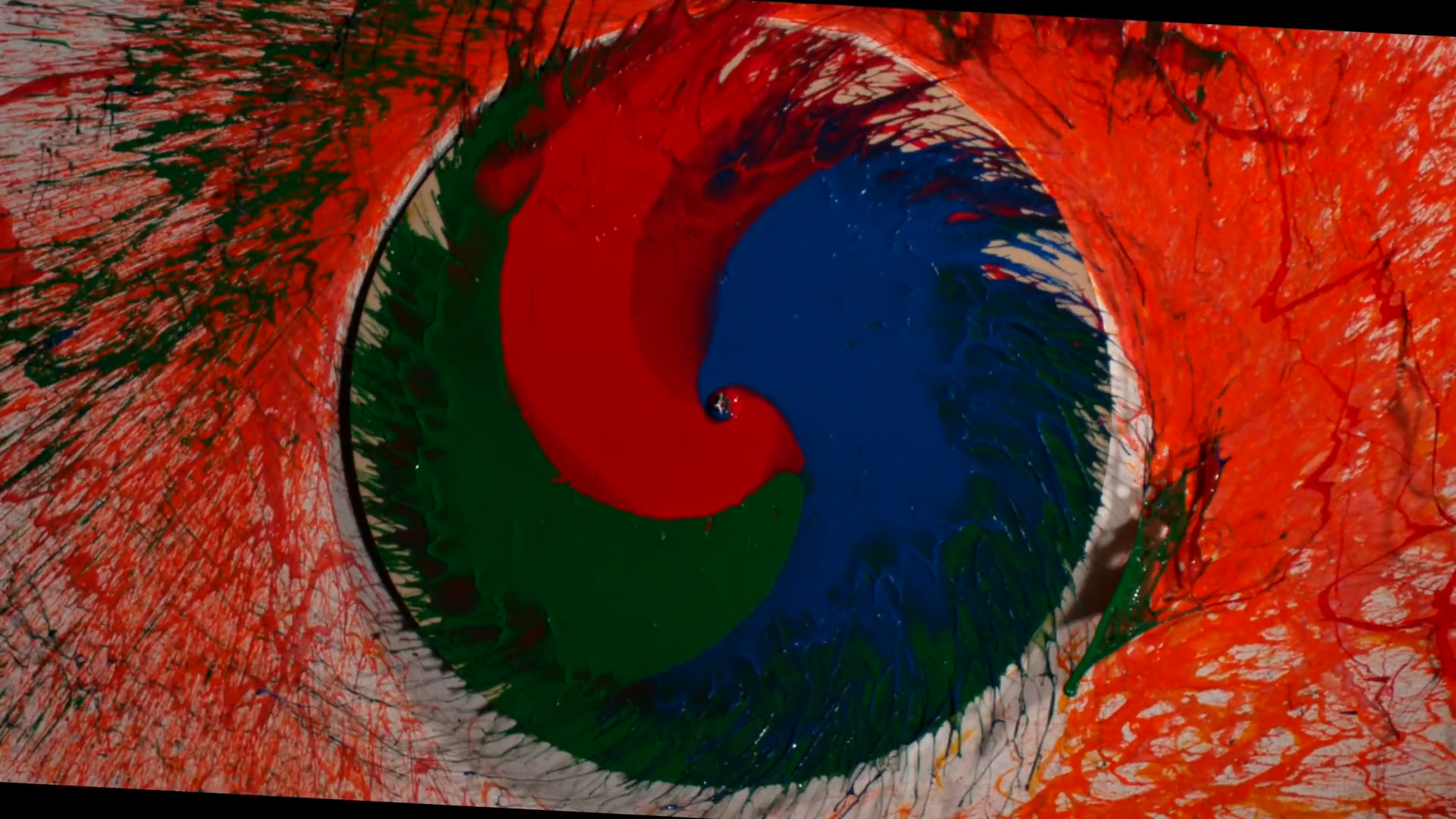
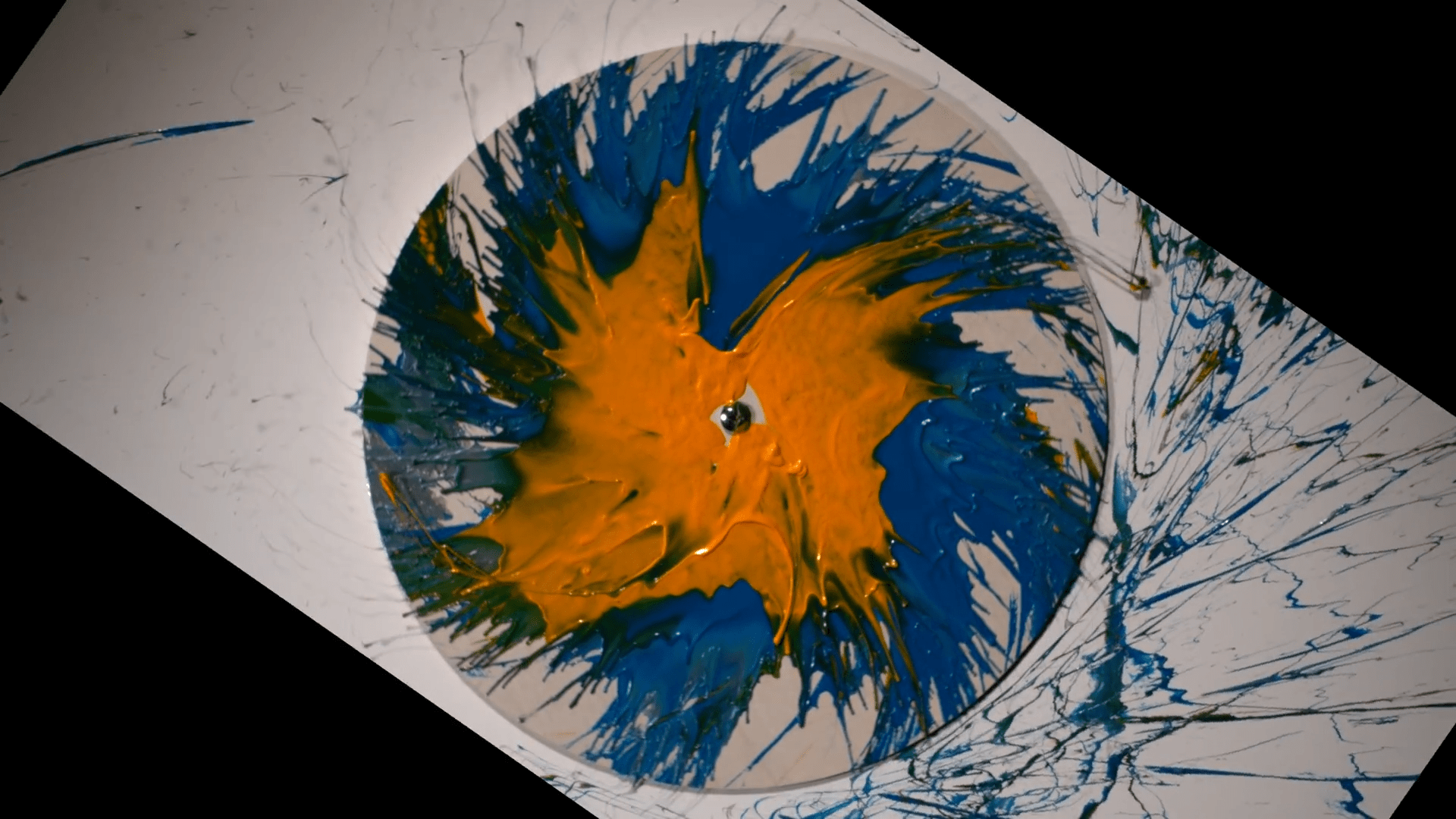
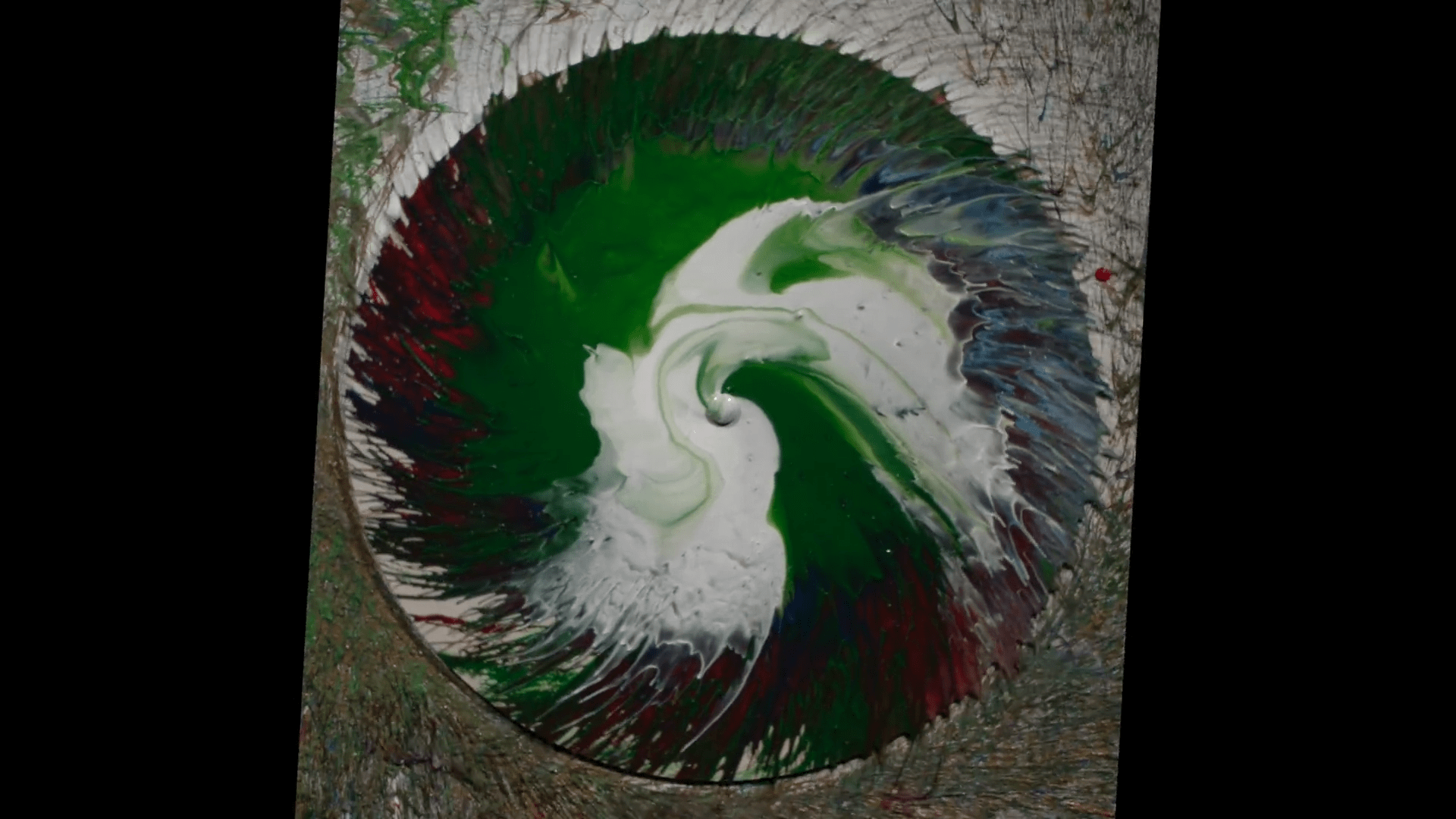
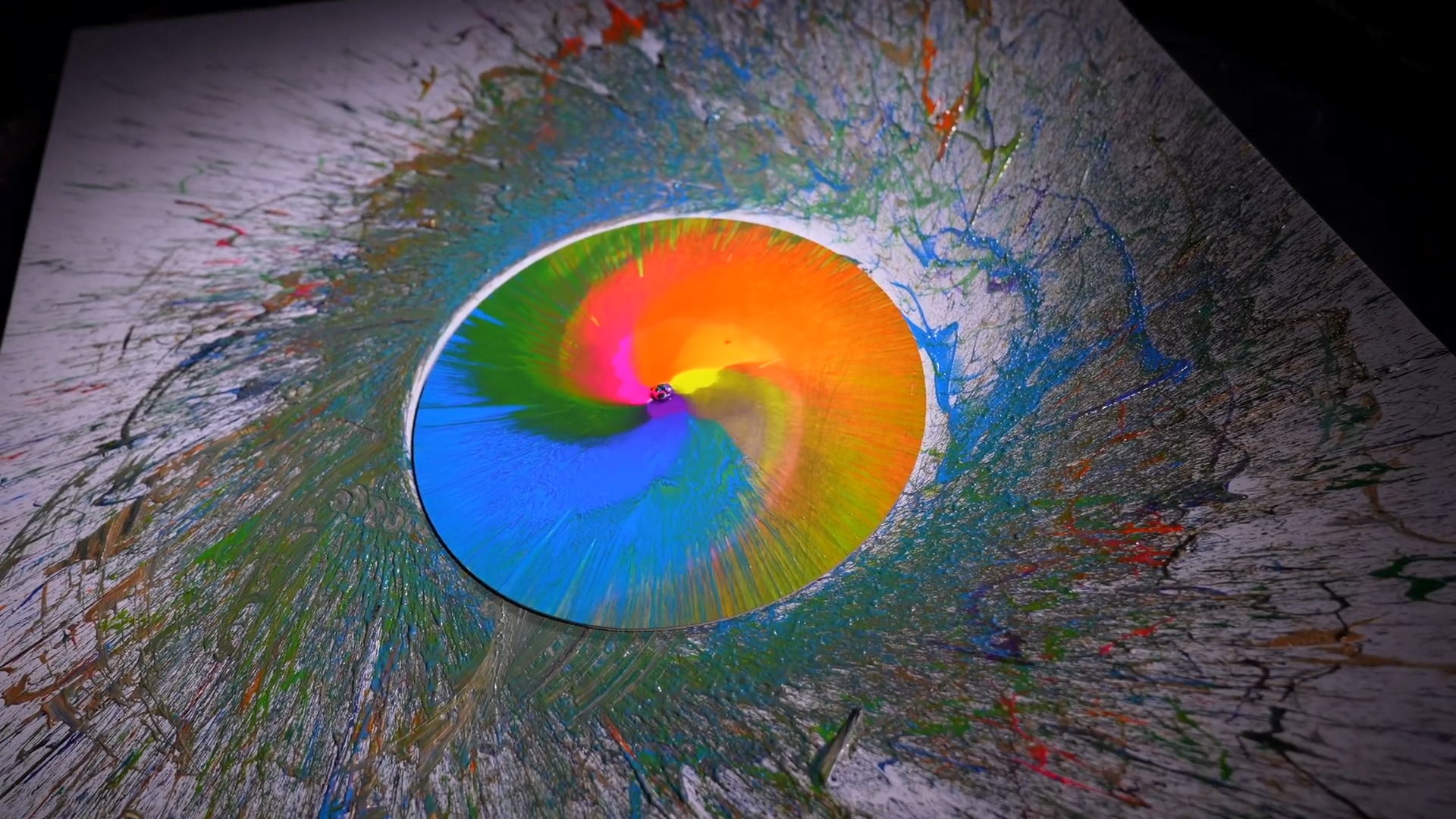
In a return to their roots, this Slow Mo Guys video features paint flowing on (and off!) a spinning disk. To help us see what’s going on, Gav uses a trick that’s familiar to many fluid dynamicists: he rotates the high-speed footage at the same speed that the disk rotates. This transformation places the viewer into a reference frame where the disk appears stationary, so that small changes in the flow are apparent.
It makes for a gorgeous view as centrifugal force flings the paint outward and eventually breaks it into drops. The rotation speed is unfortunately so high that the spinning completely dominates all other forces. The few runs with more viscous acrylic paint show some hints of more interesting behaviors that might be visible with a slower rotation rate (which would make the tug of war between inertia/viscosity/surface tension and centrifugal force less one-sided). Anyone got a high-speed camera, some speed control, and a willingness to get messy? (Image and video credit: The Slow Mo Guys)

Solid, Liquid, Both?
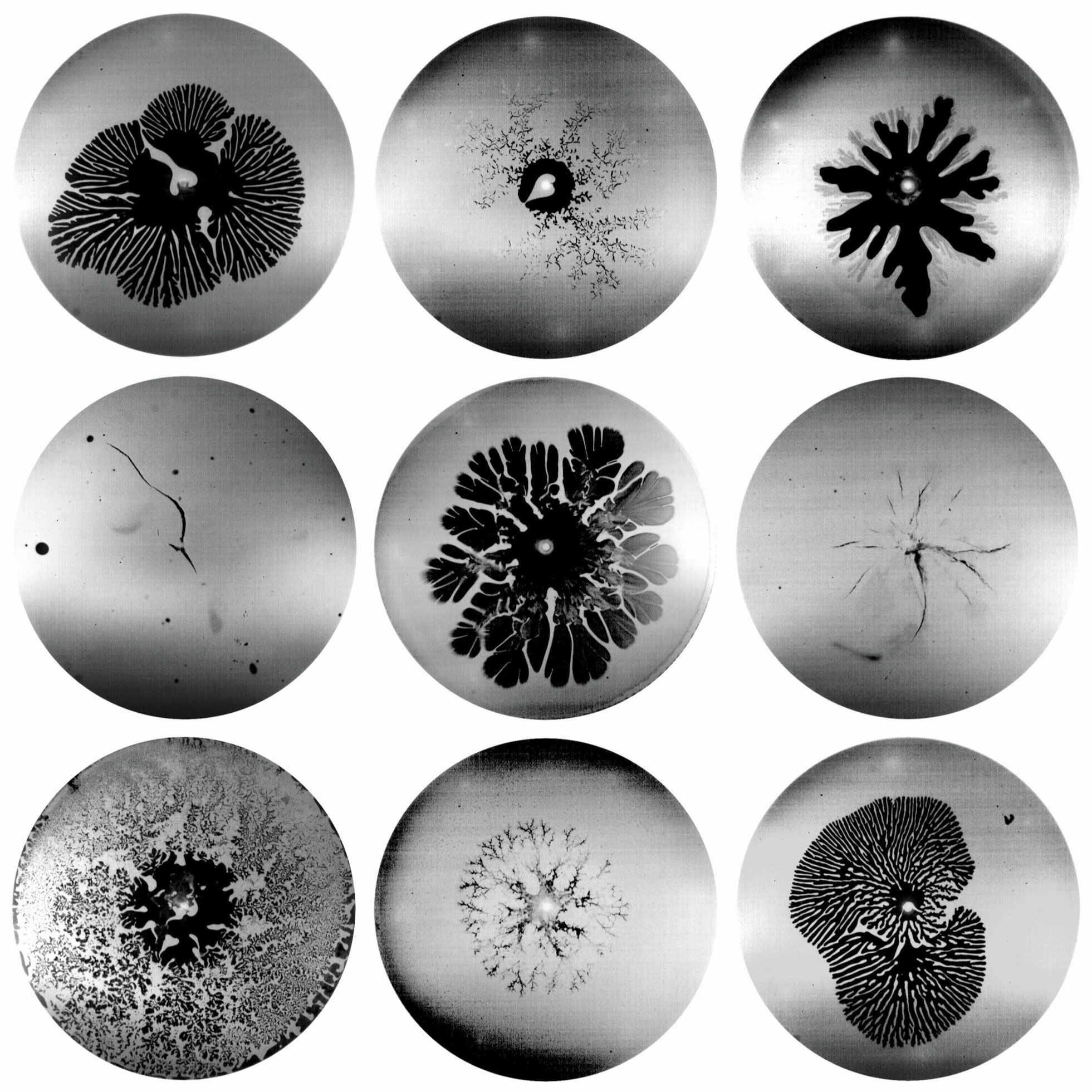
Materials like oobleck — a suspension of cornstarch particles in water — are tough to classify. In some circumstances, they behave like a fluid, but in others, they act like a solid. Here researchers sandwiched a thin layer of oobleck between glass plates and injected air into the mixture. For a fluid, this setup creates a classic Saffman-Taylor instability where rounded fingers of air push their way into the more viscous fluid. And, indeed, for low air pressures and low concentrations of cornstarch, the oobleck forms these viscous fingers. You can see examples in the top row’s first and third image, the second row’s middle image, and the bottom row’s third image.
Injecting air at high pressures and high cornstarch concentrations fractures the oobleck like a solid (middle row, first and third images). At intermediate pressures and concentrations, the oobleck forms a pattern called dendritic fracturing, where new branches can grow perpendicularly to their parent branch. Examples of this pattern are in the top row’s second image and the bottom row’s first and second images. (Image and research credit: D. Ozturk et al.; via Physics Today)

Spin Coating Capillary Tubes
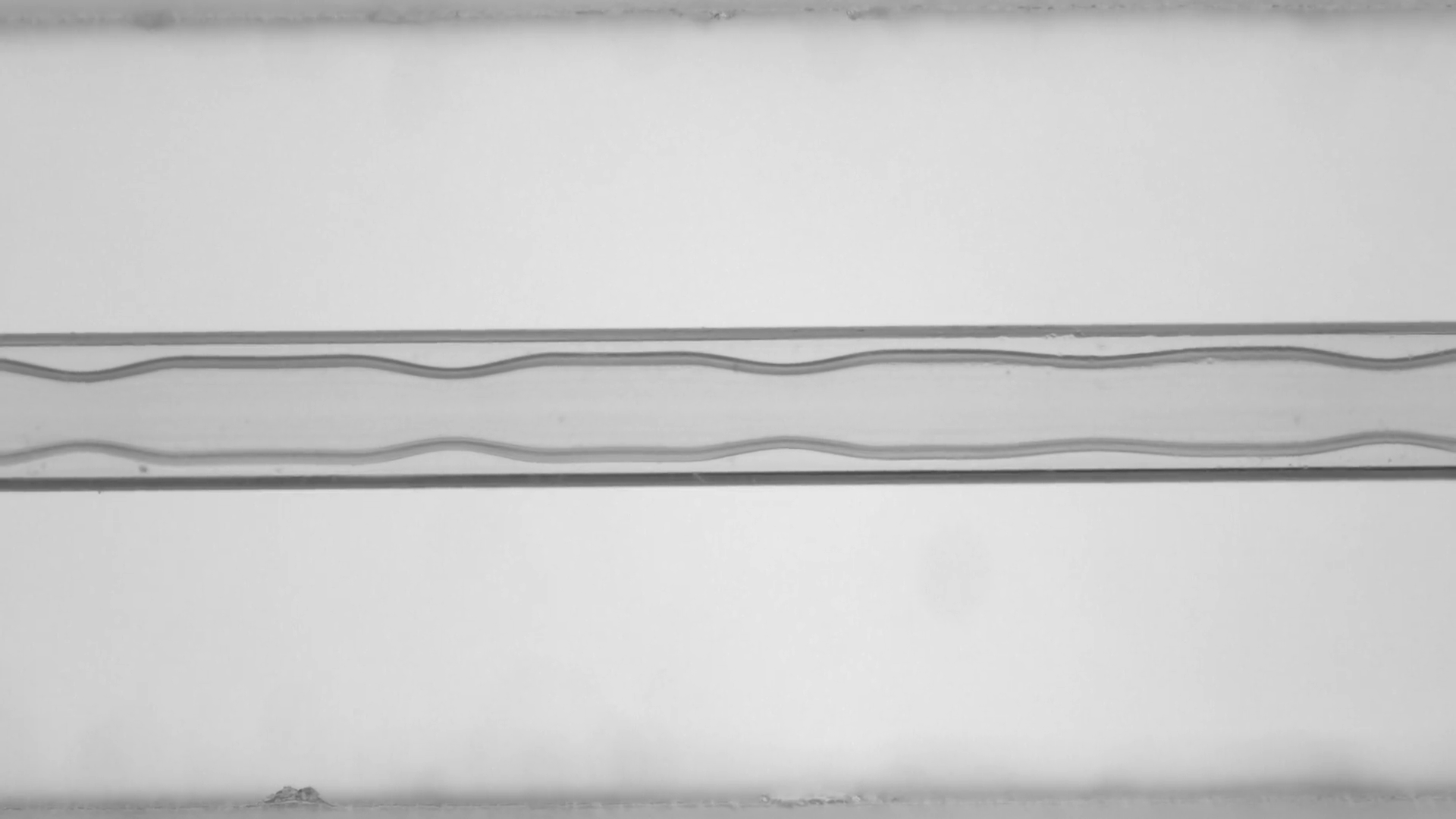
To coat the interior of a capillary tube, you typically fill the tube with a viscous liquid, then pump air in to displace the liquid, leaving behind a thin film of the viscous fluid. Keeping that film uniform and thin is a challenge, though, since the pumps used often struggle to keep a consistent low flow rate. Instead, a team of researchers used spin coating to treat the interior of capillary tubes.
Their apparatus consisted of a repurposed computer fan, stripped of its blades and fitted with a 3D-printed platform that could hold capillary tubes (left). When spinning, an oil slug inside each tube gets forced outward from the center of the platform, leaving behind a thin, uniform film coating in the tube. The group found that some fluids develop a wavy, Plateau-Rayleigh instability in the film once spinning stops (right), which is useful for creating a consistent wavy interior for the tube, particularly when using curable polymers for the coating. (Image, research, and submission credit: B. Primkulov et al.)

Tiny Symmetric Swimmers
Microswimmers live in a world dominated by viscosity, and in viscous fluids, symmetric motion provides no propulsion. That’s why bacteria and other tiny organisms use cilia, corkscrew flagella, and other asymmetric means to swim. But a new study decouples the symmetry of a swimmer’s motion from the motion of the fluid, thereby creating a tiny symmetrically-driven swimmer that does swim.
Their microswimmer consists of two beads, which attract one another via surface tension and are repelled using external magnetic fields. This effectively creates a spring-like connection between the two beads, making them move in and out symmetrically in time. But since one bead is larger than the other, its greater inertia makes it slower to start moving and slower to coast to a stop. This inertial imbalance between the two is significant enough for the beads to swim. The key here is that though the beads’ motion relative to one another is symmetric, their motion relative to the fluid is not! (Image and research credit: M. Hubert et al.; via Science; submitted by Kam-Yung Soh)

Lava Fields From Above
Lava flows are endlessly fascinating to watch. They’re a destructive act of creation that seems in many ways familiar; after all, lava moves the same way we see other viscous fluids move. But it’s so much more extreme in its temperature, viscosity, and destructive potential. These beautiful aerial photos by photographer Thrainn Kolbeinsson show the recent eruption at Iceland’s Fagradalsfjall volcano. I love the vivid texture of the lava in these shots and the sharp contrast between the hot and cooling flows. You can see the pahoehoe forming before your very eyes! (Image credit: T. Kolbeinsson; via Colossal)