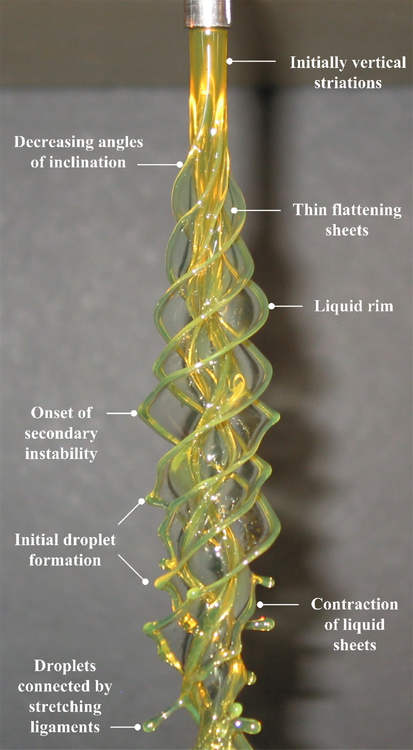
In fluid dynamics, we like to classify flows as laminar–smooth and orderly–or turbulent–chaotic and seemingly random–but rarely is any given flow one or the other. Many flows start out laminar and then transition to turbulence. Often this is due to the introduction of a tiny perturbation which grows due to the flow’s instability and ultimately provokes transition. An instability can typically take more than one form in a given flow, based on the characteristic lengths, velocities, etc. of the flow, and we classify these as instability modes. In the case of the vertical rotating viscous liquid jet shown above, the rotation rate separates one mode (n) from another. As the mode and rotation rate increase, the shape assumed by the rotating liquid becomes more complicated. Within each of these columns, though, we can also observe the transition process. Key features are labeled in the still photograph of the n=4 mode shown below. Initially, the column is smooth and uniform, then small vertical striations appear, developing into sheets that wrap around the jet. But this shape is also unstable and a secondary instability forms on the liquid rim, which causes the formation of droplets that stretch outward on ligaments. Ultimately, these droplets will overcome the surface tension holding them to the jet and the flow will atomize. (Video and photo credits: J. P. Kubitschek and P. D. Weidman)
Search results for: “viscous”

Jets from Hollows
Bubbles rising through a viscous fluid deform and interact. As they collapse into one another, the lower bubble induces a gravity-driven jet that projects upward into the higher bubble. The more elongated the bubble, the faster the jet. The same behavior is seen in the rebound of a cavity at the free surface of a liquid. The authors suggest a universal scaling law for this behavior. (Video credit: T. Seon et al.)

Fluidic Public Art by Charles Sowers
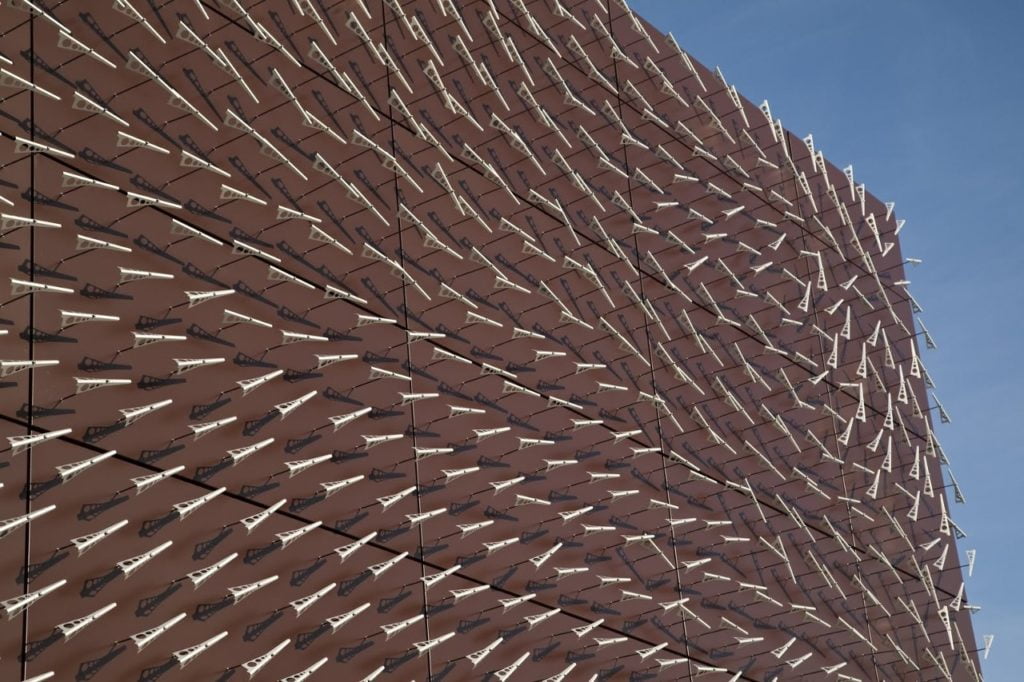


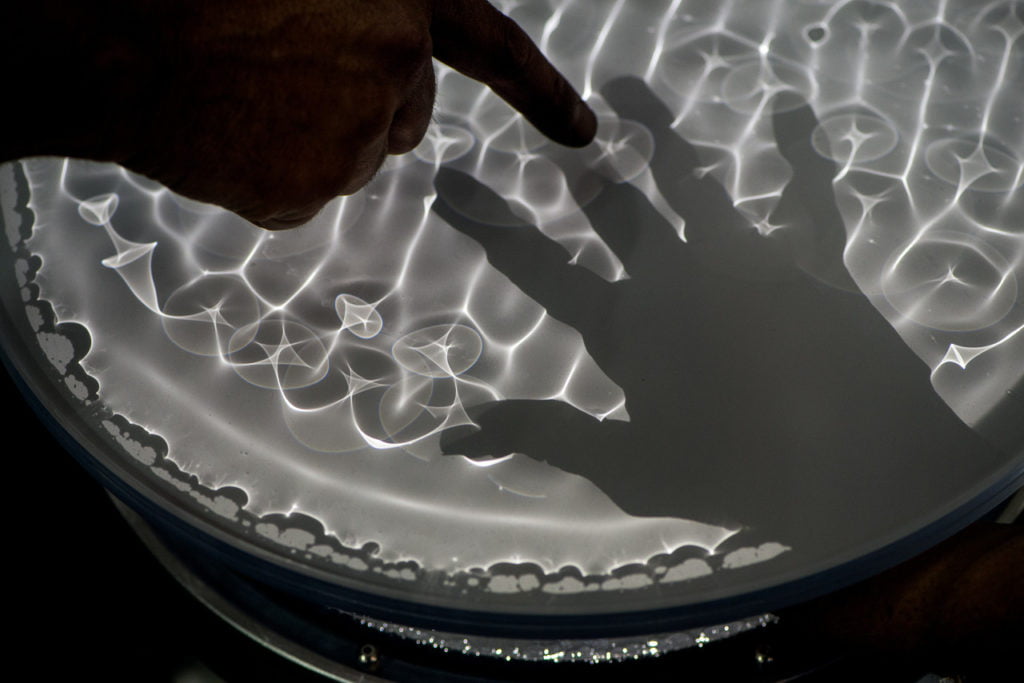


Artist Charles Sowers creates exhibits and public art focused on illuminating natural phenomenon that might otherwise go unnoticed, and much of his work features fluid dynamics directly or indirectly. “Windswept” and “Wave Wall” are both outdoor exhibits that show undulations and vortices corresponding to local wind flow. Other pieces explore ferrofluids through magnetic mazes or feature foggy turbulence. My own favorite, “Drip Chamber”, oozes with viscous fluids whose dripping forms patterns reminiscent of convection cells. Be sure to check out his website for videos of the exhibits in action. (Photo credits: Charles Sowers; submitted by rreis)
Polygonal Jumps
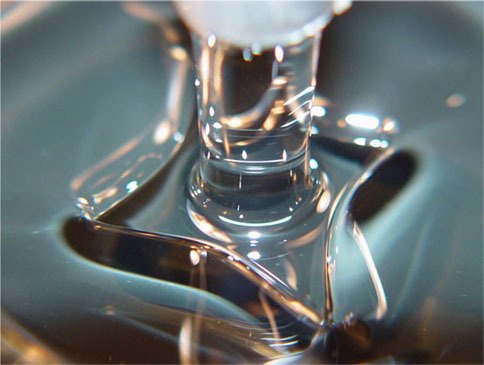
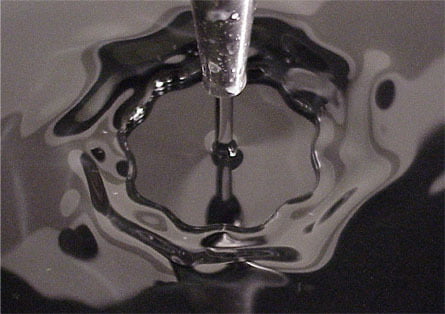
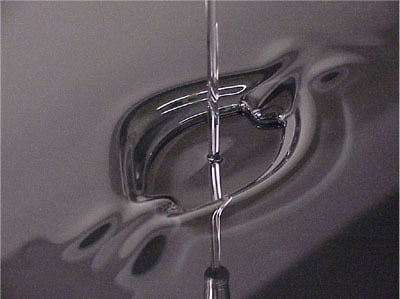
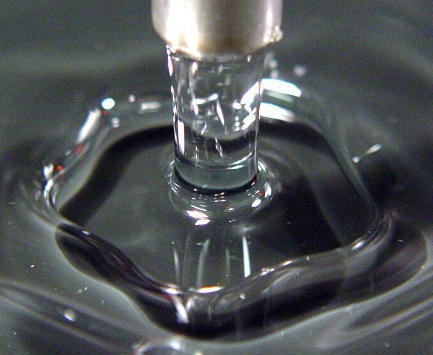
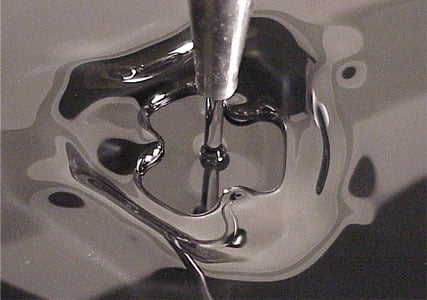
Hydraulic jumps occur when a fast-moving fluid enters a region of slow-moving fluid and transfers its kinetic energy into potential energy by increasing its elevation. For a steady falling jet, this usually causes the formation of a circular hydraulic jump–that distinctive ring you see in the bottom of your kitchen sink. But circles aren’t the only shape a hydraulic jump can take, particularly in more viscous fluids than water. In these fluids, surface tension instabilities can break the symmetry of the hydraulic jump, leading to an array of polygonal and clover-like shapes. (Photo credits: J. W. M. Bush et al.)

Shark-Tooth Instability
A viscous fluid inside a horizontally rotating circular cylinder forms a shark-tooth-like pattern along the fluid’s free surface. This is one of several patterns observed depending on the fluid’s viscosity and surface tension and the rotational rate of the cylinder. (Photo credit: S. Thoroddsen and L. Mahadevan; for more, see Thoroddsen and Mahadevan 1996 and 1997)
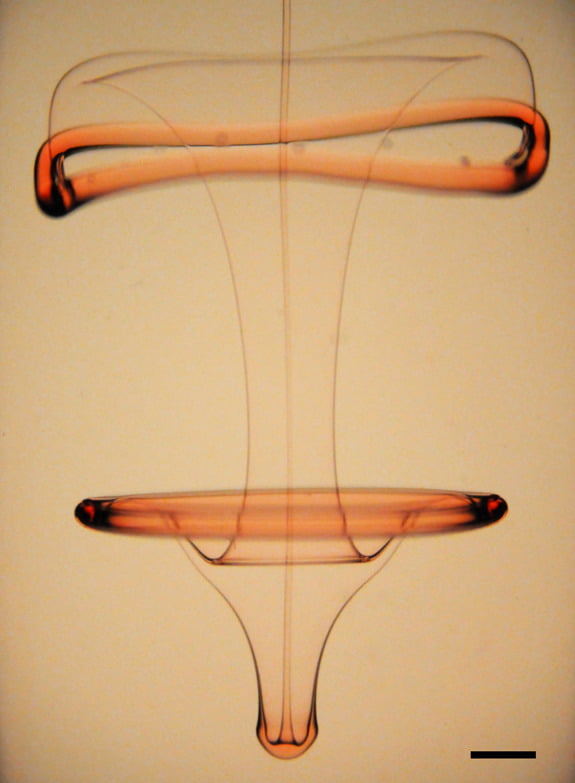
Falling Oil
A drop of silicone oil falling through a liquid with lower surface tension distorts into multiple vortex rings connected by thin films. This behavior is caused by the interaction between viscous and capillary forces and is observable for only a narrow range of oil viscosities. (Photo credit: A. Felce and T. Cubaud)
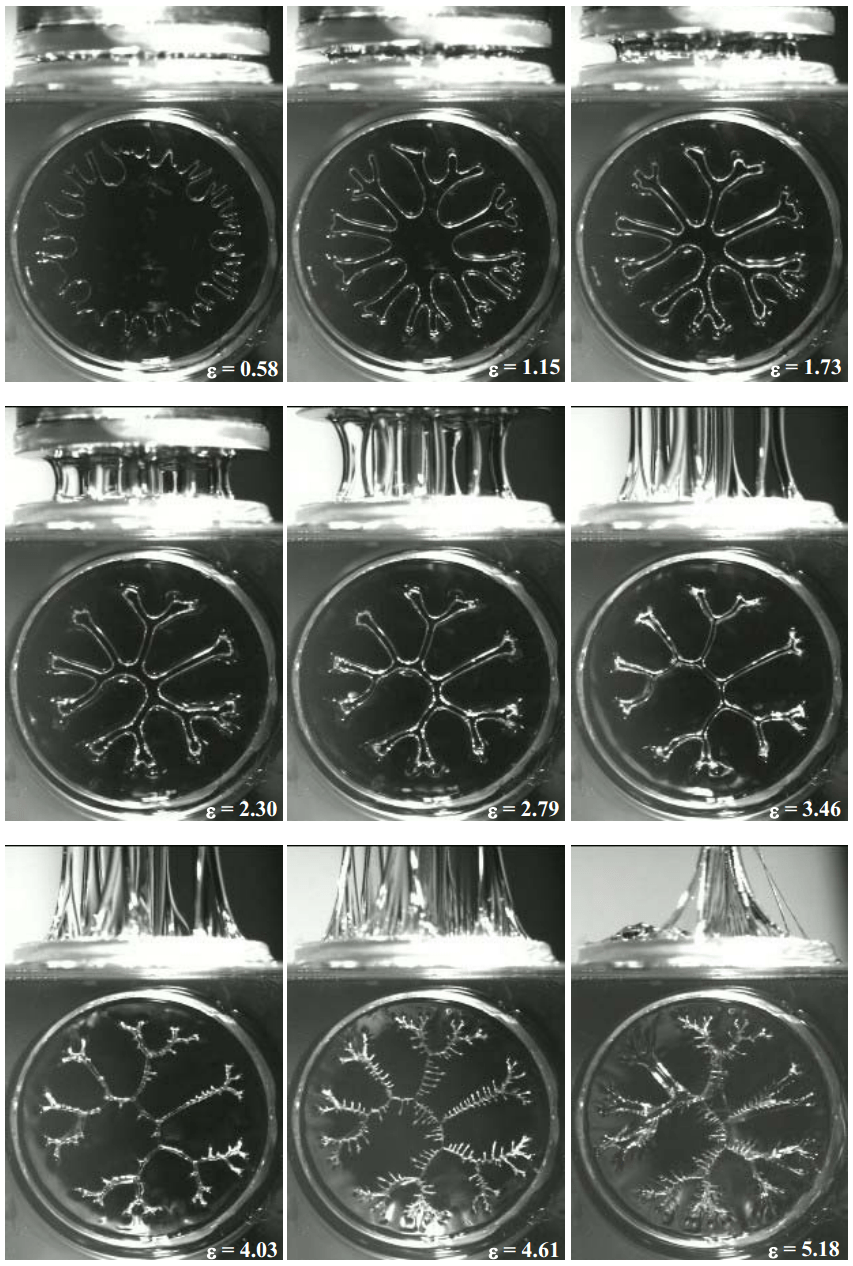
Viscoelastic Fingers
This series of photos shows two plates with a thin layer of polymer-laced, viscoelastic liquid. As the two plates are separated, complex instabilities form. The lower section of each photograph shows the fluid on the plate, with finger-like Saffman-Taylor instabilities forming as air rushes in between the gap in the plates. As the separation increases, the polymers in the liquid stretch under the increased strain, inducing elastic stresses in the fluid that cause the formation of secondary structures. (Photo credit: R. Welsh, J. Bico, and G. McKinley)
Paper Marbling
[original media no longer available]
Suminagashi, the Japanese art of “floating ink”, is one of many methods historically used for paper marbling. In it, a shallow layer of water or other viscous fluid serve as a medium for drops of ink that diffuse across the fluid surface and are manipulated with straws, brushes, or other tools. Once a design is complete, an absorbent surface like paper or fabric is carefully placed on top to preserve the art. Among other applications, the technique has historically been used for calligraphy and book bindings.

The Fluid Dynamical Sewing Machine

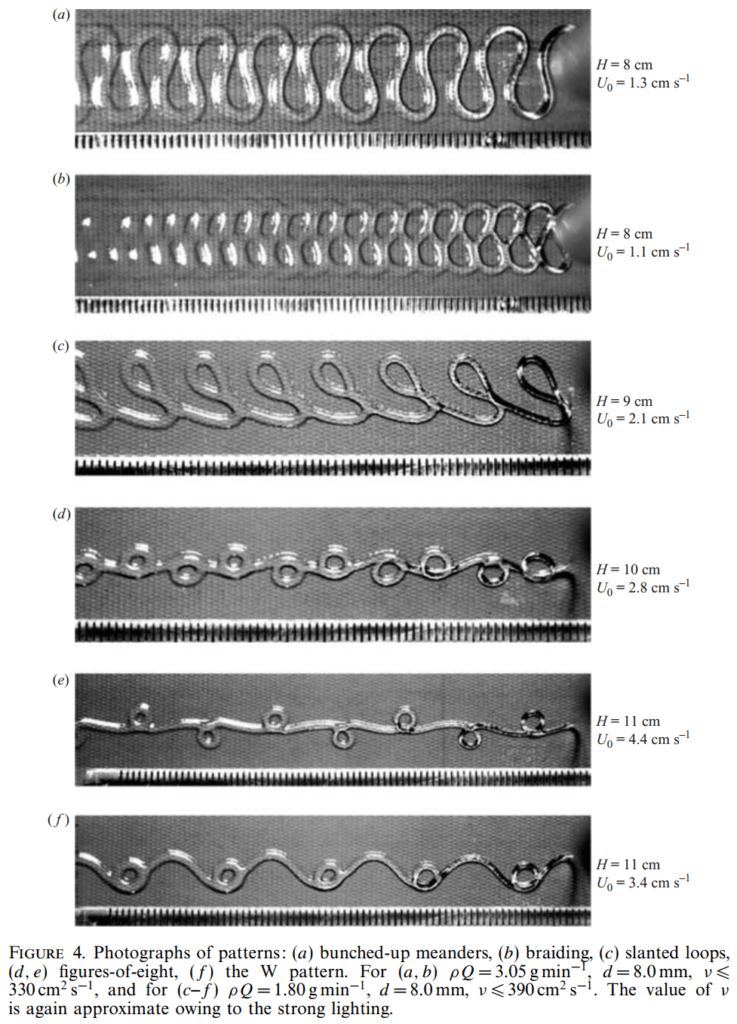


Anyone who has poured a viscous fluid like honey or syrup will have noticed its tendency to coil like rope. A similar effect is observed when a viscous fluid stream falls onto a moving belt. The photos above show some of the patterns seen in these “fluid-mechanical sewing machines” depending on the height of the thread and the speed of the moving belt. Notice how some of the patterns are doubles of another (i.e. two coils per side instead of one). This period doubling behavior is often seen in systems on their way to chaos. (Photo credits: S. Chiu-Webster and J. Lister)
Labyrinth
A labyrinthine pattern forms in this timelapse video of a multiphase flow in a Hele-Shaw cell. Initially glass beads are suspended in a glycerol-water solution between parallel glass plates with a central hole. Then the fluid is slowly drained over the course of 3 days at a rate so slow that viscous forces in the fluid are negligible. As the fluid drains, fingers of air invade the disk, pushing the beads together. The system is governed by competition between two main forces: surface tension and friction. Narrow fingers gather fewer grains and therefore encounter less friction, but the higher curvature at their tips produces larger capillary forces. The opposite is true of broader fingers. Also interesting to note is the similarity of the final pattern to those seen in confined ferrofluids. (Video credit and submission: B. Sandnes et al. For more, see B. Sandes et al.)