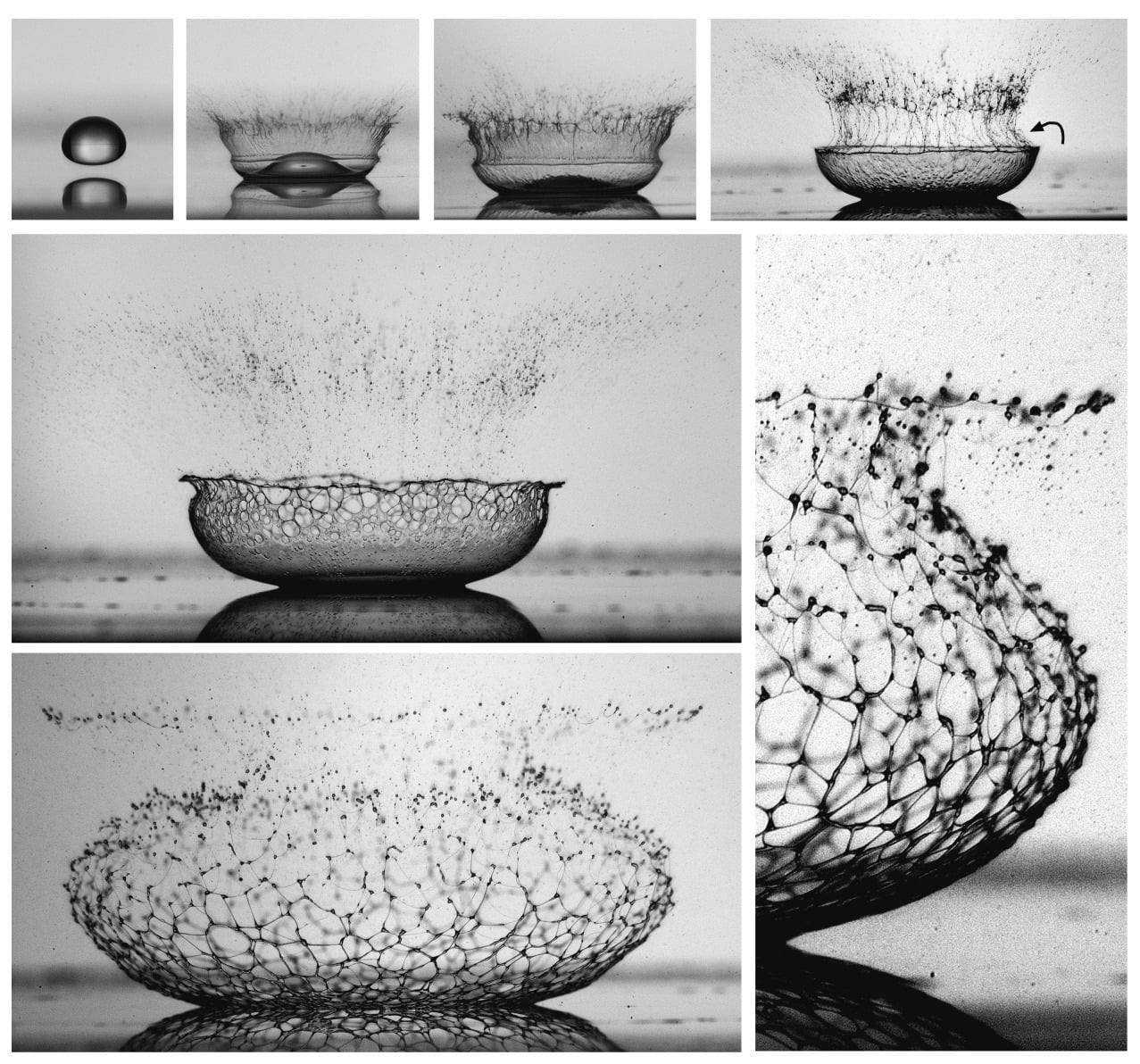
A viscous fluid droplet impacts a thin layer of ethanol, which has a lower surface tension than the viscous fluid. A spray of tiny ethanol droplets is thrown up while a bowl-shaped crown of the viscous fluid forms. As the ethanol droplets impact the bowl, the lower surface tension of the ethanol causes fluid to flow away from points of contact due to the Marangoni effect. This outflow causes holes to form in the crown, forming a network of thin fluid ligaments. For more, see this paper (PDF) and video. (Photo credit: S.T. Thoroddson et al)
Search results for: “viscous”

Air Injection Patterns
This timelapse video demonstrates the pattern variations occurring when air is injected into a wet granular mixture in a Hele-Shaw cell. When the filling fraction–the percentage of the total volume between the glass sheets taken up by grains–is relatively small, the pattern formed by the injected air develops continuously and looks similar to Saffman-Taylor fingering seen in pure fluids. When the filling fraction is larger, however, the pattern forms in an intermittent fashion with new stick-slip bubbles of air forming as narrow sections of granular material slip and give way. #
Flow Vis
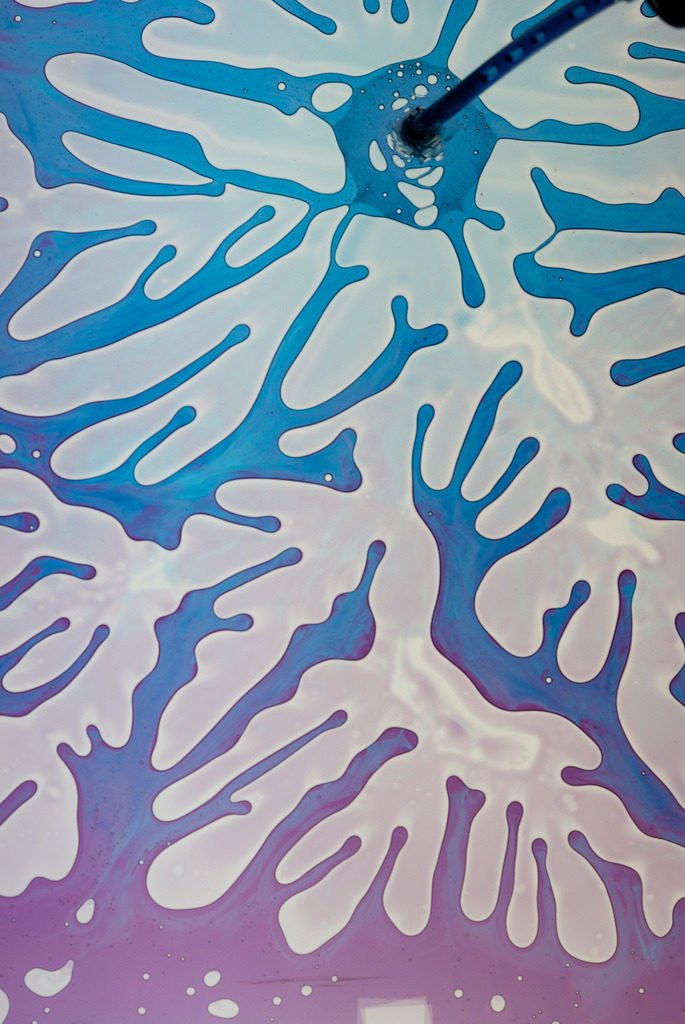
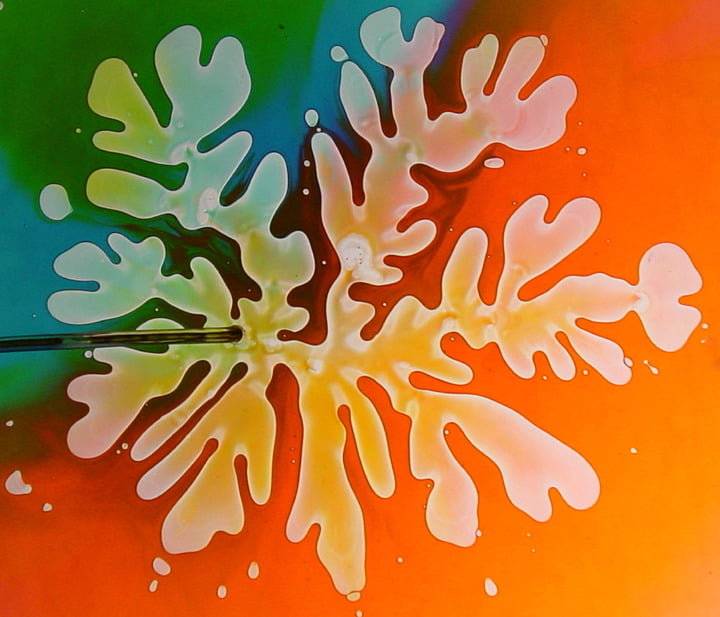
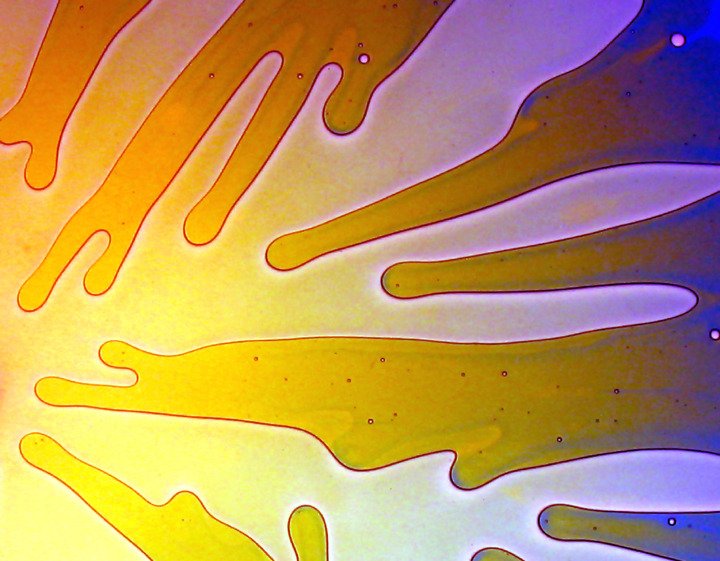
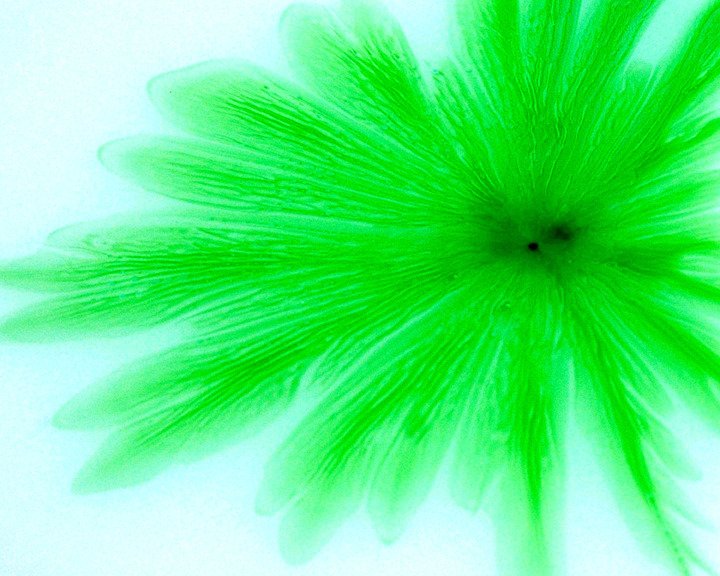
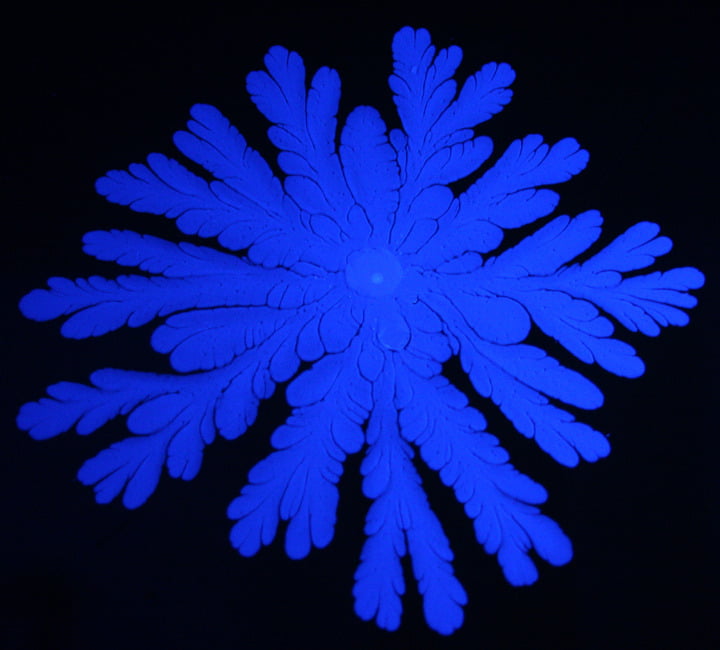
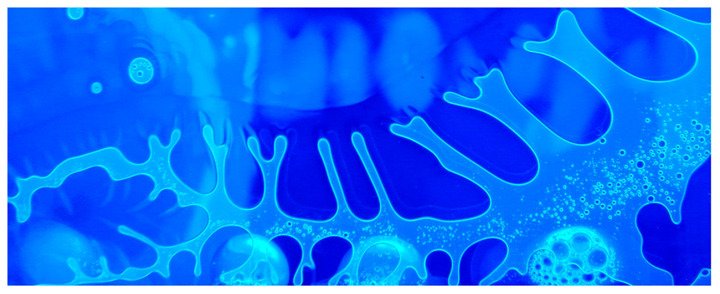
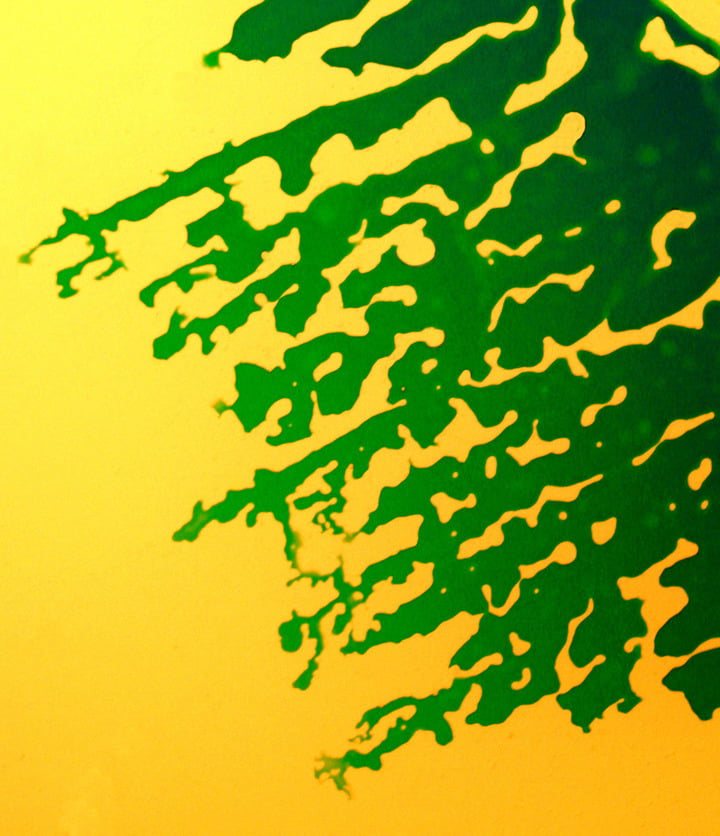
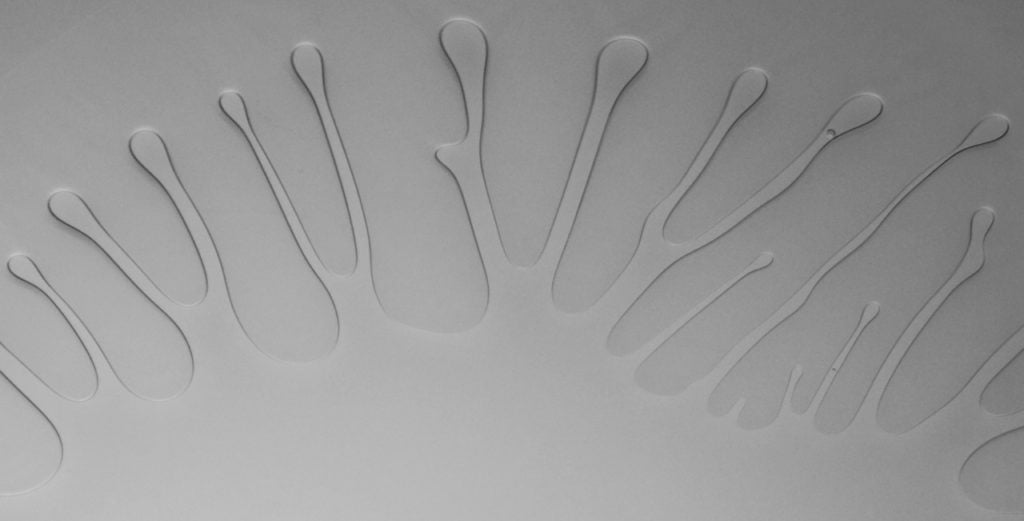
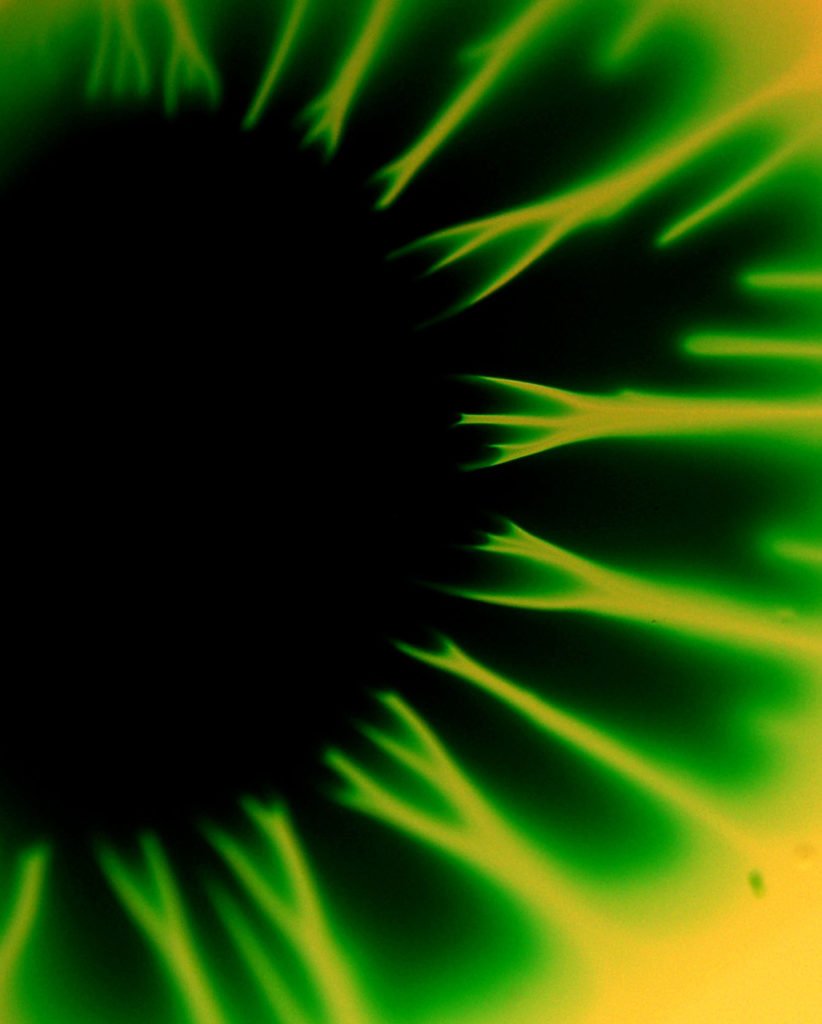
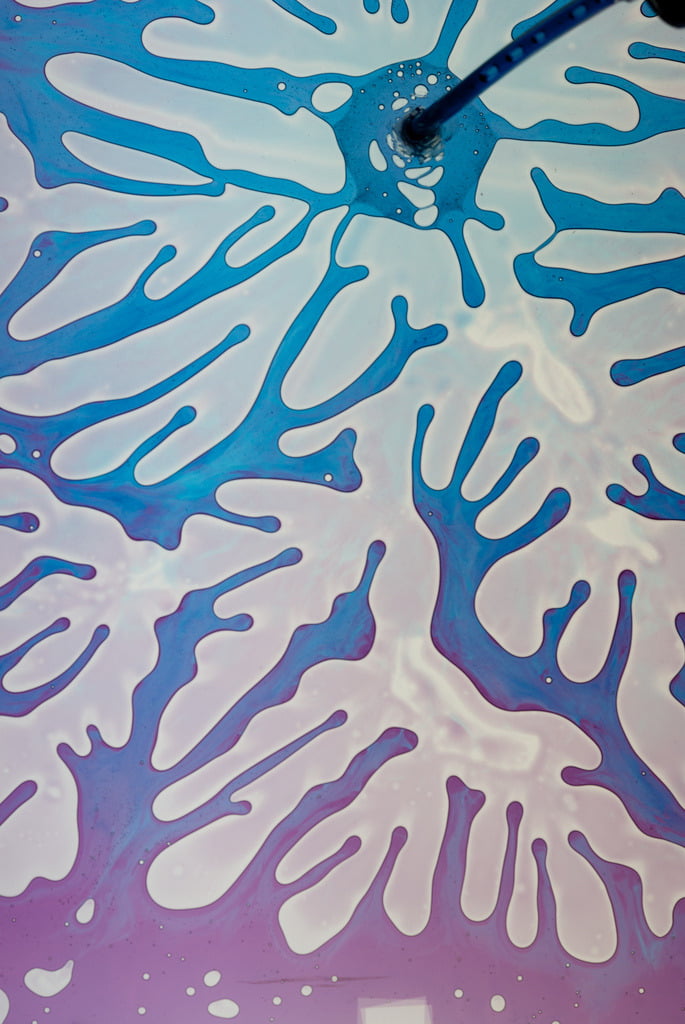
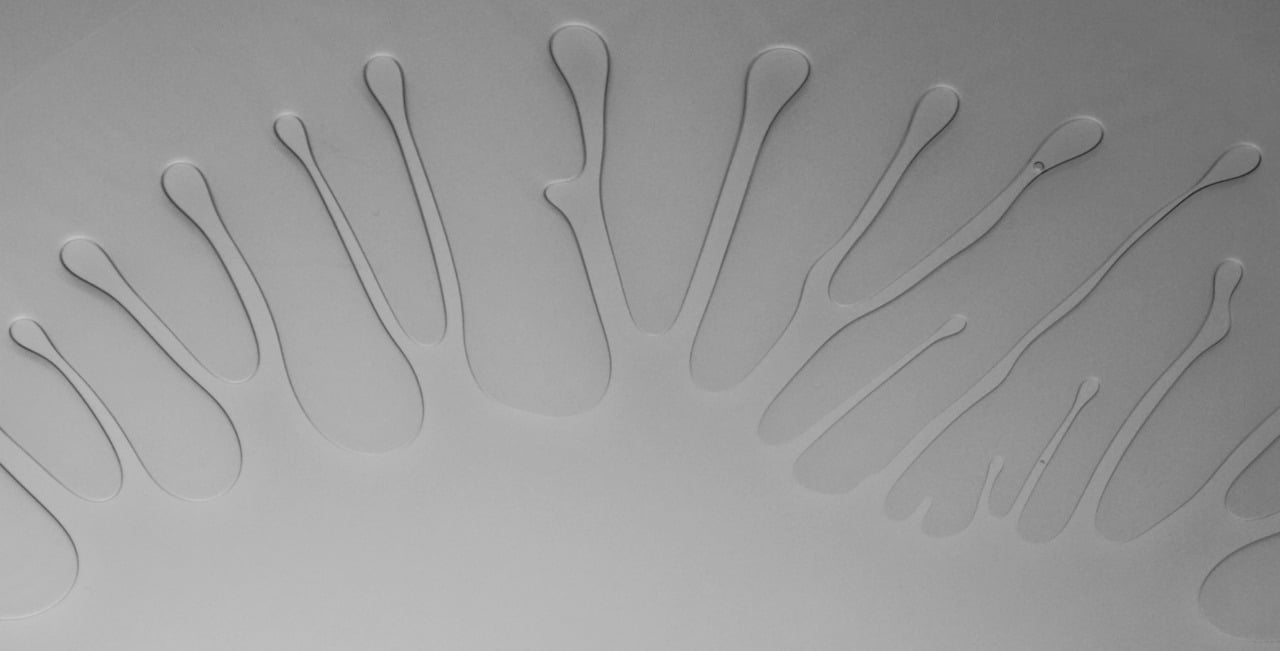
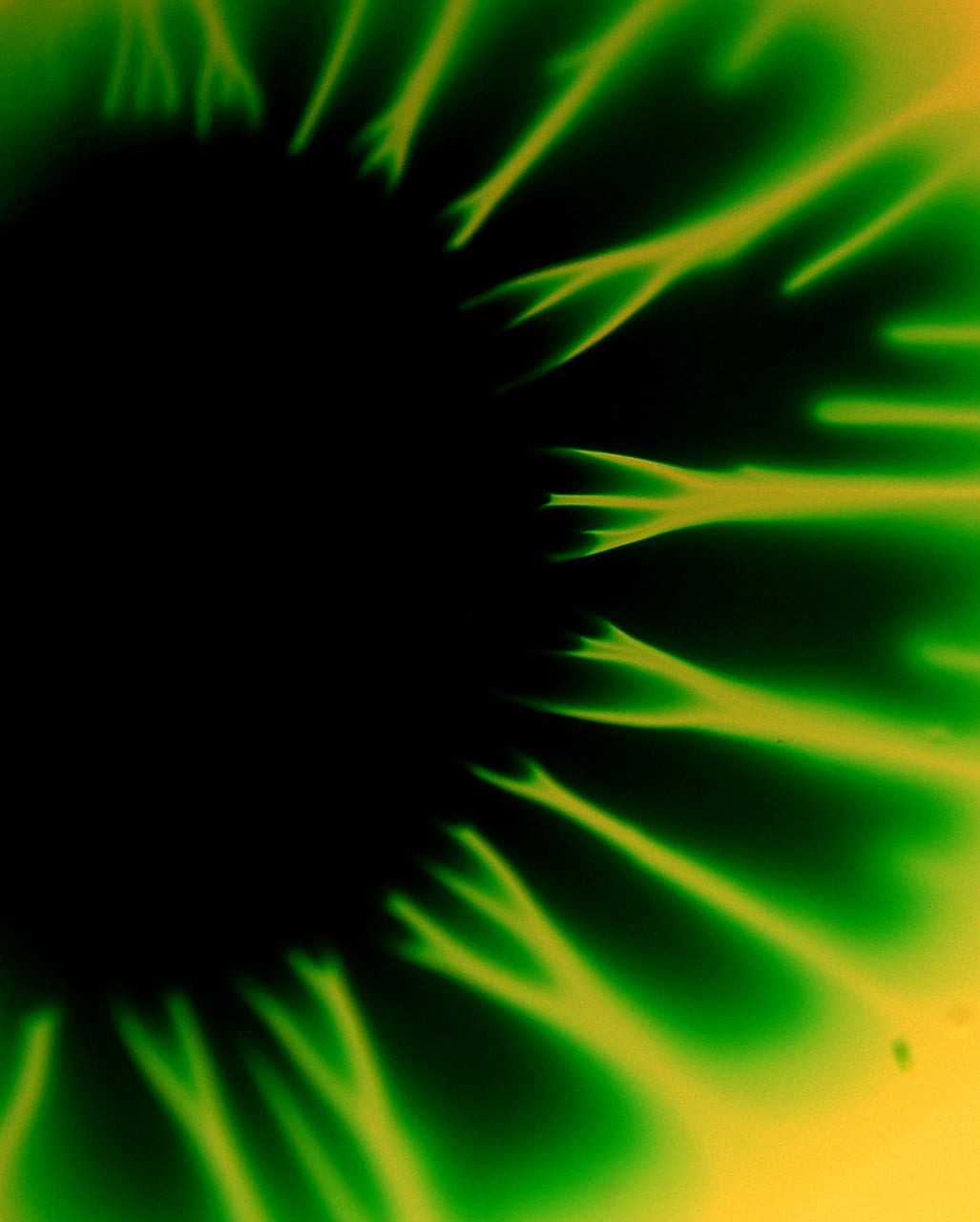
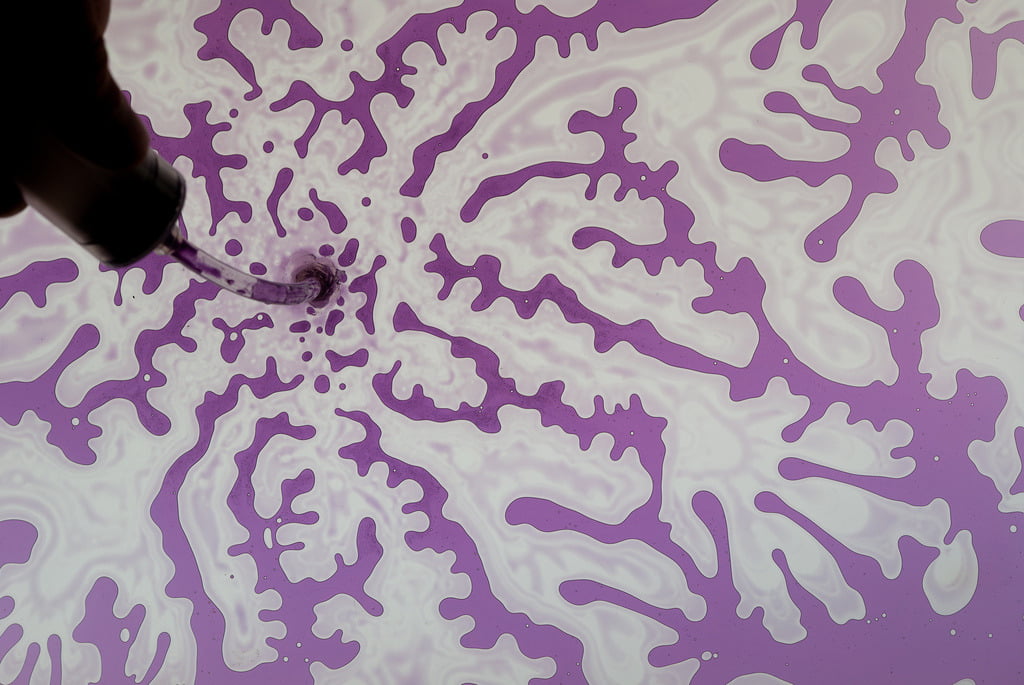
Place a viscous fluid in the gap between two plates of glass and you have created a Hele Shaw cell. If a less viscous fluid is then injected between the plates, a fascinating pattern of finger-like protrusions results. This is known as the Saffman-Taylor instability. Because of the relative simplicity of the set-up, it’s possible to create such experiments at home using common household fluids like glycerin, dish soap, dyed water, or laundry detergent. (Photo credits: Jessica Rosencranz, Jessica Todd, Laurel Swift et al, Andrea Fabri et al, Tanner Ladtkow et al, Mike Demmons et al, Trisha Harrison, Justin Cohee, and Erik Hansen)
Shear-Thickening Oobleck
Oobleck is a commonly utilized fluid in demonstrations of non-Newtonian behavior. Rather than being linearly viscous with respect to shear, oobleck is shear thickening, meaning that it becomes more viscous the more that it is sheared. This is what causes crazy formations when it’s vibrated, makes it useful as liquid armor, and enables people to run across pools full of it. Yet it flows readily when undisturbed. #
Toroidal Vortex
When instabilities exist in laminar flow, they do not always lead immediately to turbulence. In this video, a viscous fluid fills the space between two concentric cylinders. As the inner cylinder rotates, a linear velocity profile (as viewed from above) forms; this is known as Taylor-Couette flow. If any tiny perturbations are added to that linear profile–say there is a nick in the surface of one of the cylinders–the flow will develop an instability. In this type of flow, an exchange of stabilities will occur. Rather than transitioning to turbulence, the fluid develops a stable secondary flow–the toroidal vortex highlighted by the dye in the video. If the rotation rate is increased further other instabilities will develop.
High Hopes
This gorgeous high-speed video captures bubbles, droplets, wakes, cavitation, coalescence, jets, and lots of surface tension at 7000 fps. The authors unfortunately haven’t indicated whether this is air in water or something more viscous, but regardless there are some great phenomena on display here. # (via Gizmodo)
Reader Question: Froude vs. Reynolds
@spooferbarnabas asks: I was wondering what the difference is between Froude’s number and Reynold’s number? they seem very similar
Fluid dynamicists often use nondimensional numbers to characterize different flows because it’s possible to find similarity in their behaviors this way. The Reynolds number is the most common of these dimensionless numbers and is equal to (fluid density)*(mean fluid velocity)*(characteristic length)/(fluid dynamic viscosity). The Reynolds number is considered a ratio of total momentum (or inertial forces) to the molecular momentum (or viscous forces). A small Reynolds number indicates a flow dominated by viscosity; whereas a flow with a large Reynolds number is considered one where viscous forces have little effect.
The Froude number, in contrast, focuses on resistance to flow caused by gravitational effects, not molecular effects. It is defined as (mean fluid velocity)/(characteristic wave propagation velocity). Initially, it was developed to describe the resistance of a model floating in water when towed at a given speed. As the boat’s hull moves through the water, it creates a wave that travels forward (and backward in the form of the wake), carrying information about the boat–much like pressure waves travel before and behind a subsonic aircraft. The speed of the wave created by the boat depends on gravity (see shallow water waves). The closer the boat’s speed comes to the water wave’s speed, the greater the resistance the boat experiences. In this respect, the Froude number is actually analogous to the Mach number in compressible fluids.
I hope that helps explain some of the differences!
Thixotropic and Rheopectic Fluids
There’s more to non-Newtonian fluids than shear-thickening and shear-thinning. The viscosity of some fluids can also change with time under constant shear. A fluid that becomes progressively less viscous when shaken or agitated is called thixotropic. The opposite (and less common) behavior is a fluid that becomes more viscous under constant agitation; this is known as a rheopectic fluid. This video demonstrates both types of fluids using a rotating rod as the agitator. The rheopectic fluid actually appears to climb the rod–similar to the Weissenberg effect–while the thixotropic fluid moves away from the rod.
Ants as a Fluid
The collective behavior of ants can mirror the flow of a viscous fluid. It would be interesting to see if any such parallels carry over to the flocking of birds or schooling of fish. The latter two behaviors are thought to increase aero- and hydrodynamic efficiency for the group. #

Oil Chandeliers
What you see above is a composite of images of an oil droplet falling into alcohol from two different heights. The top row of images is from a height of 25 mm and the bottom from a height of 50 mm. The first droplet forms an expanding vortex ring which breaks down via the Rayleigh-Taylor instability due to its greater density than the surrounding alcohol. The second droplet impacts the alcohol with greater momentum and is initially deformed by viscous shear forces. Eventually it, too, breaks down by the Rayleigh-Taylor mechanism. This image is part of the 2010 Gallery of Fluid Motion. # (PDF)
