
A horizontal filament of viscous liquid hanging between two plates stretches under gravity. The photo above is a composite showing the stretching of a single thread over several time steps. The fluid forms a catenary, the same shape as a hanging chain or cable when supported only at its ends. This behavior is confined to viscous filaments of sufficient length and diameter. Short and thin filaments instead form a U-shape with a thin horizontal filament joined to two thicker vertical threads. This difference in shape occurs due to the drainage of the liquid along the filament’s length. If the viscous thread begins to fall before surface tension drains the fluid from the center toward the ends, then a catenary of essentially uniform diameter forms. If instead the liquid drains before falling, the non-uniform U-shape is observed. (Photo credit: M. Le Merrer et al.)
Search results for: “viscous”

Protruding Fingers
Instability is a common feature of fluid flows and can generate a near infinite set of patterns. The video above shows the Saffman-Taylor instability, an interface instability that occurs when a fluid of lower viscosity is injected into a higher viscosity fluid. In this case, the fluids inhabit a thin space between two glass plates. The less viscous fluid displaces the more viscous one in a series of branching finger-like shapes. If the situation were reversed, with a more viscous fluid injected into a less viscous one, the interface would be stable and expand radially without any pattern formation. (Video credit: William Jewell College)
The Kaye Effect
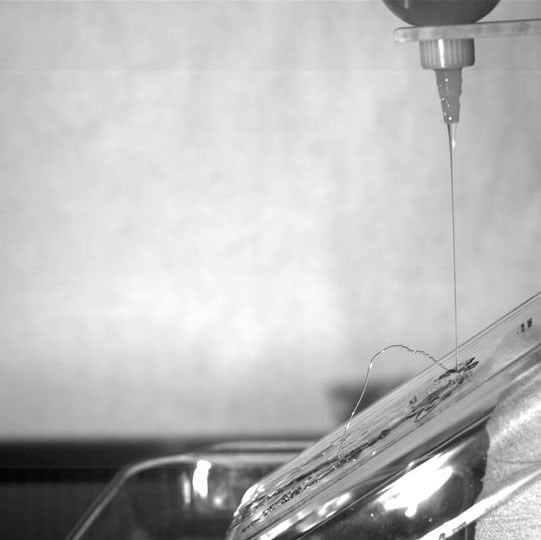
When a viscous fluid falls onto a surface, it will form a heap, like honey coiling. But for shear-thinning liquids like soap or shampoo something a little wild can happen as the heap grows. A dimple can form and, when the incoming jet of fluid hits that dimple, it slips against it and is ejected outward. If you wonder why you don’t see this every day in the shower, it’s because the outgoing jet usually hits the incoming jet, causing the whole system to collapse in less than 300 ms. By dropping the fluid on an inclined surface, one can keep the two jets from colliding, thereby creating a stable Kaye effect. (Photo credit: E. Eichelberger)

Dendritic Designs
Imagine a thin layer of viscous liquid sandwiched between two horizontal glass plates. Then pull those plates apart at a constant velocity. What you see in the image above is the shape the viscous fluid takes for different speeds, with velocity increasing from left to right and from top to bottom. For lower velocities, the fluid forms tree-like fingers as air comes in from the edges. At higher velocities, though, there’s a transition from the finger-like pattern to a cell-like one. The cells are actually caused by cavitation within the fluid. When the plates are pulled apart fast enough, the local low pressure in the fluid causes cavitation bubbles to form just before the force required to remove the plate reaches its peak. (Photo credit: S. Poivet et al.)

Stopping Jet Break-Up
When a stream of liquid falls, a surface tension effect called the Plateau-Rayleigh instability causes small variations in the jet’s radius to grow until the liquid breaks into droplets. For a kitchen faucet, this instability acts quickly, breaking the stream into drops within a few centimeters. But for more viscous fluids, like honey, jets can reach as many as ten meters in length before breaking up. New research shows that, while viscosity does not play a role in stretching and shaping the jet as it falls–that’s primarily gravity’s doing–it plays a key role in the way perturbations to the jet grow. Viscosity can delay or inhibit those small variations in the jet’s diameter, preventing their growth due to the Plateau-Rayleigh instability. In this respect, viscosity is a stabilizing influence on the flow. (Photo credit: Harsha K R; via Flow Visualization)

Lava in Action
We’ve touched on volcanoes and the fluid dynamics of lava a couple of times here at FYFD, but over at Wired volcanologist Erik Klemetti has some wonderful photos and videos he took while visiting an active lava flow in Hawaii along with great explanations of the flow shapes and processes. Above we see him using a rock hammer to remove a sample from an active flow. Klemetti describes the lava’s behavior as taffy-like – extremely viscous and stretchy but prone to break like a plastic. Be sure to check out his posts! (Photo credit: E. Klemetti; submitted by @FlexMonkey)
Spiraling Out of Coils
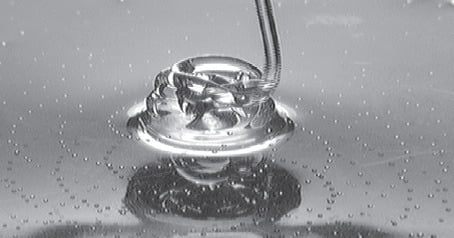
Anyone who has drizzled honey or another viscous fluid onto a surface is familiar with the rope-like coiling behavior of some liquids. But did you know that same instability can create spirals of bubbles like in this photo? Such behavior is only seen for a narrow range of parameters within the gravitational regime of liquid coiling. As the liquid falls, the center of coiling precesses along its own circle with a frequency much smaller than that of the coiling itself. This means that new coils do not fall exactly on top of old ones, trapping air bubbles between them. As the pile of coils collapses under gravity, the bubbles are carried outward, creating beautiful spiral patterns. (Photo credit: M. Habibi et al.)

A Colorful Rinse
In this image a jet of water (clear/white) is rinsing a solution of polyacrylamide (PAM; blue) off a silicon surface. In the center, a hydraulic jump marks the interface where fast-moving laminar flow changes to a slower turbulent one. At the same time, the water, which is less viscous than the PAM, creates viscous finger-like protrusions into the blue liquid as it rinses the surface clean. (Photo credit: T. Walker, T. Hsu, and G. Fuller)
Saffman-Taylor Demo
In this video, a thin film of viscous glycerin sits between two glass plates. As the plates are forced apart, air gets entrained from either side, causing finger-like instabilities to form between the two fluids. This is a result of the Saffman-Taylor mechanism. The final dendritic pattern depends on the fluid viscosities, surface tension, and any non-uniformities in the apparatus. (Video credit and submission by M. Goodman)
INK World v01
In this video, mixtures of inks (likely printer toners) and fluids move and swirl. Magnetic fields contort the ferrofluidic ink and make it dance, while less viscous fluids spread into their surroundings via finger-like protuberances. (Video credit and submission: Antoine Delach)