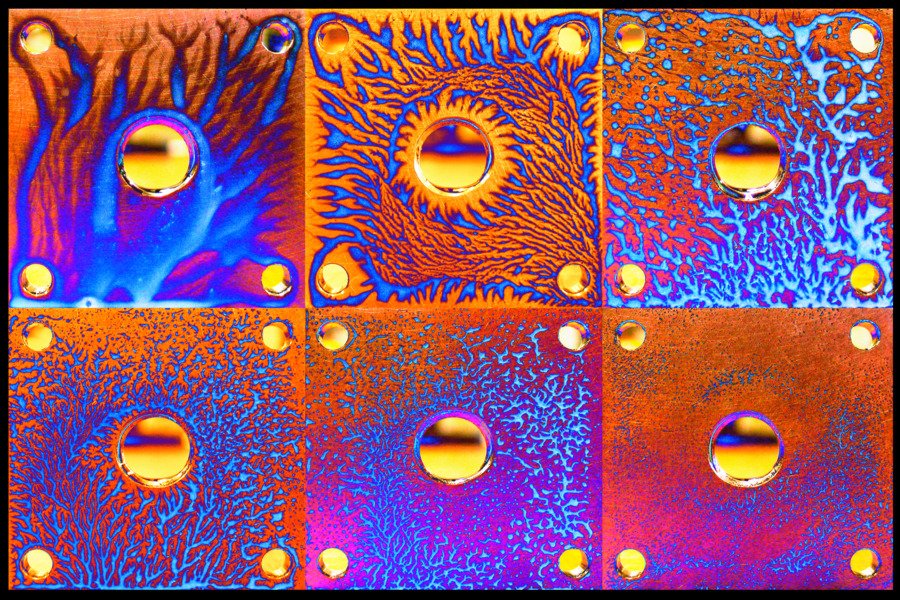
Fluid phenomena can show up in unexpected places. The collage above shows patterns formed when an aluminum block is lifted during wet sanding, a polishing technique. The dendritic fingers are formed from oil and the slurry of sanded particles being polished away. They are an example of the Saffman-Taylor instability, which forms when less viscous fluids (oil) protrude into a more viscous one (the slurry). Each image contains a different concentration of oil, resulting in very different fingering patterns. (Image credit: D. Lopez)
Search results for: “viscous”

Lava Flowing


Lava flows like these Hawaii’an ones are endlessly mesmerizing. This type of flow is gravity-driven; rather than being pushed by explosive pressure, the lava flows under its own weight and that of the lava upstream. In fact, fluid dynamicists refer to this kind of flow as a gravity current, a term also applied to avalanches, turbidity currents, and cold drafts that sneak under your door in the wintertime. How quickly these viscous flows spread depends on factors like the density and viscosity of the lava and on the volume of lava being released at the vent. As the lava cools, its viscosity increases rapidly, and an outer crust can solidify while molten lava continues to flow beneath. Be sure to check out the full video below for even more gorgeous views of lava. (Image/video credit: J. Tarsen, source; via J. Hertzberg)

Shark Tooth Instability
Imagine that you partially fill a horizontal cylinder with a viscous fluid, like corn syrup or honey. If that cylinder is still, the fluid will simply pool along the bottom. On the opposite extreme, if you spin it very fast, that cylinder will become coated in an even layer of fluid that rotates along with the cylinder thanks to centrifugal force. Between those two extremes in rotational velocity, some interesting fluid behaviors occur. Start spinning the cylinder and some of the pooled fluid will be pulled up the sides, eventually forming a thicker film with a straight front along the bottom of the cylinder. Spin faster and that straight front starts to break down, forming sharper cusp-like waves known as shark teeth. (Image credit: S. Morris et al., source; research credit: S. Thoroddsen and L. Mahadevan)

Rio 2016: Swimming
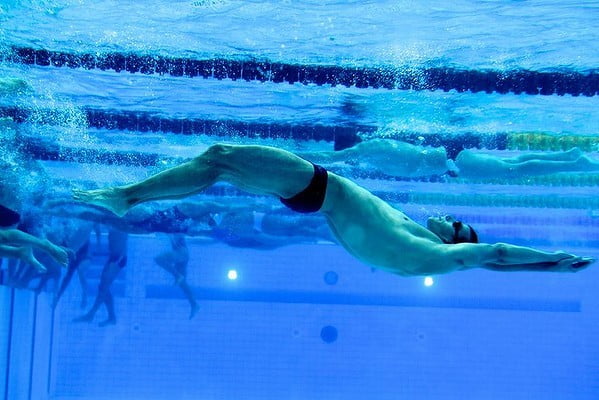 Strange as it seems, elite swimmers are faster when swimming underwater than they are at the surface. So much so, in fact, that they’re restricted to being underwater only 15 m after a dive or turn. To see just how stark a difference this makes, check out this crazy video. (I know, right?!)
To understand how this is possible, it helps to look at the three types of drag a swimmer experiences: pressure drag, skin friction, and wave drag. Pressure drag is probably the most familiar; it’s the drag that comes from the swimmer’s shape and how the fluid moves around it. Skin friction is the drag that comes from viscous friction between the swimmer and the water. The final type, wave drag, comes from the energy expended to create waves at the surface of the water. As you might expect, energy that goes into splashing is energy that isn’t going into propulsion.
When swimming at the surface, swimmers experience a lot of wave drag. At least one experiment showed that wave drag accounted for most of a surface swimmer’s drag. In contrast, at a depth of more than 0.5 m, a swimmer’s wave drag is virtually negligible. The submersion does come at the cost of higher skin friction (since more of the swimmer is in contact with the water), but there is also more opportunity for useful propulsion since both sides of a kick can move water (and not air.) Bonus read for those interested in more: Is the fish kick the fastest stroke yet? (Image credits: AP; B. Esposito)
Previously: what makes a pool fast?
Join us throughout the Rio Olympics for more fluid dynamics in sports. If you love FYFD, please help support the site!
Hagfish Escape Mechanisms

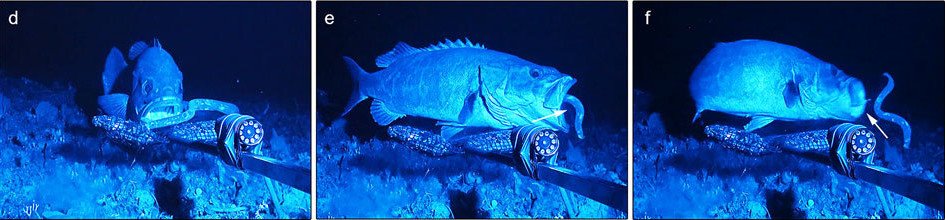
The hagfish is an eel-like creature that has not changed much in the past 300 million years in part because the hagfish is very good at escaping would-be predators. When attacked, the hagfish excretes mucins that combine with seawater to form slime. This gel-like viscoelastic fluid forms quickly and has some handy properties. For example, when stretched, the slime becomes extremely viscous. Many fish feed using a suction method, in which they thrust their jaws forward and enlarge their mouths to suck water and prey inside. This strong unidirectional flow stretches the slime, which thickens it and clogs the fish’s gills. Suddenly, the fish is much more concerned with being unable to breathe, allowing the hagfish to flee.
Being surrounded by all that slime could smother the hagfish, too, if it were not for another clever feature of the slime. When sheared, hagfish slime collapses, losing its viscosity. The hagfish actually ties itself in a knot to create this shear and slide the slime right off. (Image credit: V. Zintzen et al.; L. Böni et al., source)

Granular Plugs
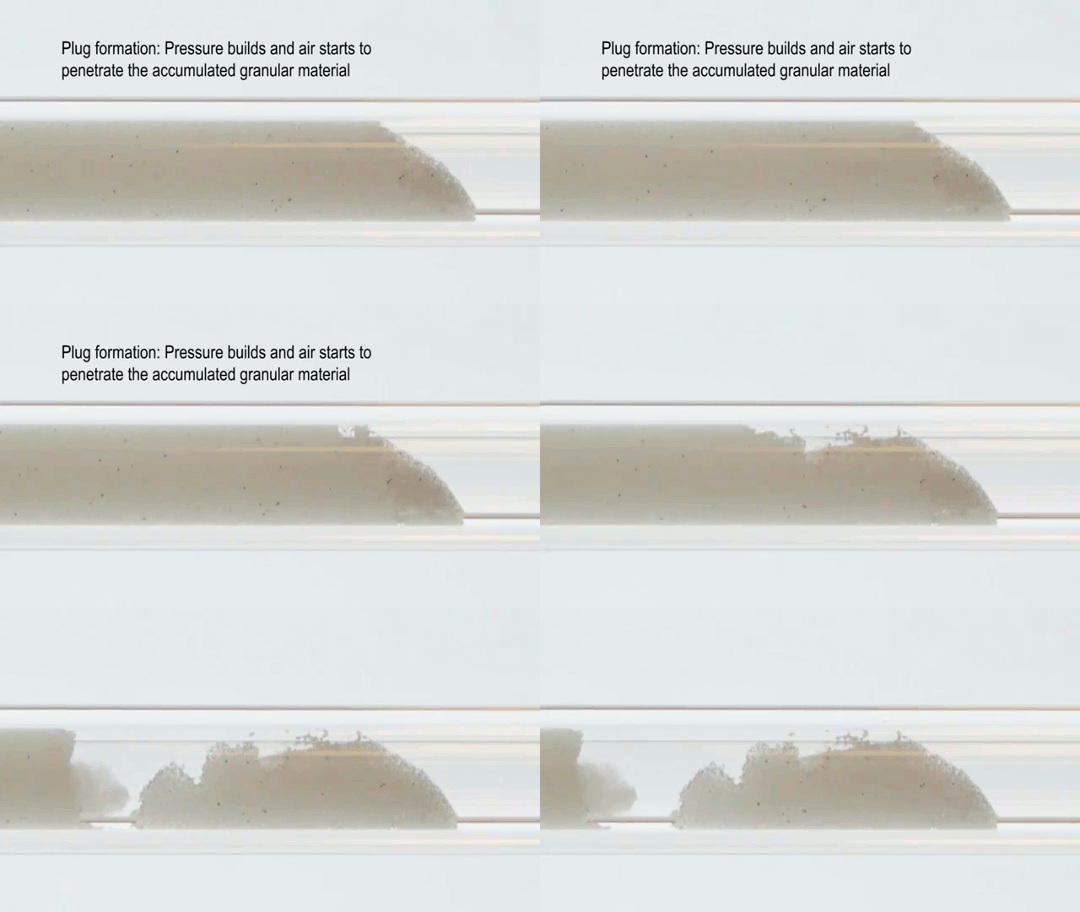
Imagine filling a narrow tube with a mixture of water and tiny glass beads. Then take a syringe and very slowly start drawing out the water. As the water gets sucked out of the tube, air will be pulled into the opposite end. The meniscus where the air and water meet sweeps up the glass beads like a liquid bulldozer. As the experiment continues, pressure builds up and air starts filtering through the beads, changing the viscous and frictional forces the system experiences. Eventually, the grains break off, leaving a chunk of glass beads – known as a plug – behind. Keep draining the tube and more plugs form. Check out the video below to see it in action! (Image/video credit: G. Dumazer et al., source; research paper; open synopsis; submitted by B. Sandnes)

Reader Question: Blood Jets
Reader shoebill-san asks:
are blood jets realistic? when someone gets shot in the movies?
This one’s a bit tough to boil down to a yes or a no, honestly. While piercing an artery can cause jetting (more on that below), movies tend to exaggerate the effect. And even among Hollywood movies, there’s a broad variation in how wounds are represented. I’m pretty sure no one thinks that blood actually behaves like it does in Monty Python or a Tarantino film!
That said, depending on the wound, there can be a jetting effect thanks to the pulsing of our hearts. Scientists have even worked to numerically simulate human blood flow after a wound. I’ve included a video example above. Be warned – some viewers may find it gross. That said, there’s nothing all that graphic on display.
As you can see, wounds to arteries have an apparent jetting motion thanks to our pulses. Bleeding from veins tends to look more uniform because the pressure pulse caused by each heartbeat has been smoothed out by the viscous effects of all the blood vessels in between. (Video credit: K. Chong et al.)

Daily Fluids, Part 3
A lot of the fluid dynamics in our daily lives centers around the preparation and consumption of food. (And in its digestion afterward, but that’s another story!) Here are a few examples of fluid dynamics you might not have realized you’re an expert on:
Low Reynolds Number Flows
This is a fancy way of discussing the motion of syrup, honey, and other thick and viscous fluids we interact with in our lives. These flows are typically slow moving and exhibit some neat properties like coiling or being possible to unstir.
Immiscible Fluids
Oil and water don’t mix, a fact anyone familiar with salad dressings or marinades is well aware of. The way around this is to shake them up! This disperses droplets of the oil within the water (or vinegar or whatever) to create an emulsion. While not truly mixed, it does make for more pleasant eating.
Multiphase Flows
Multiphase flows are ones containing both liquid and gaseous states. Boiling is an example we often see in our daily lives, though carbonated beverages, water sprayers, and sneezes are other common ones.
Leidenfrost Effect
The Leidenfrost effect occurs when liquid is introduced to a surface that is much, much hotter than its boiling point. Part of the liquid instantly vaporizes, leaving droplets to skitter around on a thin vapor layer. This is most often seen around the stove and in skillets. (And, yes, it does qualify as a multiphase flow!)Tune in all week for more examples of fluid dynamics in daily life. (Image credit: S. Reckinger et al., source)
P.S. – I’m at VidCon (@vidconblr) this year! If you are, too, come say hi and get an FYFD sticker 😀

Swimming at Microscale
Tiny organisms live in a world dominated by viscosity. There’s no coasting or gliding. If a microorganism stops swimming, friction will bring it to a halt in less than the space of a hydrogen atom! To make matters worse, simply flapping an appendage forward and backward will get them nowhere. As we’ve seen before, these highly viscous laminar flows are reversible, meaning that a backward power stroke is simply undone by a mirrored forward recovery stroke. Instead, microorganisms like the paramecium swimming above are covered in tiny hairlike cilia which beat asymmetrically. They extend to their full length during the power stroke, but they stay bent during the forward recovery stroke. That asymmetry guarantees that they move more fluid backward than forward, thereby letting the paramecium make progress. (Image credit: C. Baroud, source)

Why Does This Kite Look So Real?
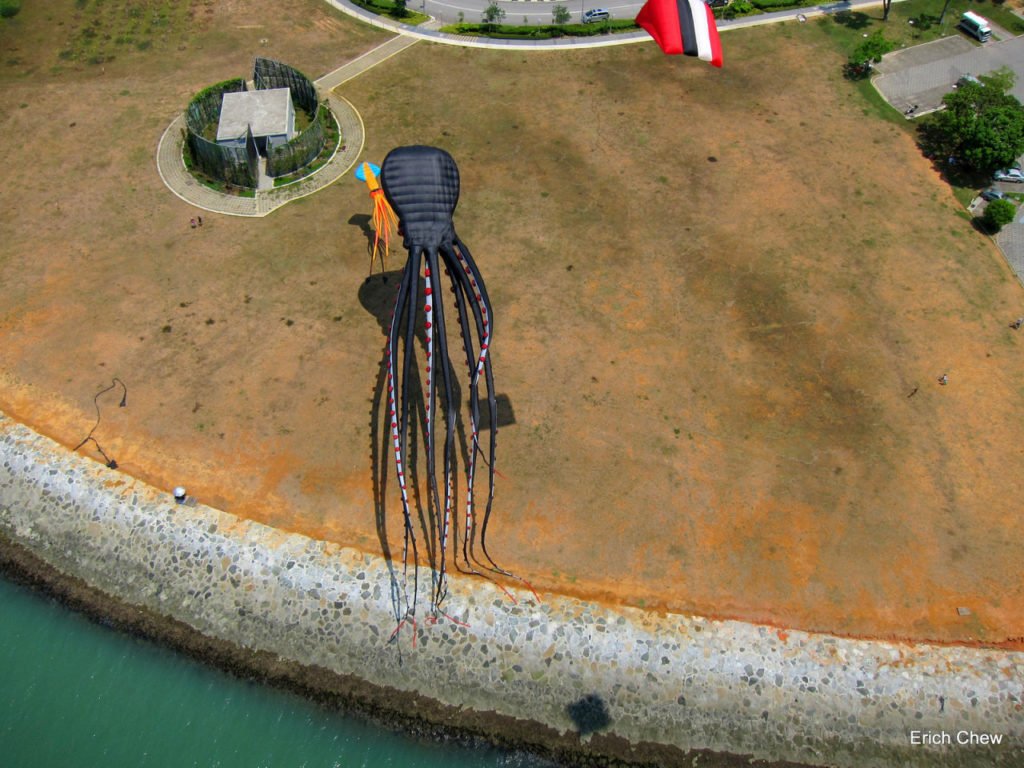


A recent viral video features mesmerizing footage of a giant octopus kite flown at a kite festival in Singapore earlier this month. The kite’s arms twist and wave lazily in the breeze. Watching the video, I was struck by how realistic the kite’s motion looks. It really looks like an octopus is just cruising there in mid-air. And that resemblance might not be accidental.
In fluid dynamics, scientists often use a concept called dynamic similitude to test the physics of a scale model instead of the full-size original. The simplest version of this uses the Reynolds number to compare the model and the original. The Reynolds number is a dimensionless number that depends on the object’s size, the flow’s speed, and the density and viscosity of the fluid. If you match the scale model’s Reynolds number to the original’s Reynolds number, then the physics will be the same – even if you changed the fluid or the size of the object.
Returning to our kite, one thing the footage doesn’t entirely convey is just how enormous this kite really is. The Straits Times reports the kite is about the length of five buses and requires six people to get aloft. But the kite’s size helps compensate for the fact that it’s flying in air instead of swimming through viscous water like a real octopus. Although I’m left estimating the kite’s size and the wind’s speed, my quick calculations put the Reynolds numbers for the kite and the octopus on the order of 10,000. So, strange as it seems, this giant kite really is acting like a swimming octopus!
