Search results for: “viscous”

  • Hagfish Crash

    Hagfish Crash

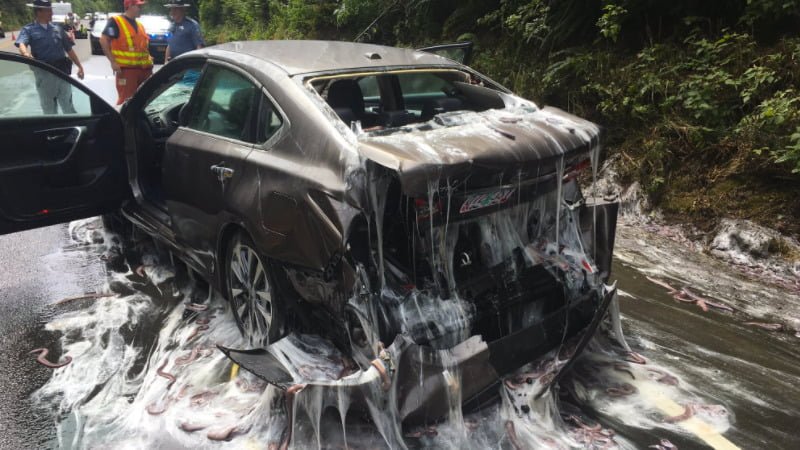
    Last week a flatbed truck in Oregon overturned and released 3400 kilograms of live hagfish on the highway and nearby cars. Hagfish are eel-like fish known for their impressive slime production. When threatened, the hagfish produce mucins that, when combined with water, form an extremely viscoelastic mucus. As it’s stretched, the mucus thickens and becomes more viscous. Normally, hagfish use this property to clog the gills of fish trying to eat them. The slime is weak, however, to shearing; hagfish actually tie themselves in knots to slide the slime off when there’s too much of it. The Oregon Department of Transportation managed to clear the road of mucus (and hagfish) using bulldozers and fire hoses, but it did take them several hours. For more photos and videos from the incident, check out Gizmodo and the Oregon State Police Twitter feed. (Image credit: Oregon State Police; via Gizmodo)

  • Stabilizing Films

    Stabilizing Films

    Liquids don’t typically survive very long as thin films. If you try to make one from water, gravity drains it away immediately. (Not so in space.) To make a liquid film stick around, we add surfactants like soap. These extra molecules congregate at the surface of the film and provide a stabilizing force to oppose gravity’s drainage. Exactly what that stabilizing force is depends on the surfactant.

    Surfactants that are insoluble are often quite viscous. These molecules distribute themselves across the interface and then they stay. They resist both gravity or even just moving thanks to their high viscosity. That produces a soap film pattern like the one on the right – symmetric and slow to change.

    Other surfactants may be soluble in the film and have no appreciable viscosity themselves. These surfactants constantly move and shift on the interface as surface tension variations occur. When weak spots form, the surfactant molecules shift, via the Marangoni effect, to stabilize the film. This creates a film pattern like the familiar one on the right, with an ever-shifting palette of colors. (Image and research credit: S. Bhamla et al., source; submission by S. Bhamla)

  • Growing Droplets on a Trampoline

    Growing Droplets on a Trampoline

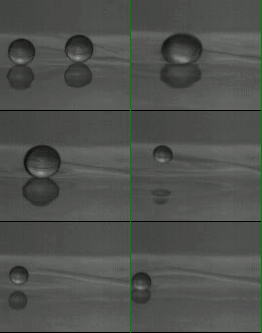
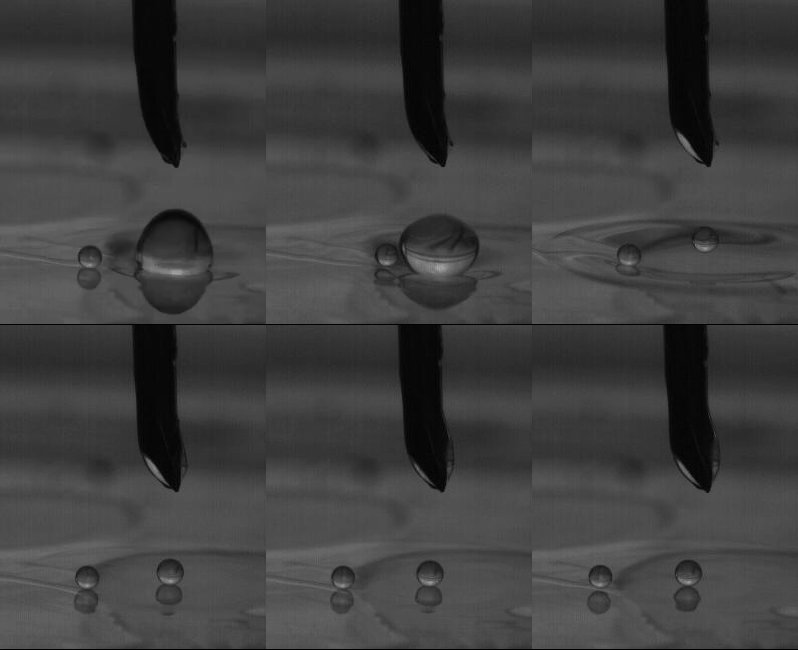
    Droplets on a liquid surface will typically coalesce, thanks to gravity and the low viscosity of the air layer between them and the pool. In certain cases, droplets will partially coalesce, producing smaller and smaller droplets until they finally coalesce completely. Vibrating the liquid surface can help prevent this coalescence but only when droplets are small.

    In fact, if the pool is more viscous than the droplets, bouncing can be used to produce droplets of a desired size, as shown above. Because the droplets are less viscous, they deform more than the pool does – behaving somewhat like a bouncy ball hitting a rigid wall. In this system, large droplets are unstable and will undergo partial coalescence until they are small enough to bounce stably. The size of stable drops is determined by the frequency and acceleration of the bouncing bath; by tuning these parameters, researchers can select what size droplets they want to end up with. (Research credit: T. Gilet et al.; images and submission by N. Vandewalle)

  • Swimming with Corkscrews

    Swimming with Corkscrews

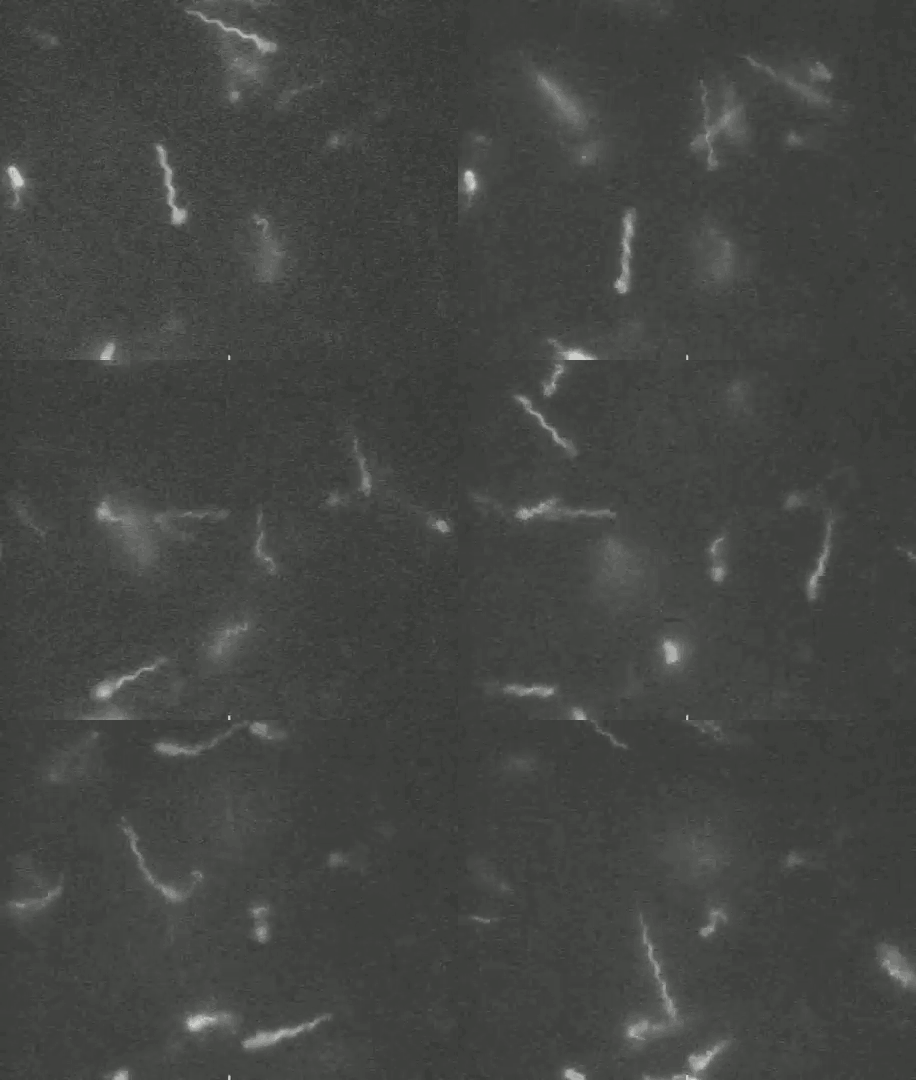
    E. coli, like many bacteria, swim using corkscrew-like appendages called flagella. Because the bacteria are extremely tiny – their flagella may be less than ten microns long – their swimming is overwhelmingly dependent on viscosity. (Inertial effects are 100 to 10,000 times smaller than viscous effects for swimming E. coli.) Rotating their helical flagella generates viscous drag along the surface of the corkscrew. Because the flagella is asymmetric when you add all of those drag components together, the net force is thrust that moves the bacterium forward. Watch carefully in the animation above and you’ll see that E. coli have multiple flagella and will swing one out to the side during maneuvers. (Image credit: L. Turner et al., source; reproduced in a review by E. Lauga, pdf)

  • Geological Flowers

    Geological Flowers

    These strange flower-like formations appear in a former limestone quarry in France. The black that you see is bitumen, or asphalt. These dendritic structures appear in spots where the rock has fractured. Originally, two rock faces met here, with a thin layer of bitumen glued between them. As one face pulled away, air began to seep into the space between, slowly injecting itself into the more viscous bitumen. Just as we observe in the laboratory, the air and bitumen formed viscous fingers, creating a classic pattern known as the Saffman-Taylor instability. It’s so cool to see an example of this in nature! You can see more photos of the formations here. (Image credit: P. Thomas)

  • Featured Video Play Icon

    “Kingdom of Colours”

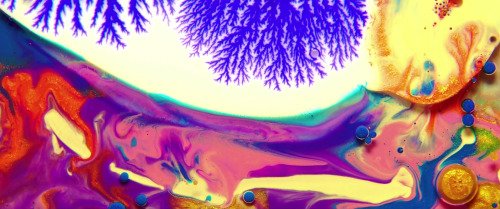
    Oil, paint, and soap combine to create a polychrome landscape in Thomas Blanchard’s “Kingdom of Colours” short film. Colorful droplets of paint coated in oil form anti-bubbles that skim along the liquid surface until they burst, dispersing new colors. One of my favorite touches in this video, though, are the branching fingers of color that appear repeatedly (most often in blue-violet). This is an example of a phenomenon known as the Saffman-Taylor instability. It’s a hallmark of a low viscosity fluid pushing into a higher viscosity one–like air into honey. (Image/video credit: T. Blanchard; via Flow Vis)

  • Ink Drops Spreading

    Ink Drops Spreading

    Ink drops atop a layer of glycerol spread in a beautiful fan of blue and white. The ink’s motion is the result of two processes: molecular diffusion and the Marangoni effect. Molecular diffusion is the mixing that occurs due to the random background motion of molecules. Since glycerol is a very viscous liquid, the ink is quite slow to spread in this manner.

    The second factor, the Marangoni effect, is driven by differences in surface tension. The ink and glycerol have different surface tensions, and the exact values depend on concentration. Notice how the ink drops spread fastest from areas where the ink is densely concentrated. This tells us that the ink’s surface tension is lower than the glycerol’s. As a result, the glycerol’s higher surface tension tends to pull ink toward it. As the ink spreads and its concentration decreases relative to the glycerol, the ink-glycerol mixture’s surface tension increases. Since the difference between the surface tension of the mixture and the pure glycerol is not as large, the Marangoni force is reduced and the spreading slows. (Image credit: C. Kalelkar, source)

  • Fingering Under Elastic

    Fingering Under Elastic

    Take a couple panes of glass and stick a viscous fluid in between them; you’ve now constructed what fluid dynamicists call a Hele-Shaw cell. If you inject a low-viscosity fluid, like air, into the cell, you’ll get a beautiful finger-like pattern like the one shown on the left. If you change one of the walls to an elastic sheet, though, things get a bit different. The flexibility of the wall allows the upper surface to inflate as air gets pushed in. This can suppress the usual viscous fingers, as seen in the center animation. However, if you push the air in quickly, as in the right animation, the sudden inflation can wrinkle the elastic sheet. In this case, the wrinkles are the dominant influence, causing the the fluid to finger – but in an entirely different way than before! (Image credit: D. Pihler-Puzovic et al., sources 1, 2, 3; see also)

  • Featured Video Play Icon

    Non-Newtonian Splashes

    What happens when a stream of liquid falls through a screen? As the above video shows, water creates a beautiful flower-like burst of fluid when it hits a screen. Adding a little polymer to the water makes it non-Newtonian and more viscous. When hitting the screen, this slows it down but doesn’t prevent the fluid from flowing.

    Add enough polymer, though, and the fluid becomes what’s known as a yield-stress fluid. These fluids behave much like a solid–they don’t flow–until you apply a certain amount of stress. Then they’ll flow. If you’ve ever tried to get ketchup out of a glass bottle, then you’re familiar with how these yield-stress fluids act. When dropped onto a screen, the yield-stress fluid just forms a pile–unless the impact speed is high enough to create the necessary force to get the fluid to flow! (Video credit: B. Blackwell et al.)

  • Fluid Fingers

    Fluid Fingers

    Fluid phenomena can show up in unexpected places. The collage above shows patterns formed when an aluminum block is lifted during wet sanding, a polishing technique. The dendritic fingers are formed from oil and the slurry of sanded particles being polished away. They are an example of the Saffman-Taylor instability, which forms when less viscous fluids (oil) protrude into a more viscous one (the slurry). Each image contains a different concentration of oil, resulting in very different fingering patterns. (Image credit: D. Lopez)