During a supernova, shock waves moving outward push denser material into less dense plasma and gas. This causes what is known as a Richtmyer–Meshkovinstability, where the interface between the two fluids first becomes wavy and then develops finger-like intrusions. Those too break down, as seen in the simulation above, causing large-scale mixing between the different fluids.
Here on Earth this instability shows up in the process of inertial confinement fusion. In that case, the outer shell material is denser than the fuel core and the instability is triggered during the implosion process. As the fusion material is suddenly compressed, waviness and mixing occurs along the interface between the shell and the fuel. That’s undesirable because it reduces the efficiency of the fusion reaction. (Image credit: E. Evangelista et al.)
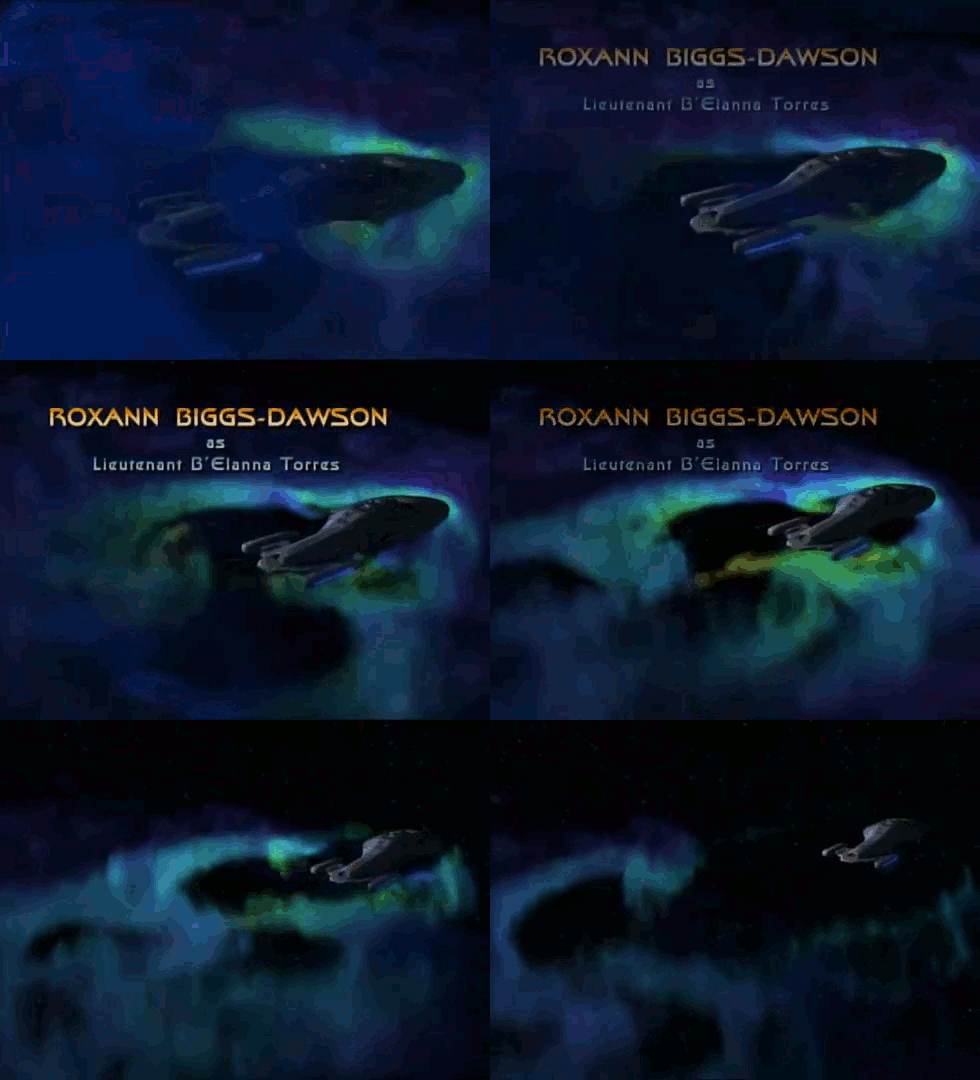
Today’s post is largely brought to you by the fact that I have been sick the past four days and my fiance and I have been bingeing on Star Trek Voyager. At some point, we began wondering about the sequence from 0:30-0:49 in which Voyager flies through a nebula and leaves a wake of von Karman vortices. Would a starship really leave that kind of wake in a nebula?
My first question was whether the nebula could be treated as a continuous fluid instead of a collection of particles. This is part of the continuum assumption that allows physicists to treat fluid properties like density, temperature, and velocity as well-defined quantities at all points. The continuum assumption is acceptable in flows where the Knudsen number is small. The Knudsen number is the ratio of the mean free path length to a characteristic flow length, in this case, Voyager’s size. The mean free path length is the average distance a particle travels before colliding with another particle. Nebulae are much less dense than our atmosphere, so the mean free path length is larger (~ 2 cm by my calculation) but still much smaller than Voyager’s length of 344 m. So it is reasonable to treat the nebula as a fluid.
As long as the nebula is acting like a fluid, it’s not unreasonable to see alternating vortices shed from Voyager. But are the vortices we see realistic relative to Voyager’s size and speed? Physicists use the dimensionless Strouhal number to describe oscillatory flows and vortex shedding. It’s a ratio of the vortex shedding frequency times the characteristic length to the flow’s velocity. We already know Voyager’s size, so we just need an estimate of its velocity and the number of vortices shed per second. I visually estimated these as 500 m/s and 2.5 vortices/second, respectively. That gives a Strouhal number of 0.28, very close to the value of 0.2 typically measured in the wake of a cylinder, the classical case for a von Karman vortex street.
So far Voyager’s wake is looking quite reasonable indeed. But what about its speed relative to the nebula’s speed of sound? If Voyager is moving faster than the local speed of sound, we might still see vortex shedding in the wake, but there would also be a bow shock off the ship’s leading edge. To answer this question, we need to know Voyager’s Mach number, its speed relative to the local speed of sound. After some digging through papers on nebulae, I found an equation to estimate speed of sound in a nebula (Eq 9 of Jin and Sui 2010) using the specific gas constant and temperature. Because nebulae are primarily composed of hydrogen, I approximated the nebula’s gas constant with hydrogen’s value and chose a representative temperature of 500 K (also based on Jin and Sui 2010). This gave a local speed of sound of 940 m/s, and set Voyager’s Mach number at 0.53, inside the subsonic range and well away from any shock wave formation.
Of course, these are all rough estimates and back-of-the-envelope fluid dynamics calculations, but my end conclusion is that Voyager’s vortex shedding wake through the nebula is realistic after all! (Video credit: Paramount; topic also requested by heuste11)
Happy 50th anniversary, Star Trek! Some of my earliest memories of TV are of watching TNG with my parents. Star Trek taught me that curiosity and scientific inquiry were vital and valuable, and that anyone could grow up to be a scientist, engineer, and leader. Thank you for such an inspiring and hopeful vision for humanity’s future!
And, seriously, those von Karman vortices are awesome.
In some countries, there are still people using dynamite to catch fish. This practice is incredibly destructive, not just to adult fish but to the entire marine ecosystem. A blast wave traveling through air loses some its energy to the compression of the gas. Water, on the other hand, is incompressible, so the blast wave’s energy just keeps going, expanding its destructive radius. Many fish contain swim bladders, gas-filled organs the fish use to regulate their depth. When a shock wave passes through the fish, the gas in the swim bladder will expand and contract violently, much like the balloons shown underwater in the animation below. This typically ruptures the swim bladder and surrounding tissues.
Fish without swim bladders will often hemorrhage after being struck by a blast wave. The sudden changes in pressure create bubbles in the dissolved gases collected in their gills. Those bubbles tear apart the fish’s blood vessels.
Blasting is effective but entirely indiscriminate. It kills adults and juveniles of all species, not just the ones a fisherman can sell. Simultaneously, it destroys the slow-growing coral reefs that are key habitats for these populations. It’s an incredibly short-sighted practice that guarantees there will be no fish to catch in years to come. (Video credit: National Geographic; image credit: M. Rober, source; research credit: K. Dunlap, pdf)
Here the U.S. Army Corps of Engineers release 13,000 cubic feet per second (~370 cubic meters per second) of water at a dam in Oklahoma. That’s the equivalent of nine-and-a-half shipping containers a second! Releasing that much water at once has created an enormous hydraulic jump, seen on the right side of the animation. Hydraulic jumps are kind of like the shock wave of open channel flow. On the left side of the image, water is moving smoothly and swiftly down the sluiceway. At the center, the incoming water encounters the large, slow-moving mass of water already in the lake. There’s no way for the incoming water to sustain its kinetic energy while discharging into the lake. Instead a hydraulic jump forms, converting the incoming flow’s kinetic energy into potential energy, as seen in the sudden height increase. Some of the energy is also converted to turbulence and dissipated as heat. (Image credit: U.S. Army Corps of Engineers/AP, source; via Gizmodo)
Atmospheric re-entry subjects vehicles to extreme conditions. At high Mach numbers, the leading shock wave compresses the air so strongly that it reaches temperatures hotter than the surface of the sun. At these temperatures, oxygen and nitrogen molecules in the air dissociate, bathing a vehicle in a plasma of ionized gas molecules. Often these atoms chemically react with the surface materials of a vehicle causing ablation that removes mass from the vehicle while helping protect the vehicle substructure from re-entry heating. Tests in specialized ground facilities like arc-jet plasma tunnels are necessary to develop thermal protection systems capable of shielding a vehicle during hypersonic flight. (Image credit: D. Ponseggi/NASA)
Pre-dawn launches provide some of the most dramatic rocket footage. This video is from an October 2nd Atlas V launch, and the really fun stuff starts at about 0:34. As the rocket climbs to higher altitudes, the atmospheric pressure around it decreases. As a result of this low pressure, the rocket’s exhaust gases balloon outward in a giant plume many times larger than the rocket. This happens in every launch, but it’s visible here because the rocket is at such a high altitude that its exhaust is being lit by sunlight while the observers on the ground are still in the dark. The ice crystals in the exhaust–much of the rocket’s exhaust is water vapor–reflect sunlight down to the earth. Around 0:47, a cascade of shock waves ripples through the plume just before the first-stage’s main engine cuts off. Once the engine stops firing, there’s no more exhaust and the plume ends. (Video credit: Tampa Bay Fox 13 News; submitted by Kyle C)
Vapor cones typically appear around aircraft flying in the transonic regime–near, but still below, the speed of sound. Air moving over the vehicle accelerates and decelerates as it moves around different parts of the plane; if it didn’t, the plane couldn’t generate lift and wouldn’t fly. When the local flow accelerates past the speed of sound, the accompanying drop in pressure and temperature can be enough to for conditions to fall below the dew point, causing the condensation we see. At the back of the airplane, a shock wave decelerates the airflow back to subsonic speeds and raises local conditions back above the dew point, thereby truncating the cone. (Image credit: C. Caine)
As dangerous as explosions are in air, they are even more destructive in water. Because air is a compressible fluid, some part of an explosion’s energy is directed into air compression. Water, on the other hand, is incompressible, which makes it an excellent conductor of shock waves. In the video above we see some simple underwater explosions using water bottles filled with dry ice or liquid nitrogen. The explosions pulsate after detonation due to the interplay between the expanding gases and the surrounding water. When the gases expand too quickly, the water pressure is able to compress the gases back down. When the water pushes too far, the gases re-expand and the cycle repeats until the explosion’s energy is expended. This pulsating change in pressure is part of what makes underwater explosions so dangerous, especially to humans. Note in the video how the balloons ripple and distort due to the changing pressure. Those same changes in pressure can cause major internal damage to people. (Video credit: The Backyard Scientist; submitted by logicalamaze)
Sound and acoustics often intersect with fluid dynamics. Most of the sounds we experience are pressure waves traveling through air. In this video, Joe of It’s Okay To Be Smart takes a closer look at sound: what it is; how we measure it; and just how loud a sound can get. For air at sea level, the loudest possible sound is 194 dB. Add any more energy and it distorts the pressure wave from what we recognize as sound into what’s known as a shock wave. (Video credit: It’s Okay To Be Smart/PBS Digital Studios)
I often receive questions about how fluids react to extremely hard and fast impacts. Some people wonder if there’s a regime where a fluid like water will react like a solid. In reality, nature works the opposite way. Striking a solid hard enough and fast enough makes it behave like a fluid. The video above shows a simulated impact of a 500-km asteroid in the Pacific Ocean. (Be sure to watch with captions on.) The impact rips 10 km off the crust of the Earth and sends a hypersonicshock wave of destruction around the entire Earth. There’s a strong resemblance in the asteroid impact to droplet impacts and splashes. Much of this has to do with the energy of impact. The asteroid’s kinetic (and, indeed, potential) energy prior to impact is enormous, and conservation of energy means that energy has to go somewhere. It’s that energy that vaporizes the oceans and fluidizes part of the Earth’s surface. That kinetic energy rips the orderly structure of solids apart and turns it effectively into a granular fluid. (Video credit: Discovery Channel; via J. Hertzberg)