Schlieren photography offers a glimpse into flows that are usually invisible to the human eye. With a relatively simple set-up–a light source, collimating mirror(s), and a razor blade–it becomes possible to see differences in density. The technique lets one visualize temperature-driven flows like the buoyant convection from a flame or other heat source, and it can also be used to visualize shock waves and sound. The video above has several neat schlieren demos, including some non-air examples using hydrogen (lighter than air) and sulfur hexafluoride (denser than air), both of which are transparent to the naked eye. (Video credit: Harvard University, via Jennifer Ouellette)
Search results for: “shock wave”
Cavitation
[original media no longer available]
Cavitation–the formation and collapse of vapor-filled cavities within a liquid–occurs in a variety of natural and manmade applications. It can shatter bottles, wreak havoc with boat impellers, is used as a hunting mechanism by several shrimp species, and can even generate light and sound. It is the collapse of the cavitation bubble that can be so damaging, and this video shows how. In the experiment, researchers generate a cavitation bubble near the free surface–or, in other words, near the air-water interface. Pressure in the bubble is much lower than the pressure of the surrounding liquid, so the bubble collapses after the momentum from its initial generation is spent. Interaction with the surface generates a jet that projects downward and pierces the cavitation bubble as it collapses. As seen from 0:54 onward, the bubble’s collapse generates a shock wave that propagates outward from the bubble site. It’s this shock wave that so effectively damages materials and stuns underwater prey. (Video credit: O. Supponen et al.)

Sound Interactions


Sound waves often interact with many objects before we hear them. Understanding and controlling those interactions is a major part of acoustic engineering. The animations above show shock waves–sound–from a trumpet interacting with different objects. The sound is made visible using the schlieren optical technique, allowing us to observe the reflection, absorption, and transmission of sound as it hits different surfaces. Fiberboard, for example, is highly reflective, redirecting the sound waves along a new path without a lot of damping. In contrast, the metal grid is only weakly reflective and a small portion of the incoming sound wave is transmitted through the grid. To see more examples, check out the full video, and, if you want to learn more about acoustics, check out Listen To This Noise. (Image credits: C. Echeverria et al., source video)

The Hidden Complexities of the Simple Match
Striking a match and blowing it out seems rather simple to the naked eye. But with high-speed video and schlieren photography, the act takes on new complexity. Schlieren photography is an optical technique that is incredibly sensitive to changes in density, which makes it a prime choice for visualizing flows with temperatures variations or shock waves. Here it shows the hot gases generated as the match is lit. Once the match ignites, the flow calms somewhat into a gently rising plume of exhaust and hot air. When someone enters the frame to blow out the match, the frame rate increases to capture what happens next. The flow field around the match becomes very complex as the air and flame interact. The range of length scales in the flow increases, from scales of several centimeters down to those less than a millimeter. This complexity and range of sizes is a hallmark of turbulence. (Video credit: V. Miller et al.)
“Courants et Couleurs”
Although flow visualization is a scientific technique, there is very much an art to it. Flow structures are, by their nature, ephemeral. To capture them, one must design an experiment that introduces dye into regions of interest without altering the flow significantly and without either ignoring or obscuring important physics. One of the great masters of this scientific art was Henri Werlé, whose extensive flow visualization work at France’s national aerospace lab is documented in the short film above. The film includes examples of simple geometries, full aircraft models, subsonic flow, shock waves, and more. eFluids has a whole gallery of Werlé images, too. Take a few minutes to enjoy the mesmerizing beauty of these experiments and appreciate the talents of those who made them possible. If you have questions about specific clips, feel free to ask! (Video credit: H. Werlé/ONERA; via J. Hertzberg)
Shooting Droplets with Lasers
Last week we saw what happens when a solid projectile hits a water droplet; today’s video shows the impact of a laser pulse on a droplet. Several things happen here, but at very different speeds. When the laser impacts, it vaporizes part of the droplet within nanoseconds. A shock wave spreads from the point of impact and a cloud of mist sprays out. This also generates pressure on the impact face of the droplet, but it takes milliseconds–millions of nanoseconds–for the droplet to start moving and deforming. The subsequent explosion of the drop depends both on the laser energy and focus, which determine the size of the impulse imparted to the droplet. The motivation for the work is extreme ultraviolet lithography–a technique used for manufacturing next-generation semiconductor integrated circuits–which uses lasers to vaporize microscopic droplets during the manufacturing process. (Video credit: A. Klein et al.)
The Chelyabinsk Meteor
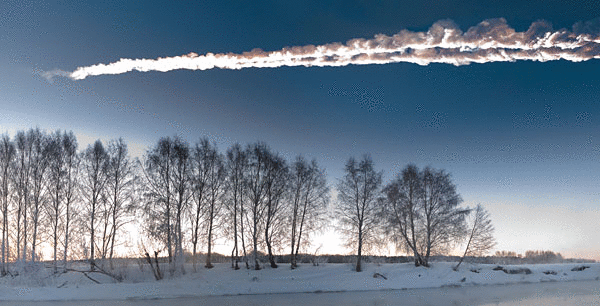
In February 2013 a meteor streaked across the Russian sky and burst in midair near Chelyabinsk. A recent Physics Today article summarizes what scientists have pieced together about the meteor, from its origins to its demise. The whole article is well worth reading. Here’s a peek:
The Chelyabinsk asteroid first felt the presence of Earth’s atmosphere when it was thousands of kilometers above the Pacific Ocean. For the next dozen minutes, the 10 000-ton rock fell swiftly, silently, and unseen, passing at a shallow angle through the rarefied exosphere where the molecular mean free path is much greater than the 20-m diameter of the rock. Collisions with molecules did nothing to slow the gravitational acceleration as it descended over China and Kazakhstan. When it crossed over the border into Russia at 3:20:20 UT and was 100 km above the ground, 99.99997% of the atmosphere was still beneath it.
Because the asteroid was moving much faster than air molecules could get out of its way, the molecules began to pile up into a compressed layer of high-temperature plasma pushing a shock wave forward. Atmospheric density increases exponentially with depth, so as the asteroid plunged, the plasma layer thickened and its optical opacity rapidly increased. About one second later, at 95 km above the surface, it became bright enough to be seen from the ground. That was the first warning that something big was about to happen. #
How often are scientific articles that gripping?! Kring and Boslough provide some excellent descriptions of the aerodynamics of the meteor and its airburst. Be sure to check it out. (Photo credit: M. Ahmetvaleev; paper credit: D. Kring and M. Boslough; via io9)

Transonic Flow
In the transonic speed regime the overall speed of an airplane is less than Mach 1 but some parts of the flow around the aircraft break the speed of sound. The photo above shows a schlieren photograph of flow over an airfoil at transonic speeds. The nearly vertical lines are shock waves on the upper and lower surfaces of the airfoil. Although the freestream speed in the tunnel is less than Mach 1 upstream of the airfoil, air accelerates over the curved surface of airfoil and locally exceeds the speed of sound. When that supersonic flow cannot be sustained, a shock wave occurs; flow to the right of the shock wave is once again subsonic. It’s also worth noting the bright white turbulent flow along the upper surface of the airfoil after the shock. This is the boundary layer, which can often separate from the wing in transonic flows, causing a marked increase in drag and decrease in lift. Most commercial airliners operate at transonic Mach numbers and their geometry is specifically designed to mitigate some of the challenges of this speed regime. (Image credit: NASA; via D. Baals and W. Corliss)
Mach Diamonds
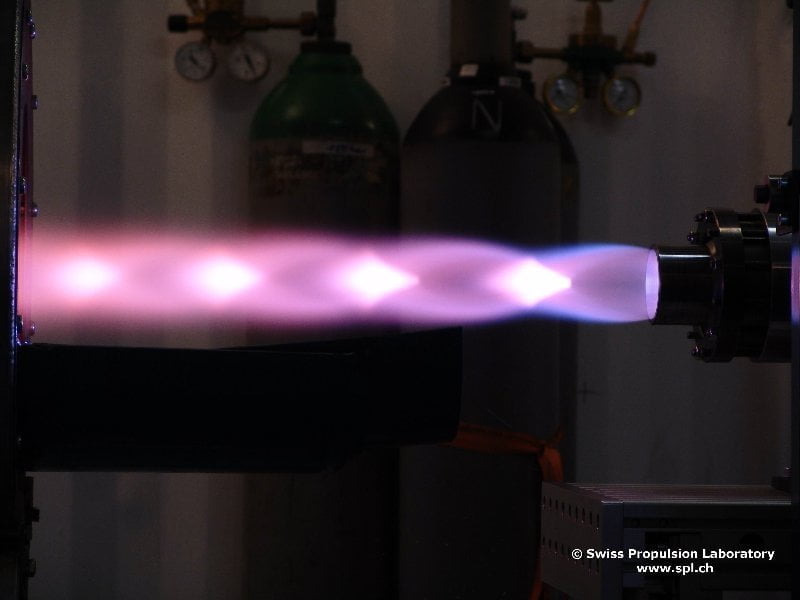
Rocket engines often feature a distinctive pattern of diamonds in their exhaust. These shock diamonds, also known as Mach diamonds, are formed as result of a pressure imbalance between the exhaust and the surrounding air. Because the exhaust gases are moving at supersonic speeds, changing their pressure requires a shock wave (to increase pressure) or an expansion fan (to decrease the pressure). The diamonds are a series of both shock waves and expansion fans that gradually change the exhaust’s pressure until it matches that of the surrounding air. This effect is not always visible to the naked eye, though. We see the glowing diamonds as a result of ignition of excess fuel in the exhaust. As neat as they are to see, visible shock diamonds are actually an indication of inefficiencies in the rocket: first because the exhaust is over- or under-pressurized, and, second, because combustion inside the engine is incomplete. (Photo credit: Swiss Propulsion Laboratory)

Putting Out Wildfires Using Explosives

Wildfires damage millions of acres of land per year in the United States alone. Using explosives to put out an uncontrolled wildfire sounds a bit crazy, but it’s actually not that far-fetched. The animations above are taken from high-speed footage of a propane fire interacting with a blast wave. The first animation shows what the human eye would see, and the second is a shadowgraph video, a technique which highlights differences in density and makes the flame’s convection and the blast wave itself visible. At close range, the shock wave from the explosion and the high-speed gas behind it push the flames away from their fuel source, stopping combustion almost immediately. For a flame farther away from the blast, the shock wave introduces turbulent disturbances that can destabilize the flame. Much work remains to be done before the technique could be scaled from the laboratory to the field, but it is an exciting concept. You can read more about the work here. (Research credit: G. Doig/UNSW Australia; original videos: here and here; submitted by @CraigOverend)