
A superheated liquid can reach temperatures higher than its boiling point without actually boiling – similar to how liquids can be supercooled below their freezing point without solidifying. The photo sequence above shows how explosive the boiling of a superheated water droplet submersed in sunflower oil can be. Image (a) in the lower left shows the superheated droplet resting on the bottom of its container. Then droplet vaporizes explosively in (b), expanding dramatically. The bubble overexpands and and begins to oscillate around its equilibrium radius. This triggers a Rayleigh-Taylor instability in the bubble’s interface, creating the large lobes in © and enlarged in the upper image. Finally, the bubble fragments in (d). See the original paper for more on superheated droplet boiling. (Image credit: M. A. J. van Limbeek et al.; via @AIP_Publishing)
Search results for: “rayleigh taylor”

Fluid Dynamics and the Nobel Prize

Last night marked the 2013 Ig Nobel Prize Award Ceremony, in which researchers are honored for work that “makes people LAUGH and then THINK”. Historically, the field of fluid dynamics has been well-represented at the Ig Nobels with some 13 winners across the fields of Physics, Chemistry, Mathematics, and–yes–Fluid Dynamics since the awards were introduced in 1991. This is in stark contrast to the awards’ more famous cousins, the Nobel Prizes.
Since the introduction of the Nobel Prize in 1901, only two of the Physics prizes have been fluids-related: the 1970 prize for discoveries in magnetohydrodynamics and the 1996 prize for the discovery of superfluidity in helium-3. Lord Rayleigh (a physicist whose name shows up here a lot) won a Nobel Prize in 1904, but not for his work in fluid dynamics. Another well-known Nobel laureate, Werner Heisenberg, actually began his career in fluid dynamics but quickly left it behind after his doctoral dissertation: “On the stability and turbulence of fluid flow.”
This is not to suggest that no fluid dynamicist has done work worthy of a Nobel Prize. Ludwig Prandtl, for example, revolutionized fluid dynamics with the concept of the boundary layer (pdf) in 1904 but never received the Nobel Prize for it, perhaps because the committee shied from giving the award for an achievement in classical physics. General consensus among fluid dynamicists is that anyone who can prove a solution for turbulence using the Navier-Stokes equation will likely receive a Nobel Prize in addition to a Millennium Prize. In the meantime, we carry on investigating fluids not for the chance at glory, but for the joy and beauty of the subject. (Image credits: Improbable Research and Wikipedia)

Shocking Instabilities
The Richtmyer-Meshkov (RM) instability occurs when the interface between two fluids of different density is impulsively accelerated – usually by the passage of a shock wave. The image above shows a thin layer of gaseous sulfur hexafluoride embedded in air. Each vertical line, from left to right, shows the distortion of the two fluids at subsequent time steps after a Mach 1.2 shock wave passes through the gases. The interface’s initial waviness grows into mushroom-like shapes that mix the two gases together, ultimately leading to turbulence. Scenarios involving the RM instability include supersonic combustion ramjet engines, supernovas, and inertial confinement fusion. The RM instability is closely related to Rayleigh-Taylor instability and shares a similar morphology. (Photo credit: D. Ranjan et al.)

Instability: Dense Over Light
Here on Earth, placing a dense layer of fluid atop a less dense layer is unstable. Specifically, the situation causes the interface between the two fluids to break down in what is known as the Rayleigh-Taylor instability.The video above shows a 2D numerical simulation of this breakdown, with the darker, denser fluid on top. The waviness of the initial interface provides a perturbation–a small disturbance–which grows in time. The two fluids spiral into one another in a fractal-like mushroom pattern. The continued motion of the dense fluid downward and the lighter fluid upward mixes the entire volume toward a uniform equilibrium. For those interested in the numerical methods used, check out the original video page. (Video credit: Thunabrain)

Fluids Round-up – 13 July 2013
Prepare yourselves for lots of links in today’s fluids round-up!
- Longtime FYFD favorite Mark Stock (see here, here, and here) and his collaborator James Susinno have unveiled a new interactive art piece, “Everything is Made of Atoms” that utilizes some impressive real-time fluids simulation. NVIDIA’s blog has some details on the computing.
- ScarbsF1 takes a detailed look at the F-duct used to stall an F1 car’s rear wing to reduce drag. (submitted by Vinnie)
- Just in time for summer fun, National Geographic talks about the physics of water slides.
- SpaceX’s reusable Grasshopper rocket has set a new altitude test of over 1000 ft. Check out this feat of aerodynamic control over at io9.
- Stanford engineers are using high-speed video of birds in the wild to study the mechanics of flapping flight. If you check out their video, you’ll notice how the birds rotate their wings as they flap in order to maximize lift throughout the flapping cycle. (via io9)
- Speaking of io9, they highlighted a couple of great examples of meteorological fluid dynamics recently: roll clouds and water spouts.
- New research suggests that thresher sharks may whip their tails quickly enough to produce cavitation-induced shockwaves to stun their prey. If so, they join the pistol and mantis shrimp in utilizing this technique for hunting.
- If you’re looking for some casual games, Liquid Sketch is a fun fluids puzzle game for iOS (submitted by Keri B)
- Finally, congratulations to Toronoto’s AeroVelo for capturing the AHS Sikorsky Prize with their human-powered helicopter. Check out this video from their historic flight (submitted by Chris R).
(Photo credit: AeroVelo)

Fluids Round-up – 9 June 2013
It’s time for some more fluidsy fun around the Internet! Here are some fun links I’ve come across since our last round-up.
- NPR reviews how dolphins and others play with vortex rings.
- Lawrence Berkeley National Laboratory/UC Berkeley offer some insight into simulating bubbles popping. (Hint: it requires supercomputers.)
- FlowViz shares some awesome accidental Rayleigh-Taylor instabilities you can replicate at home.
- PhysicsBuzz brings us a podcast on tornado physics.
- Reader Cedric Vella sent in his fluids-featuring trailer.
- io9 pointed out some great cymatics footage that shows off how granular materials and vibration creates beautiful patterns.
- And finally: what happens when you drop hot charcoal into liquid oxygen? The Periodic Table of Videos shows us, in high speed! (via Flow Visualization)
(Photo credit: L. L. A. Adams et al., multi-fluid double emulsions)
Liquid Sculptures
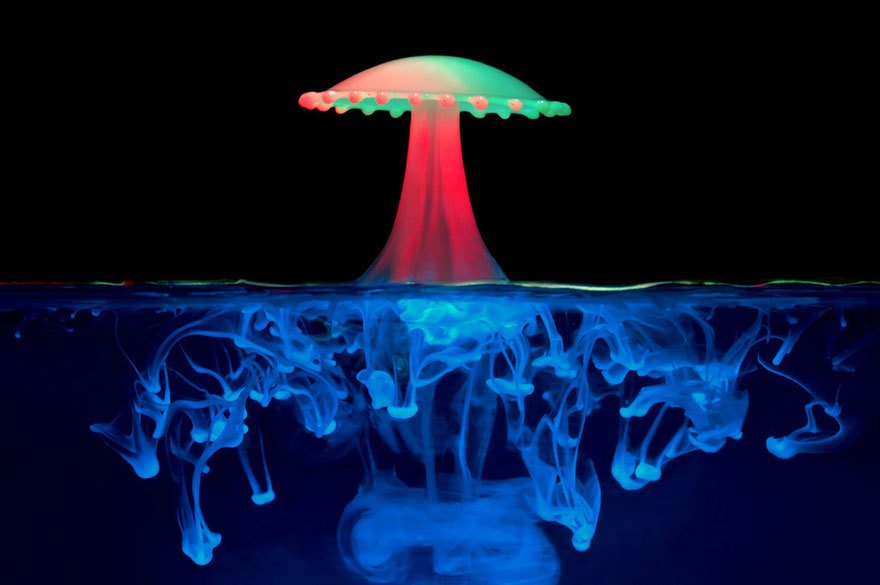
Artist Corrie White uses dyes and droplets to capture fantastical liquid sculptures at high-speed. The mushroom-like upper half of this photo is formed when the rebounding jet from one droplet’s impact on the water is hit by a well-timed second droplet, creating the splash’s umbrella. In the lower half of the picture, we see the remains of previous droplets, mixing and diffusing into the water via the Rayleigh-Taylor instability caused by their slight difference in density relative to the water. There’s also a hint of a vortex ring, likely from the droplet that caused the rebounding jet. (Photo credit: Corrie White)
Ink Drops
This super high resolution video (check the original on YouTube) by filmmaker Jacob Schwarz features slow motion diffusion of ink into water. The subtle differences in density between the ink and the water promote instabilities such as the Rayleigh-Taylor instability and its distinctive cascade of mushroom- or umbrella-like shapes. The mixing of two fluids seems like a simple concept, but the reality is beautiful, complex, and always fascinating. (Video credit: J. Schwarz; submitted by Rebecca S.)
Dropping Through Strata
When a droplet falls through an air/water interface, a vortex ring can form and fall through the liquid. In this video, the researchers investigate the effects of a stratified fluid interface on this falling vortex ring. In this case, a less dense fluid sits atop a denser one. Depending on the density of the initial falling droplet and the distance it travels through the first fluid, the behavior and break-up of the vortex ring when it hits the denser fluid differs. Here four different behaviors are demonstrated, including bouncing and trapping of the vortex ring. (Video credit: R. Camassa et al.)
Mixing Physics
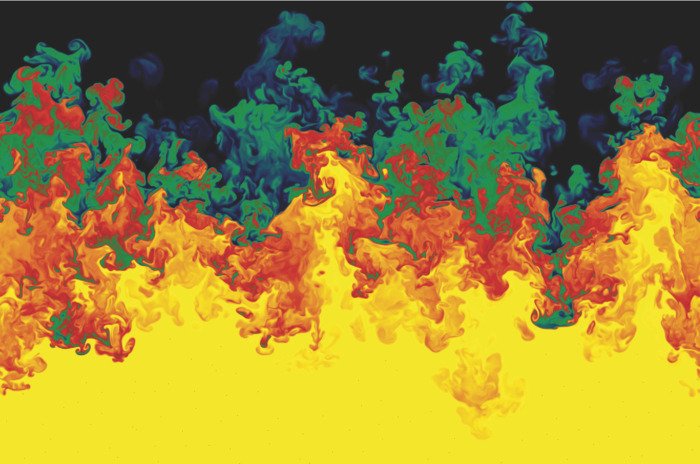
When a dense fluid sits above a lighter fluid in a gravitational field, the interface between the two fluids is unstable. It breaks down via a Rayleigh-Taylor instability, with mushroom-like protrusions of the lighter fluid into the heavier one. The image above comes from a numerical simulation of this effect well after the initial instability; the darker colors represent denser fluids and lighter colors are less dense fluids. The flow here has progressed to turbulence, and the authors of the simulation are exploring the statistical nature of this flow breakdown relative to the classical case of isotropic, homogeneous turbulence. (Photo credit: W. Cabot and Y. Zhou)
