This video explores some of the non-Newtonian behaviors of oobleck when shaken. The pattern across the surface once the vibrations start is called Faraday waves, a type of nonlinear standing wave that forms once a critical vibrational frequency is passed and the flat surface of the fluid becomes unstable. Toward the end of the video, the frequency of the vibrations is increased until “finger-like protrusions” form. This is a behavior exhibited by shear-thickening non-Newtonian fluids.
What happens when you fill a pool with a non-Newtonian fluid? Well, for one, you can hold races across the surface! In this video, the pool is filled with a mixture of cornstarch and water, a shear-thickening fluid known as oobleck.
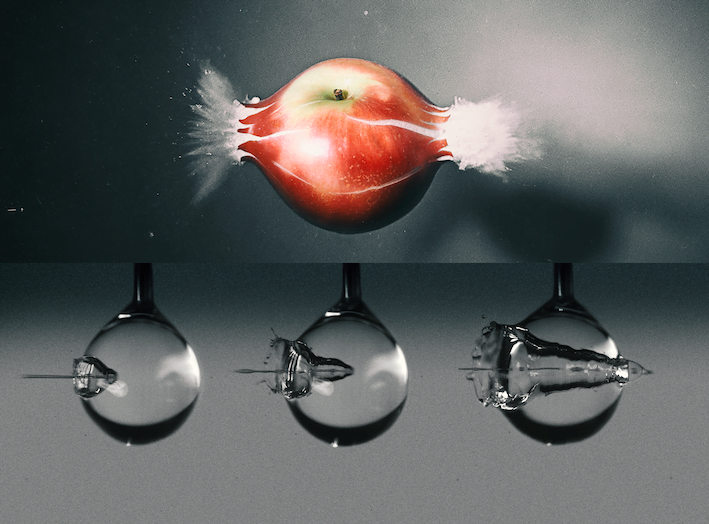
Some people don’t mind needles, and others absolutely detest them. But to replace needles with needle-free injections, we have to understand how high-speed microjets pass through skin. Given skin’s opacity, that’s tough, so researchers are instead using droplets as a model. If we can understand the dynamics of a microjet passing through different kinds of droplets, getting jets of medicine into arms becomes easier.
Researchers found that jets passed completely through a droplet if they impacted above a critical velocity. For Newtonian droplets, the jet creates a cavity and shoots straight through because the inertia of the impact outweighs the countering force of surface tension. But with viscoelastic drops, the jet goes through, slows down, and gets sucked back into the droplet. In this case, the combination of surface tension and viscoelasticity can, eventually, overpower the jet’s inertia. (Image, research, and submission credit: M. Quetzeri-Santiago et al.)
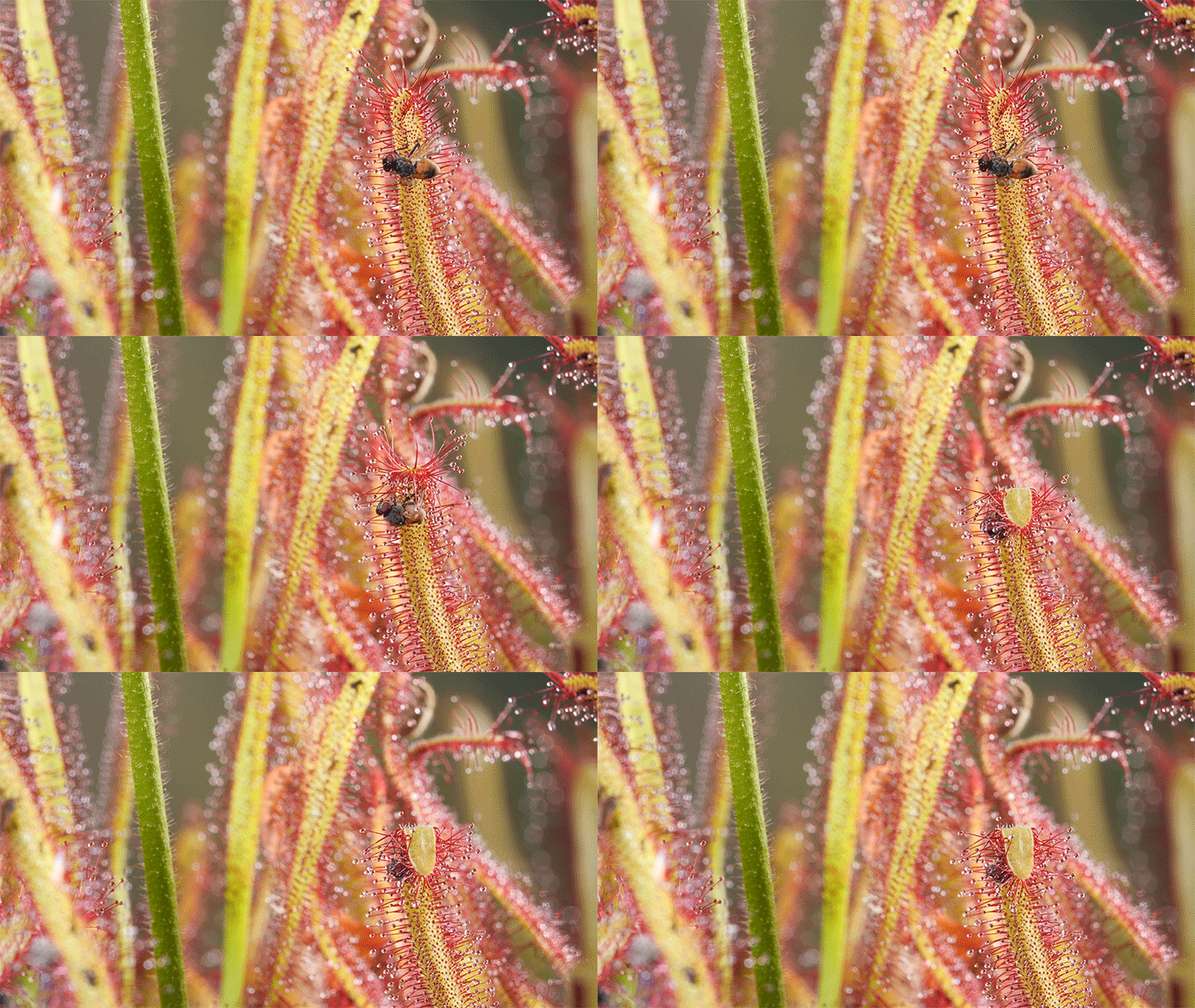
In nutrient-poor soils, carnivorous plants like the cape sundew supplement their diets by eating insects. To entice their prey, the cape sundew secretes droplets of sugary water. But unwary insects who land to feed soon find themselves unable to pull away from this viscoelastic liquid. Complex molecules in the fluid grant it elasticity, so when insects pull against it, the liquid stretches and pulls back instead of breaking up. Other carnivorous plants, like the pitcher plant, use similar non-Newtonian tricks to trap insects. (Video and image credit: Deep Look)
10 years. 2,590 posts. 21 original videos. 378,000+ followers. Countless hours spent blogging and more than 1,000 journal articles read. When I started FYFD ten years ago as a PhD student, I never imagined the impact the blog would have on my life, my career, or my field. It’s been a wild ride, and I’d like to take a moment today to thank each and every one of you for contributing to this journey, whether it’s by supporting on Patreon, liking a post, sharing content, submitting ideas, leaving a comment, sending an email, or saying hi at an event. FYFD would have petered out long ago if not for your support!
Ten years seems like a good time for a little retrospective, so I went back through the archive in search of the most popular post (based on Tumblr’s notes) from each of those ten years. Here’s what I found:
If you’d rather enjoy something random rather than something “popular”, you can always use the shortcut https://fyfluiddynamics.com/random to explore posts in the archive.
And in case you’re more interested in watching videos, here are the top FYFD videos (by YouTube views):
(Wow, my editing and production skills have evolved since some of those earlier vids!)
So what are your favorite FYFD memories and posts? Let me know in the comments! (Image and video credits: N. Sharp)
Oobleck – that peculiarly behaved mixture of cornstarch and water – continues to be a favorite of children and researchers both. Oobleck flows like a liquid when deformed slowly, but try to move it quickly and it will seize up like a solid. This sudden change depends on the tiny particles of cornstarch suspended in the liquid. When they’re given time, electrostatic forces between the particles help them repel one another and keep the liquid flowing. But under sudden impacts, the particles get jammed together and the friction between neighboring grains makes the viscosity of the fluid increase by orders of magnitude.
Researchers are now able to model these particle interactions numerically, which will help them predict how oobleck and similar substances will behave in applications like body armor or pothole repair. (Video credit: MIT; via MIT News; research credit: A. Baumgarten and K. Kamrin)