Everyone knows the familiar plonk of a stone falling into a pond but few realize the complexity of the physics. When a solid object falls into a pool, a sheet of liquid, the crown splash, is sent upward. Simultaneously, the object pulls a cavity of air down with it. As the water moves inward, this cavity is pinched, creating an hourglass-like shape reminiscent of the shape of a rocket’s nozzle. As the diameter of that pinched cavity shrinks, the velocity of the upward escaping air increases, resulting in the formation of an air jet moving faster than the speed of sound. This air jet is followed by a slower liquid jet that may rebound to a height higher than then original height of the dropped object. So next time you throw a stone into a pond, enjoy the knowledge that you’ve broken the sound barrier. (Photo credit: D. van der Meer; see also Physics World)
Search results for: “liquid jet”

Breaking up in Crossflow
This video shows some instabilities that occur when a liquid jet impinges on a flowing cross stream. Note how the jet breaks down into droplets in a fashion similar to the Plateau-Rayleigh instability but the broken tip remains stable for some time thereafter. #
Dripping into Droplets
The Plateau-Rayleigh instability is one that just about everyone has witnessed. It describes how a liquid jet breaks up into droplets. Notice the waviness in the jet before breakdown. The tiniest curvature in the jet causes an imbalance in the liquid’s pressure due to surface tension. Because the system is unstable, any small changes will become larger, ultimately resulting in the jet breaking into droplets.
Plucking Droplets
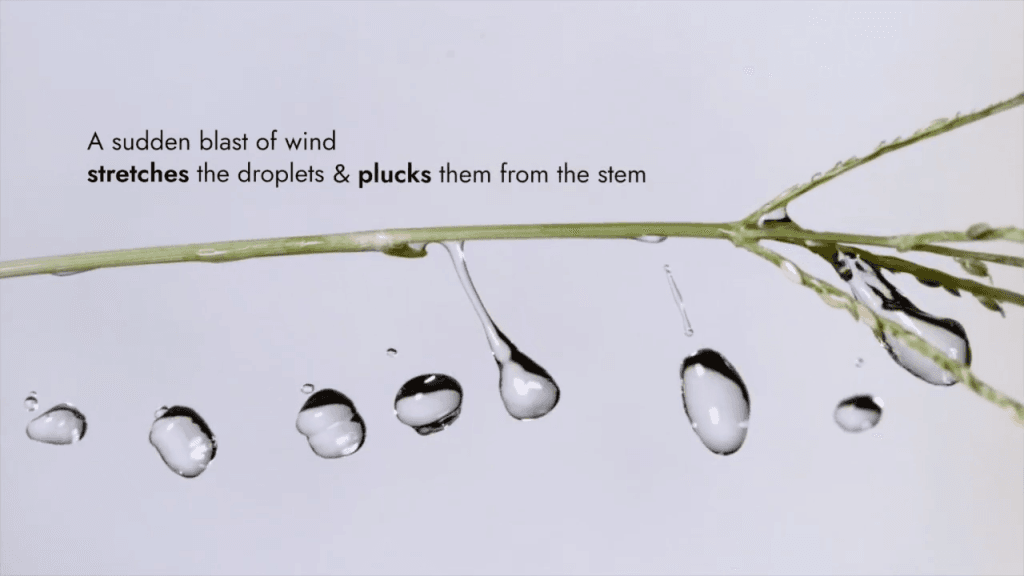
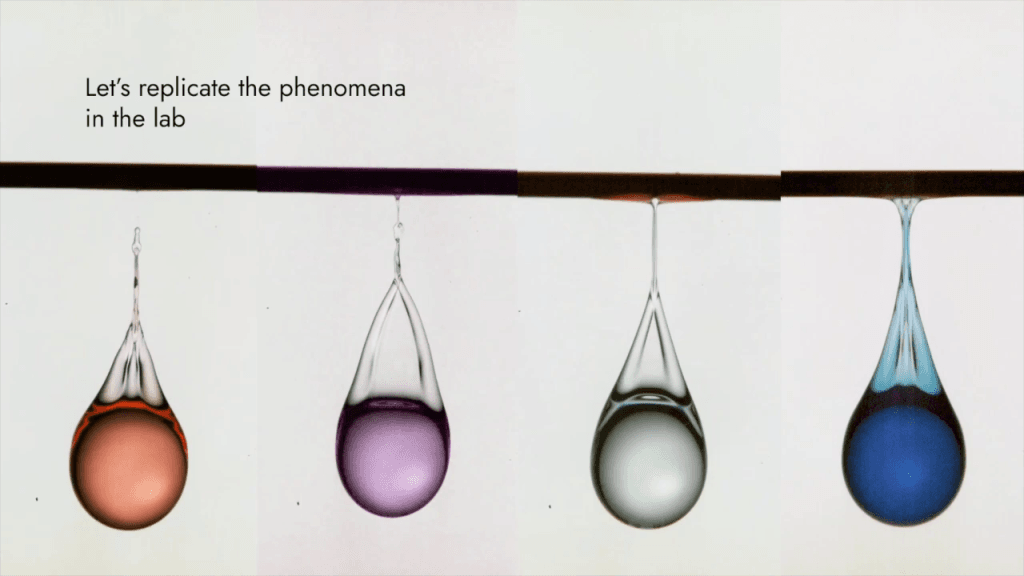
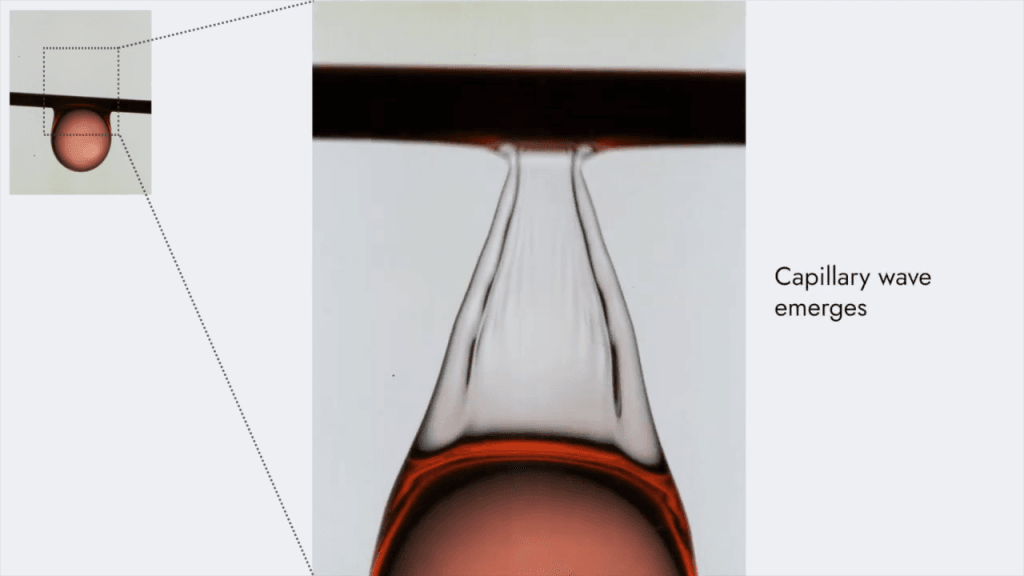
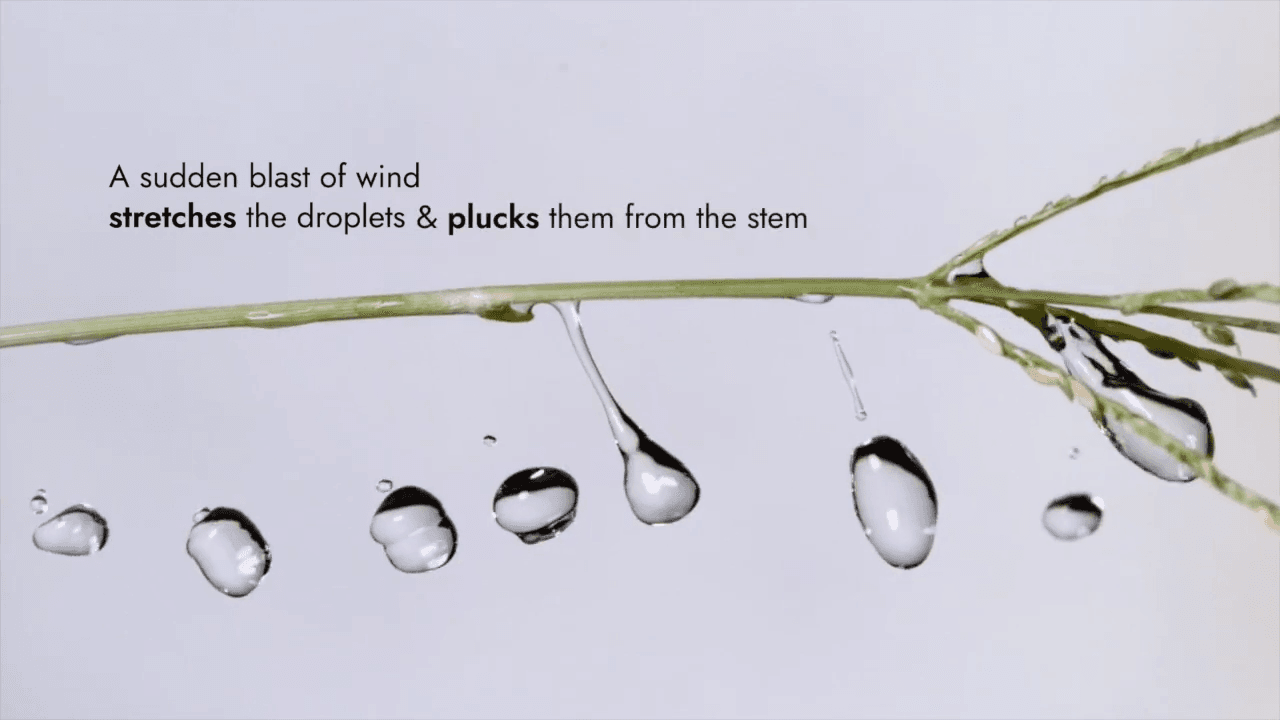
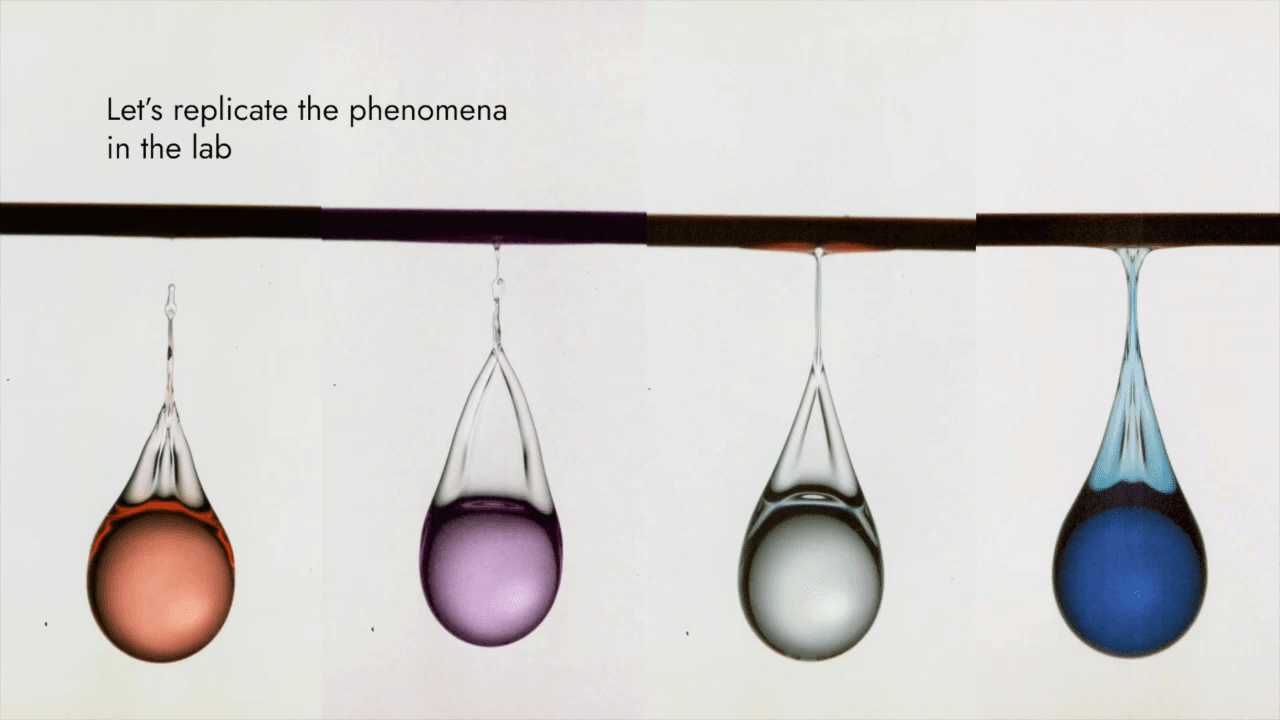
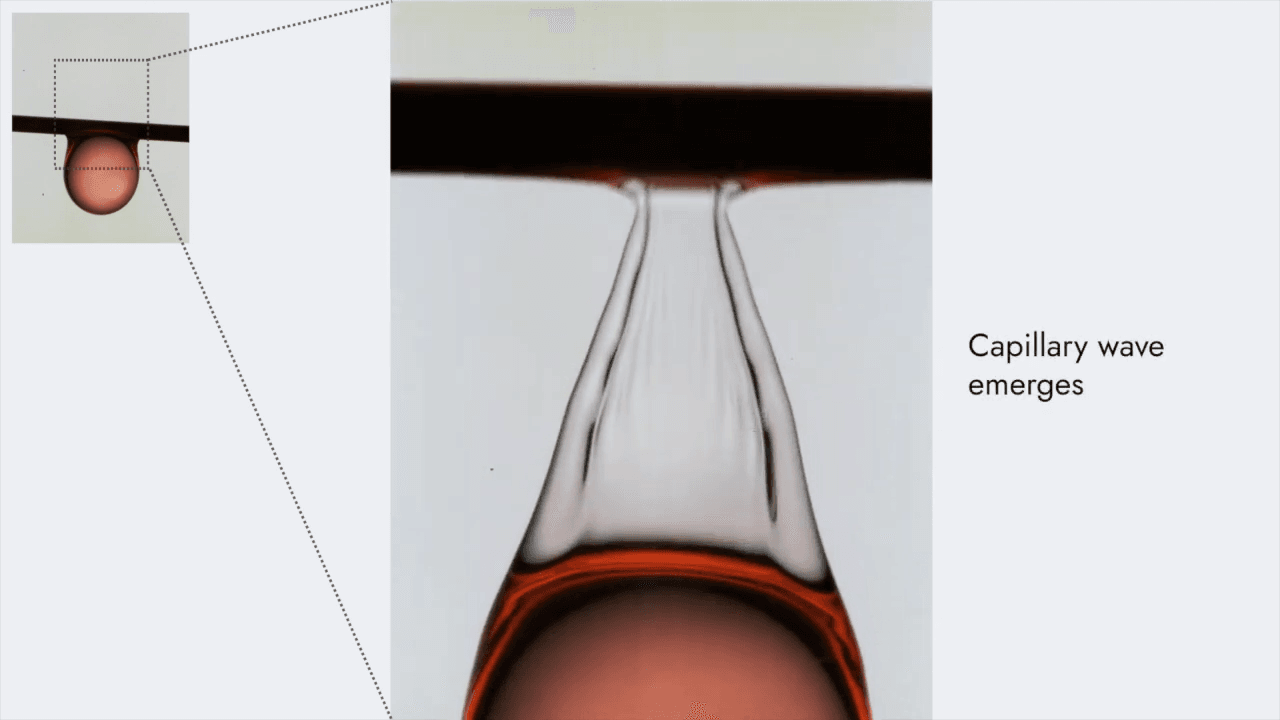
A sudden breeze can pluck droplets hanging from a stem. Here, researchers recreate that phenomenon in the laboratory. With a close-up view and high-speed images, we can enjoy every detail of the detachment and break-up. As the wire pulls away, it drags a liquid sheet off the droplet. The thicker rims on either side of the sheet eventually collide, creating a jet that stretches, deforms, and, at last, breaks. (Video and image credit: D. Maity et al.)
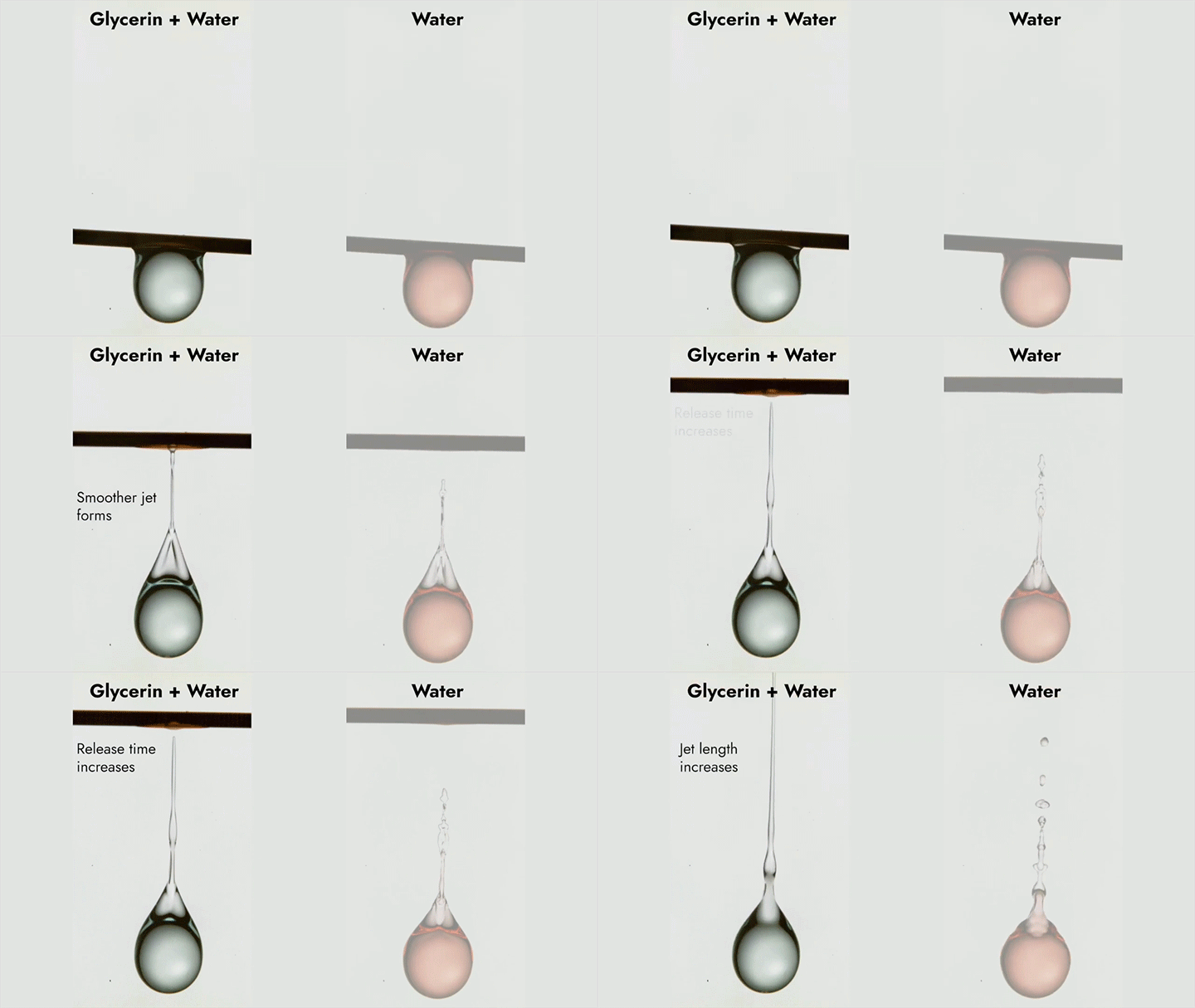
Animation of two droplets getting plucked, one made of glycerin+water (left) and one of water (right). Fediverse Reactions
-
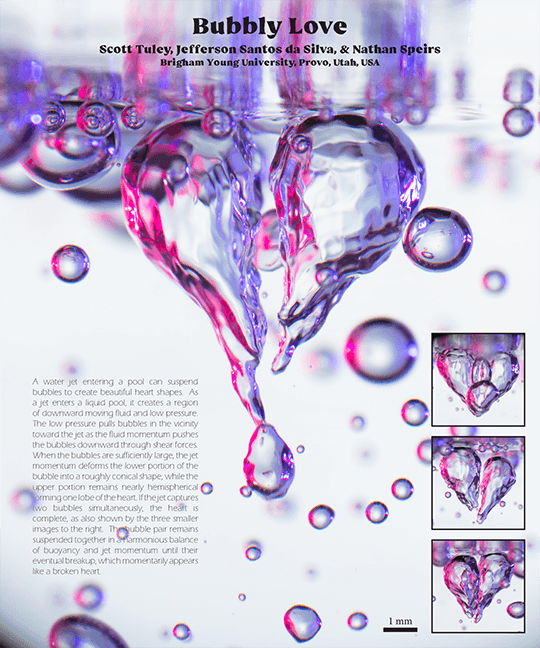
A Bubbly Heart
Next time you fill your water bottle, watch closely and see if you can spot a bubble heart like these. When a jet falls into a pool, it pulls air in with it. The low pressure of the jet pulls bubbles inward, even as shear pulls the bubbles downward with the sinking liquid. If the bubbles are large and there’s enough momentum in the jet, the lower portion of the bubble will get pulled into a conical shape, while the upper portion remains a hemisphere. That forms one lobe of the heart. The other half requires a second bubble. But with a little patience and luck, you can form a complete heart. Happy Valentine’s Day! (Image credit: S. Tuley et al.)
Fediverse Reactions
-
Non-Newtonian Effects in Magma Flows
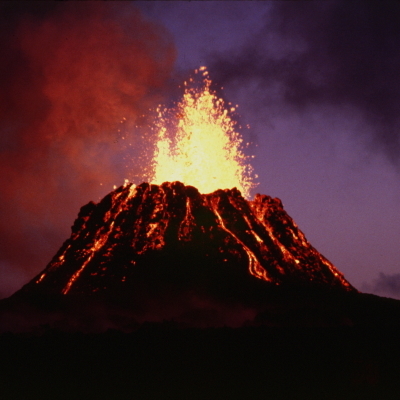
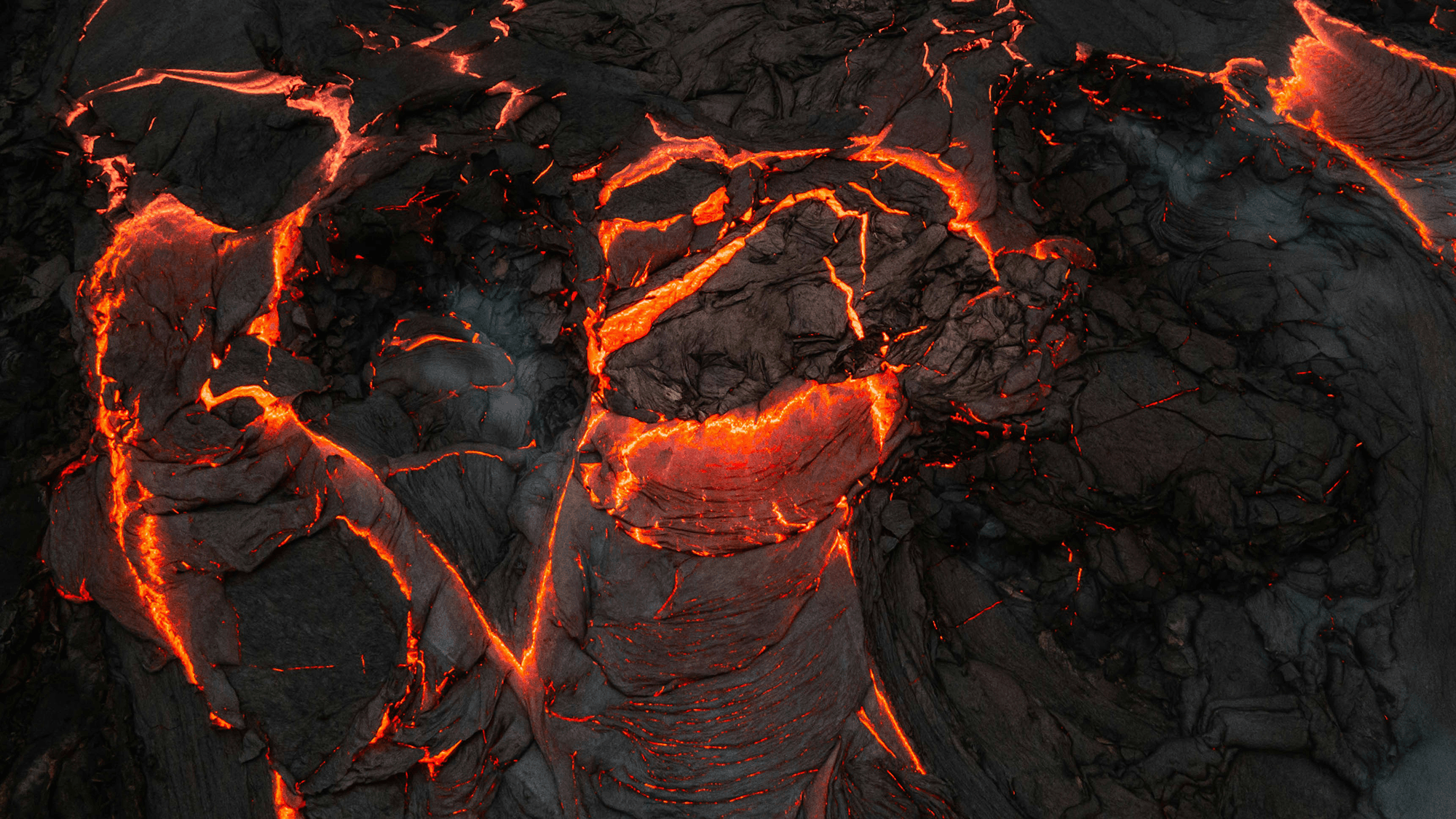
As magma approaches the surface, it forces its way through new and existing fractures in the crust, forming dikes. When a volcano finally erupts, the magma’s viscosity is a major factor in just how explosive and dangerous the eruption will be, but a new study shows that what we see from the surface is a poor predictor of how magma actually flows within the dike.
Researchers built their own artificial dike using a clear elastic gelatin, which they injected water and shear-thinning magma-mimics into. By tracking particles in the liquids, they could observe how each liquid followed on its way to the surface. All of the liquids formed similar-looking dikes at a similar speed, but within the dike, the liquids flowed very differently. Water cut a central jet through the gelatin, then showed areas of recirculation along the outer edges. In contrast, the shear-thinning liquids — which are likely more representative of actual magma — showed no recirculation. Instead, they flowed through the dike in a smooth, fan-like shape.
The team cautions that surface-level observations of developing magma dikes provide little information on the flow going on underneath. Instead, their results suggest that volcanologists modeling magma underground should take care to include the magma’s shear-thinning to properly capture the flow. (Image credit: T. Grypachevska; research credit: J. Kavanagh et al.; via Eos)
Fediverse Reactions
-
Instabilities in Competition
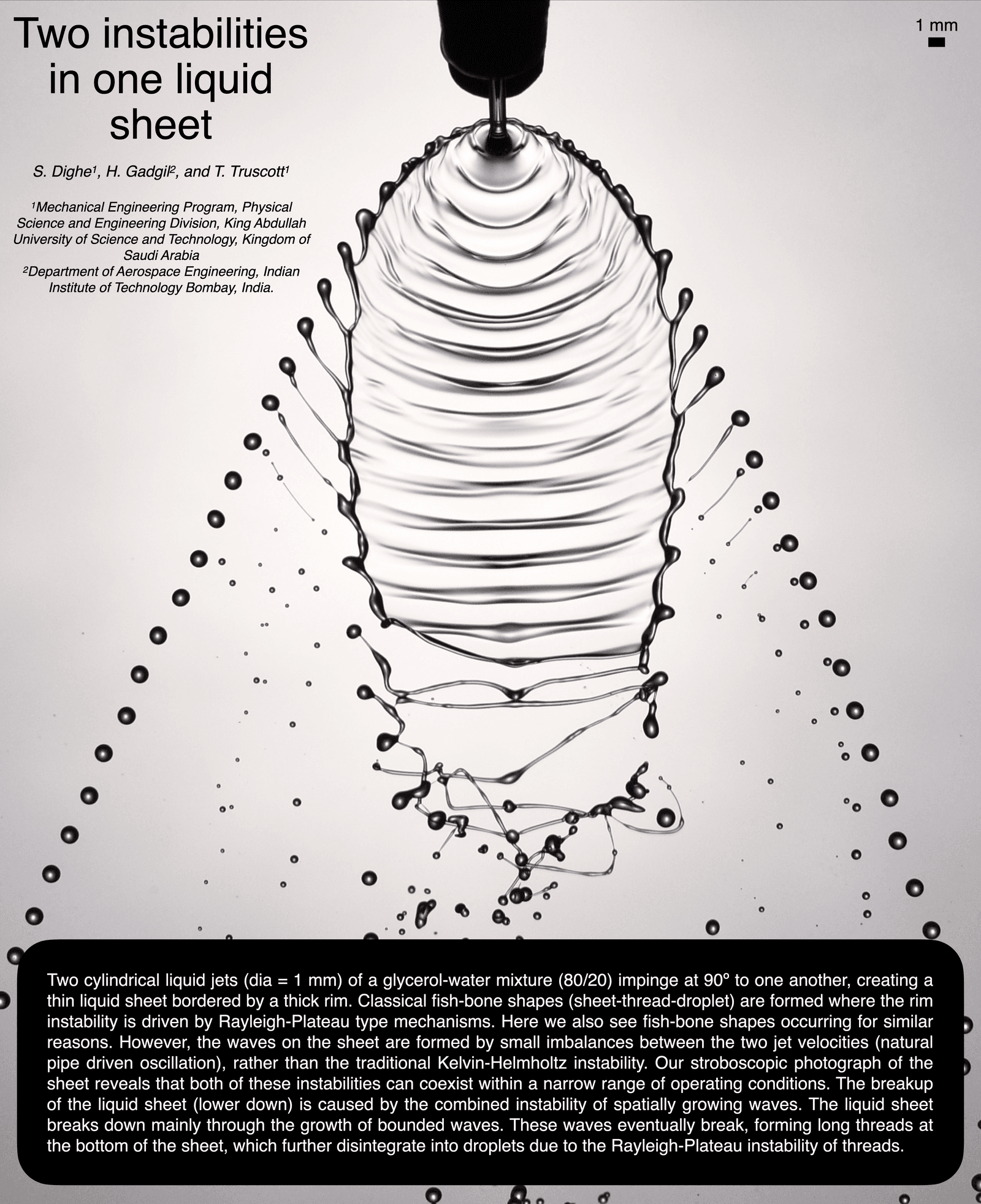
When two liquid jets collide, they form a thin liquid sheet with a thicker rim. That rim breaks into threads and then droplets, forming a well-known fishbone pattern as the Plateau-Rayleigh instability breaks up the flow. This poster shows a twist on that set-up: here, the two colliding jets vary slightly in their velocities. That variability adds a second instability to the system, visible as the wavy pattern on the central liquid sheet. The sheet’s rim still breaks apart in the usual fishbone pattern, but the growing waves in the center of the sheet eventually that structure apart as well. (Image credit: S. Dighe et al.)
Fediverse Reactions
-
Tweaking Coalescence


When a drop settles gently against a pool of the same liquid, it will coalesce. The process is not always a complete one, though; sometimes a smaller droplet breaks away and remains behind (to eventually do its own settling and coalescence). When this happens, it’s known as partial coalescence.
Here, researchers investigate ways to tune partial coalescence, specifically to produce more than a single droplet. To do so, they add surfactants to the oil layer surrounding their water droplet. The surfactants make the rebounding column of water skinnier, which triggers the Rayleigh-Plateau instability that’s necessary to break the column into more than one droplet. (Image and video credit: T. Dong and P. Angeli)
Skittering Drops
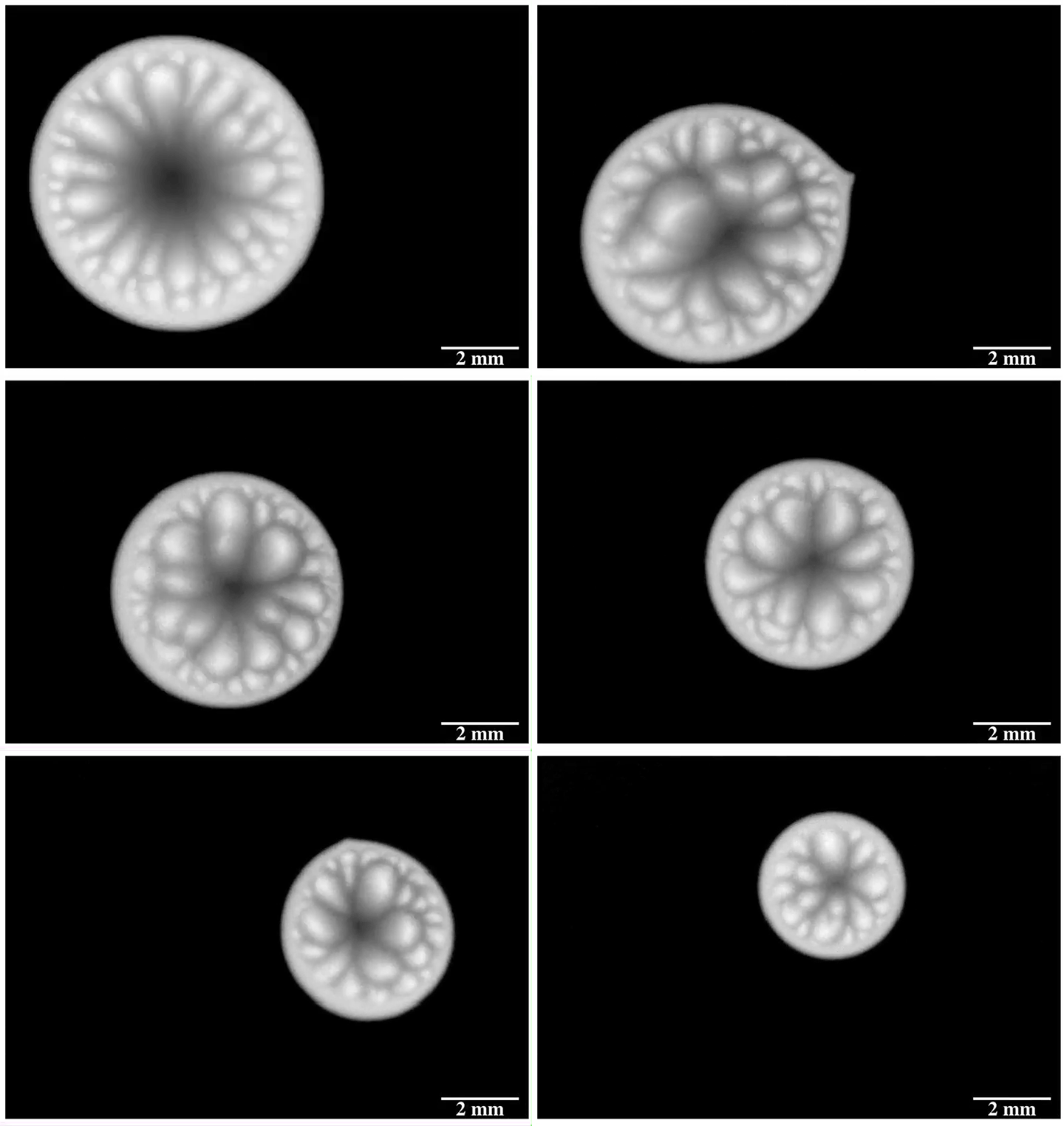
Drip some ethanol on a hot surface, and you’d expect it to spread into a thin layer and evaporate. But that doesn’t always happen, and a recent study looks at why.
Ethanol is what’s known as a volatile liquid, meaning that it evaporates easily at room temperatures, well below its boiling point. When dropped on a uniformly heated surface above 45 degrees Celsius, the drop contracted into a hemisphere and then began to wander randomly across the surface. Researchers trained an infrared camera on the drop from below (above image), and found an unsteady, roiling motion inside the drop. These asymmetric flows, they concluded, drive the drop’s erratic self-propulsion. They suspect the mechanism may explain why some ink droplets wind up in the wrong place on a page during ink-jet printing. (Image and research credit: P. Kant et al.; via APS Physics)
Shredding Gold
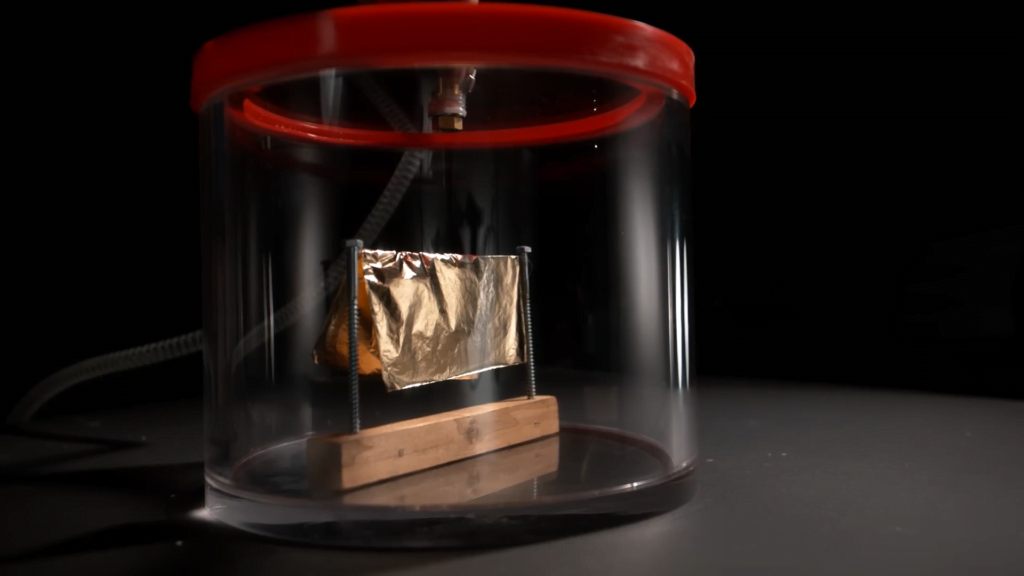
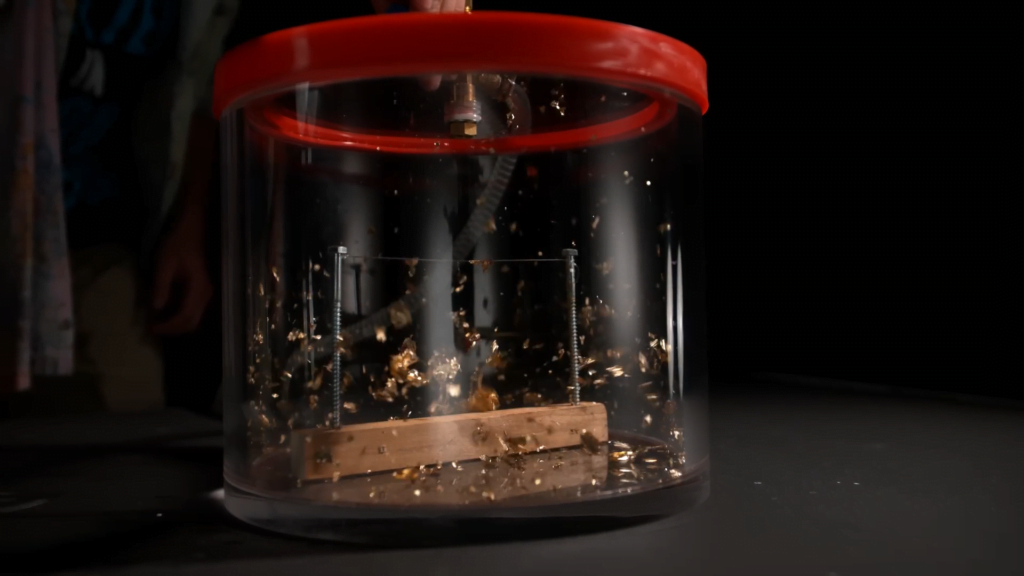
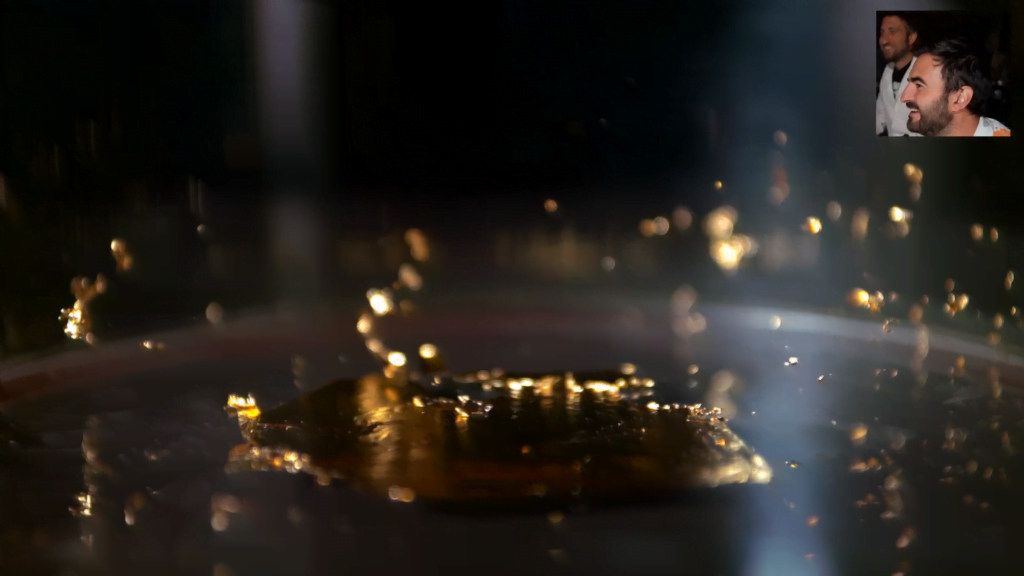


While vacuums can do pretty wild things to liquids, the title of this Slow Mo Guys video is a bit misleading. They’re not so much exploding gold in a vacuum as they are shredding it during repressurization. Regardless, the visuals are pretty awesome. They place thin foils in a vacuum chamber, pump it down, and then film what happens when they reopen the valve and pressurize the chamber. Flow-wise, that introduces a strong air jet that flows downward in the center of the chamber and causes a recirculating flow up the sides. For the foils, this sudden flow is devastating, shredding the material so thoroughly that it looks like a splash. (Video and image credit: The Slow Mo Guys)