Search results for: “liquid jet”

  • Squishy Impacts

    Squishy Impacts

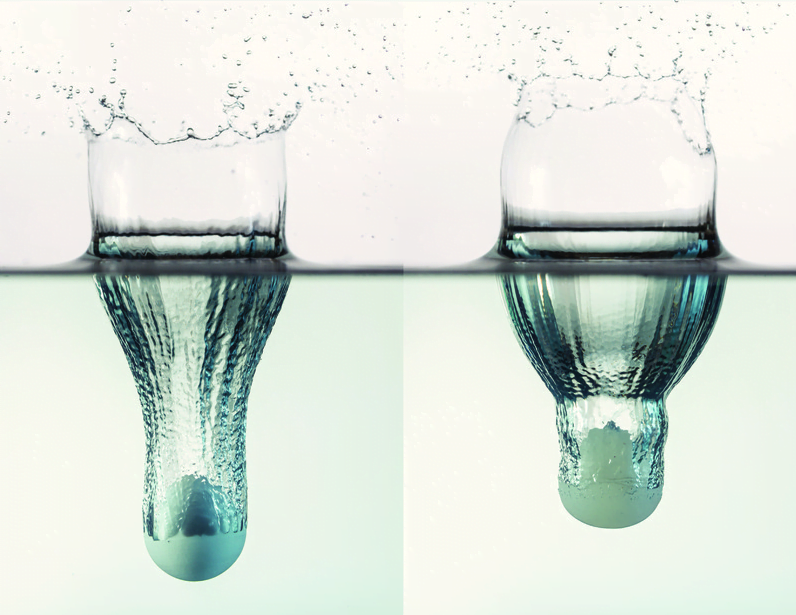
    How spheres impact water has been studied for more than a century. The typical impact for a rigid sphere creates a cavity like the one on the upper left – relatively narrow and prone to pinching off at its skinny waist. If the sphere is elastic –squishy – instead, the cavity ends up looking much different. This is shown in the upper right image, taken with an elastic ball and otherwise identical conditions to the upper left image. The elastic ball deforms; it flattens as it hits the surface, creating a wider cavity. If you watch the animations in the bottom row, you can see the sphere oscillating after impact. Those changes in shape form a second cavity inside the first one. It’s this smaller second cavity that pinches off and sends a liquid jet back up to the collapsing splash curtain

    From the top image, we can also see that the elastic sphere slows down more quickly after impact. This makes sense because part of its kinetic energy at impact has gone into the sphere’s shape changes and their interaction with the surrounding water. 

    If you’d like to see more splashy stuff, be sure to check out my webcast with a couple of this paper’s authors. (Image credits: top row – C. Mabey; bottom row – R. Hurd et al., source; research credit: R. Hurd et al.)

  • Breaking Up

    Breaking Up

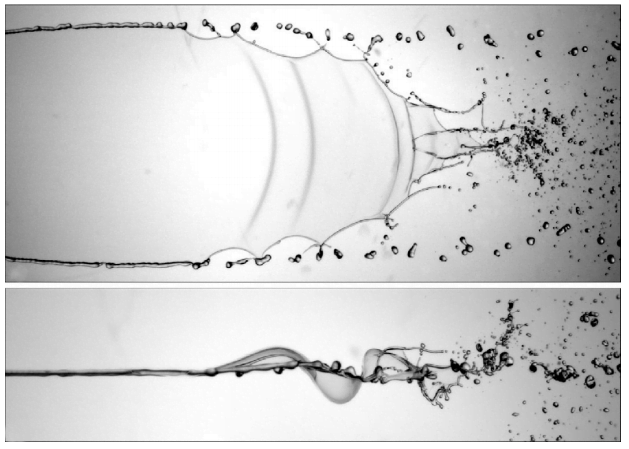
    Liquid sheets break down in a process known as atomization. Above are top and side views of a liquid sheet created by two identical liquid jets impacting head-on. The jets themselves are off-screen to the left. Their collision generates a thin sheet of liquid that flows from left to right. In the center of the images, the sheet has begun to flap and undulate, shedding large droplets from its edges as it does. At the far end of the sheet, much finer droplets are sprayed out from the center as the sheet collapses completely. This is an example of an instability in a fluid. Initially, any disturbance in the liquid sheet is extremely tiny, but circumstances in the flow are such that those disturbances gather energy and grow larger, creating the large undulations. Those undulations are unstable as well and kick off a fresh set of disturbances that grow until the flow completely breaks down. (Image credit: N. Bremond et al., pdf)

  • Featured Video Play Icon

    Weaponizing Water-Repellency

    St. Pauli, a neighborhood in the German city of Hamburg, has demonstrated one of the most unusual applications of superhydrophobicity I’ve ever heard of. St. Pauli is known as a party district, and the residents of the area have grown understandably frustrated with inebriated visitors publicly urinating on their buildings and, yes, playgrounds. When fines failed to curb the issue, they took to treating walls chemically to make them superhydrophobic. As the targeted audience has discovered, water repellency tends to make liquid jets bounce off rather than run down a surface. Well played, St. Pauli. (Video credit: IG St. Pauli; submitted by entropy-perturbation)

  • Meandering Rivulet

    Meandering Rivulet

    This rivulet is the result of a horizontal liquid jet impacting a vertical pane of glass. Gravity, surface tension, adhesion, and even surface finish can affect the path the water follows. Like the meandering path of rain on a windshield, it’s hard to predict a priori where the flow will go without accounting for a myriad of seemingly inconsequential variables governing both the liquid and solid surface. (Photo credit: T. Wang)

  • Featured Video Play Icon

    The Archer Fish’s Arrow

    Archer fish hunt by shooting jets of water at their prey to knock them into the water where the fish can eat them. Previous research showed that the archer fish’s projectile jet is pulsed such that the water released at a later time has a greater velocity. This makes the jet bunch up so that a ball of liquid hits the prey with greater force than the jet would otherwise. A recently released paper shows that the archer fish actively adjust their liquid jets in order to strike targets at different distances while maintaining this bunching effect. To control the jets, the fish adjust both how long they jet and what speed they impart to the fluid by changing how they open and close their mouths. (VIdeo credit: Nature; research credit: P. Gerullis and S. Schuster; via phys.org; submitted by @jchawner)

  • Inside a Rocket

    Inside a Rocket

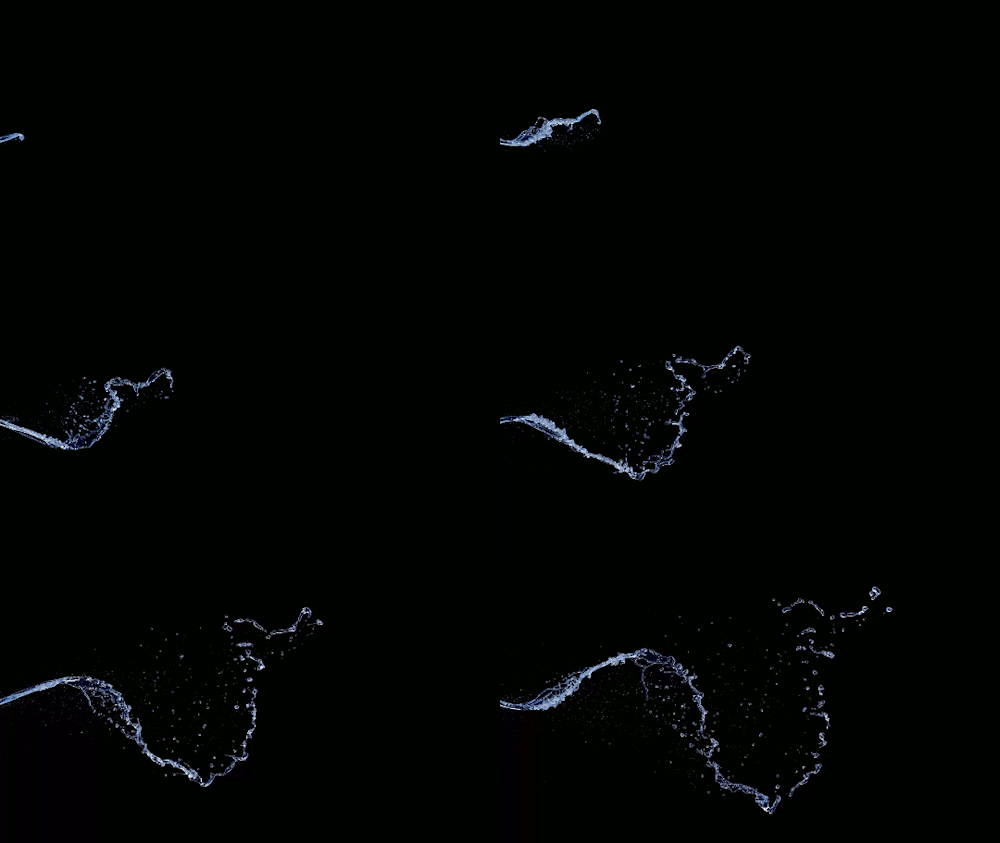
    Rockets often utilize liquid propellants for their combustion. To maximize the efficiency during burning, the liquid fuel and oxidizer must mix quickly and break up into an easily vaporized spray. One method to achieve this is to inject the fuel and oxidizer as liquid jets that collide with one another. For high enough flow rates, this creates a highly unstable liquid sheet that quickly atomizes into a spray of droplets. The animation above shows an example of two impinging jets, but rockets using this method would typically have more than just two injection points. Other rockets use co-axial or centrifugal injectors to mix and atomize the fuel and oxidizer prior to combustion.  (Image credit: C. Inoue; full-scale GIF)

  • Fishbones

    Fishbones

    When two liquid jets collide, they can form an array of shapes ranging from a chain-like stream or a liquid sheet to a fishbone-type structure of periodic droplets. This series of images show the collision of two viscoelastic jets–in which polymer additives give the fluids elasticity properties unlike those of familiar Newtonian fluids like water. The jet velocities increase with each image, changing the behavior from a fluid chain (a and b); to a fishbone structure (c and d); to a smooth liquid sheet (e); to a fluttering sheet (f and g); to a disintegrating ruffled sheet (h), and finally a violently flapping sheet (i and j). The behavior of such jets is of particular interest in problems of atomization, where it can be desirable to break an incoming stream of liquid up into droplets as quickly as possible. (Photo credit: S. Jung et al.)

  • The Archer Fish’s Arrows

    The Archer Fish’s Arrows

    The archer fish hunts by shooting a jet of water at insects in the leaves above and knocking them into the water. How the fish achieve this feat has been a matter of contention.  A study of high-speed video of the archer’s shot shows that fluid dynamics are key.  The fish releases a pulsed liquid jet, imparting greater velocity to the tail of the jet than the head.  As a result, the tail tends to catch up to the head and increase the jet’s mass on impact while decreasing the duration of impact.  Simultaneously, the jet tends to break down into droplets via the Rayleigh-Plateau instability caused by surface tension.  Surface tension’s power to hold the water in droplets combined with the inertial effects of the pulsed jet create a ball of fluid that strikes the archer’s prey with more than five times the power than vertebrate muscles alone can impart. For more on archer fish, check out this video and the original research paper by A. Vailati et a. (Photo credits: Scott Linstead and BBC; submitted by Stuart R)

  • The Supersonic Plonk

    The Supersonic Plonk

    Everyone knows the familiar plonk of a stone falling into a pond but few realize the complexity of the physics.  When a solid object falls into a pool, a sheet of liquid, the crown splash, is sent upward.  Simultaneously, the object pulls a cavity of air down with it. As the water moves inward, this cavity is pinched, creating an hourglass-like shape reminiscent of the shape of a rocket’s nozzle. As the diameter of that pinched cavity shrinks, the velocity of the upward escaping air increases, resulting in the formation of an air jet moving faster than the speed of sound. This air jet is followed by a slower liquid jet that may rebound to a height higher than then original height of the dropped object. So next time you throw a stone into a pond, enjoy the knowledge that you’ve broken the sound barrier. (Photo credit: D. van der Meer; see also Physics World)

  • Featured Video Play Icon

    Breaking up in Crossflow

    This video shows some instabilities that occur when a liquid jet impinges on a flowing cross stream. Note how the jet breaks down into droplets in a fashion similar to the Plateau-Rayleigh instability but the broken tip remains stable for some time thereafter. #