
Two jets of sugar syrup collide and interact to form very different patterns. On the left, the two jets have a low flow rate and create a chain-like wake. The jets on the right have a higher flow rate and produce a liquid sheet that breaks down into filaments and droplets. The result is often likened to fish bones. (Photo credit: Rebecca Ing)
Search results for: “liquid jet”

Particle Jets
During explosions, solid particles and liquids packed around the explosive charges can form jets, making a blast wave appear more porcupine-like than spherical. The instability mechanisms that cause this behavior are not well-understood, but researchers suspect the jets are formed due to perturbations in the particle bed on the timescale of the initial shock propagation. The presence of these jets can affect the blast wave’s subsequent growth as well as the mixing in its wake. The number of jets produced depends on many factors, including particle type, the geometry of the charge, the ratio of explosive to particles, and even whether the particles are wet or dry. Note the very different natures of the explosions in the video when shown side by side. (Video credit: D. Frost et al)
Atomizing Jets
The breakup of impinging jets into droplets (also called atomization) and the subsequent dynamics of those droplets are important in applications like jet and rocket engines where the mixing of liquid fuel with oxygen is necessary for efficient combustion. This video showcases recent efforts in high fidelity numerical simulation and modeling of such flows. The complexity of the problem requires clever ways of reducing the computational efforts required. One such method uses adaptotive meshing to concentrate grid points in areas where variables are changing quickly while leaving the grid sparse in areas of less interest. Because the flow is constantly evolving, the mesh must be able to adapt as the simulation steps forward in time. Even so, such calculations typically require supercomputers to complete. (Video credit: X. Chen et al)
Stereo Liquid Sculpture
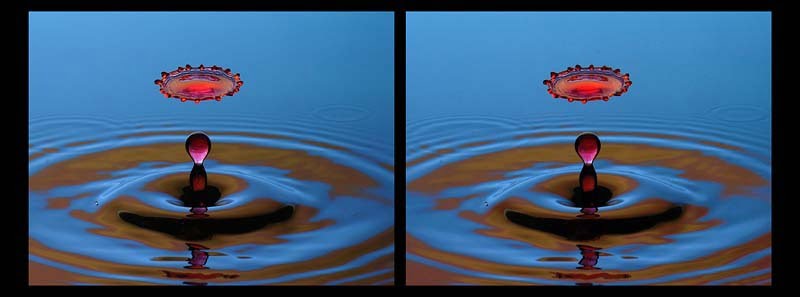
This stereo 3D photo shows the Worthington jet ejected when a droplet impacts a pool. The flat crowning drop is formed from an ejected droplet colliding with a falling droplet.
Liquid Acrobatics
Imagine blowing through a straw into a nearly empty glass–we probably all did this as children and sent water, milk, and soda flying everywhere! In essence, this video shows that same act, but filmed by a high-speed camera. The “straw” blows a steady stream of helium into a shallow pool of silicone oil and slowly moves so that the angle the straw makes with the pool changes. As the angle changes, different regimes are visible. First waves appear on the surface of the pool, then a bulge forms, which develops into a droplet stream, then on into the chaos of bubbles and jets. It’s good I couldn’t see this in slow motion as a child or I would have never used my straw for drinking!

The Bouncing Jet
Under some circumstances, a thin stream of a Newtonian fluid impacting a deep pool of the same fluid can produce a bouncing jet. The effect is observed in common liquids like canola oil and can be replicated at home. Be sure to check the research page for a video of the effect. #

Predicting Droplet Sizes
Squeeze a bottle of cleaning spray, and the nozzle transforms a liquid jet into a spray of droplets. These droplets come in many sizes, and predicting them is difficult because the droplets’ size distribution depends on the details of how their parent liquid broke up. Shown above is a simplified experimental version of this, beginning with a jet of air striking a spherical water droplet on the far left. In less than 3 milliseconds, the droplet has flattened into a pancake shape. In another 4 milliseconds, the pancake has ballooned into a shape called a bag, made up of a thin, curved water sheet surrounded by a thicker rim. A mere 10 milliseconds after the jet and drop first meet, the liquid is now a spray of smaller droplets.
Researchers have found that the sizes of these final droplets depend on the balance between the airflow and the drop’s surface tension; these two factors determine how the drop breaks up, whether that’s rim first, bag first, or due to a collision between the bag and rim. (Image credit: I. Jackiw et al.; via APS Physics)
Tracking Break-Up

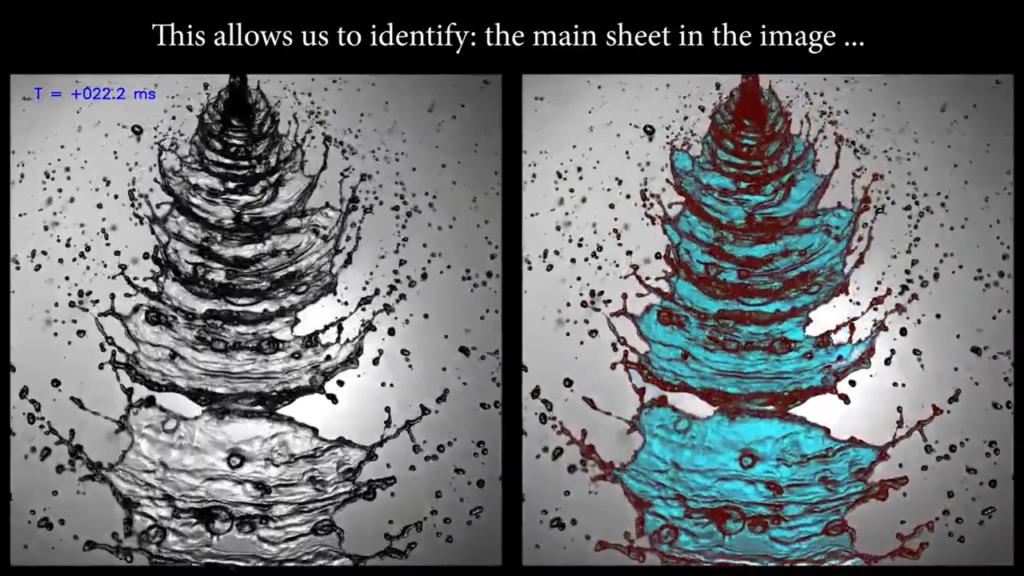
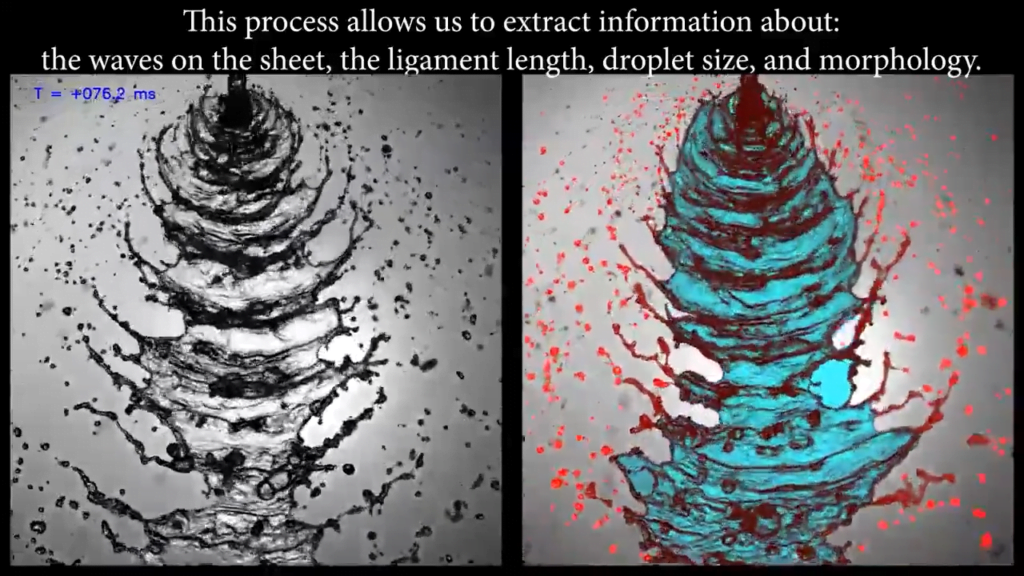


In fluid dynamics, researchers are often challenged with complicated, messy flows. With so much going on at once, it’s hard to work out a way to keep track of it all. Here, researchers are looking at the break-up of two colliding liquid jets. This setup is often used to break rocket fuel into droplets prior to combustion. This video shows off a new data analysis tool that lets researchers break the flow into different parts, track them in time, and extract data about the changes that happen along the way. (Video and image credit: E. Pruitt et al.)

Breaking Up Is(n’t) Hard to Do


Engineers often need to break a liquid jet up into droplets. To do so quickly, they surround the jet with a ring of fast-moving air in a set-up known as a coaxial jet. Shear between the gas and liquid creates instabilities that quickly distort the jet’s initial cylinder into sheets and ligaments. Those formations then undergo their own instabilities to break up into drops. The method is, as you can see in the high-speed images above, quite effective, though the breakup mechanism itself is tough to quantify. (Image credit: G. Ricard et al.)

Wrapping Rivulets
Tea lovers have long been frustrated by the tendency of liquid jets to adhere to solid surfaces – the so-called teapot effect that makes the last vestiges of every pour drip down the spout. By investigating the effect with vertical rods, researchers found that, at low enough flow rates, a liquid jet is able to adhere completely, forming a liquid helix that coils around the rod. The authors were also able to construct a mathematical model to capture the behavior. They concluded that both the wettability of a surface and the curvature of the solid are critical to determining whether or not a liquid jet will stick. (Image and research credit: E. Jambon-Puillet et al.; via APS Physics; submitted by Kam-Yung Soh)