Two liquids that collide don’t always coalesce. The image above shows two jets of silicone oil colliding. On the left, the jets collide and bounce off one another. On the right, at a slightly higher flow rate, the two jets coalesce. This bouncing, or noncoalescence, observed at lower speeds is due to an incredibly thin layer of air separating the two jets. This air layer is constantly being replenished by air that gets dragged along by the flowing oil. But if the oil flows too quickly, that air layer becomes unstable–in the same way that a droplet that falls too quickly will splash on impact. When the separating air layer becomes unstable and breaks down, the jets collide and merge. (Image credit: N. Wadhwa et al., pdf)
Search results for: “liquid jet”

Rotating Jet
This photo, one of the winners of the Engineering and Physical Sciences Research Council’s (EPSRC) annual photography contest, shows a rotating viscoelastic jet. Rotating liquid jets are common to many manufacturing processes, and their sometimes-wild appearance comes from a balance of gravitational forces and centrifugal force against surface tension. But because this fluid contains a small amount of polymer additive, surface tension has the additional aid of some elasticity to help hold the jet together and keep the globules and ligaments you see from flying off. As centrifugal forces fling the fluid outward, it stretches the polymer chains within the fluid, and they pull back against that tension like a stretched rubber band. To see some of the other contest winners–including other fluids entries!–check out the Guardian’s run-down. (Image credit and submission: O. Matar et al., ICL press release)

Granular Jets
Object impacts in water and other fluids often create cavities that generate jets when they collapse. But impacts on granular materials can produce similar results, forming a cavity, a splash corona, and, under the right circumstances, a jet. This Sixty Symbols video explores the effect of grain size (and thus weight) on the formation of such a rebound jet. Ultimately, the jet behavior is driven by air. When the granular material is poured, air gets trapped between the grains. The impact compresses the grains, forcing the previously trapped air up and out through the cavity created by the impact. Interestingly, once the air pressure is low enough, jet creation is suppressed, not unlike splash suppression in liquids. (Video credit: Sixty Symbols/Univ. of Nottingham)

Forming a Jet
Many situations can generate high-speed liquid jets, including droplet impacts, vibrated fluids, and surface charges. In each of these cases, a concave liquid surface is impulsively accelerated, which causes the flow to focus into a jet. The image above shows snapshots of a microjet generated from a 50 micron capillary tube visible at the right. This jet formed when the meniscus inside the capillary tube was disturbed by a laser pulse that vaporized fluid behind the interface. Incredibly, the microjets generated with this method can reach speeds of 850 m/s, nearly 3 times the speed of sound in air. Researchers have found the method produces consistent results and suggest that it could one day form the basis for needle-free drug injection. You can read more in their freely available paper. (Photo credit: K. Tagawa et al.)

Granular Jet
Sometimes the similarity between fluid flow and granular flows is quite striking. This video shows a stream of sand falling down a tube and impacting a rod. (Note: the view is rotated 90 degrees counter-clockwise, so down points to the right.) As the sand strikes the rod, it’s deflected into a conical sheet, very much like a water bell. There are even ripple-like instabilities that form in the granular sheet, though they move differently than in a liquid due to the sand’s lack of surface tension. (Video credit: S. Nagel et al.)

When Jets Collide
When two jets of a viscous liquid collide, they can form a chain-like stream or even a fishbone pattern, depending on the flow rate. This video demonstrates the menagerie of shapes that form not only with changing flow rates but by changing how the jets collide – from a glancing impingement to direct collision. When just touching, the viscous jets generate long threads of fluid that tear off and form tiny satellite droplets. At low flow rates, continuing to bring the jets closer causes them to twist around one another, releasing a series of pinched-off droplets. At higher flow rates, bringing the jets closer to each other creates a thin webbing of fluid between the jets that ultimately becomes a full fishbone pattern when the jets fully collide. The surface-tension-driven Plateau-Rayleigh instability helps drive the pinch-off and break-up into droplets. (Video credit: B. Keshavarz and G. McKinley)

Liquid Umbrella
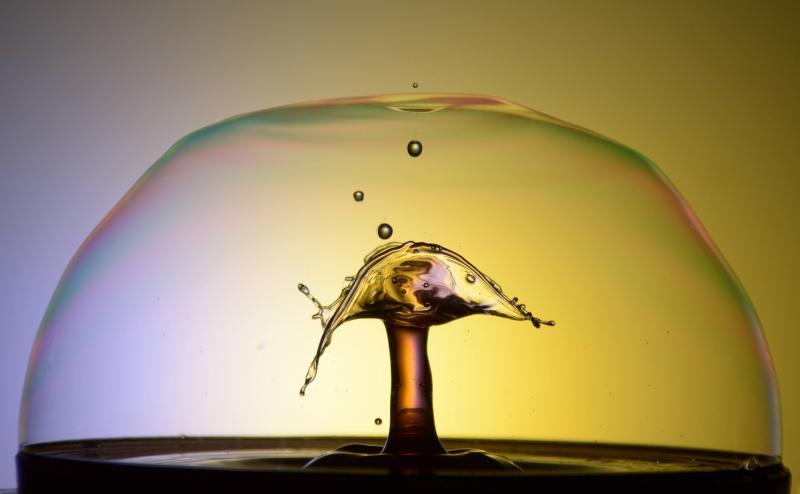
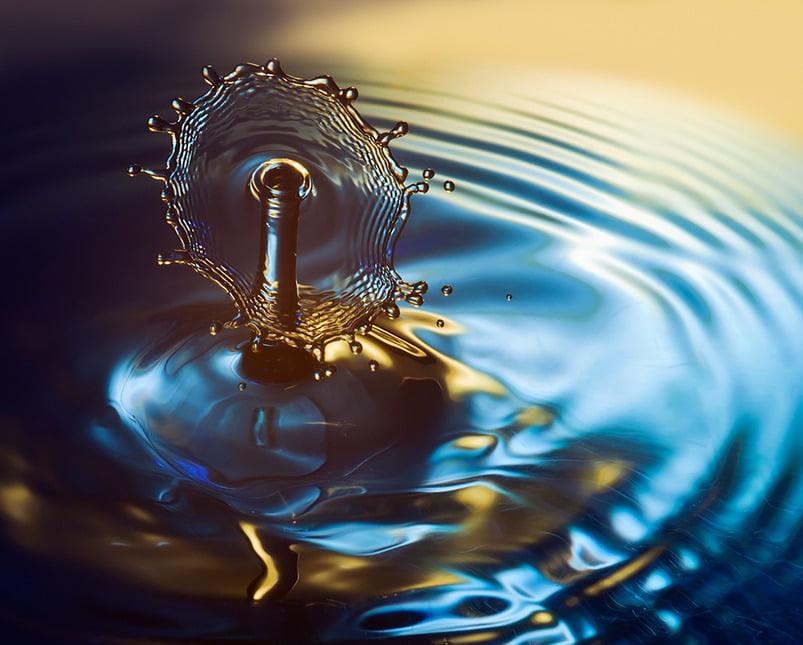
When a water drop strikes a pool, it can form a cavity in the free surface that will rebound into a jet. If a well-timed second drop hits that jet at the height of its rebound, the impact creates an umbrella-like sheet like the one seen here. The thin liquid sheet expands outward from the point of impact, its rim thickening and ejecting tiny filaments and droplets as surface tension causes a Plateau-Rayleigh-type instability. Tiny capillary waves–ripples–gather near the rim, an echo of the impact between the jet and the second drop. All of this occurs in less than the blink of an eye, but with high-speed video and perfectly-timed photography, we can capture the beauty of these everyday phenomena. (Photo credit: H. Westum)
Liquid Sculptures
[original media no longer available]
Water sculptures–a marriage of liquids, photography, and timing–are spectacular form of fluid dynamics as art. Artist Markus Reugels is a master of the form. This video captures the life and death of such water sculptures at 2,000 fps, beginning with the fall of the initial blue droplet. The droplet’s impact causes a rebounding Worthington jet, which reaches its pinnacle just as a second droplet strikes. The impact spreads into an umbrella-like skirt consisting of a thin, expanding liquid sheet with a thicker rim. The rim itself is unstable, breaking into regularly spaced filaments and tiny satellite droplets that shoot outward before the entire structure collapses into the pool. One especially cool aspect of watching this in video is seeing how the blue dye from each droplet spreads as the water splashes and rebounds. You can see the set-up Reugels uses for his photography here. (Video credit: M. Reugels and L. Lehner)

Rebounding Jets

The photo sequence in the upper image shows, left to right, a fluid-filled tube falling under gravity, impacting a rigid surface, and rebounding upward. During free-fall, the fluid wets the sides of the tube, creating a hemispherical meniscus. After impact, the surface curvature reverses dramatically to form an intense jet. If, on the other hand, the tube is treated so that it is hydrophobic, the contact angle between the liquid and the tube will be 90 degrees during free-fall, impact, and rebound, as shown in the lower image sequence. The liquid simply falls and rebounds alongside the tube, without any deformation of the air-liquid interface. (Photo credit: A. Antkowiak et al.)

Dancing Jets
Vibrating a gas-liquid interface produces some exciting instability behaviors. The photo above shows air and silicone oil vibrated vertically within a prism. For the right frequencies and amplitudes, the vibrations produce liquid jets that shoot up and eject droplets as well as gas cavities and bubble transport below the interface. To see a similar experiment in action, check out this post. (Photo credit: T. J. O’Hern et al./Sandia National Laboratories)