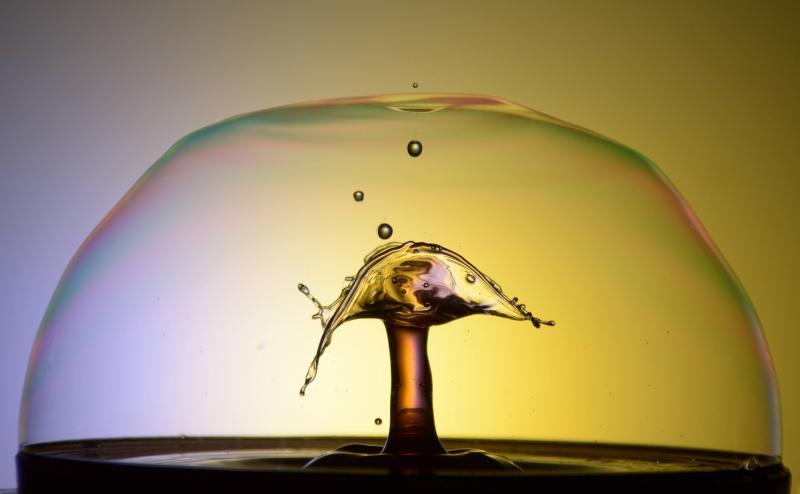
With patience and timing, one can create remarkable sculptures with fluids. To capture this shot, Moussi Ouissem used two droplets, perfectly timed. The first fell through the soap bubble (which stayed intact thanks to its powers of self-healing) and hit the pool of water. The impact caused a cavity, which then inverted into a Worthington jet. The second drop was timed to impact the column of the jet, creating the saddle-shaped splash seen here. Ripples in the bubble are still visible from the passage of the second drop, and several satellite droplets are signs of the violence of the impacts. (Image credit: M. Ouissem)
Search results for: “droplet”
Emulsions By Condensation
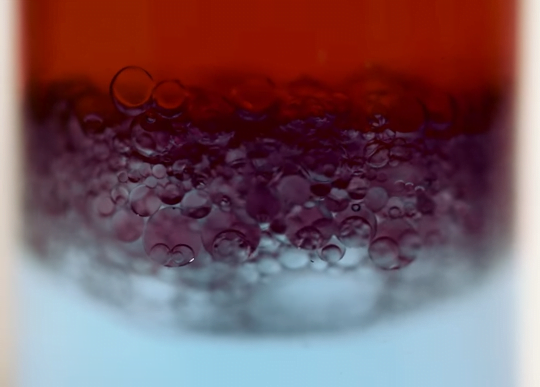
Oil and water are hard to mix, as any salad dressing aficionado will attest. Technically, the two fluids are immiscible – they won’t mix with one another – but one way around this is to emulsify them by distributing droplets of one in the other. This is usually accomplished by shaking or using sound waves to vibrate the mixture, but the results are typically short-lived. The larger a droplet is, the more gravity affects it, causing the buoyant oil to rise and separate from the water.
The key to making an emulsion last is creating tiny droplets, which a new study accomplishes energy efficiently through condensation. Instead of mixing the oil and water immediately, the researchers used a surface covered in a mixture of oil and surfactant and cooled it in a humid chamber. As the temperature dropped, water condensed onto the oil and became encapsulated, creating nanoscale emulsion droplets. At such a tiny scale, buoyant forces are unable to overcome surface tension, so the emulsion remains stable for months. (Image credit: MIT, source; research credit: I. Guha et al.; via MIT News)

Oil Splatters
Most cooks have experienced the unpleasantness of getting splattered with hot oil while cooking. Here’s a closer look at what’s actually going on. The pan is covered by a thin layer of hot olive oil. Whenever a water drop gets added – from, say, those freshly washed greens you’re trying to saute – it sinks through the oil due to its greater density. Surrounded by hot oil and/or pan, the water heats up and vaporizes with a sudden expansion. This throws the overlying oil upward, creating long jets of hot oil that break into flying droplets. These are what actually hit you. This is a small-scale demonstration, but it gets at the heart of why you don’t throw water on an oil fire. (Image credit: C. Kalelkar and S. Paul, source)

Moving Fluids in the Right Direction

One challenge in creating miniature labs-on-a-chip is keeping fluids moving in the desired direction. The top image above shows red and blue droplets being moved toward one another on the top and bottom of a vibrating surface. Eventually, they meet and mix in the middle. To force the fluids in the right direction, the surface is highly textured, as seen in the lower image. These tiny posts and arcs help trap air between the surface and the drop. This makes the drop’s contact area with the superhydrophobic substrate quite small. The arcs provide directionality, and, as the surface shakes, the drops inch along, releasing the arc on the trailing edge as they make contact with a new one. In effect, the droplets walk themselves just where their designers want them to go. (Image and research credit: T. Duncombe et al.; via SciTechDaily)
The Mist of Champagne
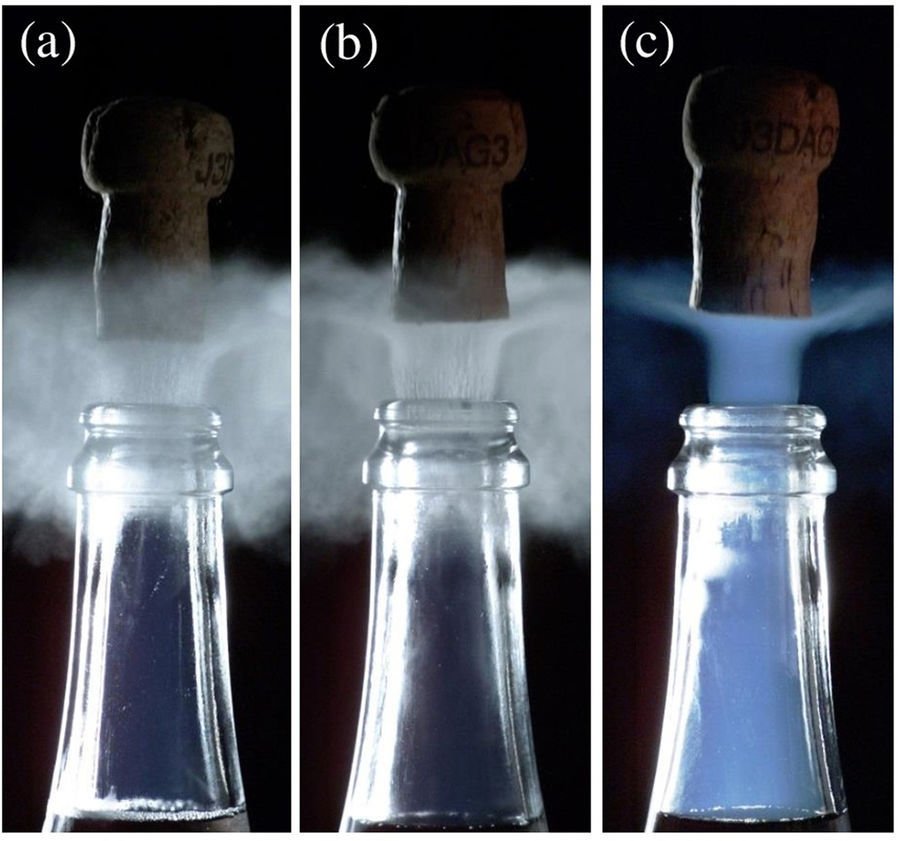
If you’ve ever popped open a chilled bottle of champagne, you’ve probably witnessed the gray-white cloud of mist that forms as the cork flies. Opening the bottle releases a spurt of high-pressure carbon dioxide gas, although that’s not what you see in the cloud. The cloud consists of water droplets from the ambient air, driven to condense by a sudden drop in temperature caused by the expansion of the escaping carbon dioxide. Scientifically speaking, this is known as adiabatic expansion; when a gas expands in volume, it drops in temperature. This is why cans of compressed air feel cold after you’ve released a few bursts of air.
If your champagne bottle is cold (a) or cool (b), the gray-white water droplet cloud is what you see. But if your champagne is near room temperature ( c ), something very different happens: a blue fog forms inside the bottle and shoots out behind the cork. To understand why, we have to consider what’s going on in the bottle before and after the cork pops.
A room temperature bottle of champagne is at substantially higher pressure than one that’s chilled. That means that opening the bottle makes the gas inside undergo a bigger drop in pressure, which, in turn, means stronger adiabatic expansion. Counterintuitively, the gas escaping the warm champagne actually gets colder than the gas escaping the chilled champagne because there’s a bigger pressure drop driving it. That whoosh of carbon dioxide is cold enough, in fact, for some of the gas to freeze in that rushed escape. The blue fog is the result of tiny dry ice crystals scattering light inside the bottleneck.
That flash of blue is only momentary, though, and the extra drop in temperature won’t cool your champagne at all. Liquids retain heat better than gases do. For more, on champagne physics check out these previous posts. (Image and research credit: G. Liger-Belair et al.; submitted by David H.)

Building Liquid Circuits

Building microfluidic circuits is generally a multi-day process, requiring a clean room and specialized manufacturing equipment. A new study suggests a quicker alternative using fluid walls to define the circuit instead of solid ones. The authors refer to their technique as “Freestyle Fluidics”. As seen above, the shape of the circuit is printed in the operating fluid, then covered by a layer of immiscible, transparent fluid. This outer layer help prevent evaporation. Underneath, the circuit holds its shape due to interfacial forces pinning it in place. Those same forces can be used to passively drive flow in the circuit, as shown in the lower animation, where fluid is pumped from one droplet to the other by pressure differences due to curvature. Changing the width of connecting channels can also direct flow in the circuits. This technique offers better biocompatibility than conventional microfluidic circuits, and the authors hope that this, along with simplified manufacturing, will help the technique spread. (Image and research credit: E. Walsh et al., source)

Detergency


Have you ever wondered just how detergents are able to get grease and oil off a surface? This simple example demonstrates one method. In the top image, a drop of oil sits attached to a solid surface; both are immersed in water. An eyedropper injects a surfactant chemical near the oil drop. This lowers the surface tension of the surrounding water and allows the mixture to better wet the solid. That eats away at the oil drop’s contact with the surface. It takes awhile – the middle animation is drastically sped up – but the oil droplet maintains less and less contact with the surface as the surfactant works. Eventually, in the bottom image, most of the oil drop detaches from the surface and floats away. (Image credits: C. Kalelkar and A. Sahni, source)

Surfing Mists
Watch your hot cup of coffee or tea carefully, and you may notice a white mist of tiny micron-sized droplets hovering near the surface. These microdroplets are a little understood part of evaporation. They form over a heated liquid, levitating on vapor that diffuses out from them and reflects off the liquid surface. (This is similar to the Leidenfrost effect, but the authors note it occurs at much lower temperatures. Unrelated research has suggested the Leidenfrost effect can occur at lower temperatures when there is very little surface roughness.)
One of the particularly peculiar behaviors of these tiny levitating microdroplets is that they can exist over dry surfaces as well. The image above shows microdroplets migrating from a liquid surface (right) to a dry surface (center and left). When the droplets near the contact line, they encounter a strong upward flow due to increased evaporation there. This launches the droplets upward and they sail to the dry area. There, their vapor layers continue creating levitation and provide a cushion between them and their neighbors, causing the drops to self-organize into arrays. (Image credit: D. Zaitsev et al.; via Physics World; submitted by Kam-Yung Soh)

Controlling Leidenfrost Drops

On a surface much hotter than their boiling point, droplets can surf on a layer of their own vapor due to the Leidenfrost effect. Recent research has shown that textured surfaces like ratchets can create corrals, traps, and mazes for such droplets. Here, researchers manipulate the propulsion of Leidenfrost drops using non-parallel grooves instead. When placed between two non-parallel plates, the droplet is squeezed by side forces perpendicular to the walls, with the resultant force in the direction where the gap widens. In most states, friction forms an opposition to this squeeze, but for Leidenfrost droplets that frictional force is negligible. Instead, the squeezing from the plates launches droplets toward the wider end of the groove, allowing researchers to design repellers (top) and traps (bottom) for the fast-moving drops. (Image credits: C. Luo et al., source)

Creating Clouds
Despite their ubiquity and importance, we know surprisingly little about how clouds form. The broad strokes of the process are known, but the details remain somewhat fuzzy. One challenge is understanding how nucleation – the formation of droplets that become clouds or rain – works. A recent laboratory experiment in an analog cloud chamber suggests that falling rain drops may help spawn more rain drops.
The experiment takes place in a chamber filled with sulfur hexafluoride and helium. The former acts like water in our atmosphere, appearing in both liquid and vapor forms, while the latter takes the place of dry components of our atmosphere, like nitrogen. The bottom of the chamber is heated, forming a liquid layer of sulfur hexafluoride, seen at the bottom of the animation above. The top of the chamber is cooled, encouraging sulfur hexafluoride vapor to condense and form droplets that fall like rain. A top view of the same apparatus during a different experiment is shown in this previous post.
When droplets fall through the chamber, their wakes mix cold vapor from near the drop with warmer, ambient vapor. This changes the temperature and saturation conditions nearby and kicks off the formation of microdroplets. These are the cloud of tiny black dots seen above. Under the right conditions, these microdroplets grow swiftly as more vapor condenses onto them. In time, they grow heavy enough to fall as rain drops of their own. (Image credits: P. Prabhakaran et al.; via APS Physics; submitted by Kam-Yung Soh)