Liquid sheets break down in a process known as atomization. Above are top and side views of a liquid sheet created by two identical liquid jets impacting head-on. The jets themselves are off-screen to the left. Their collision generates a thin sheet of liquid that flows from left to right. In the center of the images, the sheet has begun to flap and undulate, shedding large droplets from its edges as it does. At the far end of the sheet, much finer droplets are sprayed out from the center as the sheet collapses completely. This is an example of an instability in a fluid. Initially, any disturbance in the liquid sheet is extremely tiny, but circumstances in the flow are such that those disturbances gather energy and grow larger, creating the large undulations. Those undulations are unstable as well and kick off a fresh set of disturbances that grow until the flow completely breaks down. (Image credit: N. Bremond et al., pdf)
Search results for: “droplet”

Inside Ink Jet Printing
Inkjet printers produce droplets at an incredible rate. A typical printhead generates droplets that are about 10 picoliters in volume – that is, ten trillionths of a liter – moving at about 4 meters per second. Resolving the formation of those droplets would require ultra-high speed imaging at millions of frames per second. Instead researchers devised an alternative method to capture droplet formation, based on stroboscopic techniques. In this case the strobe is a 7 nanosecond laser pulse (7 billionths of a second) that illuminates a given droplet twice. By doing this for many droplets, the researchers can create a highly detailed time series like the one above, which shows the inkjet breakup and droplet formation. Here each droplet is 23 micrometers wide – about one-third the width of a human hair. (Image credit: A. van der Bos et al., source)

Quad Copter Schlieren
Schlieren photography is a classic method of flow visualization that utilizes small variations in density (or temperature) to make otherwise unseen air motion visible. Because changing air’s density or temperature changes its index of refraction, variations in either quantity show up as dark and light regions. Here researchers use it to reveal some of the airflow around a small quadcopter, including the vortices that spiral off each propeller and help generate the lift necessary for take-off. The full video includes a couple of neat demos, including what happens when the blades are wet (shown below). In that case, the wingtip vortices are somewhat disrupted by strings of water droplets being flung off the blades by centrifugal force. Beautiful! (Video and image credit: K. Nolan et al., source; submitted by J. Stafford)


A Drip’s Vortex
Drip food coloring into water and you can often see a torus-shaped vortex ring after the drop’s impact. That vortex rings form during droplet impact has been well known for over a century, but only recently have we begun to understand the process that leads to that vortex ring. Part of the challenge is that the vortex formation is very small and very fast, but recent work with x-ray imaging has allowed experimentalists to finally capture this event.
When a drop impacts a pool, surface tension draws some of the pool liquid up the sides of the drop. At the same time, the impact causes ripple-like capillary waves down the sides of the drop. This causes pool liquid to penetrate sharply into the drop, triggering the spirals that mark the forming vortex ring. When drops impact with even higher momentum, multiple vortex spirals can form, as seen on the lower right image. The authors observed as many as four rings during an impact. For more, check out the (open access) article. (Image and research credit: J. Lee et al., source)

Superhydrophobic Splashes
Superhydrophobic surfaces have a complicated microscale structure that changes how water interacts with them, like the hairs on a lotus leaf or the scales of a butterfly’s wing. The photo above shows snapshots at each millisecond as a water drop hits a superhydrophobic surface covered in rows of 18 micron-tall posts. The drop hits with enough speed to drive some water into the space between posts, as shown by the dark area near the center of the splash. As the rest of the droplet spreads, four microjets form along the directions of the micropost array. Those jets remain apparent until the drop reaches its maximum radius and starts to recoil. The rectangular shape of the post array affects how the water pulls away from the surface, or depins, causing the round droplet to instead take on a square-like shape as it pulls back. (Image credit: M. Reyssat et al.)

Blue Man Group in Slow Mo
In their latest video, the Slow Mo Guys team up with the Blue Man Group for some high-speed hijinks, some of which make for great fluidsy visuals. Their first experiment involves dropping a bowling ball on gelatin. The gelatin goes through some massive deformation but comes out remarkably unscathed. Gelatin is what is known as a colloid and essentially consists of water trapped in a matrix of protein molecules. This gives it both solid and liquid-like properties, which means that the energy the bowling ball’s impact imparts can be dissipated through liquid-like waves ricocheting through the gelatin before the elasticity of the protein matrix allows it to reform in its original shape.
The video ends with buckets of paint flung at Dan. The paints form beautiful splash sheets that expand and thin until surface tension can no longer hold them together. Holes form in the sheet and eat outward until the paint forms thin ligaments and catenaries. As those continue to stretch, surface tension drives the paint to break into droplets, though that break-up may be countered to some extent by any viscoelastic properties of the paint. (Image and video credit: The Slow Mo Guys + Blue Man Group, source)

The Coalescence Cascade and Surfactants
Drops of a liquid can often join a pool gradually through a process known as the coalescence cascade (top left). In this process, a drop sits atop a pool, separated by a thin air layer. Once that air drains out, contact is made and part of the drop coalesces. Then a smaller daughter droplet rebounds and the process repeats.
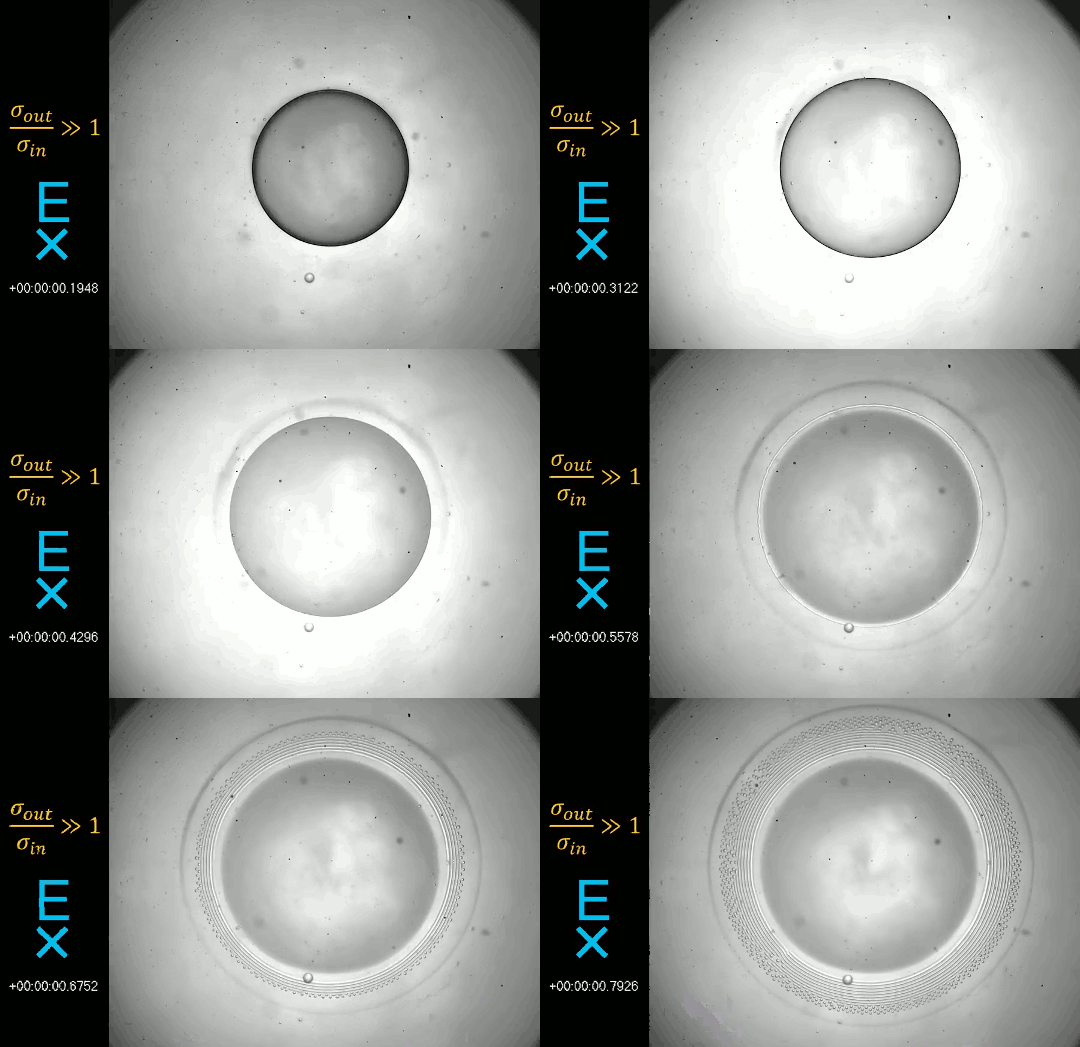
A recent study describes a related phenomenon (top right) in which the coalescence cascade is drastically sped up through the use of surfactants. The normal cascade depends strongly on the amount of time it takes for the air layer between the drop and pool to drain. By making the pool a liquid with a much greater surface tension value than the drop, the researchers sped up the air layer’s drainage. The mismatch in surface tension between the drop and pool creates an outward flow on the surface (below) due to the Marangoni effect. As the pool’s liquid moves outward, it drags air with it, thereby draining the separating layer more quickly. The result is still a coalescence cascade but one in which the later stages have no rebound and coalesce quickly. (Image and research credit: S. Shim and H. Stone, source)


The Tibetan Singing Bowl
Rubbing a Tibetan singing bowl creates sound and a spray of droplets inside the container. But the reverse works, too! Instead of rubbing the bowl, one can project sound at it to make the droplets dance. In the video above, the speaker plays a sinusoidal wave at a frequency that resonates with the bowl. It activates the most basic vibrations in the bowl, making it bulge slightly front-to-back and then side-to-side. This is called the fundamental vibrational mode. The bowl doesn’t change shape enough to see by eye, but you can tell where the bowl is flexing the most – at the four points where the droplets are ejected! The larger vibrations there are what create the spray of droplets. (Video credit: D. Terwagne)

Avoiding Coalescence
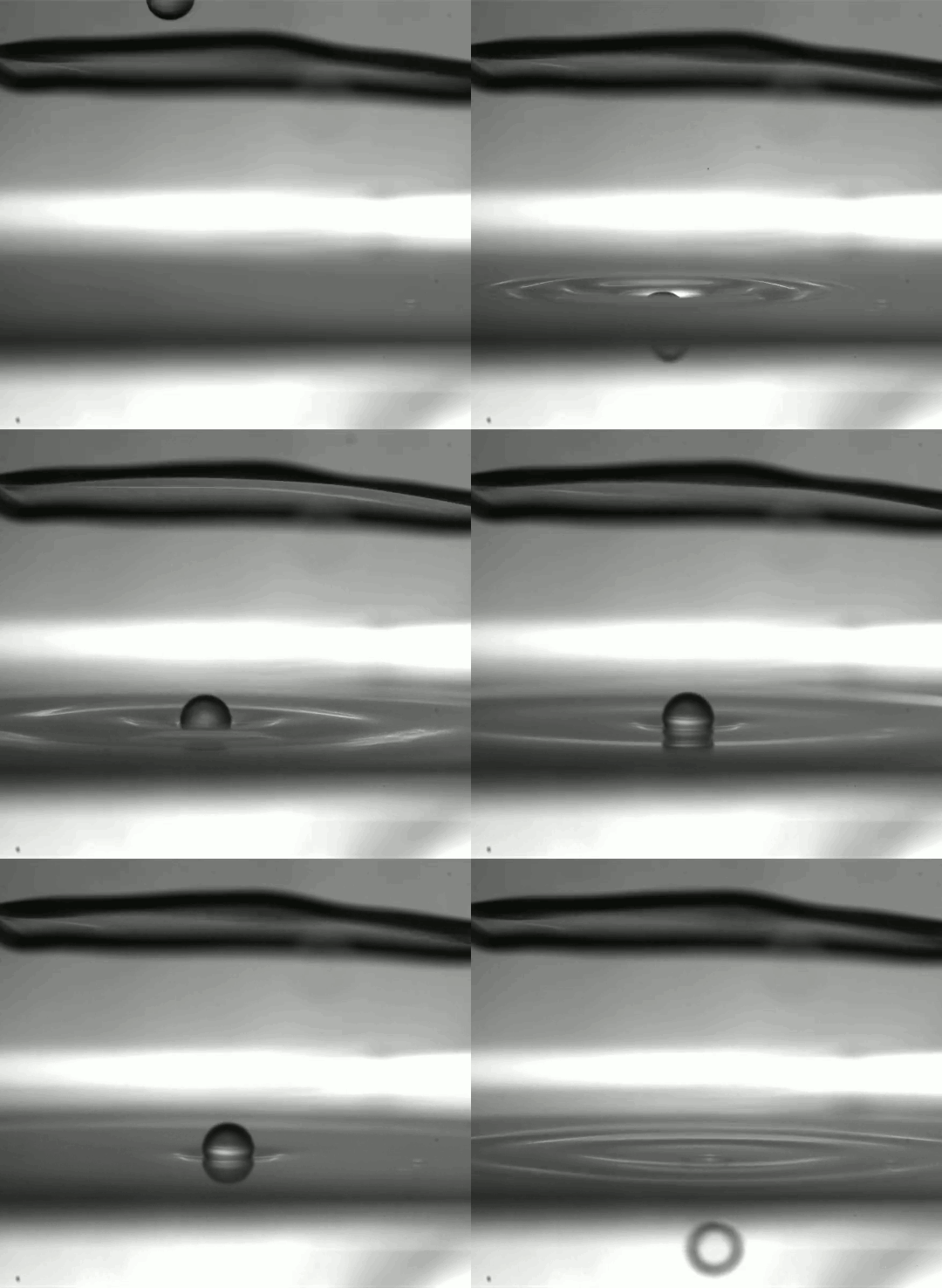
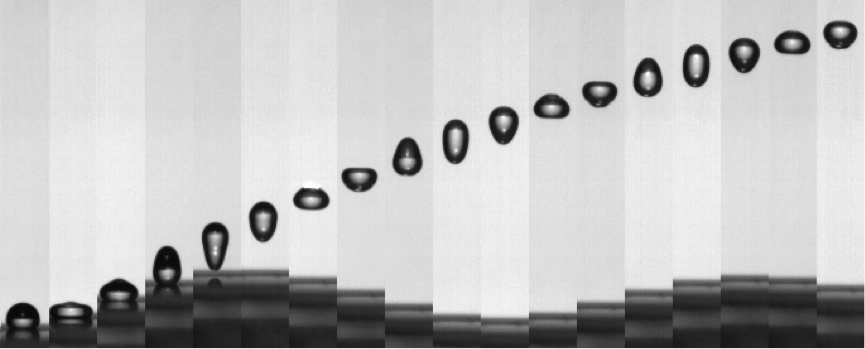
Droplets hitting a liquid surface don’t always coalesce. Above you can see a tiny droplet bounce and skate along the surface of a larger, vibrating drop. The smaller droplet doesn’t coalesce because a tiny layer of air sits between it and the vibrating drop. To actually contact and coalesce, the droplet has to sit still long enough for that air layer to get squeezed out. Instead, the vibration of the larger drop bounces it upwards, refreshing the air layer and scooting the droplet along until it falls off the vibrating drop. (Image credit: C. Kalelkar and S. Phansalkar, source)

Cavity Collapse
One of the most iconic images in fluid dynamics is that of a drop impacting a liquid. When a drop hits a pool, it creates a crater, or cavity. That cavity expands and then collapses to form a jet that rebounds above the pool’s surface. If the jet is fast enough, it will eject one or more droplets before it falls back into the pool. Faster droplets, like the one that formed the cavity and jet shown above, actually create slower and fatter jets. In this regime, the complicated interplay of surface tension and gravity effects results in a jet velocity that is independent of impact speed and the liquid’s viscosity. Understanding this jet and splash dynamics is important for many industrial applications, including ink-jet printing. (Image credit: G. Michon et al.)