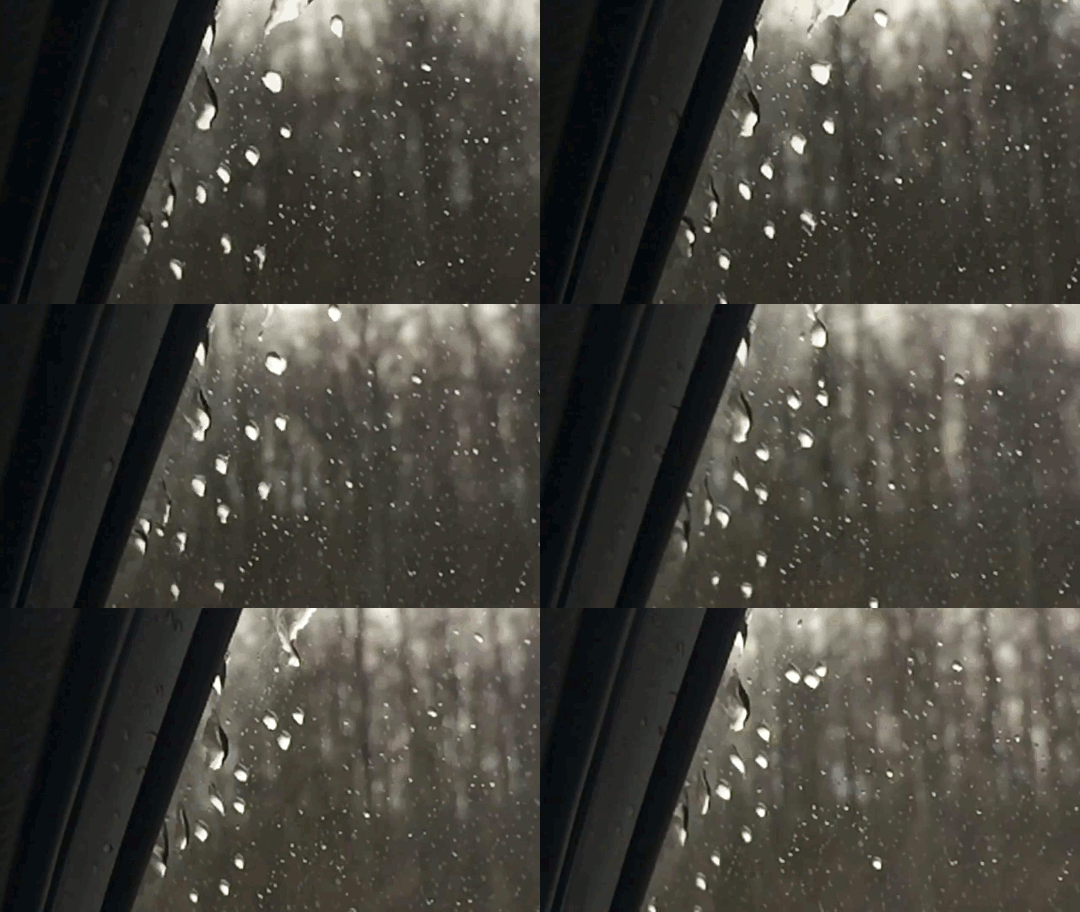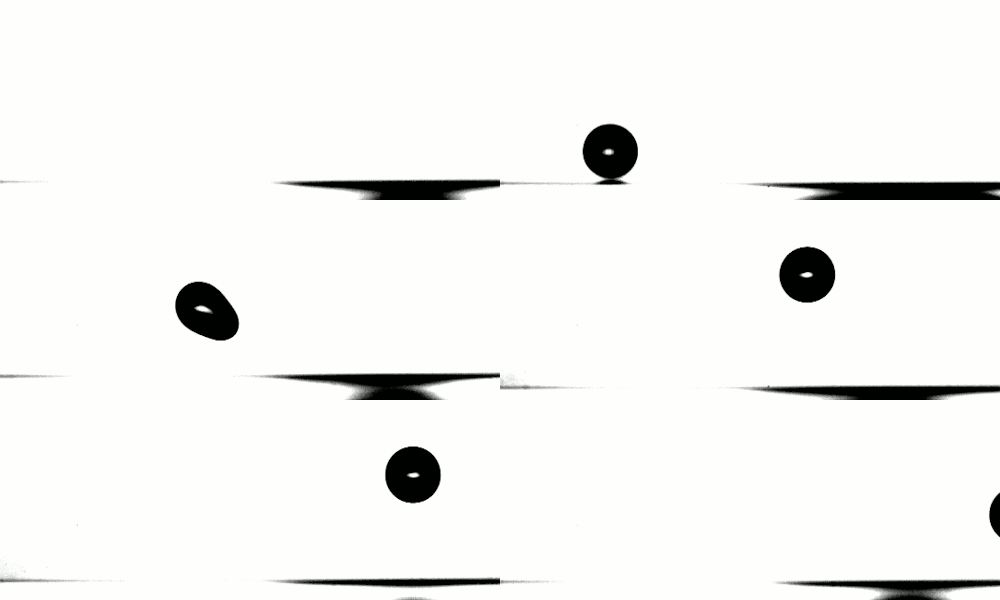
These days artificial snow-making is a standard practice for ski resorts, allowing them to jump-start the early part of the season. Snow guns continuously spray a mixture of cold water and particulates 5 or more meters in the air to generate artificial snow. The tiny droplet size helps the water freeze faster and the particles provide nucleation sites for snow crystals to form. As with natural snow, the shape and consistency of the snow depends on humidity and temperature conditions. Pyeongchang is generally cold and dry, so even the artificial snow there tends to be similar to snow in the Colorado Rockies. Recreational skiers tend to look down on artificial snow, but Olympic course designers actually prefer it. With artificial snow, they can control every aspect of an alpine course. For them, natural snowfall is a disruption that puts their design at risk. (Video credit: Reactions/American Chemical Society)
Search results for: “droplet”

Water Atop Oil
At first glance, this image looks much like the impact of any drop on a pool of the same liquid, but that’s not what you’re seeing. This is the impact of a water droplet on a thin film of oil, and the immiscibility of those two fluids has important effects on the collision. When the water drop impacts, it spreads and forms a compound crown that rises out of the fluid. Eventually, that momentum runs out and the crown falls into the liquid.
Water’s intermolecular forces are strong enough to pull the remains of the droplet back in on itself. As that fluid collides at the center, it gets forced up into a central jet with enough energy to eject a droplet or two at its tip. Even though this looks like a Worthington jet, it’s not. Worthington jets form after the collapse of a cavity in the impacted liquid – in other words, they form on pools, not on films. Despite the visual similarity, this central jet is formed entirely differently! (Image and research credit: Z. Che and O. Matar, source; submitted by O. Matar)

Pilot-Wave Hydrodynamics: Resources
This is the final post in a collaborative series with FYP on pilot-wave hydrodynamics. Previous posts: 1) Introduction; 2) Chladni patterns; 3) Faraday instability; 4) Walking droplets; 5) Droplet lattices; 6) Quantum double-slit experiments; 7) Hydro single- and double-slit experiments; 8) Quantum tunneling; 9) Hydrodynamic tunneling; 10) de Broglie’s pilot-wave theory
Thanks for joining us this week as we explored nearly two centuries’ worth of scientific discoveries around vibration, fluid dynamics, and quantum mechanics. For those who’d like to learn more about these and related topics, we’ve compiled some helpful resources below.
Other Videos, Articles, and Resources by Topic
Chladni Patterns
- ANSYS, “Chladni Plates”
- Brusspup, “Amazing Resonance Experiment!”
- Kenichi Kanazawa, “Color Sound”
- Microfluidic Chladni patterns
- Nigel Stanford, “Cymatics”
- Peter Remco, “Chladni patterns in a violin plate”
- Steve Mould, “Random couscous snaps into beautiful patterns”
Faraday Instability
- FYFD, Alligators and water dancing
- FYFD, Liquid crystals vibrating on a tuning fork
- Gallery of Fluid Motion, “The Tibetan singing bowl”
- Nigel Stanford, “Cymatics”
- Slow Mo Guys, “Chinese spouting bowl in slow motion.”
Quantum Mechanics
Pilot-wave Hydrodynamics
- Dual Walkers, learn about the physics from the researchers themselves
- Gallery of Fluid Motion, “The pilot-wave dynamics of walking droplets.”
- Gallery of Fluid Motion, “Shedding light on pilot-wave phenomena.”
- The Lutetium Project, “Never-ending bouncing droplets.”
- The Lutetium Project, “Dual walkers: drops and waves.”
- Through the Wormhole, Interview with Y. Couder
- Wired, “Have we been interpreting quantum mechanics wrong this whole time?”
- Veritasium, “Is this what quantum mechanics looks like?”
Selected (Academic) Bibliography by Topic
Articles marked with an asterisk (*) are recommended for their approachability and/or broad overview of the subject.
Chladni Patterns
- (*) M. Faraday, “On a peculiar class of acoustical figures; and on certain forms assumed by groups of particles upon vibrating elastic surfaces,” 1831.
- Lord Rayleigh, “On the circulation of air observed in Kundt’s tubes, and on some allied acoustical problems,” 1884.
- H. van Gerner et al., “Air-induced inverse Chladni pattern,” 2011.
Faraday Instability
- (*) M. Faraday, “On a peculiar class of acoustical figures; and on certain forms assumed by groups of particles upon vibrating elastic surfaces,” 1831.
Pilot-wave Hydrodynamics
- Y. Couder and E. Fort, “Single-particle diffraction and interference at a macroscopic scale,” 2006.
- A. Eddi et al., “Unpredictable tunnel of a classical wave-particle association,” 2009.
- (*) Y. Couder et al., “Walking droplets: A form of wave-particle duality at macroscopic scale?”, 2010.
- J. Molacek and J. Bush, “Droplets bouncing on a vibrating bath,” 2013.
- J. Molacek and J. Bush, “Droplets walking on a vibrating bath: toward a hydrodynamic pilot-wave theory,” 2013.
- D. Harris et al., “Wave-like statistics from pilot-wave dynamics in a circular corral,” 2013.
- O. Wind-Willassen et al., “Exotic states of bouncing and walking droplets,” 2013.
- (*) J. Bush, “Pilot-wave hydrodynamics,” 2015.
- D. Harris et al., “Visualization of hydrodynamic pilot-wave phenomena,” 2016.
(Image credit: A. Labuda and J. Belina)

Pilot-Wave Hydrodynamics: Slit Experiments
This post is part of a collaborative series with FYP on pilot-wave hydrodynamics. Previous entries: 1) Introduction; 2) Chladni patterns; 3) Faraday instability; 4) Walking droplets; 5) Droplet lattices; 6) Quantum double-slit experiments
In quantum mechanics, the single and double-slit experiments are foundational. They demonstrate that light and elementary particles like electrons have wave-like and particle-like properties, both of which are necessary to explain the behaviors observed. Similarly, a hydrodynamic walker consists of both a particle and a wave, so, perhaps unsurprisingly, researchers tested them in both single-slit and double-slit experiments.
When a walker passes through a single-slit (top row), it’s deflected in a seemingly random direction due to its waves interacting with the slit. But if you watch enough walkers traverse the slit, you can put together a statistical representation of where the walker will get deflected. Compare that with the results for a series of photons passing through a slit one-at-a-time, and you’ll see a remarkable match-up.
If you test the walker instead with two slits, the droplet can only pass through one slit, but its accompanying wave passes through both (bottom row). Let enough walkers through the system one-by-one, and they, like their photonic cousins, build up interference fringes that match the quantum experiment. Diffraction and interference are only a couple of the walkers’ tricks, however. In the next posts, we’ll take a look at another analog to quantum behavior: tunneling.
(Image and research credits: Couder et al., source, selected papers 1, 2; images courtesy of E. Fort)

Pilot-Wave Hydrodynamics: Walking Drops
This post is a collaborative series with FYP on pilot-wave hydrodynamics. Previous entries: 1) Introduction; 2) Chladni patterns; 3) Faraday instability
If you place a small droplet atop a vibrating pool, it will happily bounce like a kid on a trampoline. On the surface, this seems quite counterintuitive: why doesn’t the droplet coalesce with the pool? The answer: there’s a thin layer of air trapped between the droplet and the pool. If that air were squeezed out, the droplet would coalesce. But it takes a finite amount of time to drain that air layer away, even with the weight of the droplet bearing down on it. Before that drainage can happen, the vibration of the pool sends the droplet aloft again, refreshing the air layer beneath it. The droplet falls, gets caught on its air cushion, and then sent bouncing again before the air can squeeze out. If nothing disturbs the droplet, it can bounce almost indefinitely.

Droplets don’t always bounce in place, though. When forced with the right frequency and acceleration, a bouncing droplet can transition to walking. In this state, the droplet falls and strikes the pool such that it interacts with the ripple from its previous bounce. That sends the droplet aloft again but with a horizontal velocity component in addition to its vertical one. In this state, the droplet can wander about its container in a way that depends on its history or “memory” in the form of waves from its previous bounces. And this is where things start to get a bit weird – as in quantum weirdness – because now our walker consists of both a particle (droplet) and wave (ripples). The similarities between quantum behaviors and the walking droplets, the collective behavior of which is commonly referred to as “pilot-wave hydrodynamics,” are rather remarkable. In the next couple posts, we’ll take a look at some important quantum mechanical experiments and their hydrodynamic counterparts.
(Image credit: D. Harris et al., source)

Pilot-Wave Hydrodynamics: Faraday Instability
This post is part of a collaborative series with FYP on pilot-wave hydrodynamics. Previous entries: 1) Introduction; 2) Chladni patterns
In 1831, in an appendix to a paper on Chladni plate patterns, physicist Michael Faraday wrote:
“When the upper surface of a plate vibrating so as to produce sound is covered with a layer of water, the water usually presents a beautifully crispated appearance in the neighborhood of the centres of vibration.” #
Faraday was not the first to notice this, as he himself acknowledged, but it was his many clever observations and tests of the phenomenon that led to its naming as the Faraday instability. Like Chladni patterns, Faraday waves can take many forms, depending on the geometry of the vibrator and the frequency and amplitude of its vibration.

Beneath the “crispations” at the air interface, the liquid inside the pool is also moving, driven by the vibrations into streaming patterns. Sprinkling particles into this flow reveals discrete recirculation zones that depend on the vibrations’ characteristics, as seen above. This behavior can even be used to assemble particles into distinct formations.

When the vibrations are large enough at resonant frequencies, the rippling waves at the surface become violent enough to start ejecting droplets. You can experience this for yourself using a Chinese spouting bowl or a Tibetan singing bowl with some water. It’s also, bizarrely enough, a factor in alligator mating behaviors!
Next time, we’ll explore what happens to a droplet atop a Faraday wave.
(Image credits: N. Stanford, source; L. Gledhill, source; The Slow Mo Guys, source)

The Fishbone
The simple collision of two liquid jets can form striking and beautiful patterns. Here the two jets strike one another diagonally near the top of the animation. One is slanted into the screen; the other slants outward. At their point of contact, the liquid spreads into a sheet and forms what’s known as a fishbone pattern. The water forms a thicker rim at the edge of the sheet, and this rim destabilizes when surface tension can no longer balance the momentum of the fluid. Fingers of liquid form along the edge, stretching outward until they break apart into droplets. Ultimately, this instability tears the liquid sheet apart. Under the right conditions, all kinds of beautiful shapes form in a system like this. (Image credit: V. Sanjay et al., source)

Rolling Along
Leidenfrost drops – droplets deposited onto a surface much hotter than their boiling point – are known for their mobility. With the right surface, they can be propelled, trapped, and even guided through a maze, typically by directing the vapor layer that cushions them. But new work shows that these drops have internal dynamics that also contribute to their propulsion.
By adding tracer particles to each droplet, researchers can visualize flows inside the droplet. Large drops tend to have a flatter shape and contain two or more rotating vortices. Such drops won’t propel themselves without another force in play. But smaller droplets are more spherical and contain only a single rotating flow. Once these drops detach, they roll away! Despite the similarity to wheels, these liquid drops aren’t moving the same way. Remember that the drop is not actually in contact with the surface. To see what sets the drop’s direction, researchers examined the shape of the bottom of the drop. They found that it sits at a slant on its vapor cushion. That pushes evaporating gases out one side, propelling the drop the other way. (Image and video credit: A. Bouillant et al., source)

Atmospheric Aerosols
Recently, NASA Goddard released a visualization of aerosols in the Atlantic region. The simulation uses real data from satellite imagery taken between August and October 2017 to seed a simulation of atmospheric physics. The color scales in the visualization show concentrations of three major aerosol particles: smoke (gray), sea salt (blue), and dust (brown). One of the interesting outcomes of the simulation is a visualization of the fall Atlantic hurricane season. The high winds from hurricanes help pick up sea salt from the ocean surface and throw it high in the atmosphere, making the hurricanes visible here. Fires in the western United States provide most of the smoke aerosols, whereas dust comes mostly from the Sahara. Tiny aerosol particles serve as a major nucleation source for water droplets, affecting both cloud formation and rainfall. With simulations like these, scientists hope to better understand how aerosols move in the atmosphere and how they affect our weather. (Image credit: NASA Goddard Research Center, source; submitted by Paul vdB)

Microfluidic Chips in Action
Earlier this year, The Lutetium Project explored how microfluidic circuits are made, and now they are back with the conclusion of their microfluidic adventures. This video explores how microfluidic chips are used and how microscale fluid dynamics relates to other topics in the field. Because these techniques allow researchers very fine control over droplets, there are many chemical and biological possibilities for microfluidic experiments, some of which are shown in the video. Microfluidics in medicine are also already more common than you may think. For example, test strips used by diabetic patients to measure their blood glucose levels are microfluidic circuits! (Video and image credit: The Lutetium Project; submitted by Guillaume D.)