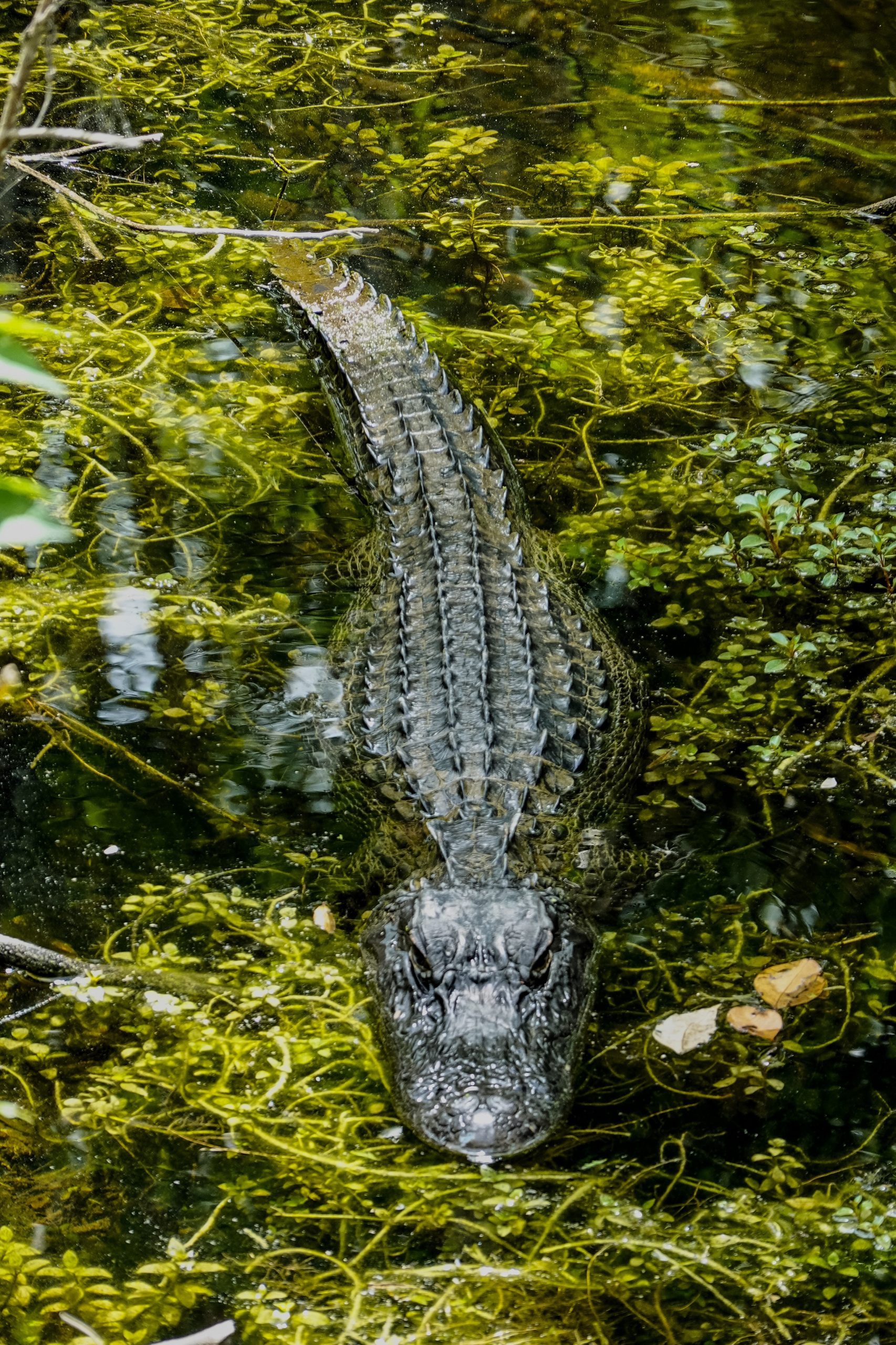
Inspired by crocodilians, young scientist Angela Rofail designed attachments to reduce wind loads on high-rise buildings. When crocodilians swim, the ridges on their back help hide their motion from observation above the surface. Rofail wondered whether similar ridges would reduce the wind-induced swaying of high-rise buildings. Using a scale-model and crocodile-inspired knobs, the Year 10 student (read “high-school freshman” for U.S. readers) conducted wind tunnel tests that showed her modifications reduced drag on the model and kept it from moving in windy conditions. (Image credit: H. Roettger; video credit: CSIRO; via CSIRO; submitted by Kam-Yung Soh)
Search results for: “drag”

Bristling Sharkskin Fights Separation
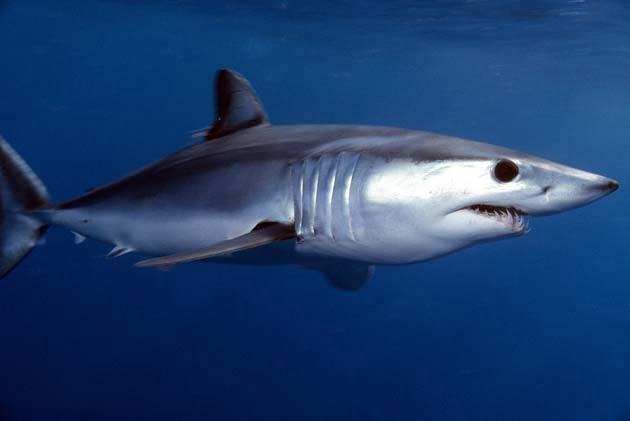
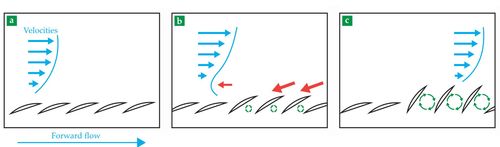
The speedy shortfin mako shark has a secret weapon to fight drag: bristling denticles that line its fins and tail. Denticles are tiny, anvil-shaped enamel scales on the mako’s skin. In the photo above, each one is about 100 microns across. Under normal conditions, with flow moving over the shark from nose to tail, the denticles lie flat, providing no interference.
But when sudden changes in flow near the shark’s skin cause water to begin moving in the opposite direction, the denticles flare up. Their rise interferes with the reversed flow, trapping it in small eddies beneath each denticle. Since that flow reversal is a precursor to the flow separating from the shark’s body, the bristling effectively cuts off flow separation before it can begin. The result is much less separation and much lower drag. Once the flow stops trying to move upstream, the denticles settle back into their original place. (Image credit: mako shark – jidanchaomian, denticles – J. Oeffner and G. Lauder, illustration – A. Lang, bristling – A. Lang et al.; research credit: A. Lang and A. Lang et al.; submitted by Kam-Yung Soh)

Watching a Droplet Freeze
Whether it’s rain hitting an airplane wing or droplet-based 3D printing, the dynamics of a droplet impacting and solidifying on a surface are important. This new study observes the process from below, tracking the progress of freezing on a scale of hundreds of nanoseconds.
All three of the drops you see above are liquid hexadecane. Each droplet was the same size and impacted at the same velocity. What differs in each image is how much colder the surface was than hexadecane’s melting point. The leftmost image shows a droplet on a surface only a few degrees cooler than the melting point. The initial expanding ring shows the droplet’s contact line expanding as it impacts. Then frozen crystals appear and grow inside the drop until the entire thing freezes.
With a slightly colder surface (middle image), frozen crystals form while the contact line is still expanding, and rather than form in distinctive spots, they form as a cloud that quickly expands throughout the drop.
But with an even colder surface (right image), something entirely new happens. As the drop freezes, we see multiple dark rings expand through the drop. Each of these rings is made up of frozen crystals. The researchers argue that we’re seeing a combination of freezing and hydrodynamics here. Essentially, whenever the frozen crystals get large enough, the outward flow of the impacting drop sweeps them toward the contact line. As new crystals grow near the center of the drop, they’re dragged out in a subsequent wave. (Image, research, and submission credit: P. Kant et al.)

Nitro Bubble Cascades

Fans of nitro beers — particularly Guinness’ stout — have probably noticed the fascinating cascade of bubbles that form as the beer settles. It’s a non-intuitive behavior — bubbles rise since they’re lighter than the surrounding fluid. So why do the bubbles appear to sink in these beers?
There are several effects at play here. Firstly, overall the bubbles in the beer are rising; even mixing nitrogen gas into a beer in place of carbon dioxide doesn’t change that. But pint glasses typically flare so that they’re wider at the top than at the bottom. Since the bubbles rise essentially straight up, this causes a bubble-less film to form near the upper walls. And as that heavier fluid sinks, it pulls some of the tiny nitrogen bubbles with it. (You don’t see this effect in typical beers because the bubbles there are larger and thus too buoyant to get pulled down by the falling fluid.)
As for the cascading waves we see in the bubbles, this, too, comes from the shape of the glass. Hydrodynamically speaking, what’s happens as the fluid film slides down the pint glass is similar to what happens when rain runs downhill. Beyond a certain angle, the flow becomes unstable and will form rolls and waves of varying thickness instead of sinking in a thin, uniform layer. As the film goes, so go the bubbles being dragged along, giving everyone at the bar a brief but entertaining fluid dynamical show. (Image credits: pints – M. d’Itri; bubble cascade – T. Watamura et al.; research credit: T. Watamura et al.)

Levitation Without Boiling
One way to levitate droplets is to place them on a surface heated much higher than the droplet’s boiling point. This creates the Leidenfrost effect, where a droplet levitates on a thin layer of its own evaporating vapor. In this study, the situation is quite different.
Although the underlying pool of liquid — here, silicone oil — is heated, its temperature is well below the boiling point of the water droplet. But the droplet still levitates over the pool, thanks to an air layer fed by convection. Aluminum powder in the oil reveals large-scale convection in the pool; note how the oil moves radially toward the droplet. That movement drags the air in contact with the oil with it, which forms the vapor layer keeping the droplet aloft.
One side effect of this convection-driven levitation is that the droplet hovers over the coldest point in the oil. That fact suggests that users can manipulate the droplet’s motion by tuning the underlying heating. (Image and research credit: E. Mogilevskiy)

Gliding Birds Get Extra Lift From Their Tails
Gorgeous new research highlights some of the differences between fixed-wing flight and birds. Researchers trained a barn owl, tawny owl, and goshawk to glide through a cloud of helium-filled bubbles illuminated by a light sheet. By tracking bubbles’ movement after the birds’ passage, researchers could reconstruct the wake of these flyers.
As you can see in the animations above and the video below, the birds shed distinctive wingtip vortices similar to those seen behind aircraft. But if you look closely, you’ll see a second set of vortices, shed from the birds’ tails. This is decidedly different from aircraft, which actually generate negative lift with their tails in order to stabilize themselves.
Instead, gliding birds generate extra lift with their maneuverable tails, using them more like a pilot uses wing flaps during approach and landing. Unlike airplanes, though, birds rely on this mechanism for more than avoiding stall. It seems their tails actually help reduce their overall drag! (Image and research credit: J. Usherwood et al.; video credit: Nature News; submitted by Jorn C. and Kam-Yung Soh)

Where are Titan’s Deltas?
Saturn’s moon Titan is the only other planetary body in our solar system known to have bodies of liquid on its surface. But where Earth has lakes and seas of water, Titan’s are hydrocarbon-based, primarily ethane and methane. As on Earth, these liquids rain from skies and run down rivers and streams into larger bodies. What they do not do, as far as scientists can tell, is form deltas.
On Earth (and ancient Mars), rivers tend to slow and branch out as they run into larger, still bodies. Many of these river deltas — like the Nile, Ganges, and Mississippi — are visible from space. But so far we’ve seen no equivalent formations on Titan, even though the radar resolution of Cassini should have allowed for it.
There are currently two hypotheses to explain this absence. One posits that density differences between hydrocarbon rivers and lakes mean that deltas do not form. On Titan, the larger bodies are warmer and do not absorb as much atmospheric nitrogen, making them lighter overall. That means a cold, dense river might just sink immediately beneath the lake without slowing to deposit sediment.
Another hypothesis is that deltas do form but that the shifting shorelines of Titan’s seas wash them out and make them unrecognizable. There’s evidence that Titan’s northern and southern hemispheres can swap their liquid hydrocarbons back and forth on a 100,000 year timescale. If that’s true, those shifts could obscure any evidence of deltas.
Experiments are underway to test the first hypothesis, but the final answers may have to wait until NASA’s Dragonfly mission reaches Titan in 2034. (Image credit: Titan – NASA/JPL-Caltech/ASI/Cornell, Alaska – NOAA; via AGU Eos; submitted by Kam-Yung Soh)
Superman’s Hair Gel
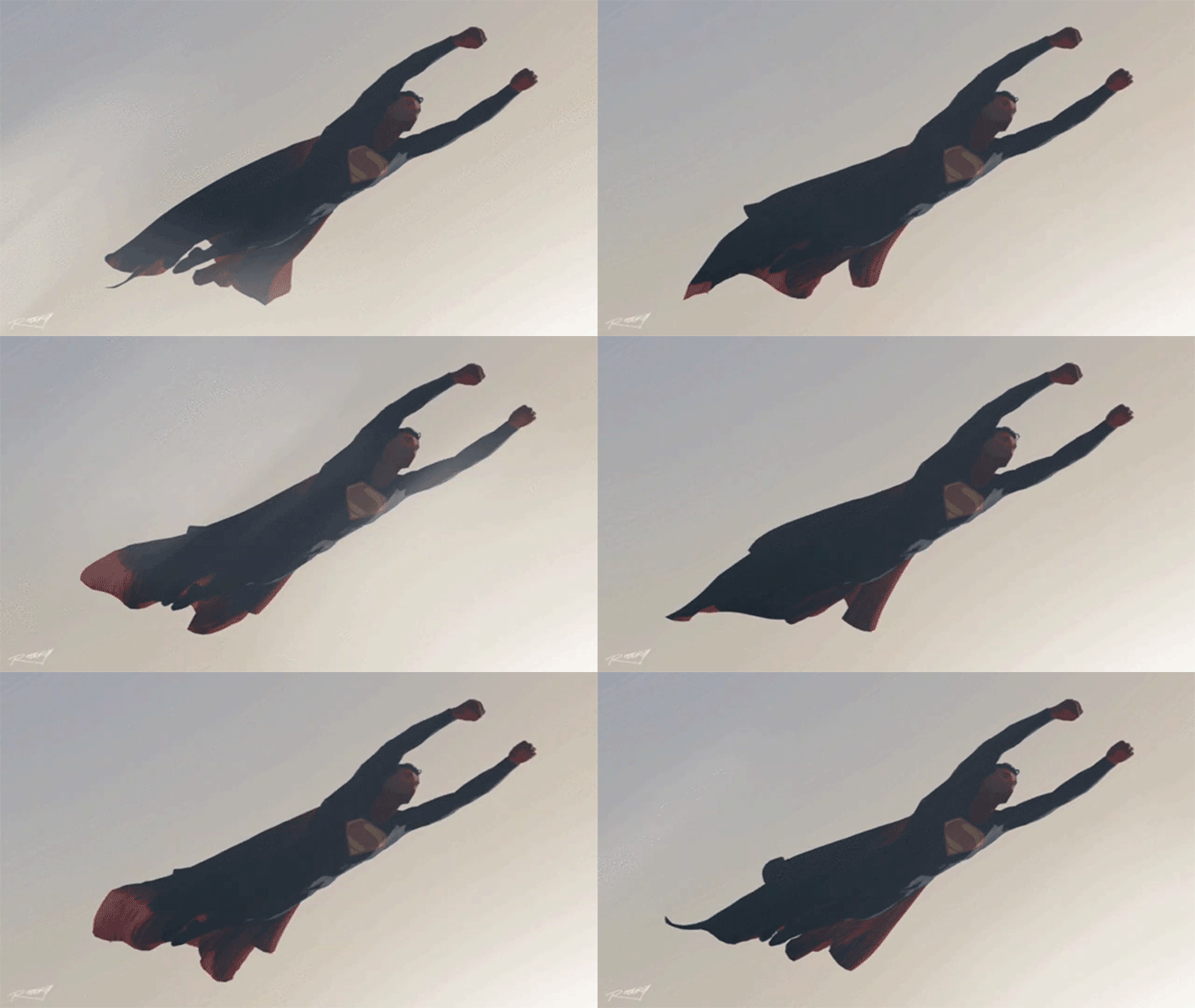
I love a good tongue-in-cheek physical analysis of superheroes. This estimate of the drag force experienced by Superman’s hair when outracing a plane or speeding bullet was done by Cornell students. According to their calculations, Superman’s hair (or his hair gel) must withstand nearly 80,000 Newtons of force. That’s a bit less than the typical force experienced by a restrained passenger in a car crash at highway speeds.
In grad school, my labmates and I held a spirited debate about the difference in drag Superman would experience when flying at hypersonic speeds depending on whether he had one or both arms extended in front of him. Sadly, we never found the chance to test our hypotheses in the wind tunnel. (Image and video credit: R. Geltman et al.)


A Dance of Hydrogen Bubbles
Hydrogen bubbles rise off zinc submerged in hydrocholoric acid in this short film from the Beauty of Science team. In high-speed video, the rise of the bubbles is stately and mesmerizing. Notice how the smallest bubbles appear as perfect spheres; for them, surface tension is strong enough to maintain that spherical shape even against the viscous drag of their buoyant rise. Larger bubbles, formed from mergers both seen and unseen, have a harder time staying round. In them, surface tension must battle gravitational forces and drag from the surrounding fluid. (Image and video credit: Beauty of Science; via Laughing Squid)