Search results for: “drag”

  • Magma Mixing

    Magma Mixing

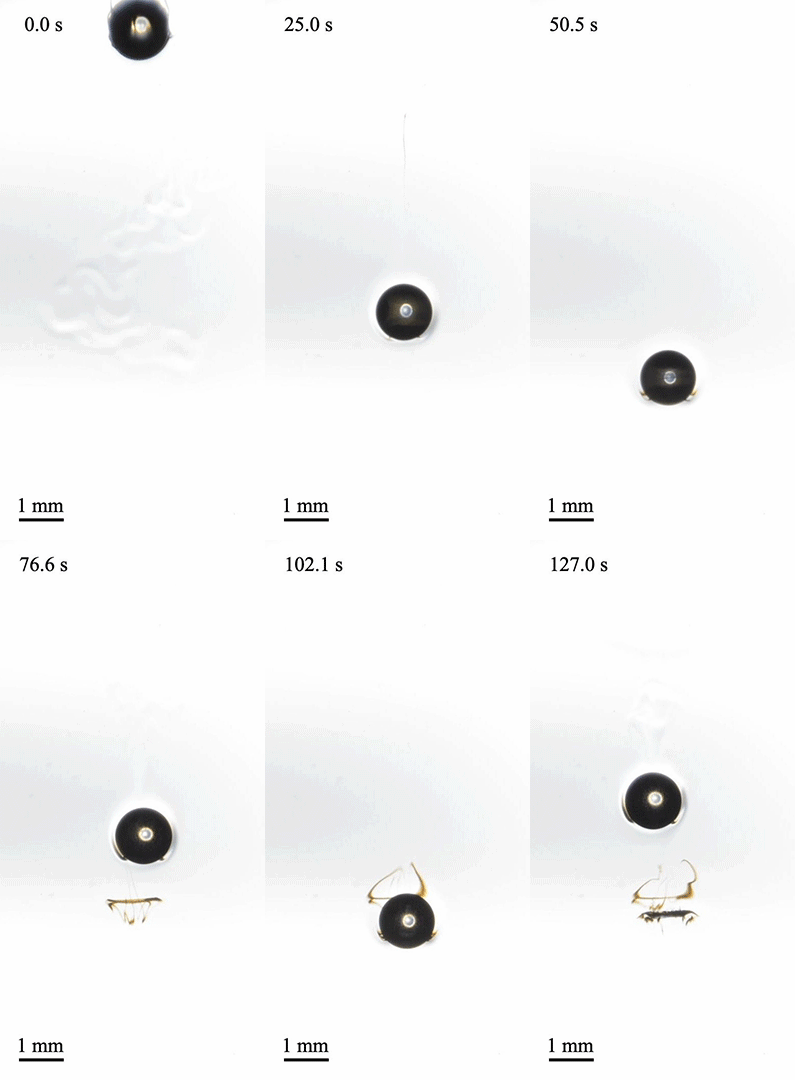
    Magmas typically consist of a mixture of molten liquid, bubbles, and solid crystals. As they mix, those crystals can sink from one viscous layer into another. To investigate this sort of process, researchers studied solid particles sinking across an interface between two viscous liquids. This is what we see above. One fluid is clear; the other is dyed red, and gravity points toward the left so the particles fall from right to left.

    What happens when the particle reaches the interface between fluids depends on three main factors: the gravitational force acting on the particle, the surface tension at the interface, and the ratio of the viscosities of the two fluids. The researchers observed two main outcomes. In one (top), the particle slows at the interface and breaks through slowly, its surface wetted by the second fluid so that it drags little to none of the previous fluid with it. The researchers named this the film drainage mode. It tends to occur when the viscosity ratio between fluids is large.

    The second method, shown in the bottom image, is the tailing mode. As the particle approaches, the interface deforms. A thick layer of the first fluid coats the particle even as it pass through, forming a tail that destabilizes behind the falling particle. This mode occurs when the viscosity ratio is small or the gravitational force is large compared to the surface tension. (Image and research credit: P. Jarvis et al.)

  • How the Hagfish Deploys Its Slime

    How the Hagfish Deploys Its Slime

    Hagfish – an eel-like species – are known for their prodigious slime production, which helps them escape predators (and, in some cases, seriously muck up highways). Part of the hagfish’s slime consists of ~10 cm fibers that the creature deploys in tiny skeins (bottom) only a hundred microns across. To form the viscoelastic slime that thwarts its predators, those skeins of fiber have to unravel and do so in only tenths of a second. A new study shows that viscous drag plays a major role in that unraveling. 

    Most fish use a suction method to catch prey. In the hagfish’s case, that does the predator more harm than good because the very flow it creates to try and catch the hagfish pulls the slime skein apart and helps the slime expand 10,000 times in volume, creating a mess that chokes the gills of the attacking fish. (Image credit: top – L. Böni et al.; bottom – G. Choudhary et al., source; research credit: G. Choudhary et al.; via Ars Technica; submitted by Kam Yung Soh)

  • Inside a Wind Tunnel

    Inside a Wind Tunnel

    When I was in graduate school, I worked in a facility known as the High-Speed Wind Tunnel Lab. We were located next door to the Low-Speed Wind Tunnel, and every few months we’d receive a phone call asking whether we could film someone in the high-speed wind tunnel. This was impossible for several reasons – the size of human beings and the necessity of drawing the hypersonic tunnels down to vacuum-like pressures before initiating flow being only two of them – but what it really did was highlight the difference in definitions. 

    What these (usually) weather forecasters wanted was to simulate hurricane force winds on a human being. And to an aerodynamicist, that hundred mile-an-hour flow is still low-speed. Because we’re comparing it to the speed of sound, not the normal range of wind speeds a human experiences. That said, watching humans struggle inside a wind tunnel is always entertaining. 

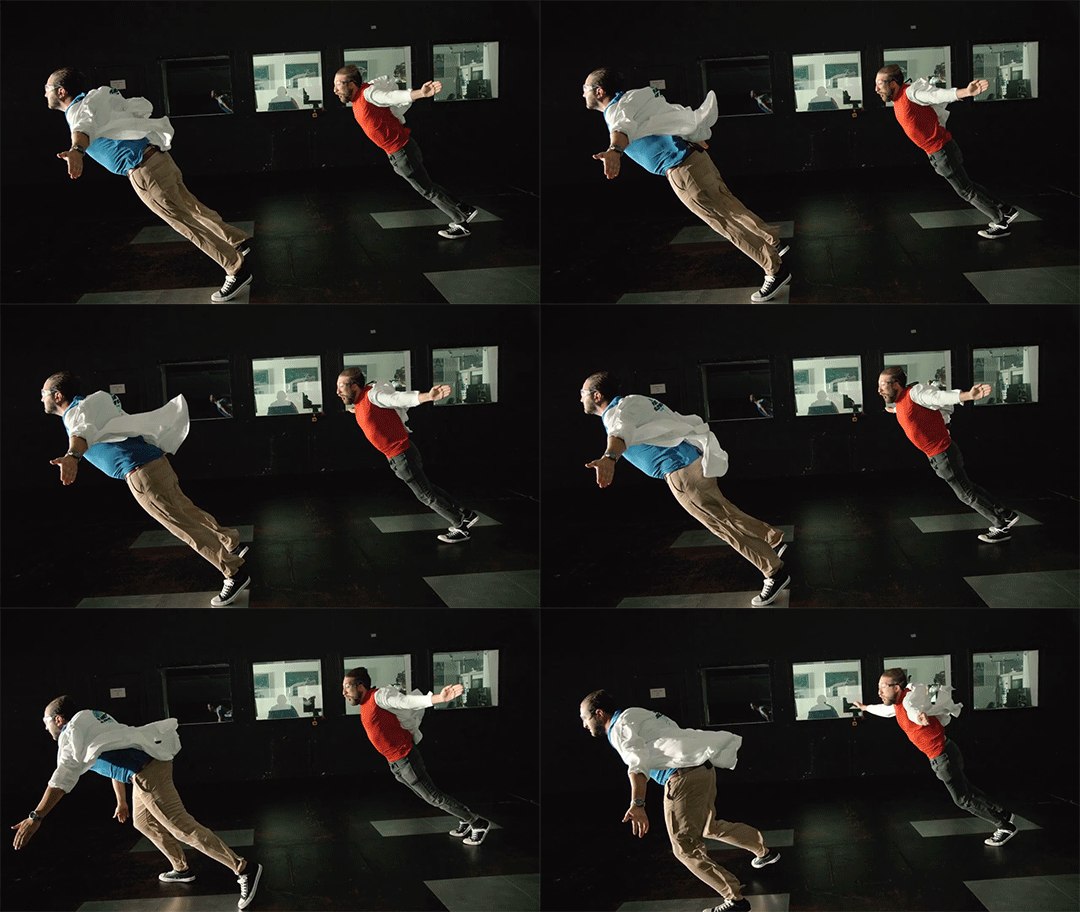
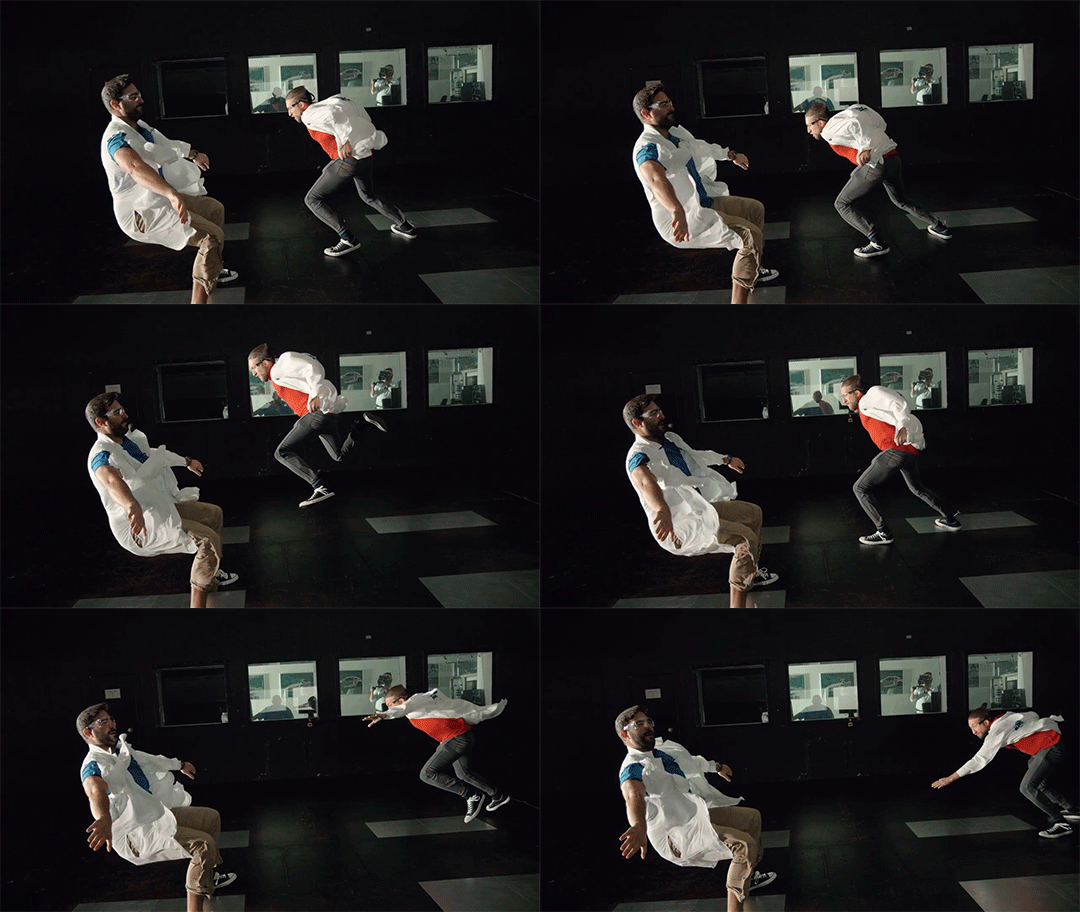
    As you can see from the Slow Mo Guys here, counteracting the lift and drag forces from these wind speeds is tough. On the bottom left, Dan has managed to balance his weight and the drag forces to hold himself in a virtual chair. Meanwhile, Gav’s attempt to jump forward against the wind just pushes him backward as his lab coat parachutes behind him. (Image and video credit: The Slow Mo Guys)

  • Ice Cream Vortex

    [original media no longer available]

    Here’s a fun demonstration of vorticity: sticking an ice cream cone in a bathtub vortex. Now, before someone points out that this is clearly a sink, not a bathtub, the term “bathtub vortex” actually has a standard scientific usage; it’s used to describe a vortex that forms when water drains out a small hole in a larger container.

    Vortices like this have a surprisingly complex flow structure. Although there is some flow dragged into the vortex near the surface, flow visualization shows that most of the flow actually occurs along the bottom of the container. Fluid there gets dragged along the surface, then sucked upward near the center of the vortex, and finally gets pulled down the drain.

    So what’s going on here? As long as the ice cream cone stays balanced inside the center of the vortex, it spins with the fluid due to viscous drag. When it’s unbalanced – like when it precesses too far or throws a chunk of cone off –  I suspect the bottom of the cone is encountering that area of upwelling, which tips the cone completely. The surface flow then pulls it back into the center of the vortex, allowing it to right itself. (Video credit: Cheesemadoodles; research credit: A. Anderson et al.; submitted by randumblrposts and eclecticca)

  • Enormous Ice Disk

    Enormous Ice Disk

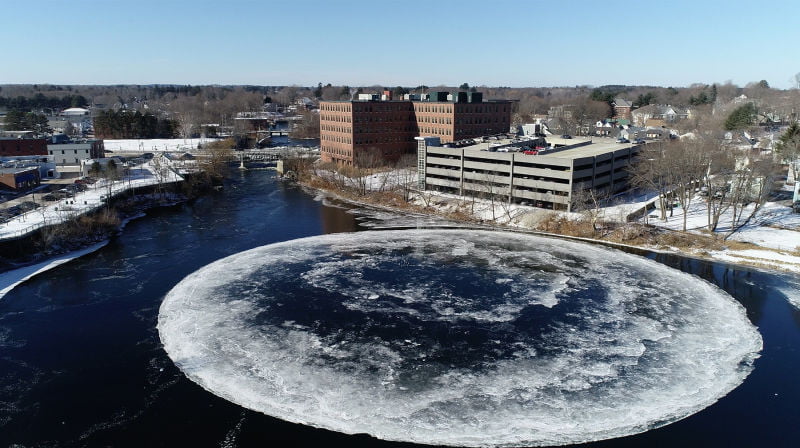
    We’ve seen spinning ice disks before, but this month Westbrook, Maine has developed the largest one I’ve ever seen. A research paper from 2016 indicates that this seemingly alien formation spins due to an oddity of water. Water is at its densest around 4 degrees Celsius, so as the ice of the disk melts in the warmer waters of the river, it sinks. That downward plume sets up a vortex in the water beneath the disk. And as the water spins, it drags the ice with it, causing the disk’s rotation. The warmer the water is, the faster the disk spins. (Image credit: T. Radel/City of Westbrook; research credit: S. Dorbolo et al.; via Gizmodo; submitted by jpshoer)

  • Dip Coating

    Dip Coating

    Imagine dipping a rod into a liquid mixture filled with particles. When you pull the rod out, do particles stick to it? The answer depends on the relative importance of two sets of forces: the viscous drag as you lift the rod and adhesive power of surface tension. Scientists express this as a dimensionless ratio known as the capillary number.

    When the capillary number is small, viscous drag dominates, and any particles that try to stick to the rod get pulled away (upper left). But as you increase the capillary number, surface tension helps particles clump together and stick to the rod (lower left and right). If the surface tension forces are strong enough – meaning that the capillary number is high –  you can actually get multiple layers of particles adhering to the dipped surface. (Image and research credit: E. Dressaire et al.)

  • A Groovy Hovercraft

    A Groovy Hovercraft

    Not long ago, researchers discovered that droplets hovering over a hot grooved surface would self-propel. The extension to this was to investigate a hovercraft on a grooved, porous surface (top half of animation)–think an air hockey table with grooves. In that case, air inside the grooves flows from the point toward the edges, and it drags the hovercraft with it, thanks to viscosity. So the hovercraft travels in the direction opposite the points. This raised an obvious question: what happens if the hovercraft is grooved instead of the surface?

    That’s the situation we see in the bottom half of the animation. Air flows from the table and interacts with the grooves on the bottom of the hovercraft. And this time, the hovercraft propels in the direction of the points. That means there’s a completely different mechanism driving this levitation. When the grooves are onboard the hovercraft, pressure dominates over viscous effects. The air still gets directed down the grooves, but now, like a rocket, the exhaust pushes the hovercraft in the other direction – toward the points. For more on this work, check out the mathematical model of the problem and our interview with one of the researchers in the video below. (Research credit: H. de Maleprade et al.; image and video credit: N. Sharp and T. Crawford)

  • Forming Asteroids

    Forming Asteroids

    Amidst the swirling gas and dust surrounding young stars, asteroids and planets form. Just how these bodies come together – especially before they are massive enough to exert any significant gravitational potential – is an open question. Researchers are trying to better understand the physics involved by studying how clusters of granular material behave when impacted. 

    Above you see footage from two experiments. Both take place in a drop tower under vacuum conditions. That means the effects of air drag and gravity are removed, just like in space. On the left, the cluster is made up of soft clumps of dust; on the right, the cluster contains hard glass beads. Surprisingly, the researchers found that the two different materials behave the same way. They were able to describe both sets of impacts with exactly the same model. This suggests there may be an underlying universal behavior behind all of these granular materials, though the researchers note more experiments are needed. (Image and research credit: H. Karsuragi and J. Blum; via APS Physics)

  • Bubbling

    Bubbling

    Many chemical reactions produce gases as a stream of bubbles out of a solution. Here we see the electrolysis of an aqueous sodium hydroxide solution (NaOH), which produces hydrogen gas on the cathode (left) and oxygen gas on the anode (right). In timelapse, the gas bubbles nucleate on the electrode, slowly growing larger. Once the the bubbles are large enough to detach, though, they rise so quickly they look like they disappear! The large buoyant forces on them drive that brief journey to the surface. By contrast, the smaller bubbles rise slowly, held back by their lesser buoyancy and the viscous drag they experience. (Video and image credit: Beauty of Science)

  • The Flutter of Kelp

    The Flutter of Kelp

    Many species of kelp change their blade shape depending on the current they experience. In fast-moving waters, the kelp grows flat blades, but when the water around them is slower, the same plant will grow ruffled edges on its blades. In a slow current, the ruffled version’s extra drag causes it to flutter up and down with a large amplitude. That helps spread the blades out to catch more sunlight and increase photosynthesis, but it comes at the cost of higher drag, which could tear the plant from its holdfast.

    In contrast, the flat-bladed kelp collapses into a more hydrodynamic shape. This clumps the flat blades together, making photosynthesis harder, but it streamlines the kelp, making it easier to resist getting ripped out by fast-moving tides. (Image credit: J. Hildering; research credit: M. Koehl et al.; submission by Marc A.)