Search results for: “art”

  • Two Views of Ocean Eddies

    Two Views of Ocean Eddies

    Colorful, sediment-laden eddies swirl off the Italian coast in this satellite image. These small-scale eddies — less than 10 km in diameter — can be short-lived and are often difficult to capture in numerical models, but remote sensing can help scientists better understand their impact on oceanic mixing, especially when we capture more than one view of the same event.

    The image below shows the same eddies in an infrared (thermal) view. The resolution on this instrument is not as fine as the natural color one, but we can still make out some of the same swirling motions. It’s also worth comparing the features we don’t see in both images. For example, the Cornia River discharges in infrared as a bright, white plume of cooler water, but it’s barely visible in the color-image, suggesting that the river is not contributing much sediment to the bay. (Image credit: USGS; via NASA Earth Observatory)

    Infrared satellite image of waters off the coast of Italy.
  • Featured Video Play Icon

    Painting on Water With Ebru

    Ebru is the South West Asian art of painting atop water, similar to suminagashi in Japan or paper marbling in European culture. This video takes you inside the studio of Garip Ay, a Turkish ebru artist, letting you observe some of the tools and techniques he uses. Ay’s painting are incredibly dynamic, transforming from one image to something entirely different as he applies more dye, adds a surfactant, or draws a clean brush through the liquid. (Video and image credit: Great Big Story; artist: G. Ay; via Colossal)

  • Featured Video Play Icon

    Digging Droplets

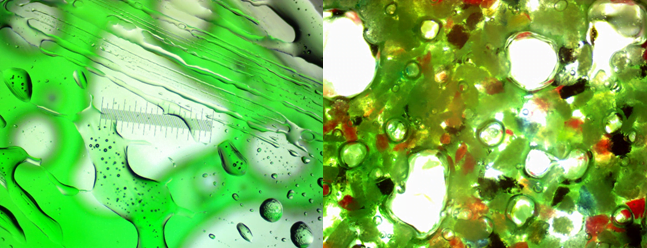
    A droplet on a surface much hotter than its boiling point will skate on a layer of its own vapor, thanks to the Leidenfrost effect. But if that surface is, instead, a granular mixture like this glass powder, the droplet will dig itself a hole.

    As in the usual Leidenfrost situation, the heat of the powder causes part of the drop to vaporize. But as that vapor flows away, it carries powder with it. At the same time, the vaporization process causes the droplet to vibrate violently, which frees more powder and helps the drop dig deeper. Eventually, the drop will vaporize completely, leaving a volcano-like crater in the powder. (Image and video credit: C. Kalelkar and H. Sai)

    A water droplet falls on heated glass powder, which it then digs its way into.
  • Ferrofluid Snakes

    Ferrofluid Snakes

    We’re used to seeing ferrofluids — with their suspended iron nanoparticles — as spiky fluids when exposed to a magnetic field. But this is not always the case. Here, the ferrofluid is immersed in a thin liquid layer — window cleaner, in this case — and when a magnet is brought near, it forms snake-like, labyrinthine lines. (Image credit: M. Carter et al.)

  • Featured Video Play Icon

    Ultrasound in Medicine

    When you hear the term “ultrasound,” your brain likely jumps to grainy black and white images of unborn babies, but this technology has a lot more medical uses than just that! Ultrasound is used to image many parts of the body — earlier this year, I got to see my own heart in action through an echocardiogram, for example. But the technology has therapeutic uses as well. At higher energies, ultrasound is used to break up kidney stones (through cavitation), treat tremors, and alleviate some sources of pain. To learn more, check out Explore Sound’s page on biomedical acoustics. (Video and image credit: Acoustical Society of America)

  • Branching Gels

    Branching Gels

    If you sandwich a viscous fluid between two plates, then pull the plates apart, you’ll often get a complex branching pattern that forms as air pushes its way into the fluid. But the exact results depend strongly on what kind of viscous fluid you used. A new study looks specifically at what happens when that fluid is a yield-stress gel.

    Yield-stress fluids behave like a solid until a critical amount of force causes them to flow. Think about your toothpaste. When you take the cap off, the toothpaste stays put until you squeeze the tube enough to make it flow. The gels used in this experiment behave similarly.

    The researchers found that their gels required a critical energy input in order to branch and flow. If the energy applied in pulling the plates apart was too low, no branching occurred (Image 1). But beyond that critical energy, separating the plates created intricate branching patterns consistent with those seen in simpler, Newtonian fluids. (Image, research, and submission credit: T. Divoux et al.; via APS)

  • Speeding Sedimentation

    Speeding Sedimentation

    Did you know that particles settle faster in an inclined container instead of a vertical one? This sedimentation phenomenon is known as the Boycott effect, after the researcher who first described it. Boycott noticed that red blood cells settled out of samples faster when the test tubes were inclined.

    The inclined walls give particles a much larger area to settle on. As the particles gather on the wall, it creates a buoyant, particle-free layer of fluid above. That fluid quickly rises to the top of the container, helping to push the sediment further toward the bottom. As you can see in the video below, the Boycott effect drastically reduces settling time. (Video and image credit: C. Kalelkar)

  • Sediment and Coral

    Sediment and Coral

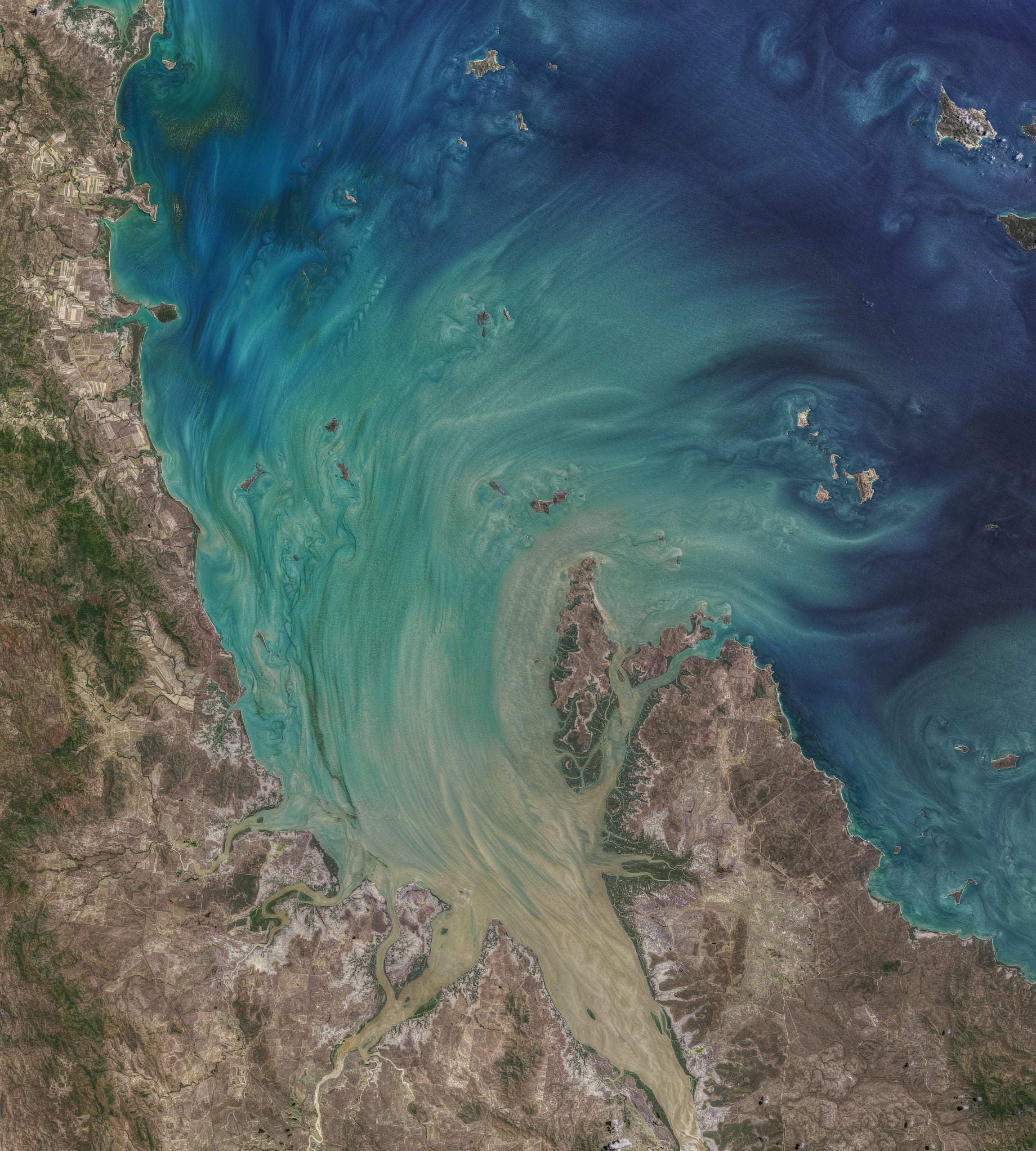
    As rivers wash sediment toward the sea, they carve elaborate deltas like that of the Rio Cauto in Cuba. Over time these sediments build up marshes, swamps, lagoons, and other wetlands that provide critical habitat and flood control. Sediment also washes into the bay, where it interacts with the coral reefs (light green lines on the lower left) and the species that live there. (Image credit: L. Dauphin/USGS; via NASA Earth Observatory)

    Satellite image of Cuba's Gulf of Guacanayabo. The green curves in the lower left are the upper portions of coral reefs in the bay.
  • Featured Video Play Icon

    The Explosive Vaporization Derby

    When pressurized, liquids can be superheated to temperatures well above their normal boiling point. When the pressure is released, the liquid will start boiling, sometimes explosively. In this video, researchers explore that dynamic by “racing” a series of liquids against one another. Each racer has been heated to a different temperature beyond the expected boiling point.

    The clear winner is the liquid with the highest overheat; as explained in the latter part of the video, beyond a critical overheat temperature, vaporization waves in the fluid enhance the boiling, helping vaporization take place faster. (Video and image credit: K. Jing et al.)

  • Mimicking Insect Flight

    Mimicking Insect Flight

    There’s an oft-repeated tale that science cannot explain how a bumblebee flies. And while that may have been true 80 years ago, when engineers assumed they could apply their knowledge of fixed-wing aircraft to insects, it’s very far from the truth now.

    Being small, insects use aerodynamic tricks that are very different from the physics used by aircraft or even birds. Insects like fruit flies use a forward-and-backward sweeping motion at a very high angle of attack as they flap. This motion creates a vortex at the leading edge of the wing that provides the lift keeping the insect aloft. It still requires fast reflexes — most insects flap their wings hundreds of times a second — but the mechanism is robust enough to keep insects aloft and maneuverable. (Image credits: Robobee – K. Ma and P. Chirarattananon, simulation – F. T. Muijres et al., illustration – G. Lauder; via APS Physics)