Search results for: “art”

  • Searching For Solar Neutrinos

    Searching For Solar Neutrinos

    An experiment in Italy has reported new findings confirming a long-standing theory of nuclear fusion in our Sun. The researchers were able to detect neutrinos released by the relatively rare fusion of carbon and nitrogen. But catching those neutrinos took an impressive fluid dynamical feat.

    The Borexino solar-neutrino detector is essentially an enormous nylon balloon, filled with liquid hydrocarbons, immersed in water, and buried beneath a kilometer of rock. Most neutrinos fly through this milieu unhindered, but a few collide with hydrocarbon molecules, creating streaks of light picked up by the detector.

    The challenge in distinguishing solar carbon-nitrogen neutrinos comes from an isotope in the balloon’s nylon lining, which slowly leaks into the detector. The noise caused by the leaking isotope is easily confused with the true solar signal. To tamp down on that noise level, the researchers took elaborate steps to ensure that all 278 tonnes of liquid in the detector remained at exactly the same temperature, thereby eliminating convection in the detector. With only molecular diffusion to move the noisy isotopes, the researchers held the liquid incredibly still. One team member described the fluid as moving only tenths of a centimeter a month! (Image credit: NASA SDO; via Nature; submitted by Kam-Yung Soh)
  • When Shear Meets Slip

    When Shear Meets Slip

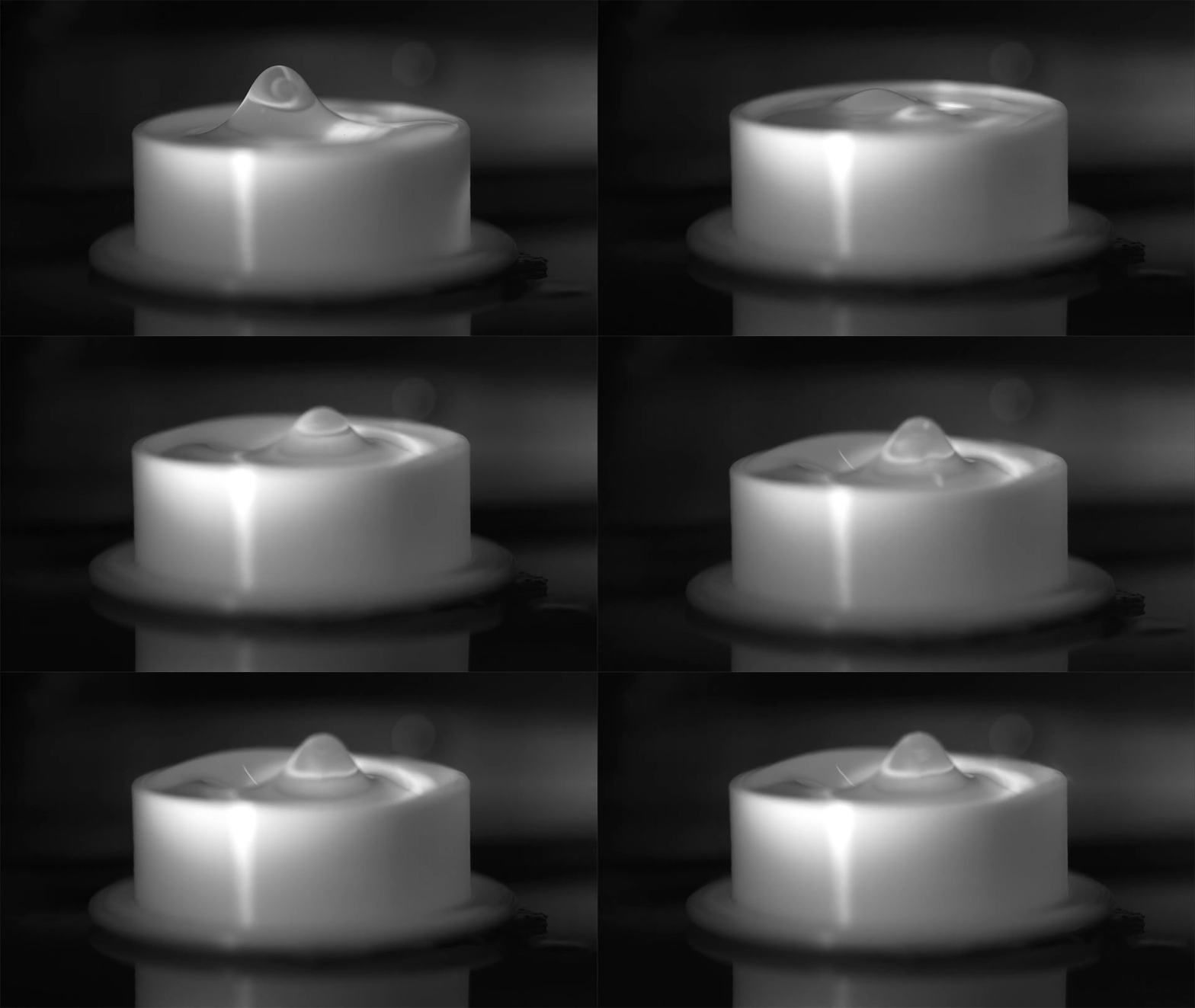
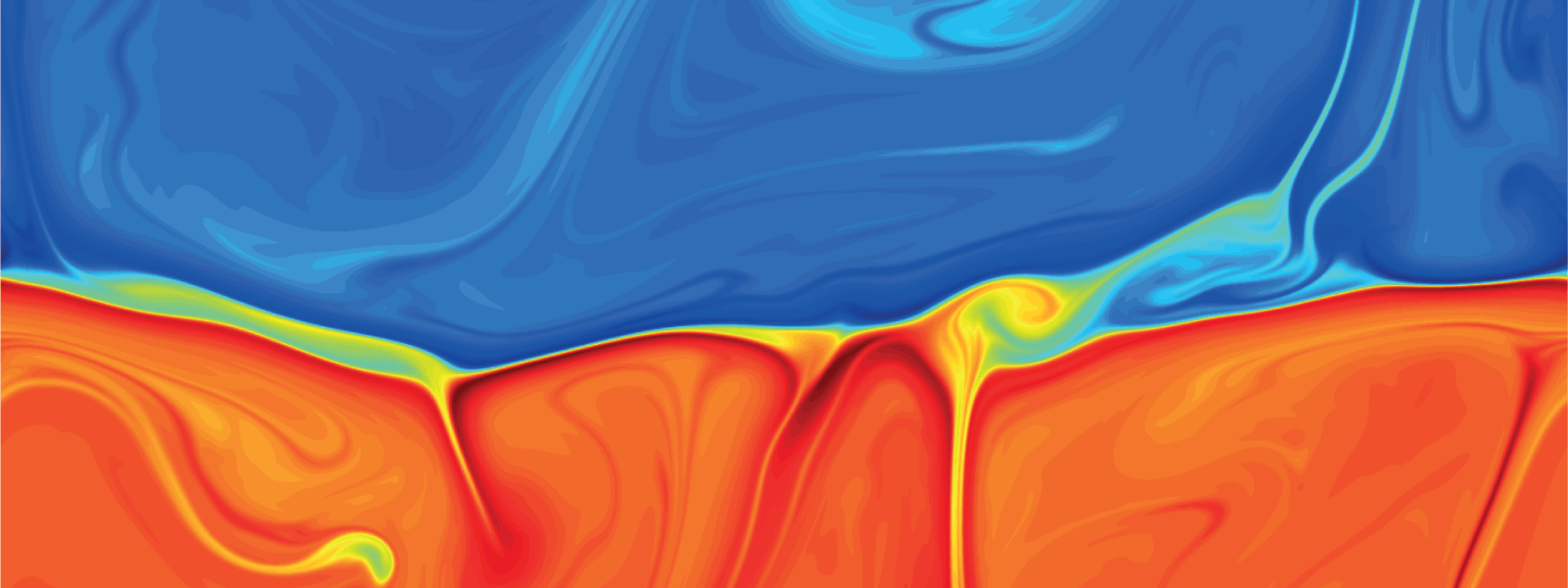
    One of the classic concepts students learn early in their fluids education is the no-slip condition. In essence, this idea says that friction between a solid object — say, a wall — and the fluid immediately next to it is such that no movement is possible where they meet. The fluid cannot “slip” along the surface, hence “no-slip”. It’s a simple concept, but one that can create a lot of complexity in practice.

    Imagine, for example, a fluid sandwiched between two surfaces: one stationary and one moving at a constant speed. This movement creates a shear flow, in which the velocity of the fluid varies from the speed of the moving plate all the way down to zero, the speed of the stationary plate. If we placed a little platelet in the middle of this flow, we’d expect it to rotate because of the faster flow on one side.

    But a new paper finds something rather different, at least when considering an extremely small nanoplatelet. With a tiny enough plate, individual molecules can slip along the surface, and when that happens, instead of rotating, the nanoplatelet aligns itself with the flow. That alignment means the added particle would disturb the flow less, creating a lower viscosity and better flowability. (Image and research credit: C. Kamal et al.; submitted by Simon G.)

  • Featured Video Play Icon

    Alien Eggs? A Virus?

    Nope, they’re hydrogel beads! The team at Chemical Bouillon seem to have once again coated them in something like paint before placing them in water. As the gel beads absorb water, they expand, tearing through their coating. The result is weirdly mesmerizing and kind of creepy. It’s no wonder that special effects artists have historically turned to fluids for sci-fi films! (Image and video credit: Chemical bouillon)

  • Featured Video Play Icon

    How Well Do Masks Work?

    Many mixed messages have been spread about the efficacy of masks in preventing transmission of COVID-19. Nevertheless, there is good evidence that they help, as discussed in this video from It’s Okay to Be Smart. Much of the video shows schlieren imaging of a (healthy) individual engaging in regular activities – like talking, breathing, and coughing — with and without a cloth mask.

    Now, it’s important to note that what you see in these images is airflow, not the droplets that can carry the virus. However, research has shown that these airflows play a significant role in transporting droplets. It follows that disrupting those airflows can disrupt transmission of diseases passed via droplet. This is one of the key reasons to wear a mask.

    Notice how far jets and plumes of air fly from a maskless person’s mouth and nose. We cannot even observe how far momentum carries that air because the area visualized in this schlieren set-up is smaller than the full distance the air moves! But wearing a mask breaks up that flow structure. It reduces the air’s momentum, and it forces any air that does escape to move in smaller, less efficient structures. Even without considering any filtering effects or the fact that masks catch large droplets coming out of the wearer’s mouth, it’s clear that mask-wearing keeps others nearby safer. (Video and image credit: It’s Okay to Be Smart; references)

  • Shake It!

    Shake It!

    Vibrate a pool of water, and you’ll get Faraday waves, ripple-like excitations that form their own distinctive pattern compared to the driving vibration. But you don’t have to vibrate a pure liquid to see Faraday waves. A recent study observed them in vibrated earthworms!

    Odd as this may sound, the results make sense. When anesthetized (as they were in the experiments), earthworms are essentially a liquid wrapped in an elastic membrane, which is not so different from a droplet held together by surface tension.

    But why vibrate earthworms in the first place? It turns out earthworms are a good model organism for studies of vertebrate neural systems, so observing how vibrations propagate through them can provide insight into how our own nervous systems transmit information. (Image, research, and submission credit: I. Maksymov and A. Pototsky)

  • Internal Waves in the Andaman Sea

    Internal Waves in the Andaman Sea

    Differences in temperature and salinity create distinct layers within the ocean. When combined with flow over submerged topography — underwater canyons, mountains, and reefs — it makes waves. But those waves aren’t always apparent when sitting at the surface. Instead, they travel along those ocean layers as internal waves that can be as tall as hundreds of meters in height.

    When the sun glints just right off the ocean, these massive internal waves can be caught by satellite imagery, as shown in the above image of the Andaman Sea near Thailand and Myanmar. Even seemingly calm waters can roil in the deep. (Image credit: USGS; via NASA Earth Observatory)

  • Featured Video Play Icon

    Making Waves

    The Seoul Aquarium is now home to an enormous crashing wave, courtesy of design company d’strict. Check out several different views of the anamorphic illusion in their video above. There’s no word on the techniques used to generate the animation, but it’s certainly a cool visual! (Image and video credit: d’strict; via Colossal)

  • New Details on the Sun’s Surface

    New Details on the Sun’s Surface

    As part of its shakedown, the new Inouye Solar Telescope has captured the surface of the sun in stunning new detail. Seen here are some of the sun’s turbulent convection cells, each about the size of the state of Texas. Hot plasma rises in the center of each cell, cools, and then sinks near the dark edges. Also visible within these dark borders are bright spots thought to mark magnetic fields capable of channeling energy out into the corona. Researchers hope the new telescope will help them uncover the physics behind these processes. (Image and video credit: Inouye Solar Telescope)

    Convection cells on the sun.

    Editor’s note: Like several other telescopes located in Hawai’i, the Inouye Solar Telescope was built against the wishes of many native Hawaiians. Although FYFD supports scientific progress, it is my personal belief that scientific advances should not come at the expense of indigenous populations. I strongly urge my scientific colleagues to listen to and work alongside those with concerns about future facilities.

  • Featured Video Play Icon

    Mimicking Supernovas

    The Hubble archives are full of incredible swirls of cosmic gas and dust, many of which were born in supernovas. Predicting the forms these massive explosions will generate is extremely difficult, thanks in large part to the complicated fluid dynamics generated by their blast waves. But new lab-scale experiments may help shed light on those underlying processes.

    Researchers mimic supernovas in the lab by launching blast waves through an interface between a dense gas (shown in white) and a lighter one (which appears black). As the blast wave passes, it drives the dense fluid into the lighter one, triggering a series of instabilities. Notice how any initial perturbations in the interface quickly grow into mushroom-like spikes that rapidly become turbulent. This behavior is exactly what’s seen in supernovas (and in inertial confinement fusion)! (Video credit: Georgia Tech; research credit: B. Musci et al.; submitted by D. Ranjan)

  • Featured Video Play Icon

    Celebrating Turbulence

    Laminar flow is easy to love, but turbulence is a far richer phenomenon. That’s the premise behind Veritasium’s new video (and, yes, I agree with him). In the video Derek provides a nice introduction to turbulence, including a checklist of qualities a turbulent flow must have.

    Personally, I don’t classify flows as simply being either laminar or turbulent; I view those two states as ends of a spectrum, which means there are many flows that fall somewhere in-between. (For more on what happens between laminar and turbulent, check out my video on transition.)

    As neat and eye-catching as laminar flow can be, turbulence is critical to life as we know it. It’s a necessary ingredient in cloud and raindrop formation. It drives the mixing of blood in our hearts. It keeps the leaves on trees from overheating. Without it, your coffee would be cold long before your cream mixes in. Turbulence is even critical to star formation; without turbulence, our entire solar system might have lacked the matter and time necessary to form! (Video and image credit: Veritasium)