Search results for: “art”

  • Granular Fingers

    Granular Fingers

    Finger-like shapes often form on fluids injected between glass plates, but what happens when that injected fluid contains particles? That’s the situation in this recent study, where researchers sandwiched a fluid between two glass plates and then injected a second, similar fluid laced with particles.

    Despite the differences from the traditional Saffman-Taylor set-up, the granular-filled fluid still forms fingers as long as there’s even a slight density difference between the original and injected fluids. It doesn’t even matter which of the two fluids has the greater density! (Image and research credit: A. Kudrolli et al.)

  • Featured Video Play Icon

    Leidenfrost on Water

    When a skillet is hot enough, water droplets will skitter across the surface almost frictionlessly thanks to the Leidenfrost effect. The incredibly high temperature of the surface relative the the liquid’s boiling point causes part of the drop to vaporize, enveloping the remainder of the liquid in a protective vapor cocoon. 

    We see this effect for more than just solid surfaces, though. This video demonstrates how pouring liquid nitrogen on a pool of water creates plenty of Leidenfrost weirdness as well. It looks as though the initial pour freezes some condensation to dust or other particles, which then stream outwards on a cloud of vapor. Larger droplets of liquid nitrogen actually manage to hold together on the pool’s surface. Their vapor keeps them from touching the water, but that flow also jostles them, creating a ring of ripples around the jiggling drop. (Video and image credit: Science Marshal)

    Animation of a droplet of liquid nitrogen skittering on water

  • Green Swirls and Dark Streaks

    Green Swirls and Dark Streaks

    Green phytoplankton blooms swirl through the currents of the Baltic Sea in this satellite image. Individual phytoplankton are microscopic, which makes them excellent tracer particles in the flow; together, they make the ocean’s motion visible. Look closely and you’ll see dark streaks across the images showing where ships’ wakes are disrupting the bloom. (Image credit: J. Stevens/USGS; via NASA Earth Observatory)

  • Droplets From Speaking

    Droplets From Speaking

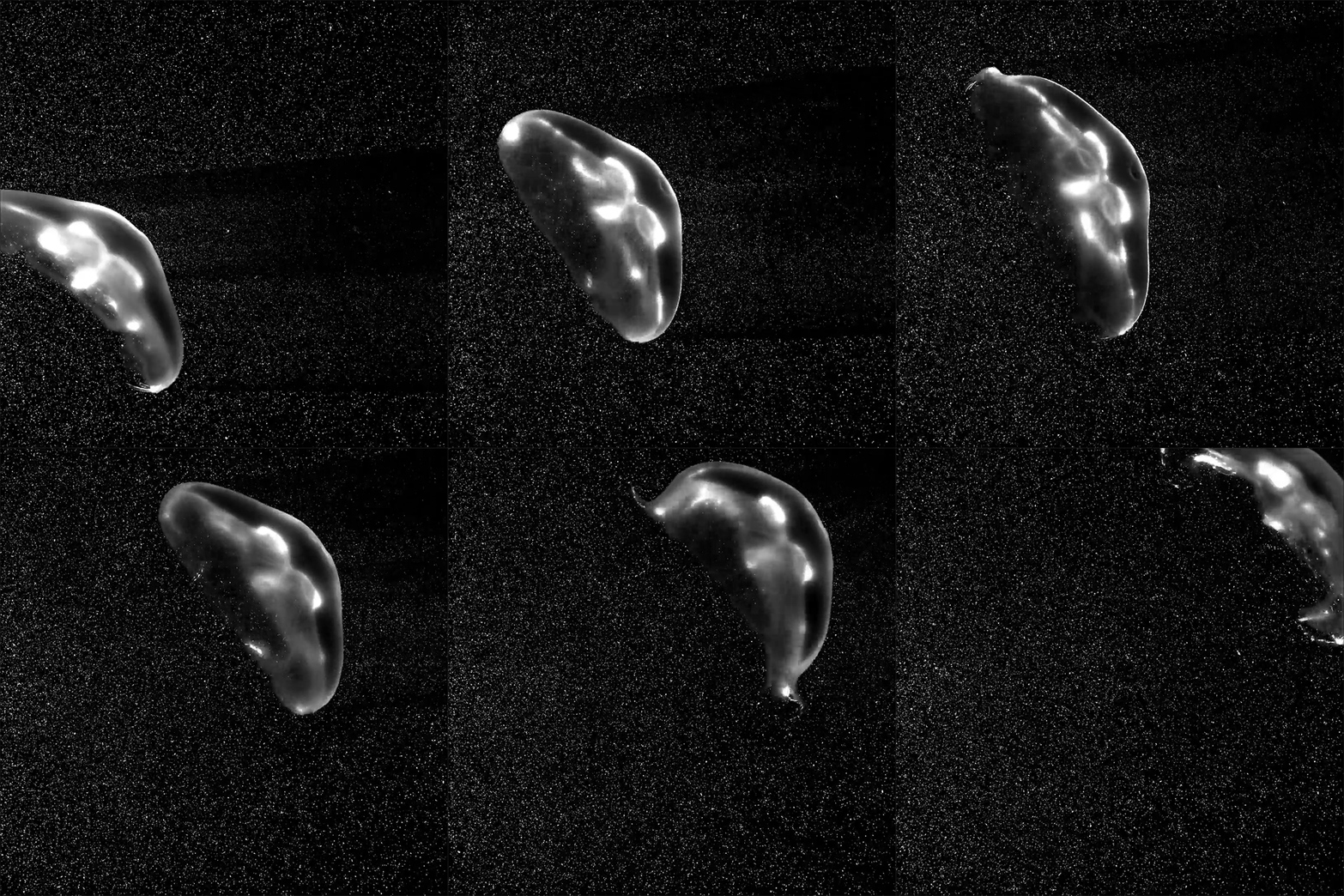
    Illnesses like COVID-19 can spread through droplets and aerosols produced by coughing, sneezing, or even speaking. New research looks at how regular speech patterns produce a spray of droplets. Researchers found that pronouncing many consonants causes a sheet of saliva to form between the speaker’s lips. That sheet stretches into filaments that then break into a spray of droplets.

    Strong, plosive consonants like /p/ and /b/ create the most droplets (Images 2 and 3), but even milder consonants like /m/ create some (Image 1). Interestingly, the researchers found that wearing lip balm drastically decreased droplet production by altering the saliva sheet formation. Even so, there’s no substitute for wearing a properly fitted mask! (Image credits: masks – K. Grabowska, droplets – M. Abkarian and H. Stone; research credit: M. Abkarian and H. Stone; via APS Physics)

  • Chaos in the Lagoon Nebula

    Chaos in the Lagoon Nebula

    Even on the scale of light-years, fluid dynamics plays a role in our universe. This photograph shows the Lagoon Nebula, where stars, gas, and dust are battling for supremacy. Jets from young stars push the dust left from supernova remnants into a chaotic patterns, and the high-energy particles streaming from the youthful stars illuminate interstellar gases, creating the nebula’s distinctive glow. This section of the nebula is about 50 light-years across, so every picture we capture is only the tiniest snapshot of the true scale of its turbulence. (Image credit: Z. Wu; via APOD)

  • Flying Through Waterfalls

    Flying Through Waterfalls

    Swifts and starlings often make their nests behind waterfalls. To explore how these birds traverse their watery curtain, researchers observed hummingbirds, a smaller sister species, flying through an artificial waterfall. They found that the birds tended to part the water with one wing while continuing to use the other to produce thrust. This behavior helped them cross the barrier smoothly and easily.

    In contrast, smaller and slower flyers, like the insect species the researchers tested, were typically unable to cross the waterfall. Instead, they got carried away by the flow or managed to pass through only to crash. The scientists suggest that protection from insects may be one reason birds choose to nest behind waterfalls. (Image and research credit: V. Ortega-Jimenez et al.; via Science; submitted by Kam-Yung Soh)

  • Featured Video Play Icon

    A Primer on Blood Pressure

    Some of the most important fluid dynamics goes on every moment inside our bodies. After only a few weeks of gestation, the human heart begins its lifelong task of pumping blood throughout tens of thousands of kilometers’ worth of blood vessels. One of our simplest methods for tracking the health of this critical system is a person’s blood pressure, which measures the forces exerted on our blood vessels as our hearts pump. This video gives a brief primer on blood pressure as well as some of the problems that arise when extended bouts of high blood pressure damage our blood vessels. (Image and video credit: TED-Ed)

  • A Colorful Portrait of Flow

    A Colorful Portrait of Flow

    This gorgeous, natural-color image shows Lake Balkhash in southeastern Kazakhstan. In early March, the ice on the lake was beginning to break up, revealing glimpses of swirling sediment below the water’s surface. In contrast, the smaller lakes and ponds of the surrounding area remained frozen amidst the wintery browns of the nearby desert and wetlands. (Image credit: J. Stevens/USGS; via NASA Earth Observatory)
  • Stratospheric Effects of Wildfires

    Stratospheric Effects of Wildfires

    Australia’s bushfires from earlier this year are offering new insights into how pyrocumulonimbus clouds can affect our stratosphere. A massive, uncontrolled blaze between December 29th and January 4th generated a towering, turbulent cloud of smoke like the one shown above.

    Using meteorological data, a new study shows this enormous cloud initially rose to 16 km in altitude, then began a months-long trek that circled the globe. The smoke plume ultimately stretched to over 1,000 km wide and reached a record altitude of over 31 km. Inside the plume, concentrations of water vapor and carbon monoxide were several hundred percent higher than normal stratospheric air.

    Researchers found the plume extremely slow to dissipate, possibly due to strong rotational winds surrounding it. This is the first time scientists have observed these shielding winds, and work is still underway to determine how and why they formed. (Image credit: M. Macleod/Wikimedia Commons; research credit: G. Kablick III et al.; via Science News; submitted by Kam-Yung Soh)

  • Featured Video Play Icon

    Hummingbird Flight in Slow Motion

    Hummingbirds are impressive, acrobatic flyers. Their figure-8 wing stroke pattern produces about 70% of their lift on the downstroke, and the remainder during the backward upstroke. But their tails and body motions also play an important role in stabilizing them, especially in gusty winds. They also have some impressive feeding dynamics. Altogether, they’re one of the most precise flyers in the animal kingdom! (Video and image credit: BBC Earth)