Search results for: “art”

  • Featured Video Play Icon

    “Reconfiguring It Out”

    Leaves flutter and bend in the breeze, changing their shape in response to the flow. Here, researchers investigate this behavior using flexible disks pulled through water. The more flexible the disk and the faster the flow, the more cup-like the disk’s final shape. Adding tracer particles to the water allows them to visualize the flow behind the disk. Every disk leaves a donut-shaped vortex ring spinning in its wake, but the more reconfigured the disk, the narrower the vortex. This, ultimately, reduces drag on the disk. That’s why trees in heavy winds streamline their branches and leaves; that flexibility lowers the drag the tree’s roots have to anchor against. (Image and video credit: M. Baskaran et al.)

  • Mixing Effectively

    Mixing Effectively

    Mixing two fluids is a tougher task than you might think. One of my favorite asides from a fluids lecture concerned how to mix fruit into yogurt in an industrial setting. Mix too quickly, and you’ll obliterate the yogurt’s consistency, but mix too little and you may as well sell it as fruit-on-the-bottom. Apparently that particular problem got solved by sending the fruit and yogurt flowing through a series of specially-shaped ducts to slowly and carefully mix them together.

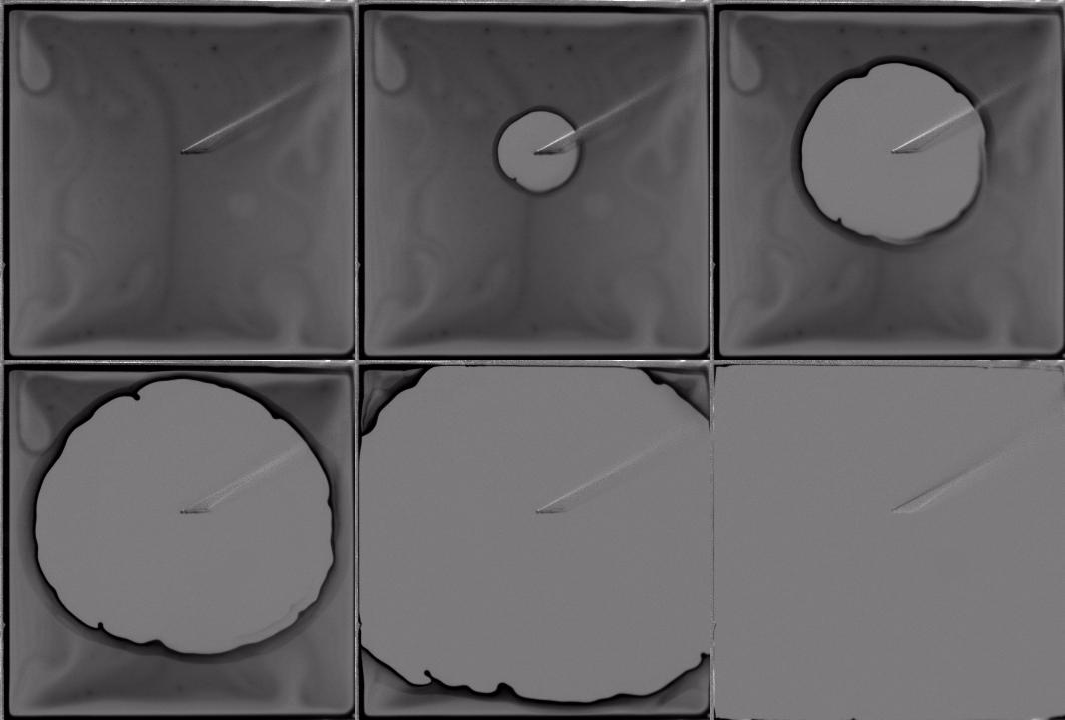
    In this study, researchers tackle a similar problem — mixing two fluids in a circular cross-section — through optimization. As you can see above, circular stirrers on their own don’t do a great job of mixing. So the researchers searched for the right combination of stirrer shape, mixing speed, and mixing trajectory to give the best mixing for a set mixing time and energy input. Their final stirrer shapes are anything but circular and often move in jerks and fits to help shed vortices that do the actual job of mixing. (Image and research credit: M. Eggl and P. Schmid; via APS Physics)

  • Featured Video Play Icon

    Cleaning the Skies

    Those of us who live in urban environments have experienced the clear, pollution-free air that comes after a rainstorm. But how exactly does rain clean the air? Air pollution typically has both gaseous and particulate components to it. As a raindrop falls, it experiences collision after collision with those particles. Depending on the particle’s surface characteristics — is it hydrophilic or hydrophobic? — and its momentum during impact, it can get trapped in the raindrop, skip off, or even pass through entirely. The physics, it turns out, are identical to those of a rock falling into or skipping off a lake — even though the raindrop and particle might be 1000 times smaller! (Image and video credit: N. Speirs et al.)

  • Featured Video Play Icon

    Flow Between Fibers

    Two vertical fibers, with a gap left between them, form a playground for flow in this Gallery of Fluid Motion video. If the fiber spacing is small enough, the flow will form a stable liquid sheet that runs the full length of the fibers. With a little more distance, though, the fluid forms intermittent bridges, whose spacing depends on flow rate. And when the fibers are not perfectly vertical, even more complex flows are possible. I love how a seemingly simple situation begets such complexity! (Image and video credit: C. Gabbard and J. Bostwick)

  • Escaping the Sun

    Escaping the Sun

    One enduring mystery of the solar wind — a stream of high-energy particles expelled from the sun — is how the particles get accelerated in the first place. The sun frequently belches out spurts of plasma, but without further momentum, that material simply falls back to the sun’s surface under the star’s gravity. Mechanisms like shock waves can further accelerate particles that are already moving quickly, but they cannot explain how the particles get going in the first place.

    A recent study used supercomputers to tackle this challenging problem in turbulent plasma physics. Each simulation tracked nearly 200 billion particles, requiring tens of thousands of processors. The results showed that turbulence itself provides the necessary initial acceleration and serves as the first step to getting particles moving fast enough to escape the sun. (Image credit: NASA SDO; research credit: L. Comisso and L. Sironi; via Physics World)

  • Featured Video Play Icon

    Recreating the Rings of Power Opening

    Everyone loves a good title sequence, especially when they feature neat visuals. Many who watched “The Rings of Power” zeroed in immediately on their use of cymatics — visuals born from the vibrations of sound. In the video above, Steve Mould delves into the physics behind cymatics and recreates patterns similar to those in the show’s opening, which was a mixture of CGI and live action.

    For Tolkien fans, the opening sequence holds additional layers of meaning; in Tolkien’s mythology, the universe is born from song, and many of the patterns shown in the opening — the two trees, Fëanor’s star, and the Silmarils themselves — are drawn directly from Tolkien’s myths. In a way, the opening sequence tells the story of the creation of Arda and the rise of Sauron’s predecessor, Melkor/Morgoth, and all the events that led to the show itself. It’s incredibly cool, both from a physics perspective and a literary one. (Image and video credit: S. Mould)

  • Droplet Bounce

    Droplet Bounce

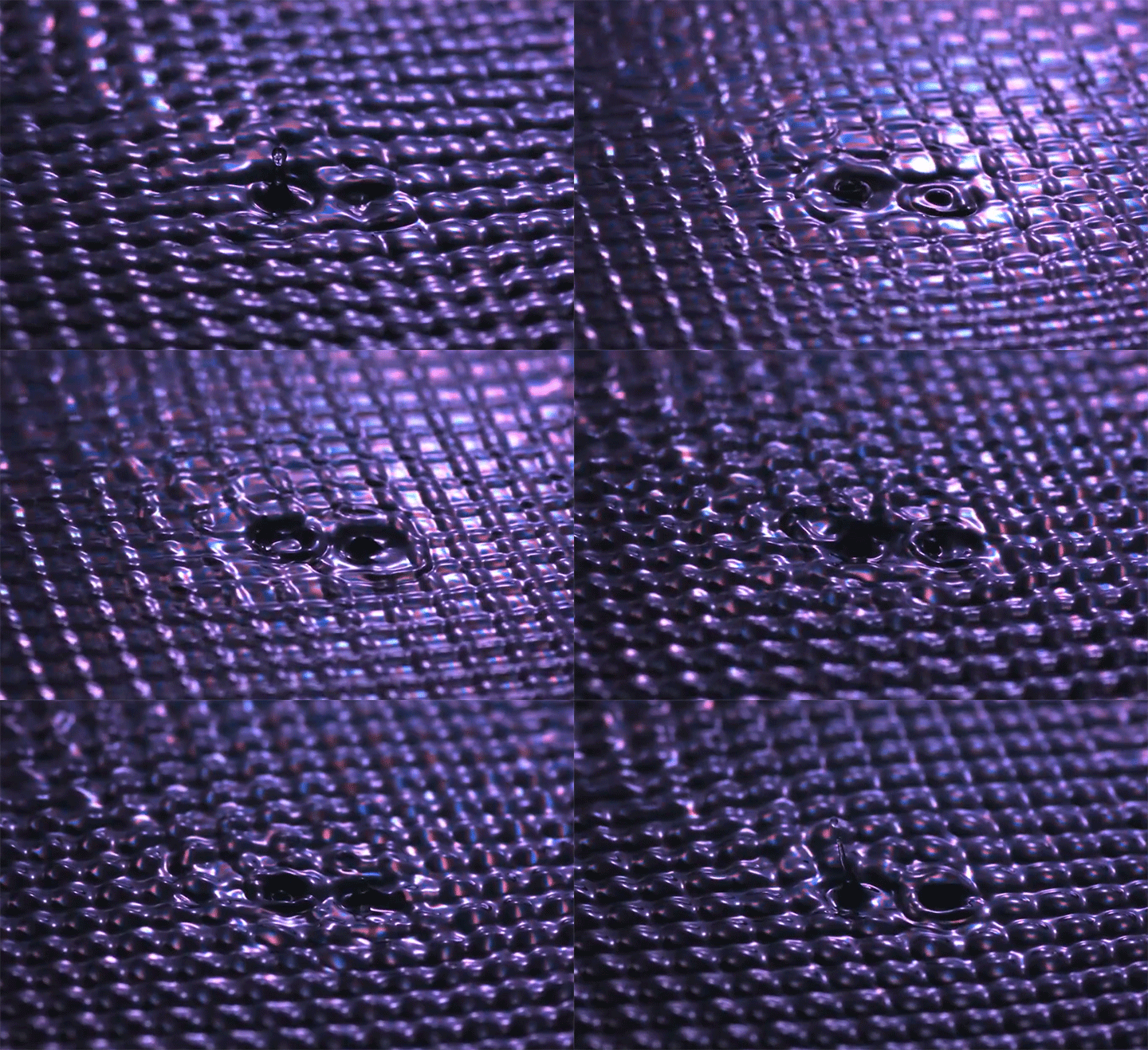
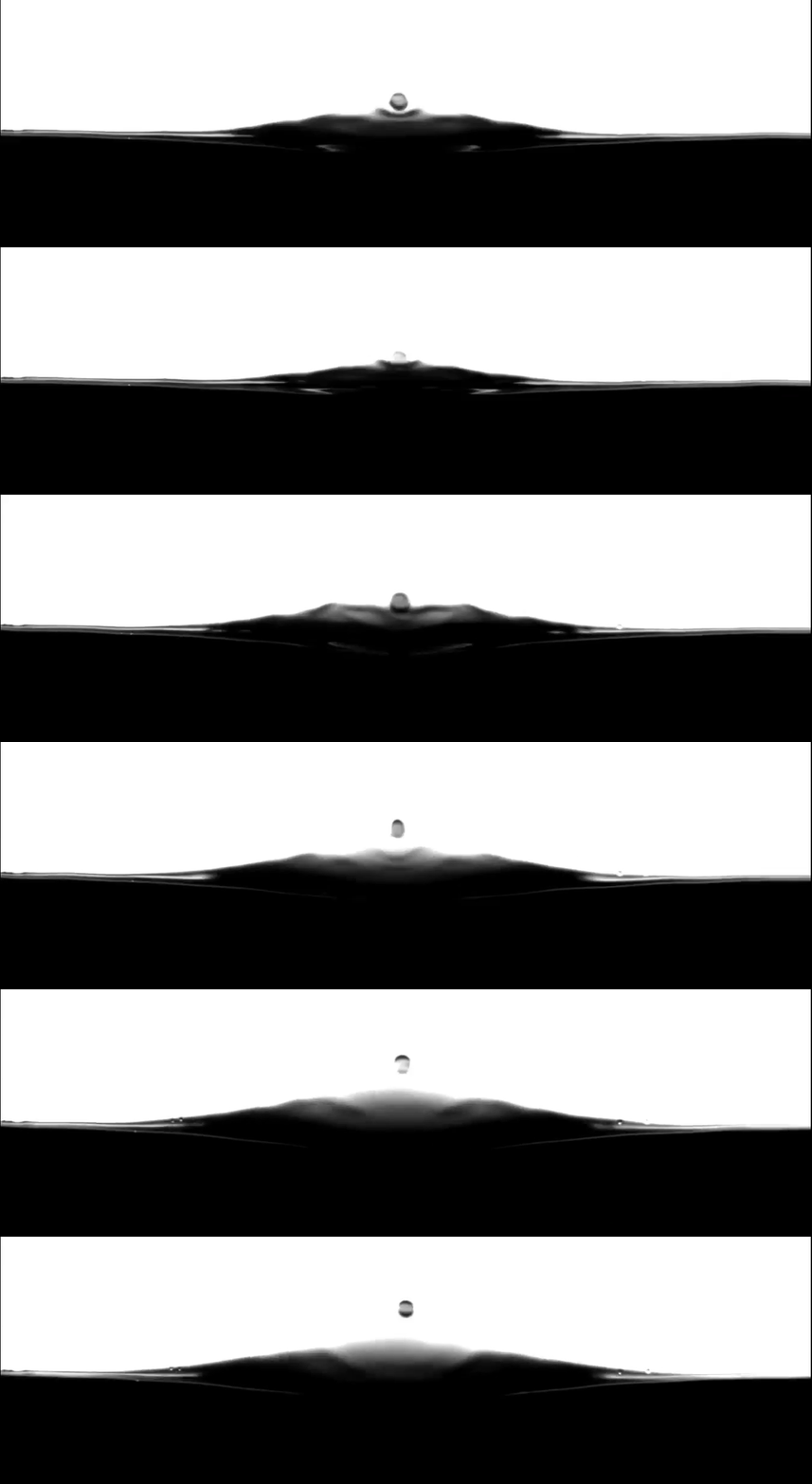
    A droplet falling on a liquid bath may, if slow enough, rebound off the surface. Its impact sends out a string of ripples — capillary waves — on the bath’s surface and sends the droplet itself into jiggling paroxysms. A new pre-print study delves into this process through a combination of experiment, simulation, and modeling. Impressively, they find that the most of the droplet’s initial energy is not dissipated during impact. Instead it’s fed into the capillary waves and droplet deformation that follow. (Image and research credit: L. Alventosa et al.; via Dan H.)

    A droplet falls on a bath, partially coalesces and rebounds. The process repeats until the droplet is small enough to coalesce completely.
    A droplet falls on a bath, partially coalesces and rebounds. The process repeats until the droplet is small enough to coalesce completely.
  • The Delta Series

    The Delta Series

    It’s easy in the rush of our daily lives to forget just how dynamic rivers are. In his “Delta Series” conservation photographer Paul Nicklen explores that ever-changing nature from above the Colorado River delta. With the ongoing megadrought in this region and ever-increasing demands for more water, the Colorado no longer flows to the ocean. It trickles its way to a tired end near Baja, Mexico, where its last gasp is not enough to sustain ecosystems that relied on the river’s irrigation long before us. Nicklen’s work is a beautiful portrait of the fractal, tree-like patterns of a slowing river. Find more of Nicklen’s work on his website and Instagram. (Image credit: P. Nicklen; via Colossal)

  • Summer Melt

    Summer Melt

    A warm summer in 2022 has resulted in record melting on Svalbard. Located halfway between the Norwegian mainland and the North Pole, more than half of Svalbard is normally covered in ice. But with glaciers in retreat and firn — a surface layer of compressed porous snow — melting, pale blue ice is getting direct exposure to the sun and warm air temperatures. The result has been melting 3.5 times larger than the average melt between 1981 and 2010. Look closely and you’ll find deep blue meltwater ponds dotting the ice, too. The run-off of meltwater has likely carried extra sediment into the surrounding waters, accounting for some of the paler water colors along the coast. (Image credit: J. Stevens/USGS; via NASA Earth Observatory)

  • Landslide-Triggered Tsunamis

    Landslide-Triggered Tsunamis

    After the 2018 Anak Krakatoa eruption, a tsunami that ricocheted through the surrounding waters, killing hundreds on nearby islands. The source of that tsunami was a small landslide. Once the air cleared and researchers could assess how much material slid into the ocean, they were shocked that such a small volume created so much destruction.

    Now new efforts are revealing the linkage between landslides and the waves they make. Researchers released glass beads into a tank of water, observing the waves that form as the beads run out. Depending on the relative initial height of the beads compared to the water depth, they observed three different kinds of waves. Not only that, they were able to connect the granular mechanics of the landslide to the hydrodynamic formation of waves, allowing predictions of the waves that will form for a given landslide.

    Currently, the predictive model isn’t sophisticated enough to handle a geometry as complex as that of the Anak Krakatoa landslide, but it’s an important step toward understanding — and potentially mitigating the damage of — future oceanside landslides. (Image and research credit: W. Sarlin et al.; via APS Physics; submitted by Kam-Yung Soh)