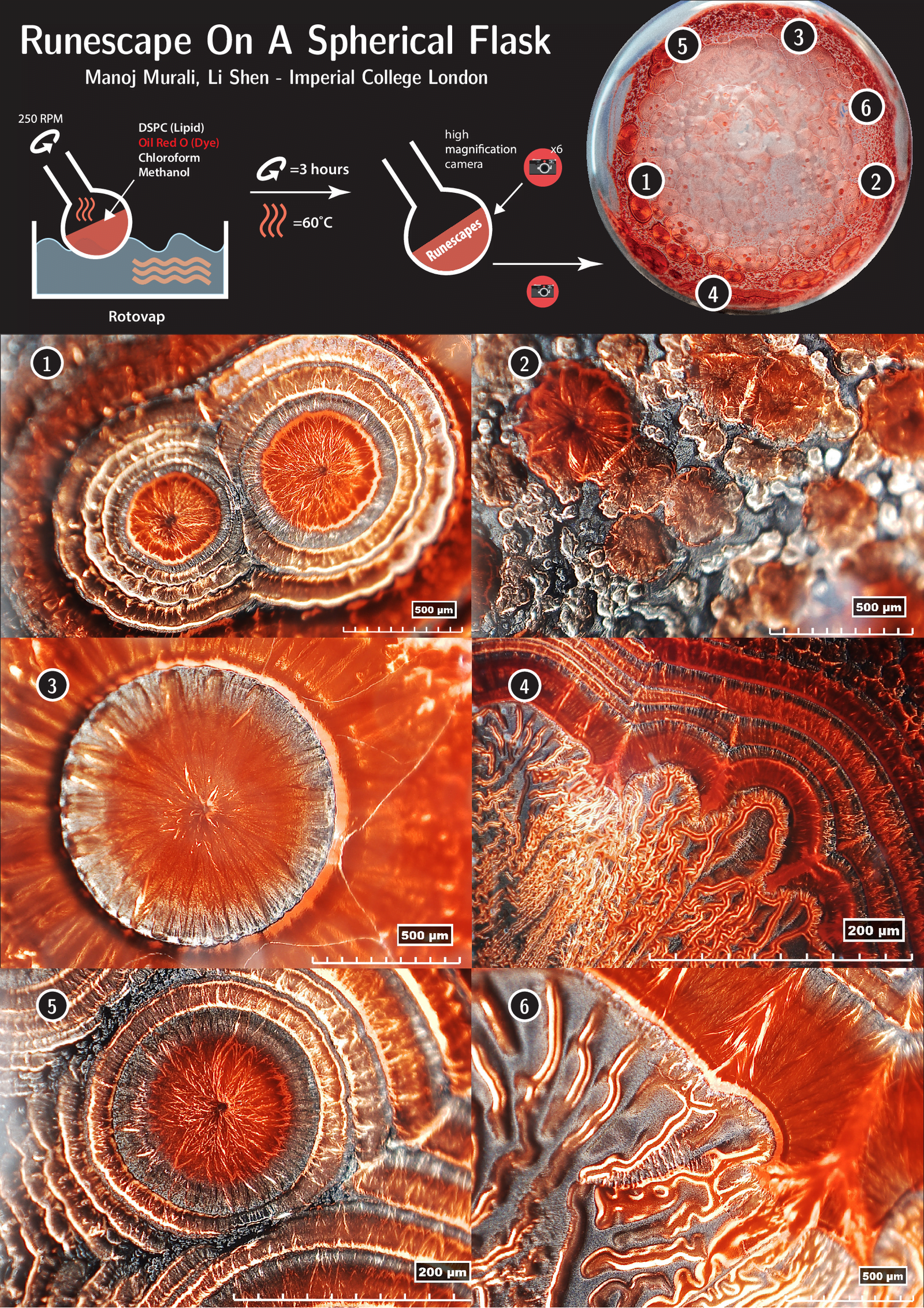
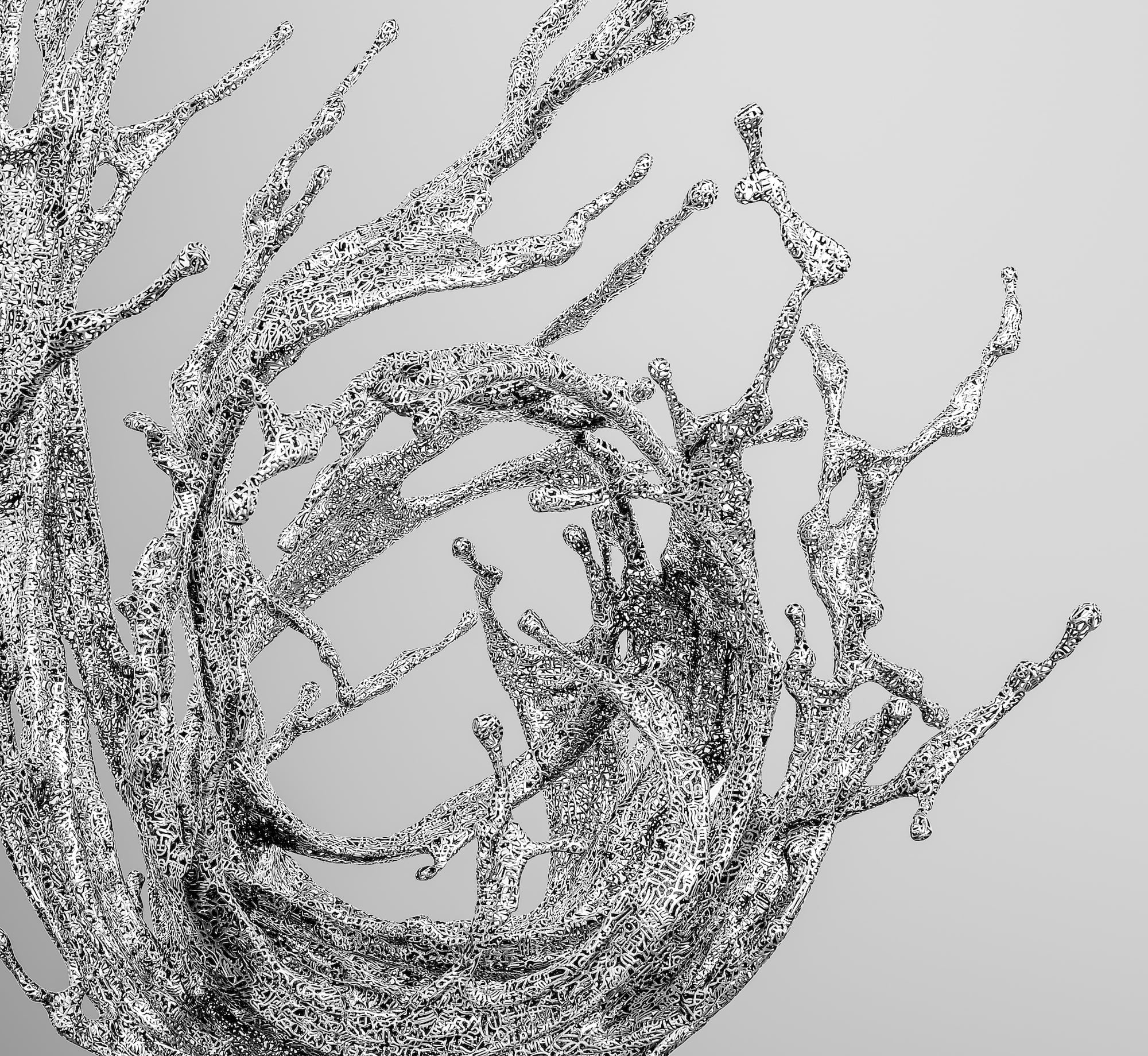
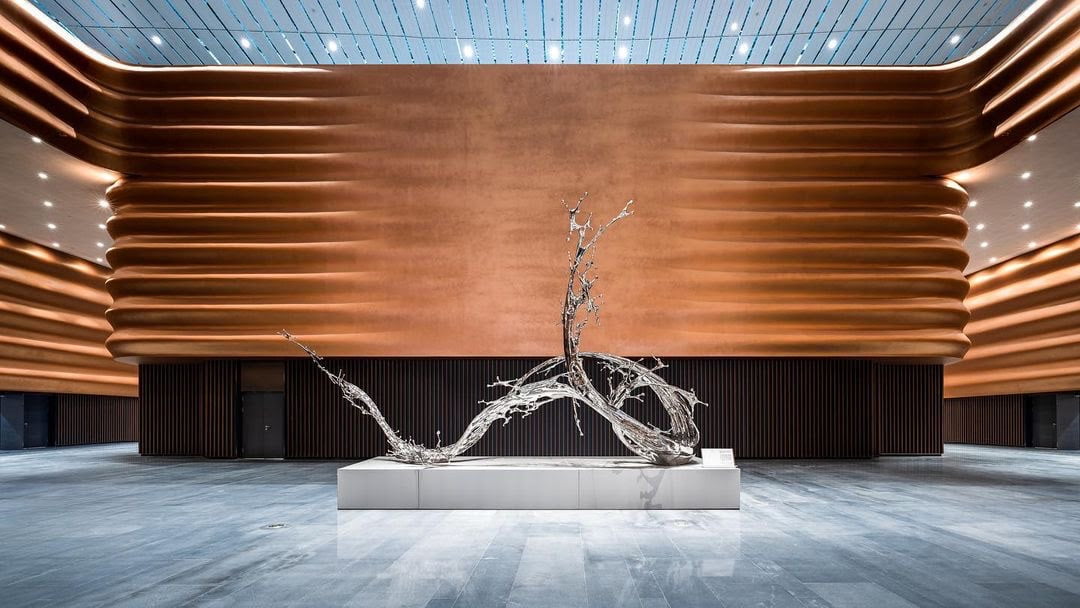
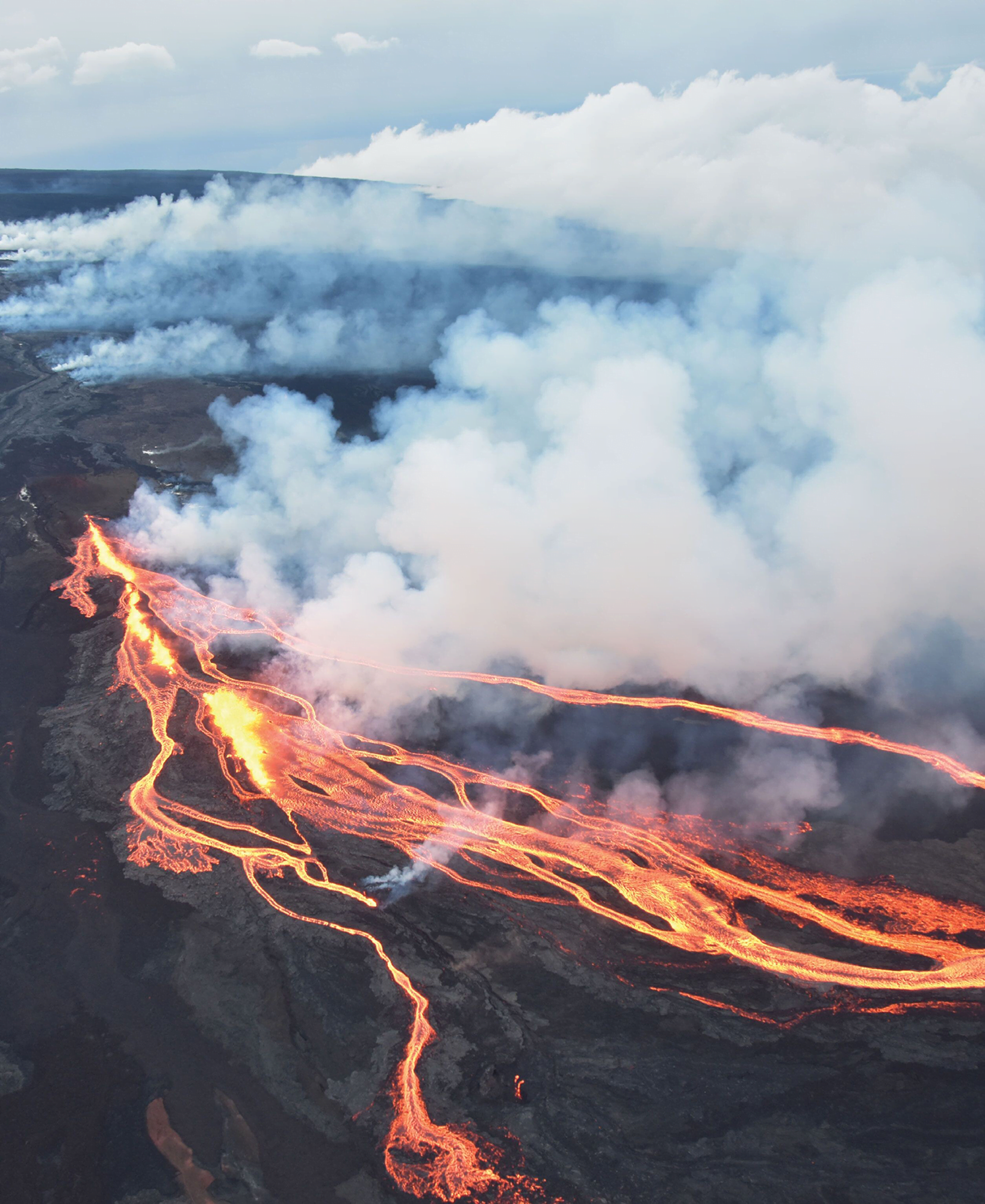
When flowing over a ridged surface, particles follow a drifting, helical trajectory. In this video, researchers delve into the physics behind this phenomenon. Differences in the pressure gradient along different parts of the corrugation push particles along the groove. With their analysis, the team is able to predict particle trajectories above surface roughness of any shape. With these tools, they can design roughened microchannels that disperse particles at a desired speed, something that could be especially helpful in medical diagnostics. (Image and video credit: D. Chase et al.; research credit: D. Chase et al.)
Search results for: “art”

Seashore Hunting
Watch sea gulls, plovers, and other birds hunt in the tidal zone, and you may notice them stepping over and over in the same spot. This is part of bird’s hunting strategy. Each footfall compresses the wet sand and drives water out. Mechanically, this is the same thing that happens when a human walks on wet sand; you’ll see the sand go from a glossy appearance to a matte one as the local water level falls. Once the weight is removed, the water will seep back and the sand appears glossy again.

Illustration of a gull’s hunting process. Compressing the sand by stepping on it drives water out of the area. Once the bird’s foot is removed, water floods back, diluting the sand, and making it easier for the bird to reach its prey without digging. For the birds, the flood of returning water loosens and dilutes the sand. That makes prey easier to expose and reach without the additional effort of digging. (Image credits: bird – C. Davis, illustration – P. Fischer; via Physics Today)

Beneath the Waves
Surfing looks entirely different from below the wave. Photographer Ben Thouard captures his images by freediving and observing what goes on overhead. Whether the surfers nearby ride a barrel roll or bail into the churn, the results are incredible. You can find more of Thouard’s artwork on his website and Instagram. (Image credit: B. Thouard; via Oceanographic Magazine)

Slab Avalanche Physics
Slab avalanches like the one shown here begin after weak, porous layers of snow get buried by fresher, more cohesive snow layers. On a steep slope, the weight of the new snow can be too great for friction to hold the slab in place, causing the upper layer to crack and slide at speeds up to 150 meters per second. Scientists had two competing theories for how slab avalanches began. One theory presumed that the weak layer of snow failed under shear; the other argued that the collapse of the lower, porous layer was at fault.
In a new study combining large-scale numerical simulation with real-life observations, scientists came to a new conclusion: cracks began to form in the porous layer as the weight of heavier snow crushed down, but once the cracks formed, the shear mechanism took over. Cracks formed by shear could propagate along the existing cracks in the porous layer, allowing faster crack propagation than through undamaged snow. In the end, it’s the combination of the two mechanisms that triggers the avalanche. (Image credit: R. Flück; research credit: B. Trottet et al.; via Physics World)

Turbulence From Vortex Rings
When vortex rings collide, they reconnect into smaller, rings that eventually break down into chaos. Here, researchers experiment with colliding multiple vortex rings — focusing on an eight-ring collision. When they collide rings over and over, it creates a zone of isolated turbulence at the heart of the collisions.
Many of the theories and predictions that exist around turbulence assume that the flow is homogeneous and isotropic; what this means is that the (statistical) characteristics of the flow are the same in every direction. In reality, this kind of flow isn’t always easily achieved, which makes testing theoretical predictions challenging.
What’s neat about this set-up is that you get this desired turbulence in a very controlled way. It’s easy to tune the size and energy of your vortex rings, and those tweaks allow you to observe what — if any — changes occur in the resulting turbulence. (Image and video credit: T. Matsuzawa et al.)

“A Sense of Scale – Reminiscence”
In so much of fluid dynamics, size does not matter. We see the same patterns mirrored across nature from a fuel injection nozzle to galactic clusters. And no one plays with that sense of scale better than artist Roman De Giuli, whose microscale practical effects give the impression of flying above glittering alien coastlines. Ink and paint squeeze around craggy islands, leaving perfect streamlines to mark their passage. Fractal fingers expand like river deltas seeking the path to the sea. Enjoy more of De Giuli’s work on his website and Instagram. (Image and video credit: R. De Giuli; via Colossal)

Simulating Schools
In nature, fish school for many reasons: protection from predators, increased sensing, and hydrodynamic advantages. To capture this complex behavior, researchers are building their own digital fish, governed by known rules. Here, scientists give each fish social rules — based on vision range and preferred distance from a neighbor — and hydrodynamic rules — based on a fish’s wake. With the rules in place, they can then observe the schooling behaviors of their digital fish. Like their real counterparts, these schools show different flocking based on apparent “moods”. (Image and video credit: J. Zhou et al.)

Soapy Solutions
When a drop of soap falls into a pool of water, its surface-loving molecules spread out on the water’s surface. Exactly how the soap spreads depends on the local concentration of its surfactant molecules, which create areas with different surface tensions that cause flow. All in all, it’s a tough process to predict because it varies in time at every point on the pool. But a recent paper offers a new class of exact solutions for the problem.
The paper considers a surfactant-laden droplet spreading over a (relatively speaking) deep pool. Other researchers showed recently that this situation can be described with a complex version of the Burgers’s equation, which was originally developed to describe turbulent flows. The authors solved the equation for a variety of initial conditions and found that the time-dependent spread of the surfactants was sensitive to the initial surface distribution. The higher the initial surface concentration, the faster the surfactants spread. (Image credit: T. Despeyroux; research credit: T. Bickel and F. Detcheverry; via APS Physics; submitted by Kam-Yung Soh)

Reflections of the Storm
Fall and winter storms rip Lake Erie with violent waves. Photographer Trevor Pottelberg of Ontario captures the dramatic eruptions of mist and spray from these massive, turbulent waves. It’s amazing how many different characters a wave can take on. Just compare Pottelberg’s waves with those caught by Lloyd Meudell or Ray Collins. It’s almost hard to imagine all of these waves growing from the same wind-driven start. See more from Pottelberg on his website and Instagram. (Image credit: T. Pottelberg; via Colossal)

Waves in Liquid Crystals
Liquid crystals are now ubiquitous in displays, but scientists are still discovering new properties for this state of matter. Here, a team explores nematic liquid crystals, whose rod-like shape rotates in three dimensions as they apply a voltage. The layer of liquid crystals is held between polarizing filters, creating regions of light and dark that depend on the liquid crystals’ orientations.

Traveling waves and other wave patterns form in this liquid crystal as the voltage applied to it increases. As the researchers increase the voltage, traveling waves form. With higher voltages, the waves appear to slow a stop. The slowing waves result from the molecules tilting far from a vertical orientation, which makes it harder for individual molecules to rotate since they experience greater resistance from their neighbors. (Image, video, and research credit: V. Panov et al.; via APS Physics)