When you run into a fire ant, you’re in for a bad day. But if you run into a colony-sized raft of fire ants, well, that’s going to be a very bad day. These insects evolved to survive Amazonian floods, and that prowess has helped them spread far from their original homes. When waters start rushing into their home, the ants set out on a rescue mission, pulling their young out. The ants lash themselves and the youngsters together with their own bodies and form a floating raft. Thanks to the hydrophobic hairs on the larvae and ants, they trap a layer of air near their bodies. This helps them breathe, even if they’re on the bottom of the raft. Learn lots more about fire ants, including how they act as fluid, over here. (Image and video credit: Deep Look)
Search results for: “art”

A Comet’s Tail Swept Away
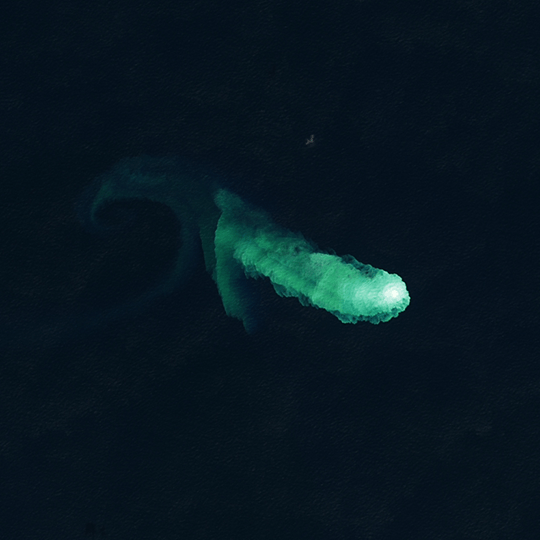
On Christmas Day 2021, Comet Leonard put on a show in our skies. Though the comet was a pale streak to the naked eye, photographer Gerald Rhemann caught a striking event: the moment part of the comet’s tail disconnected from its body. The solar wind swept the comet’s gas and dust away. Though I’ve talked about the fluid dynamics of comets before, this image is the most stunning example I’ve seen. It’s no wonder that it won the top prize at the Astronomy Photographer of the Year competition. (Image credit: G. Rhemann; via Colossal; see also APOTY)

Aerosols and Instruments
Although COVID has disrupted all of our lives, orchestras saw particular disruption, as little was known about how instruments spread aerosol droplets. In this recent study, a team looked at many wind instruments, as played by professional musicians, for the aerosol load and air flow each instrument creates. They found that, on the whole, wind instruments — like flutes, clarinets, trumpets, and others — create aerosol loads comparable to normal speech. The air flow from each instrument comes primarily from the bell (for brass instruments) or tone holes (for woodwinds) and has a much lower velocity than coughing or sneezing. As a result, the flow decays away to the background air-flow after about 2 meters. (Image credit: trumpet – E. Awuy, trombone – Q. Brosseau et al.; research credit: Q. Brosseau et al.)

As a musician plays a scale on their trombone, flow from the bell is revealed through artificial fog and laser illumination. 
Free Contact Lines
How a simple drop of water sits on a surface is a strangely complicated question. The answer depends on the droplet’s size, its chemistry, the roughness of the surface, and what kind of material it’s sitting on. Vetting the mathematical models that describe these behaviors is especially difficult since droplets often get stuck, or “pinned,” along their contact line where water, air, and surface meet.
To get around this issue, researchers sent their experiment to the International Space Station, asking astronauts to run the tests for them. Without gravity‘s influence squishing drops, the astronauts could use much larger droplets than they could on Earth. Larger drops are less likely to get pinned by a stray surface defect, so on the space station, astronauts could place droplets on a vibrating platform and observe their contact line freely moving as the drop changed shape. Under these conditions, the experiment tested many surfaces with different wetting characteristics, thereby gathering data to test models we cannot easily confirm on Earth. (Image and research credit: J. McCraney et al.; via APS Physics)

Dripping Glaze on Ceramics
Candy-colored glaze oozes down the sides of Brian Giniewski’s Drippy Pots. These mugs seem like a great way to the start the day with a little happy, fluidsy action! (Image credit: B. Giniewski; via Colossal)

Rising Through Turbulence
Plankton — microscopic creatures with often limited swimming abilities — can face daily journeys of hundreds of vertical meters in the ocean. That’s a daunting prospect for any tiny swimmer. A new mathematical model suggests that plankton can have an easier time of it, though, by riding turbulent currents.
The researchers modeled an individual planktar (singular of plankton) capable of sensing nearby velocity gradients and rotating its body to control its swimming direction. With this simple set of controls, their simulated planktar was able to “surf” turbulent currents, covering vertical distances at twice its normal swimming speed despite its curvy path.
Currently, there’s no direct experimental evidence that plankton do this, but it does seem to make sense of experimenters’ observations. With the model’s results to guide them, experimentalists are looking for microswimmers actively orienting themselves based on turbulence. (Image credit: top – B. de Kort, illustration – R. Monthiller et al.; research credit: R. Monthiller et al.; via APS Physics)
How Gas Pump Nozzles Work
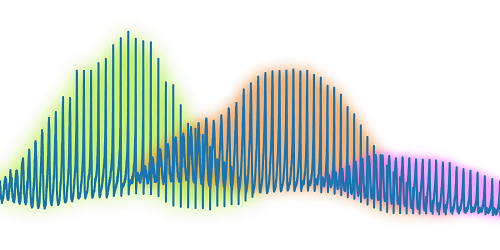
Ever wonder how a gas pump shuts off when the tank is full? You might guess that there’s a sophisticated electronic sensor hidden in there. But there isn’t! Gas pumps use an entirely mechanical technique to sense a full tank and shut off flow, as Steve Mould demonstrates in this video.
There are two key components — one fluid mechanical and one based on mechanical linkages — inside the handle. The part that senses a full tank is a Venturi tube, shown in Image 2. The top section of the Venturi tube contains a constriction, where (incompressible) flow is forced to speed up. That increase in speed creates a drop in pressure, which is reflected by the movement of the water in the curved tube below the constriction.
Notice that when there’s no flow through the top tube, the water level is equal on either side of the lower, curved tube. That means that the outside air pressure (connected to the short arm) equals the pressure in the constriction (connected to the long arm). When air is flowing through the constriction, the water level shifts. The water in the short arm gets pushed down while the water in the long arm gets sucked up. That change means that the air pressure outside the tube is now higher than pressure in the constriction.
I’ll let Steve explain what that means for the gas pump! (Image and video credit: S. Mould)

Flowers Through a Hazy Veil
A smoke-like haze obscures colorful bouquets in these photographs from artist Robert Peek. To achieve the effect, Peek submerges his subjects underwater with white dye that sinks due to its greater density. The wakes traced by the dye are impressively laminar, so the dye must drift rather slowly past each petal. The overall effect is beautifully dream-like. You can find more of Peek’s work on Behance and Instagram. (Image credit: R. Peek; via Colossal)

Mixing the Perfect Batter
In baking, there’s a point when wet and dry ingredients get combined to form the batter (or dough) that eventually becomes a tasty treat. Experienced bakers know that the ratio of wet-to-dry must be just right for the final product. Too dry and the mixture won’t come together; too wet and the final product is a soggy mess.
Mixing liquids and powders is ubiquitous outside the kitchen, too. Ceramics, concrete, laundry detergent, chocolate — all involve this critical step. To understand how these mixtures transition from fluid to clustered granules to granulations (think wet sand), researchers carefully studied a mixture of glass spheres and glycerol. When there were relatively few particles in the mixture (in technical terms, a smaller “particle volume fraction”), the mixture was fully fluid (top image, orange background). When the ratio of particles-to-liquid was high, the mixture was granular (blue background). And in-between these ratios, whether the mixture formed clumps, or granules, depended on how it was mixed (green background). Vigorous mixing (top row) formed large granules, which consisted of a wet, jammed interior and an outer layer of dry particles (lower image).
Their observations allowed the researchers to predict what ratio of liquid and powder is needed, and how much mixing is necessary, to create a desired outcome. (Image and research credit: D. Hodgson et al.; via Physics Today)

A cross-section of a granule, showing the wet, jammed interior (left) surrounded by a region of dry particles (center, enclosed between red dashes). 
Dolphins Playing With Bubble Rings
Blow a jet of air underwater and you can make a bubble ring. It takes some practice for humans, or you can use a device. In this video, a team introduced wild dolphins to a bubble-ring-making machine and observed how the dolphins reacted. After some initial wariness, the animals played with them for hours, creating games and having fun. Note that there are some dolphins who create their own bubble rings to play with, so it’s hard to say that these particular dolphins have never seen a bubble ring before. But even if they have seen the bubbles, they wouldn’t have seen a machine making them. (Image and video credit: BBC Earth)