Search results for: “art”

  • Mixing in a Winter Lake

    Mixing in a Winter Lake

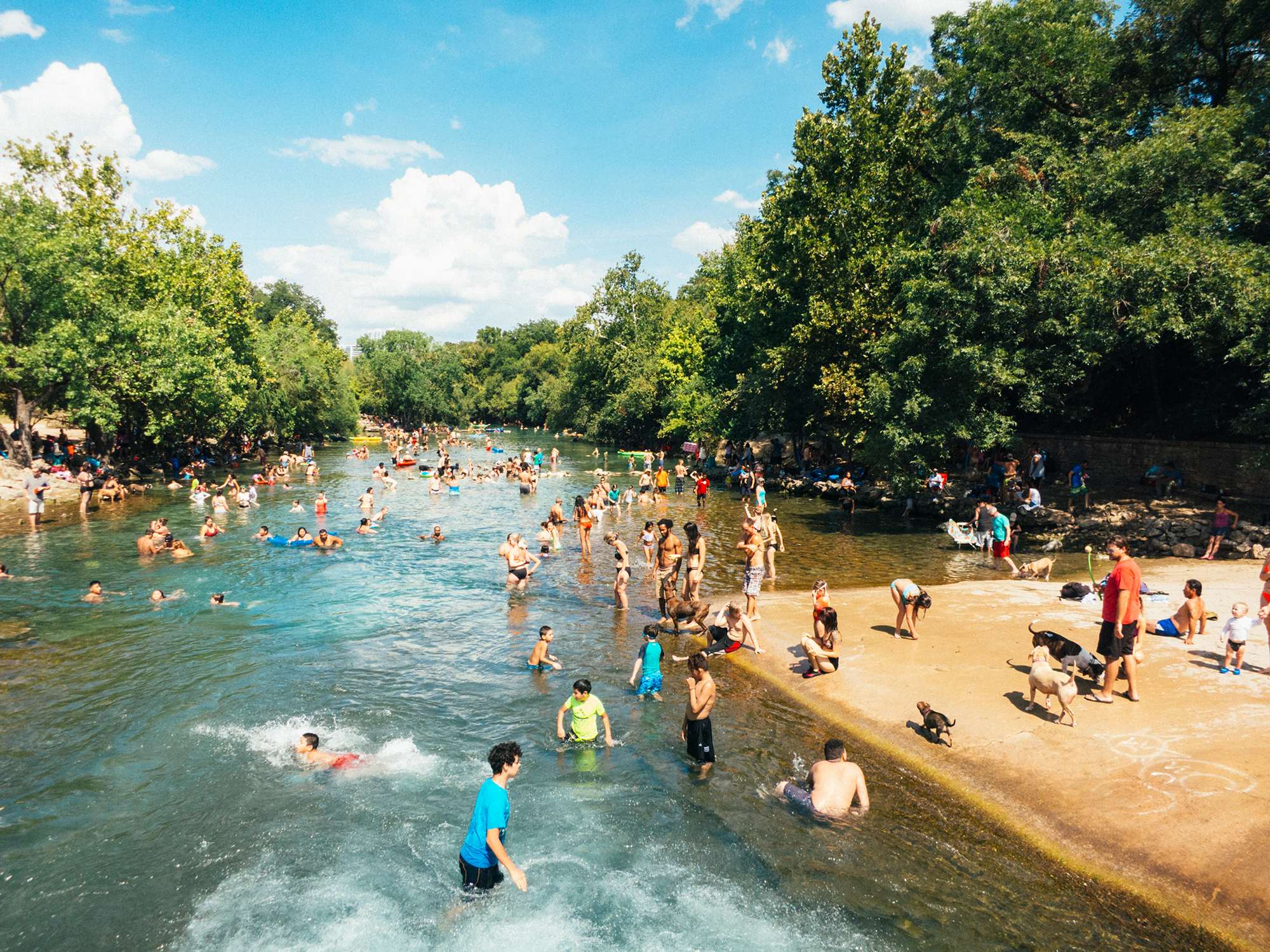
    A frozen winter lake can hide surprisingly complex flows beneath its placid surface. Since water is densest at 4 degrees Celsius — just above the freezing point — mixing two water sources can lead to counterintuitive effects. A cold lake, for example, may contain water below 4 degrees Celsius, while a stream running into the lake is a bit warmer than 4 degrees Celsius. When the two parcels of water meet, they mix to form water at an intermediate temperature. But because of water’s density anomaly, that mixed water can wind up denser than the average of its parents. This is known as cabbeling.

    Mixing patterns within a cold lake with a slightly warmer inflow. Image from A. Grace et al.
    Mixing patterns within a cold lake with a slightly warmer inflow. Image from A. Grace et al.

    As shown in a recent study, this newly mixed water sinks to the bottom of the lake, forming a warm current that heats the lake from below. The researchers were able to model this current and its behavior over a range of conditions. Understanding these winter circulation patterns is key to tracking both nutrient transport and how pollutants spread in the ecosystem. (Image credit: lake – G. Murry, simulation – A. Grace et al.; research credit: A. Grace et al.; via APS Physics)

  • Rippling Airglow

    Rippling Airglow

    Though we rarely notice it, our sky is always aglow. Washed in solar radiation, the oxygen and nitrogen molecules at high altitude get broken apart during the daytime and recombine at night, producing a luminescent glow that forms a uniform backdrop against the sky. In this image, the airglow forms a bull’s-eye-like set of rings, thanks to atmospheric gravity waves left behind by a thunderstorm. (Image credit: J. Dai; via APOD)

  • Chilly Soap Films

    Chilly Soap Films

    Evaporation is a well-known effect in soap films and bubbles. It’s responsible for the ever-changing thickness reflected in the film’s many colors. But evaporation does more than change the bubble’s thickness: it affects its temperature, too. Just as sweat evaporating off our skin cools us, the soap film’s evaporation makes it cooler than the surrounding air.

    Researchers found that their soap films could be as much as 8 degrees Celsius cooler than the surrounding air! They also found that the film’s glycerol content affect how much cooler the soap film is; films with more glycerol had higher temperatures, which could impact their overall stability. (Image credit: E. Škof; research credit: F. Boulogne et al.; via APS Physics)

  • Featured Video Play Icon

    Hollow Drops

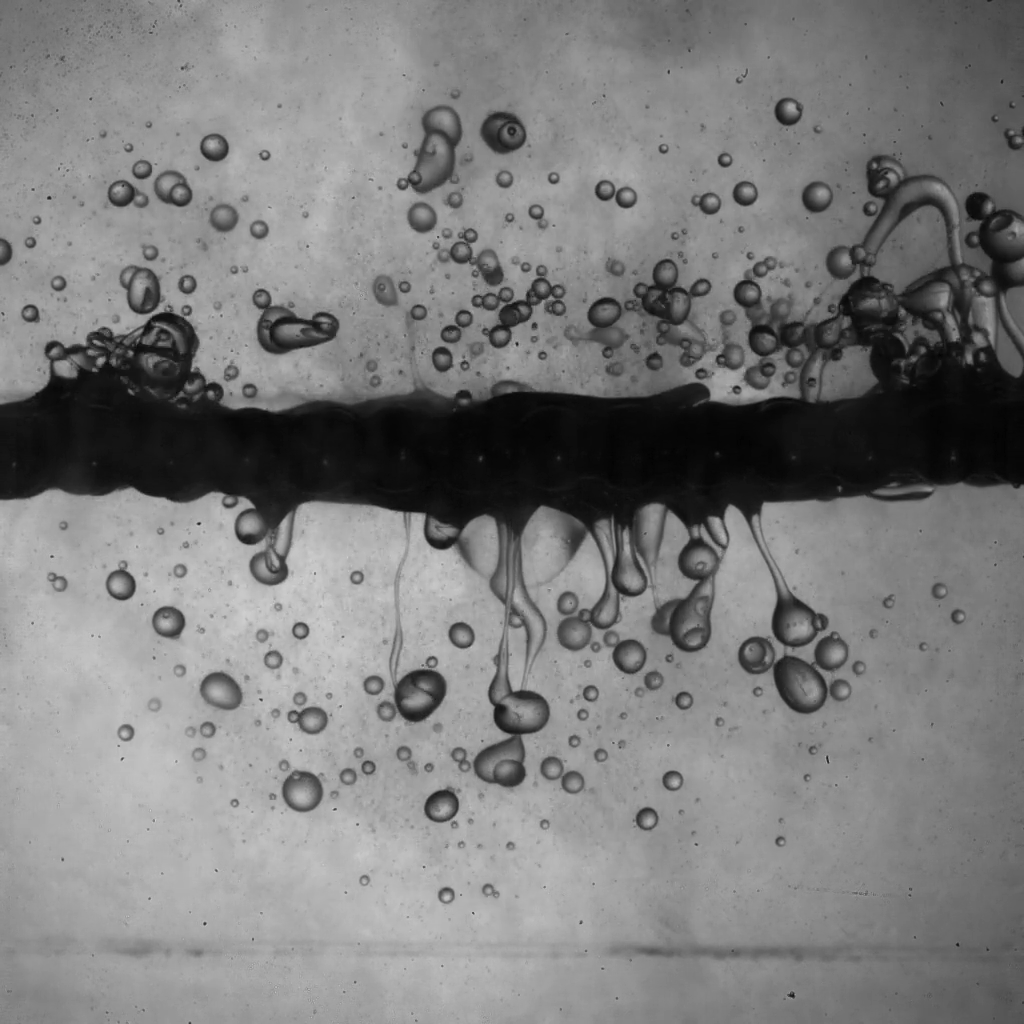
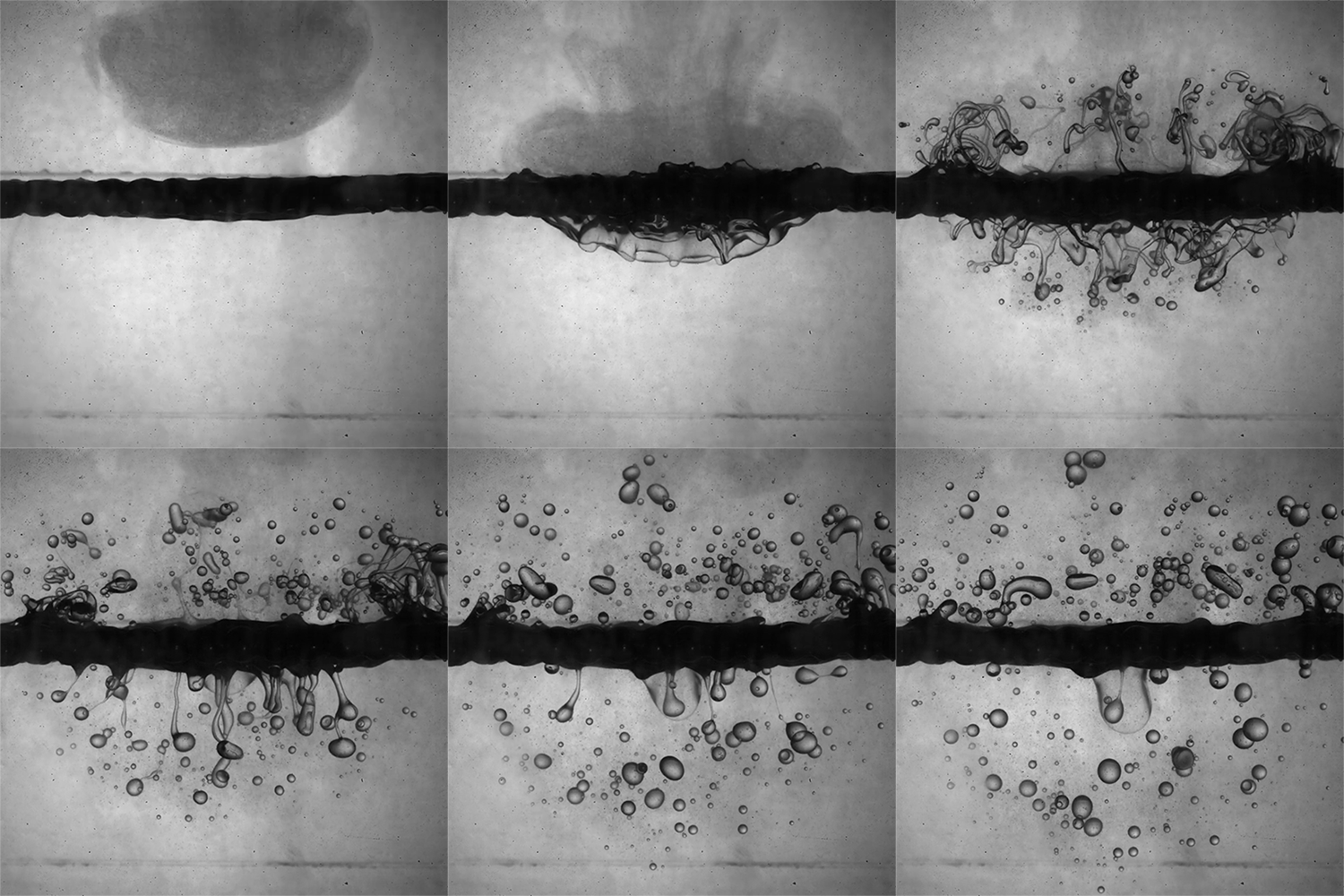
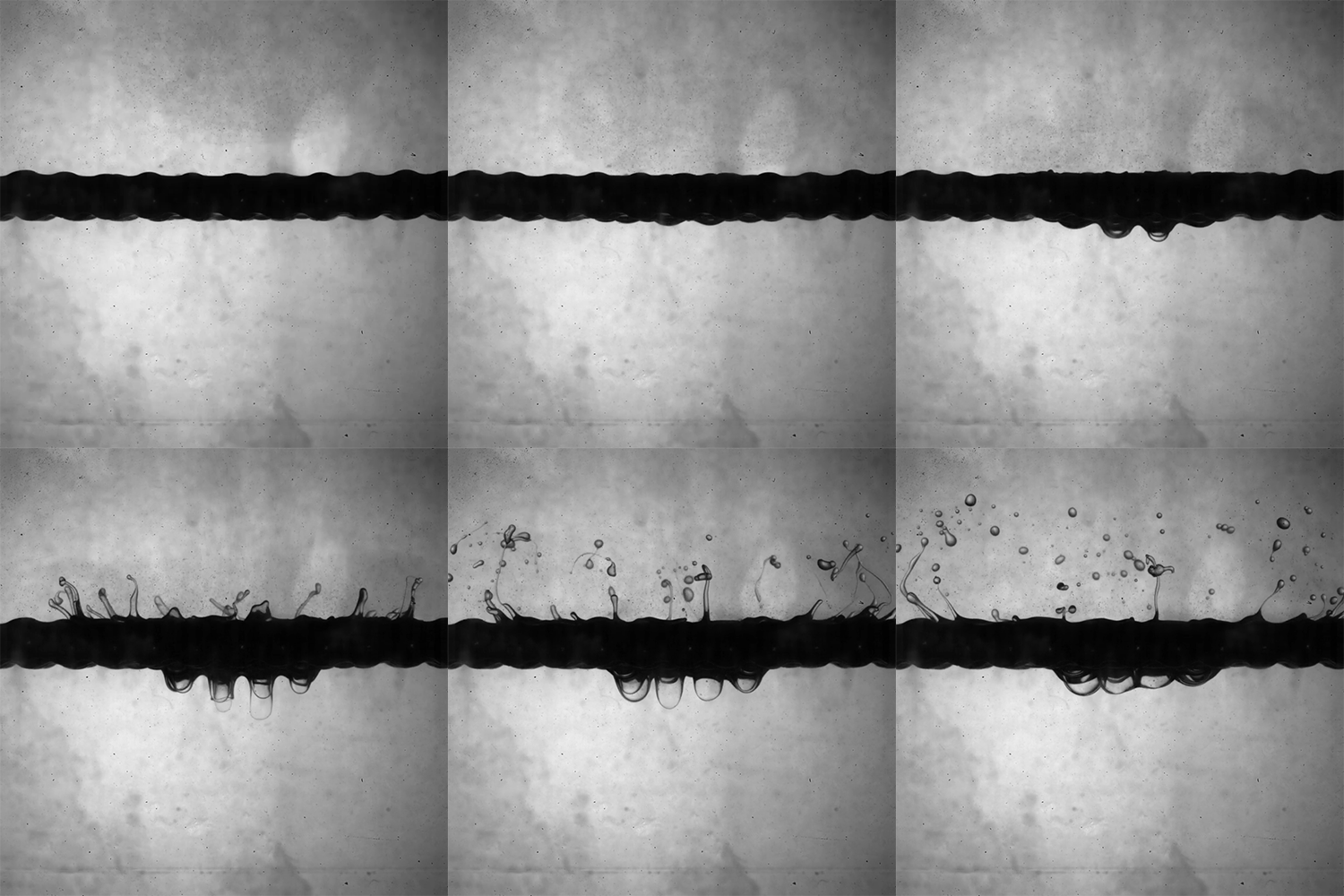
    When a partially-air-filled drop hits a surface, it splashes and rebounds in a complex fashion. This video breaks down the physics of the process. Upon impact, a lamella spreads, eventually becoming wavy and unstable along its rim. At the same time, a counterjet forms, growing until it pierces the remaining bubble of the drop. The jet continues to stretch upward due to its momentum, pinching off and forming wobbly satellite drops that finally fall back to the surface. (Image and video credit: D. Naidu and S. Dash)

  • Featured Video Play Icon

    “aBiogenesis”

    Many theories posit the physical and chemical origins of life. In the short film “aBiogenesis”, CGI artist Markos Kay imagines one such theory — the lipid world theory — in which cellular life began as a soup contained within immiscible fatty membranes. Chemicals trapped within these vesicles interacted and ultimately formed the building blocks of life as we know it, including RNA. Kay’s interpretation is a beautiful exploration of this intersection of physics, chemistry, and biology. (Image and video credit: M. Kay; via Colossal)

  • Where Fresh and Salty Meet

    Where Fresh and Salty Meet

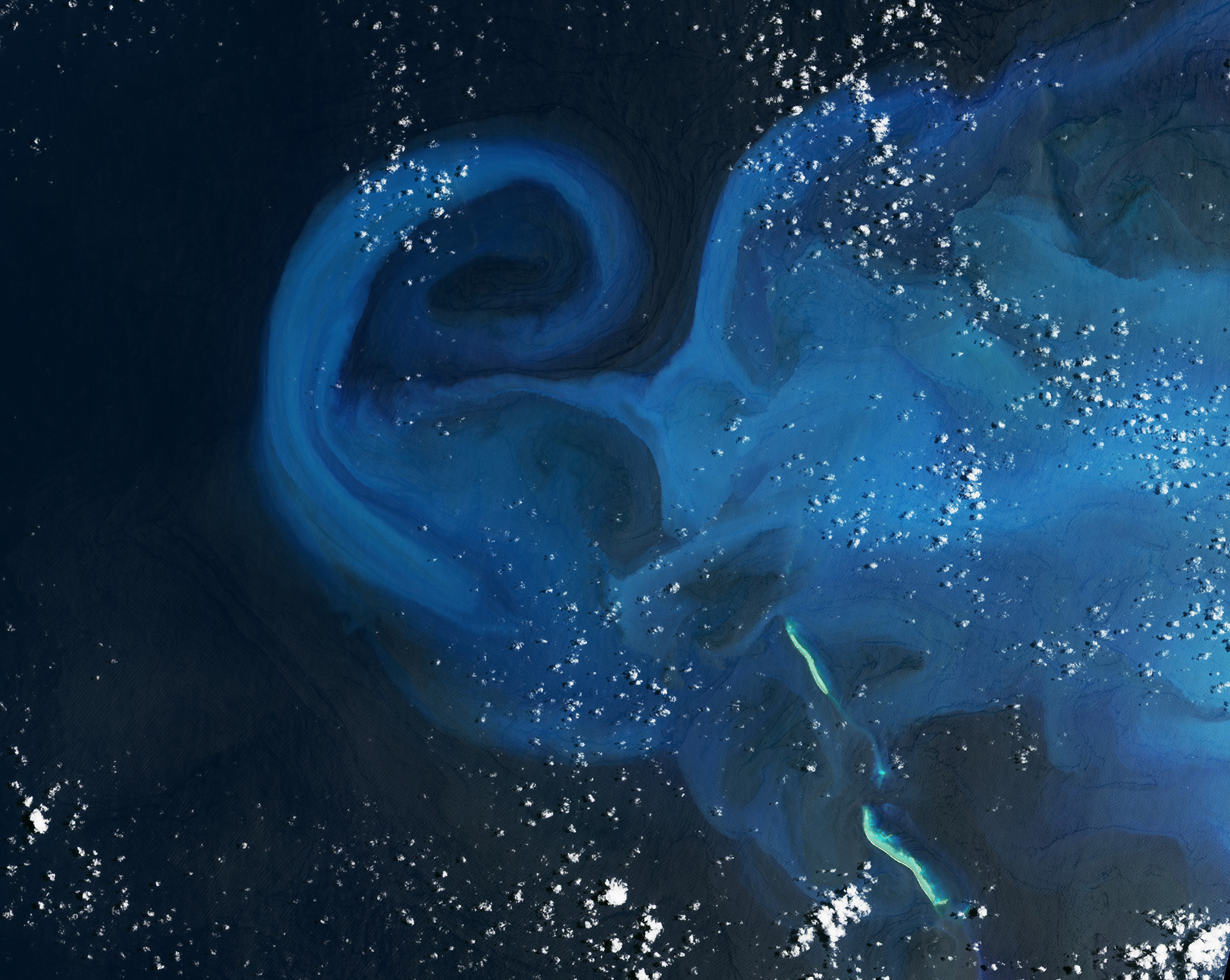
    Waterways twist through the wetlands of Adair Bay in this astronaut-captured image of northwestern Mexico. The estuary marks the transition between the Great Altar Desert and the Gulf of California. Fresh and salt water mix in the sediment-rich waterways. Mangroves and other salt-tolerant vegetation flourish in the coastal marsh. During low tides, evaporating water leaves behind salt flats, seen here in gray and white. High tides flood the area with nutrients that support both the vegetation and abundant aquatic life. (Image credit: NASA; via NASA Earth Observatory)

  • Featured Video Play Icon

    Kelvin-Helmholtz Flows Downhill

    Gravity currents carry denser fluids into lighter ones, like cold air drifting under your door in winter or dense fogs flowing downhill in San Francisco. Here, researchers visualize the situation using denser salt water flowing into fresh water. Once the gate separating the two fluids rises, the salt water slides down an artificial slope into the fresh water.

    Very quickly the flow forms a Kelvin-Helmholtz instability due to the different flow speeds between the two fluids. Kelvin-Helmholtz waves form distinctive swirls and billows that are reminiscent of a cat’s eye. As the swirls rotate, they can flow over one another, and break up into turbulence. (Image and video credit: C. Troy and J. Koseff)

  • Featured Video Play Icon

    “The Dark Days”

    “The Dark Days” is the third film in artist Thomas Blanchard’s N-UPRISING series. Like its siblings, this film features plants and insects, along with creeping — and sometimes overwhelming — fluid flows. The vivid colors of the orchids here make an uncomfortable juxtaposition with the air raid horns, sirens, and sounds of war that make up the soundtrack. It works well as a metaphor for life these days, where some of us can enjoy the new and the beautiful while others are caught up in war and suffering. (Image and video credit: T. Blanchard)

  • Icicles and Impurities

    Icicles and Impurities

    In nature, icicles often form horizontal ripples along their outer surface. Researchers found that these shapes only form when impurities are present in the water forming icicles; icicles made from pure water are smooth. Now researchers are uncovering more details of the ripple formation process, though the underlying mechanism remains unknown.

    Cross-sections of an icicle reveal chevron-like inclusions of impurities.
    Icicle using sodium fluorescein as an impurity. a) A vertical cross-section through the icicle shows chevron-like inclusions where impurities are concentrated. b) A similar icicle using salt as the impurity shows a similar pattern. c) A horizontal cross-section through the icicle reveals tree-like rings of concentrated impurities.

    Researchers first grew wavy icicles, then melted through them to reveal cross-sections of the icicle. They found chevron-like patterns within the ice, corresponding to areas with higher concentrations of impurities. The team think these chevrons record the process by which flowing water accumulates on the surface of the icicle prior to freezing. (Image credit: top – M. Shturma, cross-sections – J. Ladan and S. Morris; research credit: J. Ladan and S. Morris; via APS Physics)

  • Featured Video Play Icon

    Dancing Over Ridges

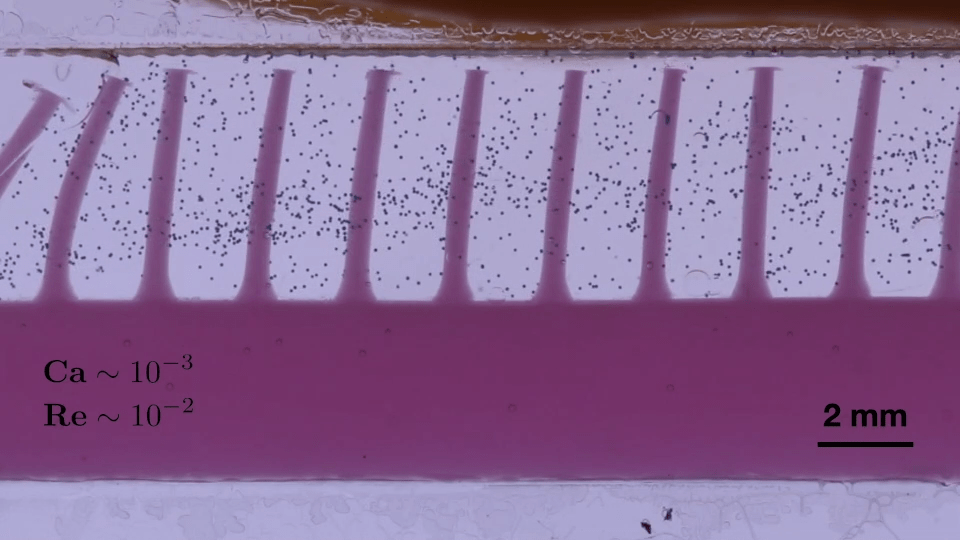
    When flowing over a ridged surface, particles follow a drifting, helical trajectory. In this video, researchers delve into the physics behind this phenomenon. Differences in the pressure gradient along different parts of the corrugation push particles along the groove. With their analysis, the team is able to predict particle trajectories above surface roughness of any shape. With these tools, they can design roughened microchannels that disperse particles at a desired speed, something that could be especially helpful in medical diagnostics. (Image and video credit: D. Chase et al.; research credit: D. Chase et al.)