Search results for: “art”

  • Slushy Snow Affects Antarctic Ice Melt

    Slushy Snow Affects Antarctic Ice Melt

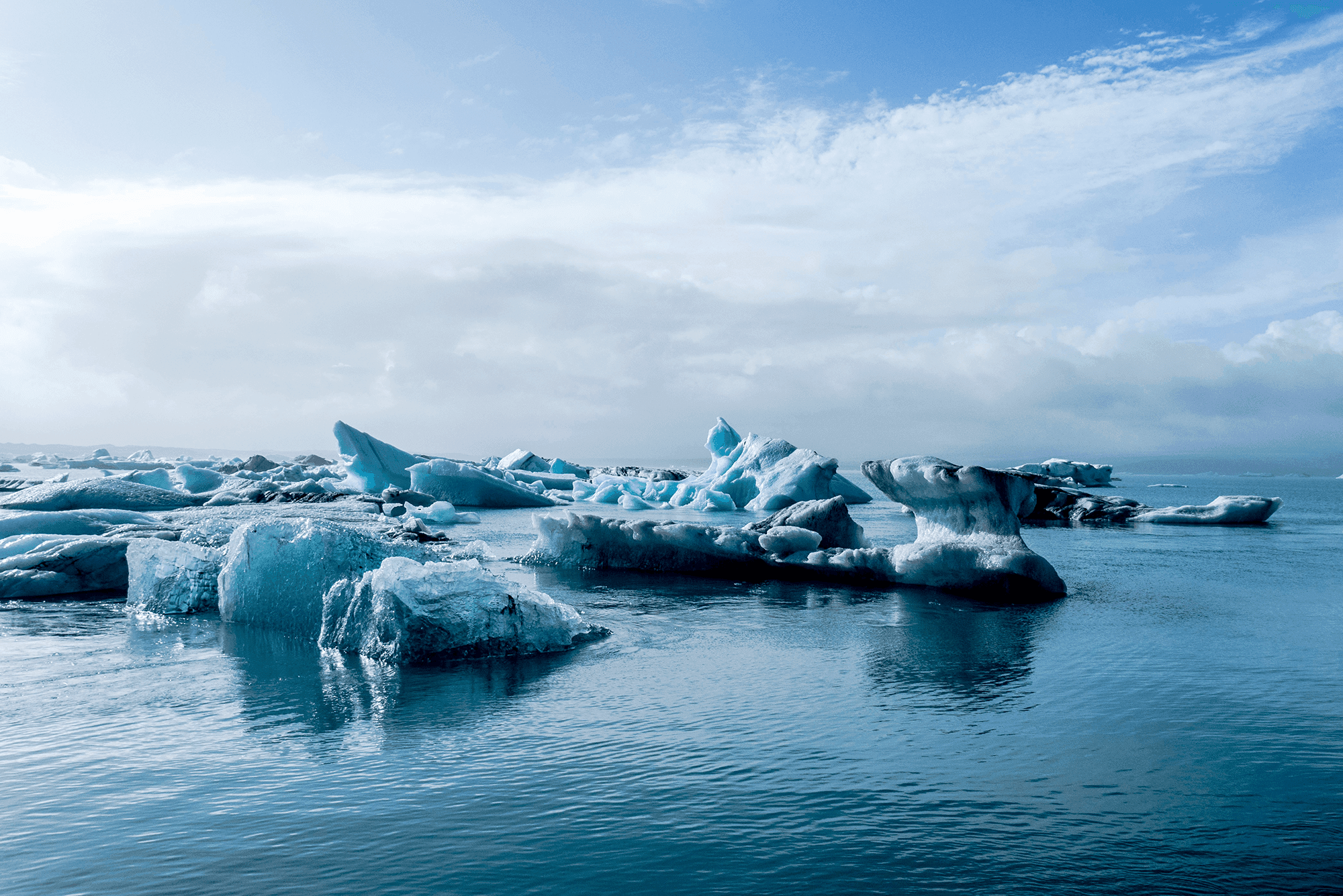
    More than a tenth of Antarctica’s ice projects out over the sea; this ice shelf preserves glacial ice that would otherwise fall into the Southern Ocean and raise global sea levels. But austral summers eat away at the ice, leaving meltwater collected in ponds (visible above in bright blue) and in harder-to-spot slush. Researchers taught a machine-learning algorithm to identify slush and ponds in satellite images, then used the algorithm to analyze nine years’ worth of imagery.

    The group found that slush makes up about 57% of the overall meltwater. It is also darker than pure snow, absorbing more sunlight and leading to more melting. Many climate models currently neglect slush, and the authors warn that, without it, models will underestimate how much the ice is melting and predict that the ice is more stable than it truly is. (Image credit: Copernicus Sentinel/R. Dell; research credit: R. Dell et al.; via Physics Today)

  • Peering Inside Viscous Fingering

    Peering Inside Viscous Fingering

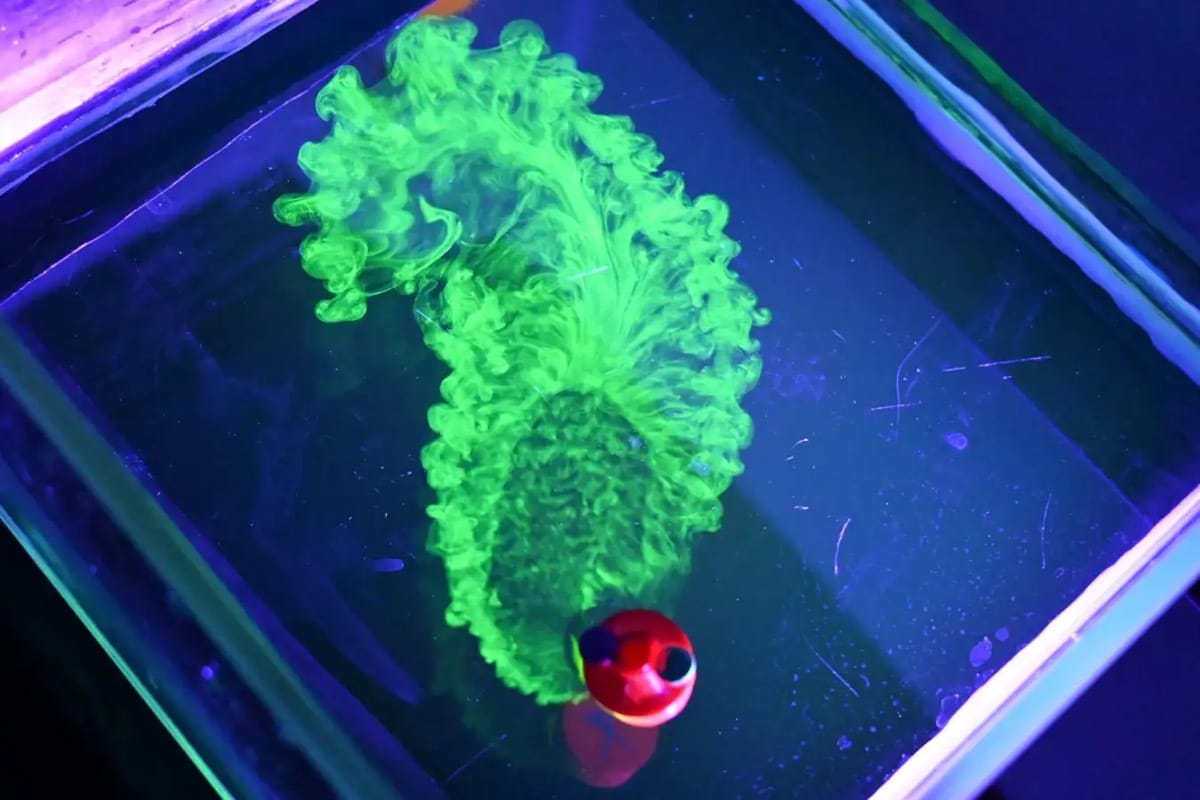
    Viscous fingers form when a low-viscosity fluid is pumped into a narrow, viscous-fluid-filled gap. The branching pattern that forms depends on the ratio of the two viscosities, among other factors. To better understand what goes on inside these fingers, researchers carefully alternated injecting dyed and undyed fluid. This creates a pattern of concentric rings that deform as the fingers spread.

    In this particular study, the initial fluid and injected fluids are miscible, meaning that they can mix into one another. In modeling their experiments, the team found that this mixing created stratification — i.e., layers of fluids with different densities — in the narrow gap between their plates. The stratification’s effects were large enough that the model required a correction term for them; that’s a bit surprising because we’d usually expect that the tiny third-dimension of the gap would be too small to matter! (Image and research credit: S. Gowan et al.)

  • Featured Video Play Icon

    Tweaking Coalescence

    When a drop settles gently against a pool of the same liquid, it will coalesce. The process is not always a complete one, though; sometimes a smaller droplet breaks away and remains behind (to eventually do its own settling and coalescence). When this happens, it’s known as partial coalescence.

    Here, researchers investigate ways to tune partial coalescence, specifically to produce more than a single droplet. To do so, they add surfactants to the oil layer surrounding their water droplet. The surfactants make the rebounding column of water skinnier, which triggers the Rayleigh-Plateau instability that’s necessary to break the column into more than one droplet. (Image and video credit: T. Dong and P. Angeli)

  • Featured Video Play Icon

    Billowing Ouzo

    Pour the Greek liquor ouzo into water, and your glass will billow with a milky, white cloud, formed from tiny oil droplets. The drink’s unusual dynamics come from the interactions of three ingredients: water, oil, and ethanol. Ethanol is able to dissolve in both water and oil, but water and oil themselves do not mix.

    In this video, researchers explore the turbulent effects of pouring ouzo into water. In particular, pouring from the top creates a fountain-like effect, due to a tug-of-war between the ouzo’s momentum and its buoyancy. Momentum wants the ouzo to push down into the water, and buoyancy tries to lift it back up. For an extra neat effect, they also show what happens when the ouzo is confined to a 2D plane and what happens when momentum and buoyancy act together instead of oppositely. (Image and video credit: Y. Lee et al.)

    Fediverse Reactions
  • Pterosaur Tail Vanes

    Pterosaur Tail Vanes

    Among vertebrates, pterosaurs were the first to achieve powered flight. Early pterosaurs have tail vanes — similar in appearance to the frills seen on some lizards — but later species lost this feature. Whether the tail vanes helped in flight or served a display purpose is an open question among paleontologists. One group, in a recent pre-print, studied the vanes’ fossilized interior structure and found a cross-linked lattice that provided internal tension to the vanes. That means the vanes could potentially be held stiff, even in the face of aerodynamic forces that would cause untensioned surfaces to flutter. The result suggests that the tail vanes could have helped early fliers steer, even if evolution later moved that function (along with display) to other parts of the body. (Image credit: Sviatoslav-SciFi; research credit: N. Jagielska et al.; via jshoer)

  • Jamming Soft Grains

    Jamming Soft Grains

    Hard granular materials — sand, gravel, glass beads, and so on — can flow, but, in narrow regions or under large forces, they can also jam up, essentially turning into a solid. Soft particles can also flow and jam, but do so under different conditions than hard particles. One group of researchers used a custom-built rheometer to measure jamming in soft particles like the hydrogel beads pictured here. They found that they could extend existing models for jamming in hard particles, but they had to rescale the mathematics to account for the way soft particles change their shape under pressure. (Image credit: Girl with red hat; research credit: F. Tapia et al.; via APS Physics)
  • Featured Video Play Icon

    “Ink In The Water. Mix One.”

    In this ASMR video, black ink diffuses in water. When the video starts, the ink is so diffuse that it’s not apparent the video is playing backward. It’s only as specific structures — things like Rayleigh-Taylor instabilities, plumes, and jets — coalesce from the background that we recognize the time reversal. Though it’s probably unintentional, this makes for a neat, subtle commentary on the nature of isotropic turbulence. (Video and image credit: Wryfield Lab)

  • Water Suspected Beneath Mars

    Water Suspected Beneath Mars

    The surface features of Mars — crossed by river deltas and sedimentary deposits — indicate a watery past. Where that water went after the planet lost its atmosphere 3 – 4 billion years ago is an open question. But a new study suggests that quite a bit of that water moved underground rather than escaping to space.

    The research team analyzed seismic data from the Mars InSight Lander. Marsquakes and meteor strikes on the Red Planet send seismic waves through the planet’s interior. The waves’ speed and other characteristics change as they pass through different materials, and by comparing different waves picked up from the same originating source, scientists can back out what the waves passed through on the way to the detector. In this case, the team concluded that the data best fit a layer of water-filled fractured igneous rock 11.5 – 20 kilometers below the surface. They estimate that the water trapped in this subsurface layer is enough to cover the surface of the planet in a 1 – 2 kilometer deep ocean. (Image credit: NASA/JPL-Caltech; research credit: V. Wright et al.; via Physics World)

  • Featured Video Play Icon

    Breaking Down a Water-Powered Timer

    In his latest “cutaway” video, Steve Mould takes a look at how you can nest siphons to create a system that periodically flushes itself. This kind of water-powered timer is useful in, say, public restrooms with a urinal system that collectively flushes every once in a while. In the video, Mould talks through each step of the system and some of the challenges he ran into when trying to create a pseudo-2D version of it. As is often the case with these videos, it’s a strangely satisfying process to watch. (Video and image credit: S. Mould)

  • Shaped Splashes

    Shaped Splashes

    When a raindrop hits a leaf, it spreads out into a rimmed sheet that breaks up into droplets. These tiny drops can carry dust, spores, and even pathogens as they fly off. But many leaves aren’t smooth-edged; instead they have serrations or teeth. How does that affect a splash? That’s the question at the heart of today’s study.

    A water drop hits a star-shaped pillar and breaks up.
    A water drop hits a star-shaped pillar and breaks up.

    To simplify from a leaf’s shape, the team studied water dropping onto star-shaped pillars. As seen above and below, the pillar’s edge shaped the splash sheet, with the sheet extending further in the edge’s troughs. This asymmetry extends into the rim also, concentrating the liquid — and the subsequent spray of droplets — along lines that extend from the edge’s troughs and peaks.

    A viscous water-glycerol drop hits a star-shaped pillar, spreads, and breaks into droplets.
    A viscous water-glycerol drop hits a star-shaped pillar, spreads, and breaks into droplets.

    The team found that, in addition to sending drops along a preferred direction, the shaped edge made the droplets larger and faster than a smooth edge did. (Image and research credit: T. Bauer and T. Gilet)