This high-speed footage shows how a dog drinks. The dog’s tongue curls backwards, creating a large area of surface contact with the water. When the dog pulls its tongue back up, water adheres to it and is drawn upward in a column. The dog then closes its mouth around the water before it falls. Fundamentally, this is the same mechanism as the one cats use. Part of the reason that dogs are messier drinkers, though, is that the backwards curl of their tongue picks up extra water. Because the dog has no cheeks, there’s no way to move this water from the underside to the top of the tongue and so the water just falls back out. (Video credit: Oxford Scientific Films; submitted by Carolyn W.)
Search results for: “art”
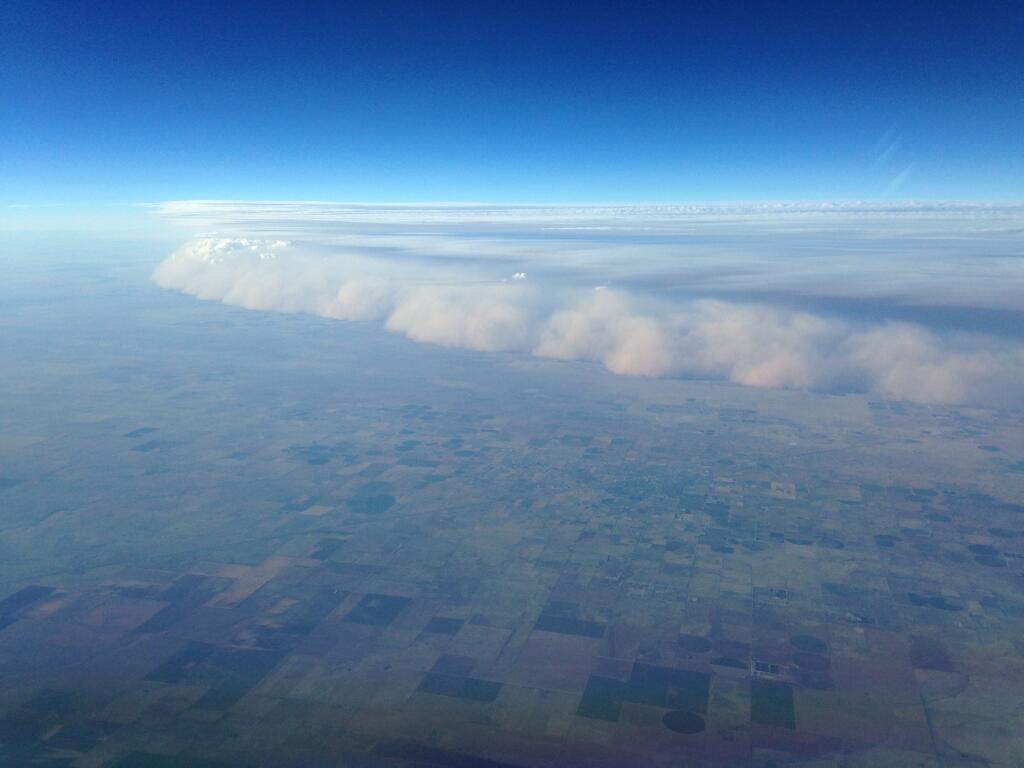
Dust Storm in Texas
This aerial photo shows the leading edge of a haboob–an intense dust storm–sweeping across Texas last week. Although dust can be stirred up under many circumstances, haboobs are a specific meteorological phenomenon with winds as high as 100 kph and towering clouds of dust kilometers high. This particular storm swept through five US states last week along an incoming cold front. The winds accompanying the cold front swept up silt, dirt, and dust from the drought-ridden Southwest and carried it along to envelope towns and cities along the way. Although the term is Arabic in origin, haboobs occur throughout the world, typically at the leading edge of a cold front or thunderstorm. (Photo credit: R. Scott)

Flowing Uphill
Science Friday takes an inside look at self-propelled Leidenfrost droplets like those we’ve featured previously. The Leidenfrost effect takes place when a liquid comes in contact with a surface much, much hotter than its boiling point. Part of the liquid is vaporized, creating a thin gas layer that both insulates the remaining liquid and causes it to move with very little friction. Over a flat surface, this underlying vapor will spread in any direction. But by covering the surface with ratchets, it’s possible to direct the vapor in a particular direction, which propels the droplet in the opposite direction. Check out the video and our previous posts for more! (Video credit: Science Friday; via io9 and submitted by Urs)

“Demersal”

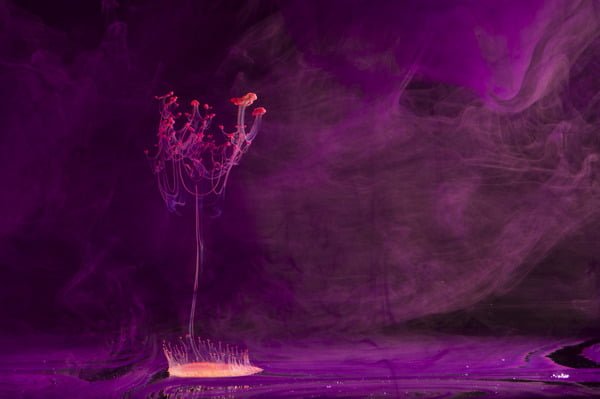
The ethereal shapes of inks and paints falling through water make fascinating subjects. Here the ink appears to rise because the photographs are upside-down. The fluid forms mushroom-like plumes and little vortex rings. The strands that split apart into tiny lace-like fingers are an example of the Rayleigh-Taylor instability, which occurs when a denser fluid sinks into a less dense one. Similar fingering can occur on much grander scales, as well, like in the Crab Nebula. These images come from photographer Luka Klikovac’s “Demersal” series. (Photo credit: L. Klikovac)
Australian Fire Tornado
The fire tornado is one of nature’s most impressive and terrifying examples of fluid dynamics. Although they are relatively common phenomena, it’s rare to get such a clear glimpse of them since they usually occur in the midst of giant wildfires. The fire tornado is driven by a combination of updraft from the fire and rotation from the surrounding flow. Take a look at how they form:
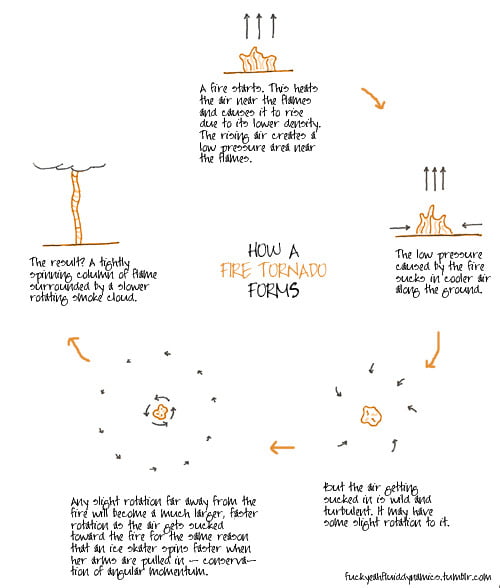
There are artificial fire tornadoes as well, including homemade ones. That said, please do not try this at home without full safety measures and extreme caution. In general, watching YouTube videos is a much safer way to enjoy this phenomenon. (Video credit: C. Tangey; h/t to Flow Visualization)
Hawk in Flight
For a little more than century, mankind has taken flight in fixed-wing aircraft. But other species have flown for much longer using flapping techniques, the details of which humans are still unraveling. To really appreciate flapping flight, it helps to have high-speed video, like this beautiful footage of a goshawk attacking a water balloon. The motion of the hawk’s wings is far more complex than the simple up and down flapping we imitate as children. On the downstroke, the wings and tail stretch to their fullest, providing as large an area as possible for lift. During steady flight, the bird flaps while almost horizontal for minimal drag, but as it approaches its target, it rears back, allowing the downstroke to both lift and slow the bird. In the upstroke, the bird needs to avoid generating negative lift by pushing air upward. To do this, it pulls its wings in and simultaneously rotates them back and up. Its tail feathers are also pulled in but to a lesser extent. Leaving them partially spread probably maintains some positive lift and provides stability. At the end of the upstroke, the hawk’s wings are ready to stretch again, and so the cycle continues. (Video credit: Earth Unplugged/BBC; h/t to io9)
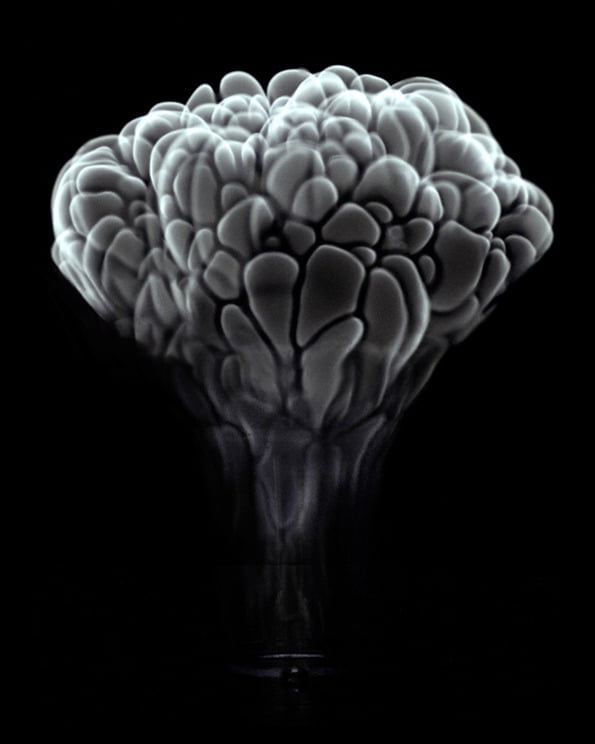
“Aurora”
This bulbous, ethereal shape is a spreading flame front captured by artist Fabian Oefner in his new “Aurora” series. Oefner used a few alcohol droplets in a glass vessel and ignited the volatile vapors, capturing the propagating flame. Take a look at it in action. Because the air inside the vessel is mostly still, the chemical reactions in the combustion occur much faster than the air’s motion. As a result, the flame spreads as a thin sheet instead of a uniform, widespread flame. The wrinkled and corrugated look of the flame front is due local turbulence distorting the flame. (Photo credit: F. Oefner)
When Turbulence Is Desirable
One of the common themes in aerodynamics, especially in sports applications, is that tripping the flow to turbulence can decrease drag compared to maintaining laminar flow. This seems counterintuitive, but only because part of the story is missing. When a fluid flows around a complex shape, there are actually three options: laminar, turbulent, or separated flow. An object’s shape creates pressure forces on the surrounding fluid flow, in some cases causing an increasing, or unfavorable, pressure gradient. When this occurs, fluid, especially the slower-moving fluid near a surface, can struggle to continue flowing in the streamwise flow direction. Consider the video above, in which the flow moves from left to right. Near the surface a turbulent boundary layer is visible, where fluid motion is significantly slower and more random. Occasionally the flow even reverses direction and billows up off the surface. This is separation. Unlike laminar boundary layers, turbulent boundary layers can better resist and recover from flow separation. This is ultimately what makes them preferable when dealing with the aerodynamics of complex objects. (Video credit: A. Hoque)

Cylinder Wakes
A simple cylinder in a steady flow creates a beautiful wake pattern known as a von Karman vortex street. The image above shows several examples of this pattern. Flow is from bottom to top, and the Reynolds number is increasing from left to right. In the experiment, this increasing Reynolds number corresponds to increasing the flow velocity because the cylinder size, fluid, and temperature were all fixed. As the Reynolds number first increases, the cylinder begins to shed vortices. The vortices alternate the side of the cylinder from which they are shed as well as alternating in their sense of rotation (clockwise or counterclockwise). Further increasing the Reynolds number increases the complexity of the wake, with more and more vortices being shed. The vortex street is a beautiful example of how fluid behavior is similar across a range of scales from the laboratory to our planet’s atmosphere. (Image credit: Z. Trávníček et. al)
Soil Liquefaction
Soil liquefaction is a rather unsettling process in which apparently solid ground begins moving in a fluid-like way after agitation. It occurs in loose sediments when the spaces between individual particles become nearly saturated with water. This can happen, for example, after heavy rains or in a place with inadequate drainage. Such cases are typically very localized, though, and require some significant agitation of the surface, like pressing with heavy machinery or jumping in a single spot. Soil liquefaction becomes a greater danger, however, in an earthquake. Even in a dry area, the earth’s shaking can force groundwater up into the surface sediment and vibrate the soil sufficiently to liquify it, causing whole buildings to sink or tip and wreaking havoc on manmade infrastructure. (Video credit: jokulhlaups)


