Search results for: “art”

  • Fluids Round-up – 11 January 2014

    Fluids Round-up – 11 January 2014

    It’s a big fluids round-up today, so let’s get right to it.

    (Photo credit: Think Elephants International/R. Shoer)

  • Aurora From Space

    Aurora From Space

    An aurora, as seen from the International Space Station, glows in green and red waves over the polar regions of Earth. These lights are the result of interactions between the solar wind–a stream of hot, rarefied plasma from the sun–and our planet’s magnetic field. A bow shock forms where they meet, about 12,000-15,000 km from Earth. The planet’s magnetic field deflects much of the solar wind, but some plasma gets drawn in along field lines near the poles. When these energetic particles interact with nitrogen and oxygen atoms in the upper atmosphere, it can excite the atoms and generate photon emissions, creating the distinctive glow. Similar auroras have been observed on several other planets and moons in our solar system. (Photo credit: NASA)

  • Is the Star Trek Voyager Opening Sequence Physically Realistic?

    Is the Star Trek Voyager Opening Sequence Physically Realistic?

    Today’s post is largely brought to you by the fact that I have been sick the past four days and my fiance and I have been bingeing on Star Trek Voyager. At some point, we began wondering about the sequence from 0:30-0:49 in which Voyager flies through a nebula and leaves a wake of von Karman vortices. Would a starship really leave that kind of wake in a nebula?

    My first question was whether the nebula could be treated as a continuous fluid instead of a collection of particles. This is part of the continuum assumption that allows physicists to treat fluid properties like density, temperature, and velocity as well-defined quantities at all points. The continuum assumption is acceptable in flows where the Knudsen number is small. The Knudsen number is the ratio of the mean free path length to a characteristic flow length, in this case, Voyager’s sizeThe mean free path length is the average distance a particle travels before colliding with another particle. Nebulae are much less dense than our atmosphere, so the mean free path length is larger  (~ 2 cm by my calculation) but still much smaller than Voyager’s length of 344 m. So it is reasonable to treat the nebula as a fluid.

    As long as the nebula is acting like a fluid, it’s not unreasonable to see alternating vortices shed from Voyager. But are the vortices we see realistic relative to Voyager’s size and speed? Physicists use the dimensionless Strouhal number to describe oscillatory flows and vortex shedding. It’s a ratio of the vortex shedding frequency times the characteristic length to the flow’s velocity. We already know Voyager’s size, so we just need an estimate of its velocity and the number of vortices shed per second. I visually estimated these as 500 m/s and 2.5 vortices/second, respectively. That gives a Strouhal number of 0.28, very close to the value of 0.2 typically measured in the wake of a cylinder, the classical case for a von Karman vortex street.

    So far Voyager’s wake is looking quite reasonable indeed. But what about its speed relative to the nebula’s speed of sound? If Voyager is moving faster than the local speed of sound, we might still see vortex shedding in the wake, but there would also be a bow shock off the ship’s leading edge. To answer this question, we need to know Voyager’s Mach number, its speed relative to the local speed of sound. After some digging through papers on nebulae, I found an equation to estimate speed of sound in a nebula (Eq 9 of Jin and Sui 2010) using the specific gas constant and temperature. Because nebulae are primarily composed of hydrogen, I approximated the nebula’s gas constant with hydrogen’s value and chose a representative temperature of 500 K (also based on Jin and Sui 2010). This gave a local speed of sound of 940 m/s, and set Voyager’s Mach number at 0.53, inside the subsonic range and well away from any shock wave formation.

    Of course, these are all rough estimates and back-of-the-envelope fluid dynamics calculations, but my end conclusion is that Voyager’s vortex shedding wake through the nebula is realistic after all! (Video credit: Paramount; topic also requested by heuste11)

  • The Inside of an Evaporating Drop

    [original media no longer available]

    Evaporating droplets may not look like much to the naked eye, but they contain complicated flow patterns. The type of pattern observed depends strongly on the contact line, the place where the liquid, solid, and air meet. When the contact line is pinned–kept unchanged–during evaporation, any particulates in the drop get pulled toward the edges as the drop evaporates. This is what leaves the classic coffee ring stain. It is also what is shown in the first clip in the video above. Contrast this with the second clip, in which the contact line is unpinned and varies irregularly as the drop evaporates. In the unpinned drop, particles are drawn inward during evaporation. The flow patterns are very different as well, complicated by swirling that is the result of force imbalances caused by the irregularly receding contact line. (Video credit: H. Kim)

  • Featured Video Play Icon

    What Makes Squids Fast

    Cephalopods like the octopus or squid are some of the fastest marine creatures, able to accelerate to many body lengths per second by jetting water behind them. Part of what makes its high speed achievable, though, is the way the animal changes its shape. In general, drag forces are proportional to the square of velocity, meaning that doubling the velocity increases the drag by a factor of four. The energy necessary to overcome such large drag increases generally prevents marine animals from going very fast (compared to those of us used to moving through air!) But drag is also proportional to frontal area. Like the bio-inspired rocket in the video above, jetting cephalopods begin their acceleration from a bulbous shape and then shrink their exposed area as they accelerate. Not only does this shape change help mitigate increases in drag due to velocity, it prevents flow from separating around the animal, shielding it from more drag. The result is incredible acceleration using only a simple jet for thrust. For example, the octopus-like rocket in the video above reaches velocities of more than ten body lengths per second in less than a second. (Video credit: G. Weymouth et al.)

  • Featured Video Play Icon

    Impacts on Sand

    Granular materials like sand are sometimes very fluid-like in their behaviors. The high-speed video above shows a ball bearing being dropped into packed sand. Many features of the splash are fluid-like; the initial impact creates a spreading crownlike splash, followed by a strong upward jet that eventually collapses back into the medium. At the same time, many of the impact characteristics are decidedly non-fluidic. Sand has no surface tension, so both the crown and the jet readily break up into small particles. The granular jet is very narrow and energetic, reaching heights greater than the impacter’s drop height. Interestingly, the column begins collapsing on its lower end before the jet even reaches its highest peak. This may be due to the lower energy of the sand particles that were ejected later in the crater formation process. (Video credit: J. Verschuur, B. van Capelleveen, R. Lammerink and T. Nguyen)

  • The Science of Champagne

    The Science of Champagne

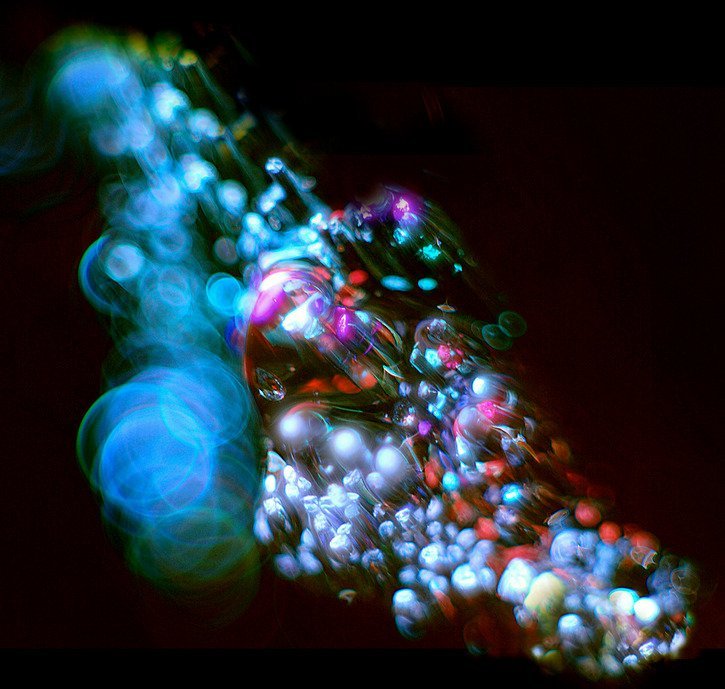
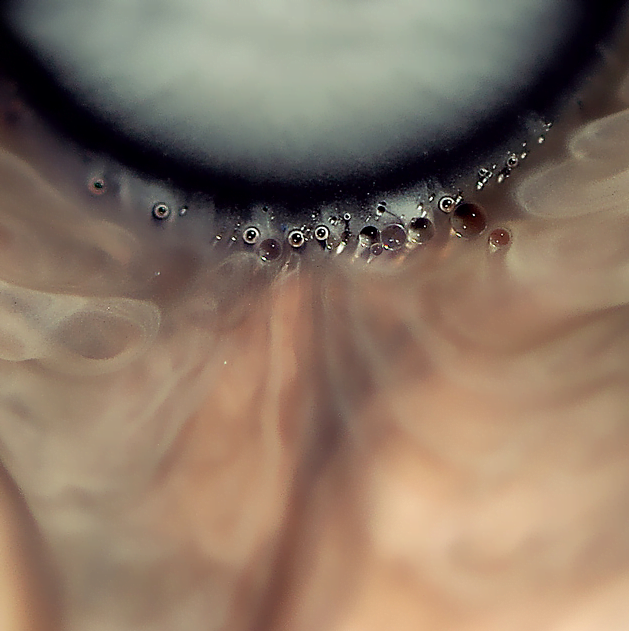
    Champagne owes much of its allure to its tiny bubbles. Unlike other wines, champagne undergoes a secondary fermentation in the bottle, during which the yeasts in the wine consume sugars and produce carbon dioxide, which dissolves into the wine. When opened, the carbon dioxide can begin to escape. Bubbles form in the glass around imperfections, either due to intentional etching of the glass or impurities left behind by cleaning. Once formed, trails of bubbles rise to the surface, swelling as more dissolved carbon dioxide is absorbed into each bubble. The bubbles then cluster near the surface of the champagne, occasionally popping and creating a flower-like distortion of the surrounding bubbles. The gases within the bubbles contains higher concentrations of aromatic chemicals than the surrounding wine, and the bursting of each bubble propels tiny droplets of these aromatics upwards, carrying the scent of the champagne to the drinker. For more beautiful champagne photos, I recommend this LuxeryCulture article; for more on the science of champagne, see Chemistry World’s coverage. Happy 2014! (Image credits: G. Liger-Belair et al.)

  • Featured Video Play Icon

    Holiday Fluids: What is Fire?

    Snowy holidays and long, dark nights are a great time to sit by the fire or enjoy some candlelight. We’ve talked before about how buoyancy affects a flame’s shape, how atomization mixes liquid fuel and oxidizers, how flames propagate, how internal combustion works and how instabilities can end combustion. But in all that we haven’t addressed what fire actually is! Combustion is a chemical process–a reaction between a hydrocarbon fuel and oxygen, but the flame we’re accustomed to seeing is a combination of blue light produced by the complete reaction and incandescent red/orange/yellow light from glowing soot particles produced when there is insufficient oxygen for the reaction. If you have time after the Minute Physics version, this video from Ben Ames has a wonderful explanation of flames. Of course, if you just prefer your holiday fun with more explosive high-speed videos, you’re going to want to see this Christmas tree made from detonation cord (see 2:40 for the start of the best part). This wraps up our holiday-themed fluid dynamics series. Happy holidays from FYFD! (Video credit: Minute Physics)

  • Featured Video Play Icon

    Holiday Fluids: Cocoa Convection

    If you make a proper cup of hot chocolate this holiday, watch carefully and you just may catch some Rayleigh-Benard convection like the video above. (Note, video playback is 3x.) The canonical Rayleigh-Benard problem is one in which fluid is heated from below and cooled from above. For the cup of hot chocolate, the cooling comes from the colder, ambient air at the cocoa’s surface. Because cooler fluid is denser than warmer fluid, the cocoa near the surface will tend to sink down, allowing warmer cocoa to rise. As that warm cocoa reaches the surface, it too will cool and sink back down, continuing the cycle. The effect relies on buoyancy and, by extension, gravity; on the International Space Station, for example, astronauts would not observe such convection. The distinctive shape of the cells depends on the boundaries of the cup. This post is part of our weeklong holiday-themed fluid dynamics series. (Video credit: Armuotas)

  • Featured Video Play Icon

    Holiday Fluids: Santa’s Aerodynamics

    Today we have some holiday-themed fluid dynamics: visualization of flow around Santa’s sleigh! This is a flowing soap film visualization at a low speed (author Nick Moore has some other speeds as well). Santa’s sleigh is what aerodynamicists call a bluff body–a shape that is not streamlined or aerodynamic–and sheds a complicated wake of vortices. Like any object moving through a fluid, Santa’s sleigh generates drag forces made up of several components. There is viscous drag, which comes from friction between the sleigh’s surface and the fluid, and form drag (or pressure drag), which comes from the shape of the sleigh. That wake full of complicated vortices significantly increases the sleigh’s pressure drag, requiring Rudolph and the other reindeer to provide more thrust to counter the sleigh’s drag. Speaking thereof, the visualization does not take into account the aerodynamics of the reindeer, who, in addition to providing the sleigh’s thrust, would also affect the flowfield upstream of the sleigh. This post is part of this week’s holiday-themed post series. (Video credit: N. Moore)