Fire tornadoes, despite their name, are more closely related to dust devils or waterspouts than to true tornadoes. Though rarely documented, they are relatively common, especially in wildfires. The heat of the fire creates an updraft of warm, rising air that leaves behind a low-pressure region. Air from outside is drawn toward this low-pressure area, gets heated, and rises. As the outside air gets pulled in, any vorticity or rotation it had gets intensified via conservation of angular momentum–the same way a spinning ice skater speeds up when she pulls her arms in. The result is the tightly-spinning vortex at the heart of a fire tornado. (Video credit: C. Fleur; via NatGeo)
Search results for: “art”

Turbulent Ink
Turbulence is found throughout our lives, but rarely is it as startlingly beautiful as in this Slow Mo Guys video. Here they show high-speed videos of ink being injected into water. The resulting plumes are turbulent from the very start, with innumerable folds and eddies billowing outward as the plume expands. The large difference in length scales–from the millimeter-sized curls to the meter-sized length of the plume–is one of the classic characteristics of turbulence and part of what makes turbulent flows so difficult to model computationally. Energy in these flows is generated at the large scales, but it’s dissipated at the very smallest scales through viscosity. This means that to properly model a turbulent flow, you have to capture the largest scales, the smallest scales, and everything in between in order to represent this energy cascade from large to small. It’s a problem that engineers, mathematicians, meteorologists, and physicists have struggled with for more than a century. But, here, at least, we can all just sit back and enjoy the beauty. (Video credit: The Slow Mo Guys)

Controlling Droplet Bounce


Water repellent, or hydrophobic, surfaces are common in nature, including lotus leaves, many insects, and even some geckos. These hydrophobic surfaces typically gain their water-repelling ability from extremely tiny nanoscale structures in the form of tiny hairs or specially textured surfaces. But, while the nanoscale structures impart superhydrophobicity, researchers have found that larger macroscale structures can improve water-repellent characteristics by reducing a drop’s time of contact with the surface. A smaller contact time means less chance of contamination on self-cleaning surfaces. It’s also helpful in preventing water from freezing on contact to cold surfaces – valuable, for example, in protecting airplane wings’ leading edges from icing over. This combination of nanoscale and macroscale, water-repelling structures can be found in nature, too, such as on the wings of butterflies, which must quickly shed water in order to fly. (Image credits: K. Hounsell et al.; A. Gauthier et al., source video)
Leaping Mobulas
Mobula rays engage in some pretty incredible aerial acrobatics. This species of ray, second only to manta rays in size, can jump up to 2 meters into the air. Large groups of mobula rays will engage in this behavior, including both males and females, but it remains unclear to scientists exactly what purpose the jumping serves. It may be a form of communication, which might explain the rays’ apparent preference for belly flopping. By striking the water surface with as much of their body as possible simultaneously, the rays generate both a large splash and a concussive clap that carries through the water. (Video credit: BBC; via J. Hertzberg)
Tides
Most of us think we understand why Earth’s oceans have tides, but it turns out that there are some misconceptions in the common explanation. Yes, it’s true that the moon’s gravity pulls on water in the ocean, but it equally pulls on everything else, too, and we don’t levitate at high tide! In reality, it’s the distribution of tidal forces across the enormity of the ocean that causes the ocean to bulge along the Earth-moon line and create high and low tides. Lakes, puddles, and humans experience tides, too, but we’re so small that the tidal forces we experience are too tiny to be noticeable. For the full explanation, I encourage you to watch PBS Space Time’s video. Don’t let the 15 minute run-time deter you; the tidal explanation is contained within the first 9 minutes. (Video credit: PBS Space Time; via It’s Okay To Be Smart)
Weaponizing Water-Repellency
St. Pauli, a neighborhood in the German city of Hamburg, has demonstrated one of the most unusual applications of superhydrophobicity I’ve ever heard of. St. Pauli is known as a party district, and the residents of the area have grown understandably frustrated with inebriated visitors publicly urinating on their buildings and, yes, playgrounds. When fines failed to curb the issue, they took to treating walls chemically to make them superhydrophobic. As the targeted audience has discovered, water repellency tends to make liquid jets bounce off rather than run down a surface. Well played, St. Pauli. (Video credit: IG St. Pauli; submitted by entropy-perturbation)
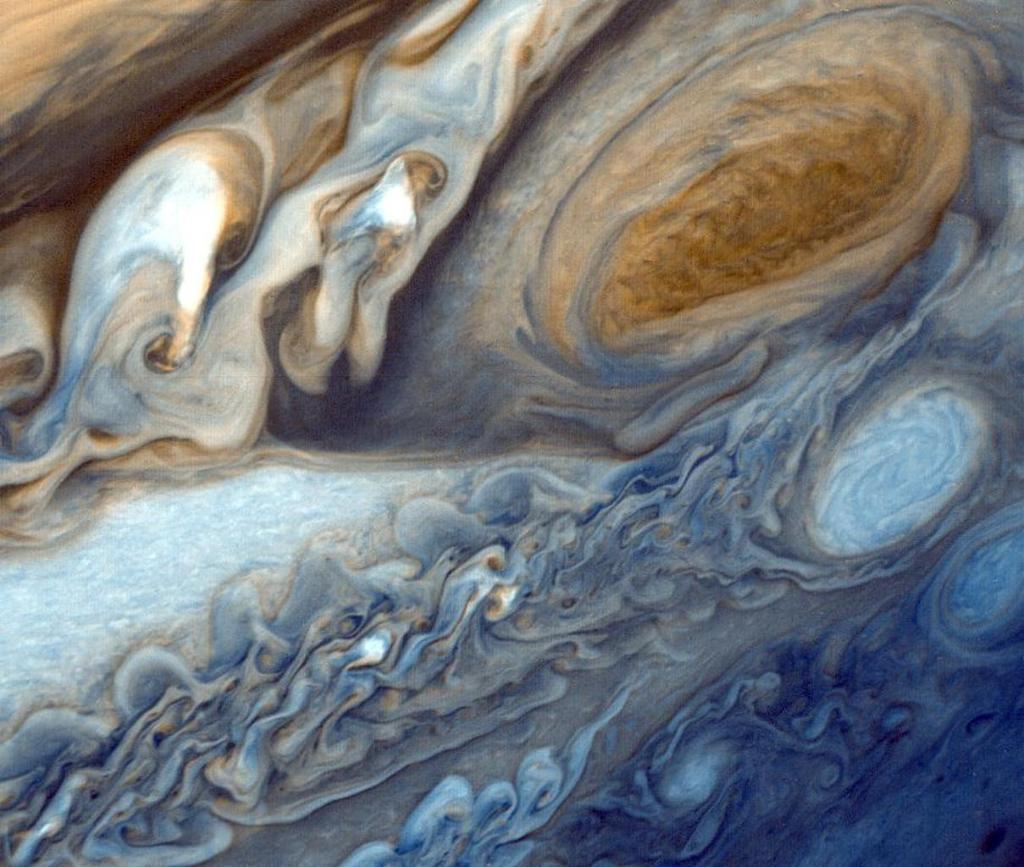
Jovian Dynamics
Our solar system’s largest planet is a mysterious and majestic font of fluid dynamics. Unlike rocky Earth, Jupiter is made entirely of fluids. Beneath its massive gaseous atmosphere lies an ocean of liquid hydrogen. The lack of solid ground to weaken storms may explain some of the longevity of Jupiter’s Great Red Spot, a hurricane that’s been raging on the planet for more than a hundred and fifty years. Part of the challenge of understanding Jupiter’s dynamics is that most of our data consists of observations of the uppermost layer of the atmosphere. It’s kind of like trying to describe an entire ocean based on the surface alone; what we see is part of the story, but it’s only a small portion of a much greater whole. (Image credit: NASA; submitted by jshoer)
——————
FINAL CALL: FYFD reader survey closes TODAY! I’ve teamed up with researcher Paige Brown Jarreau to create a survey of FYFD readers. By participating, you’ll be helping me improve FYFD and contributing to novel academic research on the readers of science blogs. It should only take 10-15 minutes to complete. You can find the survey here.

Convection Cells
This magnified photo shows Rayleigh-Benard convection cells in silicone oil. This buoyancy-driven convection occurs when a fluid is heated from below and cooled above. Inside the cells, fluid rises through the center and sinks along the edges; this motion is made apparent here thanks to aluminum flakes in the oil. The distinctive hexagonal shape of the cells is actually due to surface tension. Here, the upper surface of the fluid is left open to the air and this free surface boundary condition causes hexagonal shapes to form. If the fluid were instead covered by a solid surface, the convection cells that form would be shaped differently. (Image credit: M. Velarde et al.; via Van Dyke’s An Album of Fluid Motion)
——————
LAST CALL: FYFD reader survey closes Wednesday! I’ve teamed up with researcher Paige Brown Jarreau to create a survey of FYFD readers. By participating, you’ll be helping me improve FYFD and contributing to novel academic research on the readers of science blogs. It should only take 10-15 minutes to complete. You can find the survey here.
Carbonation in Space
Astronauts don’t typically drink soda or other carbonated beverages while in space. The reason is probably apparent if you watch this new video of an effervescent tablet in water on the space station (or, you could watch the older classic one from Don Pettit). Unlike on Earth, where the carbon dioxide bubbles are buoyant and rise to the surface, the bubbles in a fluid in microgravity are randomly distributed. Those few bubbles that happen to be located along the edge of the water sphere will sometimes burst, creating the halo of tiny droplets you see in the video. In the case of sodas, though, the bubbles’ behavior creates a foamy mess, and, after ingestion, the bubbles are stuck travelling through the astronaut’s digestive system instead of getting burped out. Sounds rather unpleasant to me. (Video credit: NASA; submitted by entropy-perturbation and buckitdrop)
——————
LAST CALL: Help us do some science! I’ve teamed up with researcher Paige Brown Jarreau to create a survey of FYFD readers. By participating, you’ll be helping me improve FYFD and contributing to novel academic research on the readers of science blogs. It should only take 10-15 minutes to complete. You can find the survey here.

Wave Clouds Over the Galapagos
This dramatic example of Kelvin-Helmholtz clouds was taken near the Galapagos Islands last week. The shark-fin-like clouds are the result of two air layers moving past one another. The velocity difference at their interface creates an unstable shear layer that quickly breaks down. The resemblance of the clouds to breaking ocean waves is no coincidence – the wind moving over the ocean’s surface generates waves via the same Kelvin-Helmholtz instability. In the case of the clouds above, the lower layer of air was moist enough to condense, which is why the pattern is visible. Clouds like these don’t tend to last for long because the disturbances that drive the instability grow exponentially quickly, leading to turbulence. (Image credit: C. Miller; via Washington Post; submitted by @jmlinhart)
——————
Help us do some science! I’ve teamed up with researcher Paige Brown Jarreau to create a survey of FYFD readers. By participating, you’ll be helping me improve FYFD and contributing to novel academic research on the readers of science blogs. It should only take 10-15 minutes to complete. You can find the survey here.