
One of the key features of turbulent flows is that they contain many different length scales. Look at the plume from an erupting volcano, and you’ll see eddies that are hundreds of meters across as well as tiny ones on the order of millimeters. This enormous difference in scale is one of the major challenges in simulating turbulent flows. Since energy enters at the large scale and is passed to smaller and smaller scales before being dissipated at the tiniest scales of the flow, properly simulating a turbulent flow requires resolving all of these length scales. This is especially challenging for applications like the solar wind – the stream of charged particles that flows from the sun and gets diverted around the Earth by our magnetic field. The image above shows some of the turbulence in our solar wind. The structures seen in the flow range from the size of the Earth all the way to the scale of electrons! (Image credit: B. Loring, Berkeley Lab)
Search results for: “art”

Arriving at Jupiter


Today all eyes turn to Jupiter where NASA’s Juno spacecraft will enter orbit around the gas giant. In preparation, Hubble and ground-based telescopes have been observing Jupiter in both the visible (upper right) and infrared (upper left) spectrum. The lower image shows a 1:5 scale model of Juno and a full-size replica of one of its solar panels; note the mannequin in the lower right corner for scale.
Juno is entering one of the harshest environments in the solar system with intense magnetic fields that trap lethal amounts of radiation around the planet. The lovely blue auroras Hubble sees around Jupiter’s poles are a never-ending hailstorm of solar wind particles hitting Jupiter’s atmosphere. Juno will be studying the structure of Jupiter’s magnetosphere, gravitational field, and its interior, hopefully helping scientists explain how the planet formed and the role it played in the formation of our solar system. (Image credits: infrared Jupiter – ESO/L. Fletcher; Jovian auroras – Hubble/ESA; Juno model and solar panel – N. Sharp)

Denticles and Sharkskin
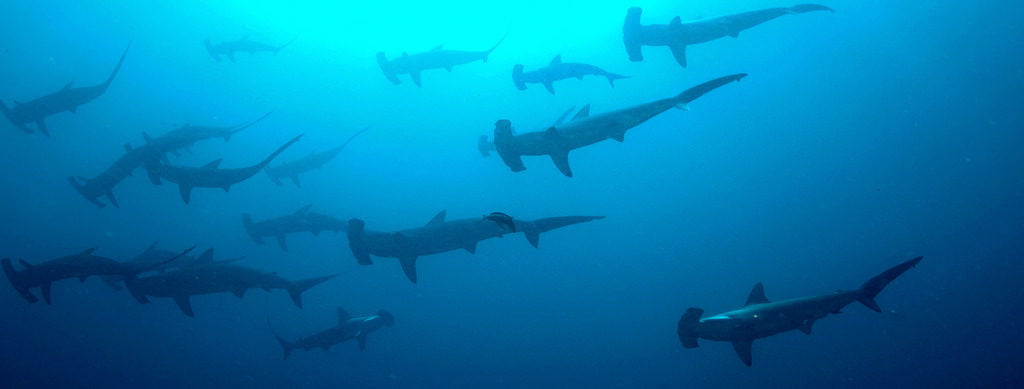


Look closely enough at a shark’s skin, and you will find it is covered in tiny, anvil-shaped denticles (lower left). To try and discover how and why these denticles help sharks, researchers are 3D printing denticles in different patterns onto flexible sheets to create biomimetic shark skin (lower right).
They test the artificial shark skin in a water tunnel by moving it with prescribed motions and measuring different characteristics, like the swimming speed attained and the power required. When compared to a smooth but flexible control surface, one pattern came out ahead. The staggered-overlapped denticle pattern (shown in C of the lower right figure) achieved swimming speeds 20% higher than the smooth control despite having far more surface area due to the denticles. The cost of that speed was only 13% greater than the smooth case on average, and was about equal to the smooth case for small amplitude motion. This suggests that the patterning of a shark’s skin may help it swim faster with little to no additional cost in effort.
For more on shark hydrodynamics, check out my previous posts on the topic, and if you want even more shark science, check out these great videos. (Image credit: R. Espanto; J. Oeffner and G. Lauder; L. Wen et al.; research credit: L. Wen et al., 1, 2)

Resonating Bowls
Rub your hands on the handles of a Chinese resonance bowl and you can generate a spray of tiny droplets. The key to this, as the name suggests, is vibration. Rubbing the handles vibrates the bowl, causing small oscillations in the bowl’s shape that are too small for us to see. But those vibrations do produce noticeable ripples on the water in the bowl. When you hit the right frequency and amplitude, those vibrations disturb the water enough that the up-and-down vibration at the surface actually ejects water droplets. The vibration of the bowl affects water near the wall most strongly, which is why that part of the bowl has the strongest reaction. It takes even larger amplitude vibrations to get droplets jumping in the middle of the bowl, but you can see that happening in this video of a Tibetan singing bowl. (Image/video credit: Crazy Russian Hacker, source)
Rayleigh-Taylor Waves
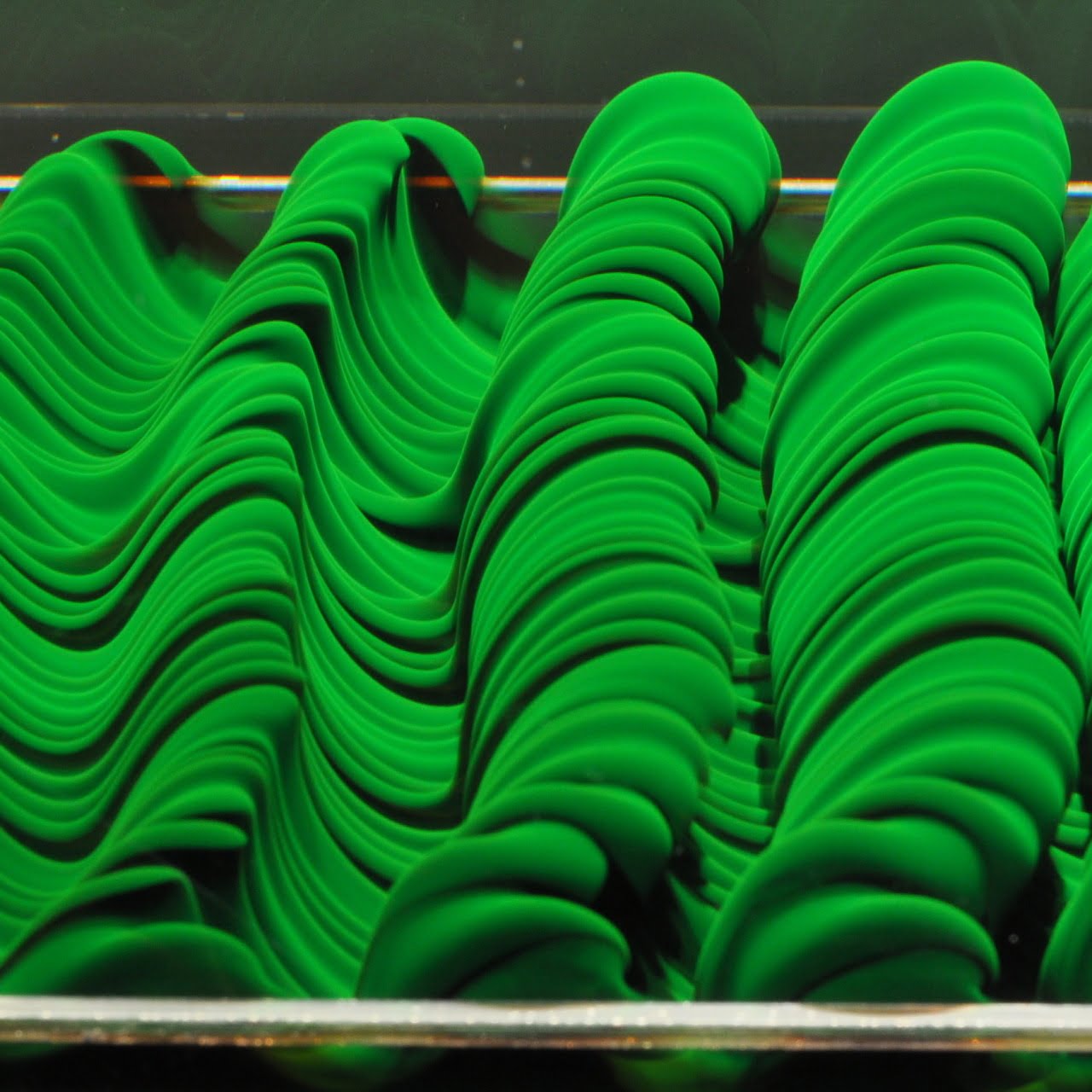
Here on Earth, placing a denser fluid over a lighter one creates an unstable equilibrium. Thanks to gravity, the heavier, denser fluid wants to sink and the lighter fluid wants to rise. Any small disturbance will kick this into action, just like a tiny nudge can send a ball rolling down the hill. For the fluid, that nudge manifests as waviness in the interface between the two fluids. That waviness will quickly grow into billows like those shown above as the Rayleigh-Taylor instability takes over and the heavy (clear) fluid trades places with the lighter (green) fluid. You’ve probably witnessed this effect yourself when pouring milk into iced coffee. To see it in action, check out the video of this experiment or my FYFD video on the Rayleigh-Taylor instability. (Image credit: M. Davies Wykes)

Sublimation
Sublimation is a transition directly from a solid phase to a gaseous one. Given typical Earth atmospheric conditions, one of the most commonly observed examples of sublimation is that of solid carbon dioxide, a.k.a. dry ice. Submerging dry ice in water both speeds up the sublimation–since water is a better conductor of heat than air–and creates ethereal fog that’s a combination of the expanding carbon dioxide and condensate from the water. This gorgeous video from Wryfield Lab lets you admire the process close-up. As the dry ice sublimates, watch for the ice crystals that grow on its surface. This is deposition–the opposite of sublimation–and comes from water vapor freezing onto the dry ice. (Video credit: Wryfield Lab; via Gizmodo)
A warning for those who want to try this at home: only do this in well-ventilated spaces. The shift from solid to gas requires a huge increase in volume. Carbon dioxide is denser than air, so it does stay low to the ground, but you can still suffocate yourself (or children or pets) if you do this in an enclosed space.
A Day in the Life of a Fluid Dynamicist
Today I’m sharing one of my favorite videos from last year’s Gallery of Fluid Motion. It’s a short film entitled “A Day in the Life of a Fluid Dynamicist.” Although some parts of it probably only apply to fluid dynamicists (Navier-Stokes equations, anyone?) a lot of the activities depicted are common to everyone. The film does a nice job of highlighting some of the many examples of fluid dynamics that we come across in our daily lives. As a film by scientists made for scientists, though, you may find some of the terminology obscure. Never fear! This week on FYFD, I’ll be breaking down some of the film’s segments, explaining what they mean, and showing you just how much fluid dynamics you experience every day! (Video credit: S. Reckinger et al.)

Vortices in the Wind
Heard Island, a remote patch of rock in the southwestern Indian Ocean, peeks its head above the marine cloud layer. The volcanic island disrupts the atmosphere enough to generate a von Karman vortex street, a line of alternating vortices shedding from either side of the island. Usually these vortices would march in a straight line downstream from their source. But here strong winds from the south have blown a bunch of its vortices northward, creating an unusual kink in the island’s wake. (Image credit: J. Schmaltz/LANCE EOSDIS Rapid Response; via NASA Earth Observatory)
Paper Marbling
Fluid dynamics and art have gone hand-in-hand for centuries. In this video, artist Garip Ay demonstrates one of the coolest fluids-based art techniques: paper marbling. In this technique, artists float ink or paints on a liquid surface, manipulate the colors as desired–in this case to recreate Van Gogh’s “Starry Night”–and then float a piece of paper atop the surface to transfer the image. Multiple cultures around the world developed marbling techniques, dating all the way back to the Middle Ages. Ay is an expert in ebru, a Turkish form of the art. For more of Ay’s art, check out his website and YouTube channel. (Video credit: G. Ay; via Gizmodo)
Bubble Tricks
[original media no longer available]
Everyone remembers playing with soap bubbles as a child, but most of us probably never became as adept with them as magician Denis Lock. In this video, Lock shows off some of the clever things one can do with surface tension and thin films. My favorite demo starts at 1:25, when he constructs a spinning vortex inside a bubble. He starts with one big bubble and adds a smaller, smoke-filled one beneath it. Then, using a straw, he blows off-center into the large bubble. This sets up some vorticity inside the bubble. When he breaks the film between the two bubbles, the smoke mixes into the already-swirling air in the larger bubble. Then he pokes a hole in the top of the bubble. Air starts rushing out the deflating bubble. As the air flows toward the center of the bubble, it spins faster because of the conservation of angular momentum and a miniature vortex takes shape. (Video credit: D. Lock/Tonight at the London Palladium/ via J. Hertzberg)