Acoustic levitation uses the radiation forces generated by sound waves to trap small, lightweight particles at the nodes of standing waves. We’ve seen this a number of times previously, both with solid objects and liquid droplets. What makes this example particularly impressive, though, is that these researchers use an array of speakers to manipulate multiple objects at once. Check out the video above for a whole series of clips from the research. (Video credit: Science; research credit: A. Marzo and B. Drinkwater)
Search results for: “art”

Finding New Shapes in Foam
In the summer of 2018, a group of researchers announced they’d discovered a new geometrical shape, the scutoid. They found the scutoid, a sort of twisted prism, in the shape of epithelial cells packed between curved surfaces. Having heard of this new geometry, a different group of physicists wondered if they could find scutoids elsewhere, specifically, in the cells of a foam. As shown in the picture above, they did.
To visualize a scutoid, first image a prism. Take two polygons with an equal number of sides and connect them. But if you imagine packing such prisms between two curved surfaces, you’ll quickly see that it won’t work. They just don’t fit together. Instead, one face may adopt, say, six sides, while the other takes on five. To join those two end faces, one of the sides will have to have a Y-shaped junction and a triangular face. This is a scutoid.
You can see two such shapes in the image above. In the left bubble, the far side forms a pentagon, while the near face is a hexagon. On the right, the bubble has six faces in the background and eight in the foreground. And between them, you can just see the triangular face that connects the two scutoids.
It’s not only exciting to find scutoids in a new, non-biological medium; it suggests a physical mechanism behind their formation. Foams are a well-known example of energy minimization. The fact that scutoids are found in a curved foam suggests that the shape itself is connected to energy minimization, something that could help us understand how biological scutoids grow and form. (Image and research credit: A. Mughal et al.; via Physics World; submitted by Kam-Yung Soh)

Vortices and Ground Effect
Though typically unseen, the vortices that swirl from the tips of aircraft wings are powerful. Here you see a Hawker Sea Fury equipped with a smoke system used to visualize the vortices that form at the wingtip as high-pressure air from the bottom of the wing and low-pressure air from the top swirl together. As you can see, the vortices persist in the wake long after the plane passes. The size and strength of the vortices depend on the size and speed of the aircraft; this is why air traffic control requires smaller planes to wait longer to take off or land if there was just a larger aircraft on the runway.
The other cool thing to note here is how the wingtip vortices move apart from one another in the animation above. In flight, wingtip vortices usually stay roughly parallel to one another, but they drift downward in the aircraft’s wake. Near the ground, though, the vortices cannot move down, so instead ground effect forces them apart from one another, as seen here. (Image and video credit: E. Seguin; via Kelsey C.)

Stress Between Grains
Granular materials like sand and beads can shift and flow in fluid-like ways, but they’re much harder to predict. Part of this is due to the way friction between individual grains transmits force through the network. Here, we see photoelastic beads responding to the intrusion of a narrow rod. The lightning-like flashes show how stress is traveling between neighboring grains. Notice how the lower grains are essentially frozen into a state of high stress, but the movable upper grains shift and readjust themselves to try and relieve stress.
This experiment took place under lunar gravitational conditions. Lower gravity means that it takes a larger pile of grains on top to create a given stress. But it also means it’s easier for those movable top grains to shift or even get thrown up by a hastily applied force. The purpose of experiments like this is to better understand how rovers and probes should dig in low-gravity environments without kicking up a cloud of regolith and dust. (Image credit: K. Daniels et al., source)

The Best of FYFD 2018


2018 was a busy year for me with over 40 days of business travel, 10 invited talks, and a whole slew of new YouTube videos on top of regular FYFD posts. But now it’s time for the traditional look back at the top 10 FYFD posts of 2018, according to you:
1. Swimming so easy a dead fish can do it
2. The wall of lava lamps that helps secure the Internet
3. Jellyfish versus vortex ring
4. Crushing crayons in a hydraulic press shows off the sharkskin instability
5. Vortex ring from an exploding meteor
6. Starburst patterns form when avalanching materials size separate
7. Kelp change shape depending on their currents
8. The creepy hydraulics of a spider’s gait
9. Pneumatically-driven, 3D-printed plants of the future
10. Exothermic chemistry visualized in infraredThis year’s list is an interesting mix – some biology, vortex rings, non-Newtonian and granular physics; it’s a good list for some of the more unexpected sides of fluid dynamics.
If you’d like to see more great posts like these, please remember that FYFD is primarily supported by readers like you. You can help support the site by becoming a patron, making a one-time donation, or buying some merch. Happy New Year!
(Image credits: fish – D. Beal et al.; lava lamps – T. Scott; vortex ring – V. de Valles; crayons – Hydraulic Press Channel; meteor – P. Horálek; rotating drum – I. Zuriguel et al.; kelp – J. Hildering; spider – R. Miller; hydrophytes – N. Hone; chemistry – Beauty of Science)

Fire Tornado in a Bubble
File this one under awesome tricks you shouldn’t try at home. Here bubble artist Dustin Skye demonstrates his handheld inverted fire tornado. First, he blows a large encapsulating bubble, then blows butane and smoke into a smaller secondary bubble. When he breaks the wall between the two, the mixture swirls into the larger bubble. Then, by breaking a narrow hole into the remaining bubble, Skye forms a swirling tornado. He’s using conservation of angular momentum here to concentrate the vorticity he created by blowing into the original butane bubble. As the big bubble shrinks, the vorticity inside gets pulled inward and speeds up – like when a spinning ice skater pulls his arms in. That’s how you get the tornado. And from there, it’s just a matter of lighting the exiting butane and air mixture. (Video credit: D. Skye; via Gizmodo)
“Winter’s Magic”
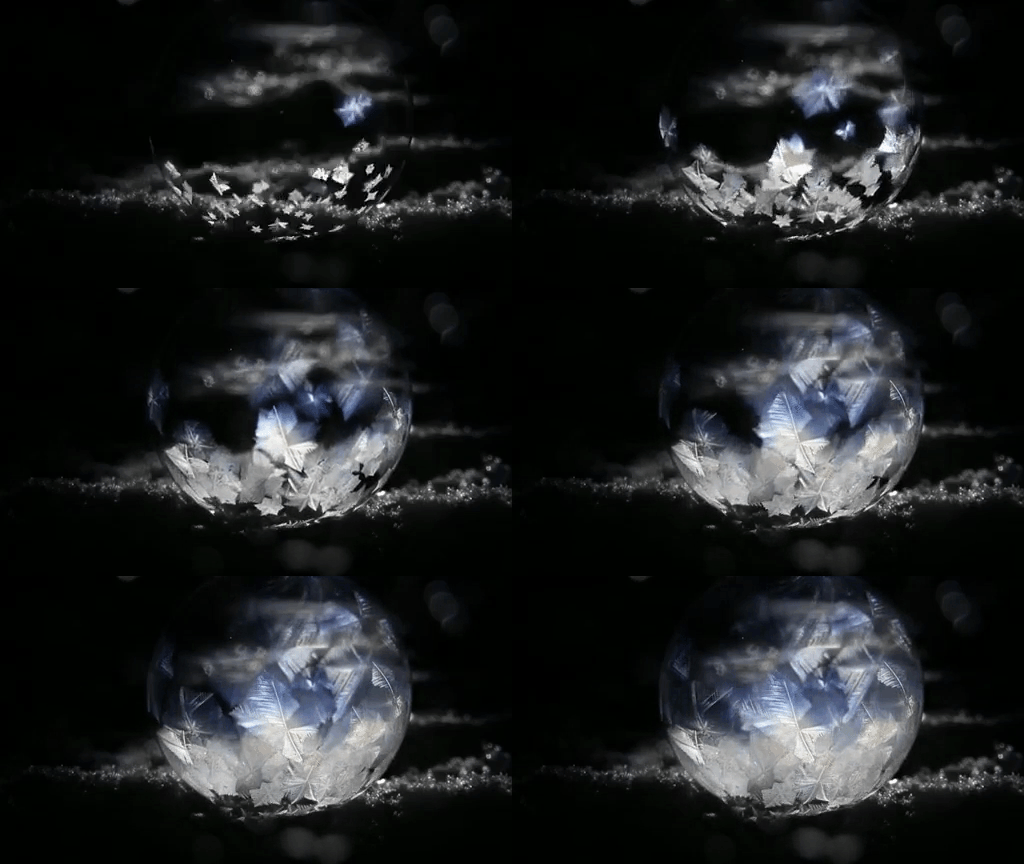
Don Komarechka’s beautiful short film, “Winter’s Magic,” captures the beauty of soap bubbles as they freeze. It’s a delicate process and one difficult to capture in video. The bubble freezes first at the bottom, where it touches the cold surface – in this case, snow. That freezing releases latent heat and creates a temperature gradient along the thin liquid film. With that temperature gradient comes a variation in surface tension, and it’s this that creates the flow that lifts the ice crystals from the surface and turns the bubble into a snow globe. Eventually, as the frozen crystals continue growing, flow in the bubble walls comes to halt as the film solidifies.
For more on the physics of freezing bubbles, check out this interview with the researchers, or, to learn more on how to film freezing bubbles, check out Komarechka’s description. (Video and image credit: D. Komarechka; via Laughing Squid; h/t to Jennifer O.)

Fighting a Viscous World


Vaucheria is a genus of yellow-green algae (think pond scum), and some species within this genus reproduce asexually by releasing zoospores. Once mature, the zoospore has to squeeze out of a narrow, hollow filament in order to escape into the surrounding fluid (top). To do so, it uses tiny hair-like flagella on its surface. Despite the minuscule size of these micron-length flagella, they generate some major flows around the zoospore (middle and bottom). Even several body lengths away, the flow field shows significant vorticity. All this active entrainment of fluid from the surroundings helps the zoospore escape its confinement and swim away to start a new plant. (Image and research credit: J. Urzay et al., source)
A Golden Swirl
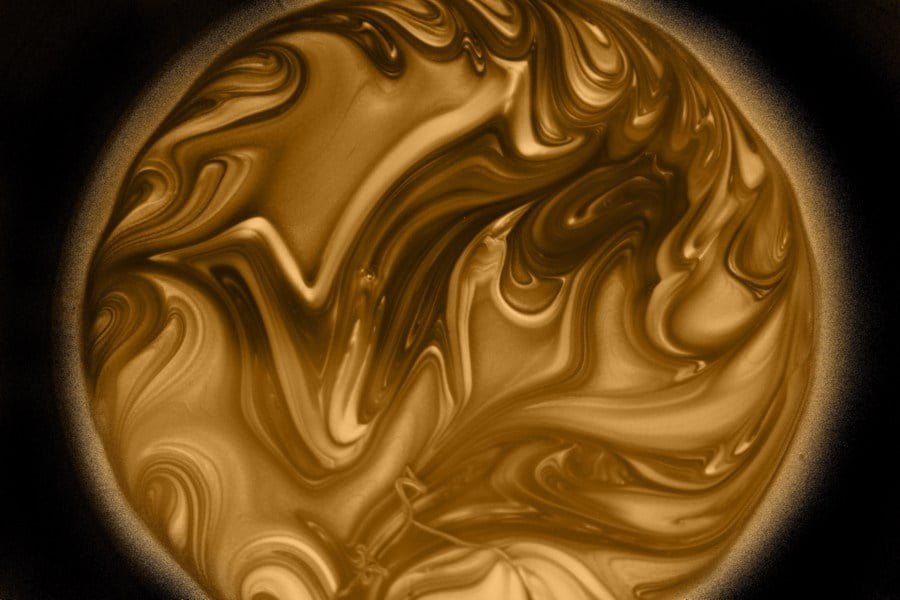
As much as I love exploring flashy examples of fluid dynamics, like shock waves around aircraft or what happens when non-Newtonain fluids get crushed by a hydraulic press, my favorite moments are the simple, everyday ones. Getting to see fluid dynamics in my daily life, whether I’m standing in the kitchen cooking or trying to wash my hands, is what excites me the most. The photo above is an example of this kind of simple, satisfying fluid experience. The image shows wax being melted in a crockpot. As it melts and its optical characteristics change, the wax reveals the mixing pattern inside the container. There’s nothing earth-shattering or scientifically important about something like this. But it’s still a moment where the otherwise unseen and unnoticed becomes visible and beautiful. It’s the fluid dynamical equivalent of stopping to smell the roses. When did you last pause to appreciate the flows around you? (Image credit: A. Unger et al.)
Review: “How to Walk on Water and Climb Up Walls”


“An eight-year-old girl kicked her feet back and forth on the seat of a Long Island Railroad train. I beckoned her to cover over and pointed to the top of my winter jacket, which I slowly unzipped. Inside, nestling against me for warmth, were ten snakes, their forked tongues waving back and forth. The child shrieked and ran back over to her mother, who was napping. ‘That man has a coat full of snakes,’ she shouted.”
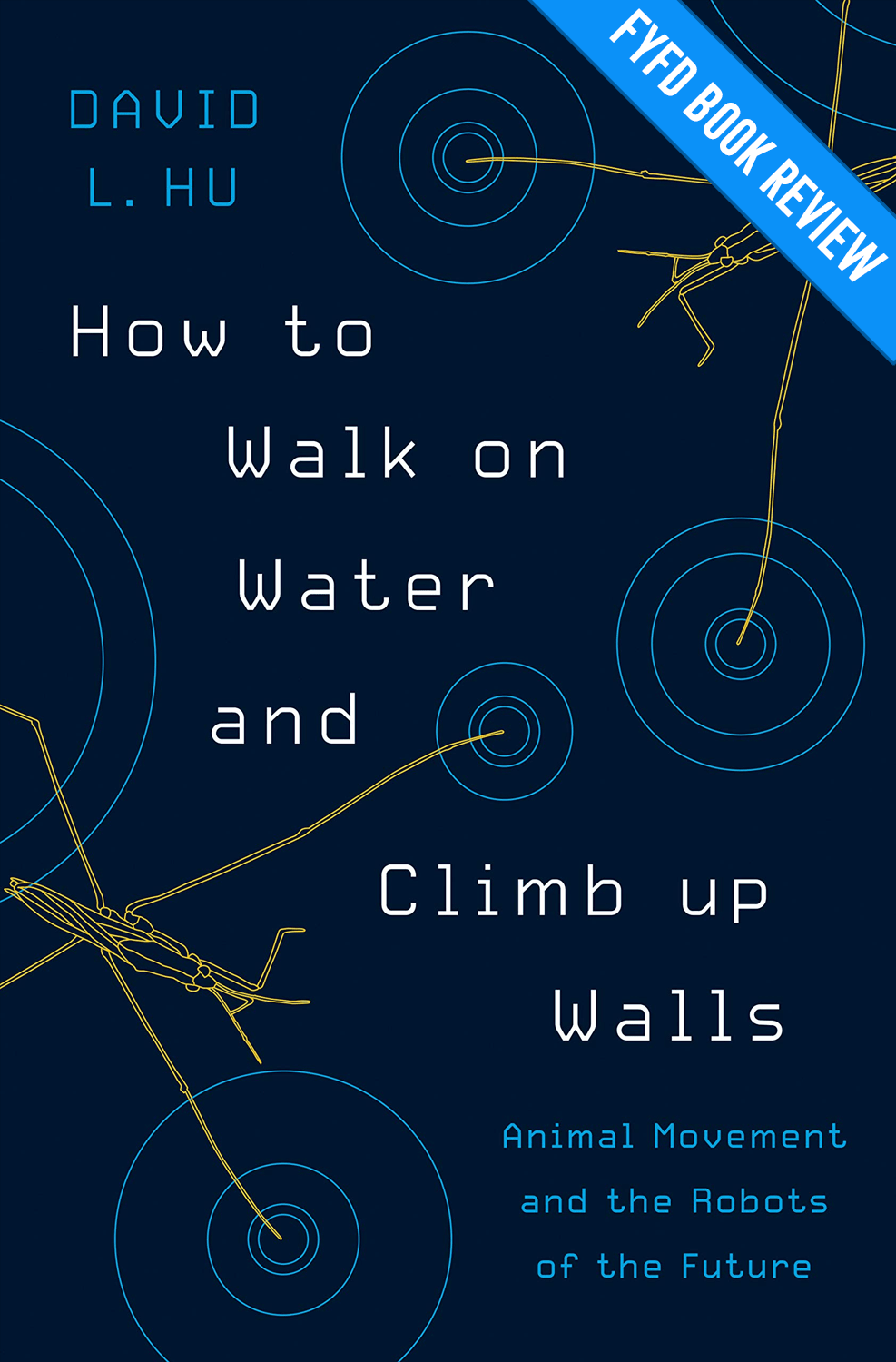
So begins Chapter 2 of Dr. David Hu’s new book, How to Walk on Water and Climb Up Walls (*), a captivating and funny journey through animal locomotion and biorobotics. Don’t let that fool you, though; this book has plenty of fluid dynamics to it. Long-time FYFD readers will recognize some of the topics, such as the fluid-like behavior of fire ants, how eyelashes keep our eyes clean and moist, and why swimming behind an obstacle is so easy even a dead fish (like the one shown above) can do it.
There are plenty of exciting, new stories as well, like how sandfish – a type of lizard – can swim under sand and why a lamprey’s nervous system may lead to better robots. The explanation of how cockroaches are virtually unsquishable and able to squeeze themselves into crevices a quarter of their height absolutely floored me.
Hu’s book offers a front-row seat to research at the cutting edge of biology, engineering, and physics, with anecdotes, explanations, and applications that will stick with you long after you put the book down. If you’re looking for a holiday gift for yourself or another science-lover, check this one out for certain (*).
*Disclosures: I purchased my copy of this book using my own funds, and this review is not sponsored in any way. This post contains affiliate links – marked with (*); if you click on one of these links and purchase something, FYFD may receive a small commission at no additional cost to you.
(Image credits: book – Princeton University Press; fish – D. Beal et al.; ants – Vox/Georgia Tech; eyelashes – G. Diaz Fornaro; shark denticles – J. Oeffner and G. Lauder)