Search results for: “art”

  • The Disappearing Cotton Candy

    The Disappearing Cotton Candy

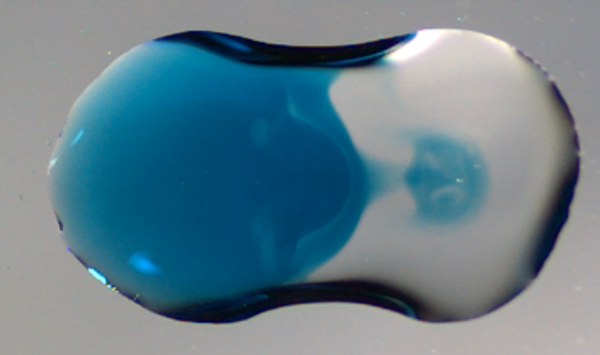
    Moisture is cotton candy’s natural enemy. The spun sugar dissolves incredibly quickly under the influence of even a couple drops of water. Why that’s so is clearer when looking at a single fiber. Inside the droplet there’s a gradient in the sugar concentration. The more sugary water sinks, and the sugar fiber dissolves more quickly in the upper part of the droplet, where the less sugary water can more easily take up new sugar. 

    Once the fiber breaks, capillary forces draw the droplet upward, giving it a fresh section of fiber to dissolve. In a web of fibers, this process can pull droplets apart and together as they quickly eat through the spun sugar. (Image and video credit: S. Dorbolo et al.; submitted by Alexis D.)

  • Galileo’s Descent

    Galileo’s Descent

    In December 1995, the Galileo probe made its dramatic descent into Jupiter’s atmosphere at a velocity of more than 47 km/s. In 30 seconds, it decelerated from Mach 50 to Mach 1, undergoing incredible heating as it did so. Anytime an object moves through a fluid faster than the local speed of sound, it creates a leading shock wave that compresses the fluid, heats it, and redirects it around the object. The faster the speed, the hotter the fluid will be after passing through the shock wave. 

    Above about five times the speed of sound, the heating effect is so strong that it’s able to rip molecules apart, creating a chemically reactive mixture that will ablate away material from the object. For this reason, Galileo and other planetary entry vehicles carry heat shields made to sacrifice themselves while protecting the cargo and (in some cases) crew onboard. Data from Galileo showed that, although the heat shield survived the brunt of its descent, it experienced worse conditions than expected. Near the heat shield’s shoulder, almost all of its material ablated away. 

    Scientists continue to study Galileo’s descent even now, using it to test and inform their models of the flow and chemistry that occurs at these hypersonic speeds. The better we can understand and predict these flows, the better our designs will become. Mass that’s currently spent on overly-conservative heat shields can instead go toward additional instruments or supplies. (Image credit: Chop Shop Studio; research credit: L. Santos Fernandes et al.; via AIP)

  • Reader Question: Exoplanetary Life

    Reader orbiculator asks:

    I’ve been having this thought regarding biological adaptations to viscous mediums. In a hypothetical exoplanet where the ocean is this thick, aqueous gel – could we assume that the native macroscopic species would have morphologies similar to Earth’s plankton despite their large sizes? That is, instead of being propelled by fins like our fish and whales, they’d go around using large ciliar or flagella?

    Propulsion-wise, that’s a reasonable theory. If the ambient environment were viscous enough that macroscopic creatures would still be limited to laminar flow, then, yes, you could expect them to use something like cilia or flagella to move. They’d be restricted by the same reversibility that microscopic species are here on Earth.

    But there are other factors that could come into play. Many microscopic species rely on diffusion for survival, whether that’s chemical diffusion across their exterior or diffusion within their body. As a species gets larger, the distance diffusion has to occur across grows, and diffusion becomes harder and harder to sustain. 

    So while hydrodynamic constraints might result in an exoplanet’s fauna having features similar to Earth’s microscopic life, it probably wouldn’t be as simple as merely enlarging the species we see here on Earth. Some of the key biophysics that goes on inside cellular life as we know it just doesn’t hold at larger scales.

  • Featured Video Play Icon

    A Broken Monitor’s Fingers

    In this short video, the artists of Chemical Bouillon explore a broken LCD monitor and its liquid crystals. By sandwiching the fluid between thin, transparent sheets, they create dendritic shapes as the liquid crystals and other fluids (air? ink?) push into one another. There’s a lot here that’s likely connected to the Saffman-Taylor instability, but without knowing more details on the ingredients and set-up, it’s hard to speculate beyond that. (Video and image credit: Chemical Bouillon)

  • Boiling in Microgravity

    Boiling in Microgravity

    In the playground of microgravity, every day processes can behave much differently. This photo comes from the RUBI experiment, the Reference mUltiscale Boiling Investigation, aboard the International Space Station. Freshly installed and switched on, the apparatus is now generating bubbles like this one. On the left, you see temperature sensors used to measure bubble temperatures. High-speed and infrared cameras are also part of the experiment.

    The advantage of studying boiling in space is a lack of gravity that can mask or overwhelm subtler effects. It effectively slows down the process, making it easier to observe. And since boiling is such an important part of heat transfer in many manmade devices, it shows us how we have to adapt when operating in an environment where heat – and bubbles – don’t automatically rise. (Image credit: ESA; submitted by Kam-Yung Soh)

  • Champagne’s Shock Wave

    Champagne’s Shock Wave

    The distinctive pop of opening a champagne bottle is more than the cork coming free. The sudden release of high-pressure gas creates a freezing jet that’s initially supersonic. It even creates a Mach disk, like those seen in rocket exhaust. That supersonic flow can only be maintained, though, with a large enough pressure difference between the gas in the bottle and the atmosphere outside. Once the pressure drops below that critical point, the jet slows down and becomes subsonic. For more on champagne popping and its colorful plume, check out this previous post. (Image and research credit: G. Liger-Belair et al.; via Nature; submitted by Kam-Yung Soh)

  • Explosive Flame Fronts

    Explosive Flame Fronts

    Though they look like jellyfish or space creatures, these images from photographer Linden Gledhill are actually explosions. What you’re seeing is the detonation of hydrogen gas with oxygen. The teal sphere with its wavy surface marks the flame front, and the crisp, stringy edges seen here and there in the foreground are the remains of a soap bubble that held the hydrogen before it sparked. You can see a similar set-up (using methane rather than hydrogen) in action here, and you can see other artistic takes on combustion in previous posts like this one. (Image credit: L. Gledhill, Flickr)

  • Avoiding Shear Thickening

    Avoiding Shear Thickening

    Many substances – like the cornstarch and water mixture above – exhibit a property called shear-thickening. In these fluids, deforming them quickly causes the viscosity to increase dramatically. That shear-thickening occurs when particles inside the fluid jam together, creating large chains able to resist the force being applied. That’s why the oobleck on this vibrating speaker can sustain these “cornstarch monsters”.

    Shear-thickening is useful in many contexts, but it’s problematic during manufacturing, when pumping these substances can become incredibly difficult due to the fluid’s innate resistance to flowing. A new study, though, finds that it’s possible to temporarily suppress shear-thickening using acoustic waves. The researchers used piezoelectric devices to generate acoustic waves at a frequency around 1 MHz while shearing the cornstarch mixture. The acoustic waves disrupt the formation of particle chains inside the mixture, keeping its viscosity 10 times lower than during regular shear-thickening. (Image credit: bendhoward, source; research credit: P. Sehgal et al.; submitted by Brian K.)

  • Featured Video Play Icon

    How to Build a Lava Moat

    If you’re looking for a new and impractical way to protect your home, here’s a great option: a lava moat. Nothing says “Don’t try to knock on my door” like a glowing inferno of molten rock. And Minute Physics – along with xkcd – has put together a short, handy guide to some of the challenges you’ll face in building and maintaining this fearsome fortification. If running your own commercial-scale power plant seems overly daunting but you still want to see what lava’s all about, I have good news; here’s a selection of some of my favorite looks at lava here at FYFD:

    – Upstate NY’s homemade lava
    – What happens when you step on lava
    –  A veritable river of lava in action
    – What happens when water meets lava

    Now, if you’ll excuse me, I’m off to Hawai’i for the next two weeks. There will be lava. (Video credit: Minute Physics)

  • Featured Video Play Icon

    “Emergence”

    Artist Susi Sie explores fluidic worlds through her macro lens. In “Emergence,” her focus is on ferrofluids immersed in other liquids. Beginning with tiny droplets traversing the thin fluid channels of a foam, she allows the unique qualities of ferrofluids to slowly take center stage. Dark blobs grow into curvy labyrinths as a magnetic fields come into play. Until ultimately the magnetic nature of the fluid becomes undeniable as scattered droplets elongate into miniature compass needles and swing around to follow the field lines. (Video and image credit: S. Sie)