Flow visualization is a powerful design tool for engineers. When Google was interested in determining optimal configurations for their heliostat array, they turned to NASA Ames’ water tunnel facility to test upstream barriers to deflect flow off the heliostats. In each photo, flow is from left to right and fluorescent dye is used to mark streamlines and reveal qualitative flow detail. Upstream of the obstacles, the streamlines are coherent and laminar, but after deflection, the flow breaks down into turbulence. In this case, such turbulence is desirable because it lowers the local fluid velocity and thus the aerodynamic loads experienced by each heliostat, potentially allowing for a savings in fabrication. For more, see Google’s report on the project. (Photo credits: google.org)
Search results for: “aerodynamics”

London 2012: Discus Physics
Like the javelin, the discus throw is an athletic event dating back to the ancient Olympics. Competitors are limited to a 2.5 m circle from which they throw, leading to the sometimes elaborate forms used by athletes to generate a large velocity and angular momentum upon release. The flight of the discus is significantly dependent on aerodynamics, as the discus flies at an angle of attack. Spin helps stabilize its flight both dynamically and by creating a turbulent boundary layer along the surface which helps prevent separation and stall. Unlike many other events, a headwind is actually advantageous in the discus throw because it increases the relative velocity between the airflow and the discus, thereby increasing lift. The headwind also increases the drag force on the discus, but research shows the benefits of the increased lift outweigh the effects of increased drag, so much so that a discus flies further in air than it would in a vacuum. (Photo credits: P Kopczynski, Wiki Commons, EPA/K Okten)
FYFD is celebrating the Olympics by featuring the fluid dynamics of sports. Check out our previous posts, including why corner kicks swerve, what makes a pool fast, how an arrow flies, and how divers avoid splash.

London 2012: Rowing Physics
In rowing, as in any water sport, drag comes in three varieties: skin friction, form (or pressure) drag, and wave drag. Skin friction comes from the friction between the hull and water causing the boat to drag water with it as it moves. This can be mitigated with the right materials and surface finish but will never be completely negligible. In fact, the racing shells used in rowing are unusual for boats because skin friction is their major source of resistance. This is because form drag, caused by the shape of the boat cutting through the water, and wave drag, the energy lost due to the waves that form along the hull, are small in racing shells due to their long, narrow, and streamlined shape. Because skin friction dominates among the three types of drag, the force a rower overcomes to move the boat is proportional to the hull’s velocity squared, and the power required to do so is proportional to the hull’s velocity cubed. This means that it is more efficient for rowers to keep a constant hull speed throughout a race than it is to start slow and speed up or start fast and slow down because the work (power x time) needed to keep a constant speed is smaller. For more on the physics of rowing, check out Anu Dudhia’s excellent website or this video from Physics of Life. (Photo credits: Ecouterre, AP)
FYFD is celebrating the Olympics by featuring the fluid dynamics of sport. Check out some of our previous posts, including what makes a pool fast, how divers reduce splash, and the aerodynamics of badminton.

London 2012: Diving Physics
Divers twist and spin gracefully in the air, but the highest marks come when they enter the water with little to no splash. This rip entry–named after paper-ripping sound characteristic of such a dive–is possible thanks to fluid dynamics. Any time a solid object enters a still liquid, it tears a cavity into the liquid. The smaller this cavity is, the less the liquid will rebound and splash when the cavity gets refilled. In diving, achieving a small splash requires a couple items. First, the diver will grab his hands over his head to form a flat surface. This will create the initial small cavity through which his body follows. When entering, the diver will keep his body straight and rigid, with arms pressed against his head; this adds stability to keep the diver from letting the force of striking the water at 35 mph affect his body’s form and create splash. Finally, the perfect dive enters vertical to the water surface. This ensures that all of the diver’s body finds its way into that cavity created by the hands without striking any undisturbed water. Once under the water, divers often extend their arms to generate enough drag to slow down quickly. All in all, the rip entry minimizes the cavity size and thus the splash, adding a great exclamation point to a beautiful dive. (Photo credits: Associated Press, Adam Pretty/Getty Images, Nigel Wade, Jed Jacobsohn)
FYFD is celebrating the Olympics by featuring the fluid dynamics of sport. Check out our previous posts on how the Olympic torch works, what makes a pool fast, the aerodynamics of archery, the science of badminton, and how cyclists “get aero”.

London 2012: Cycling Physics
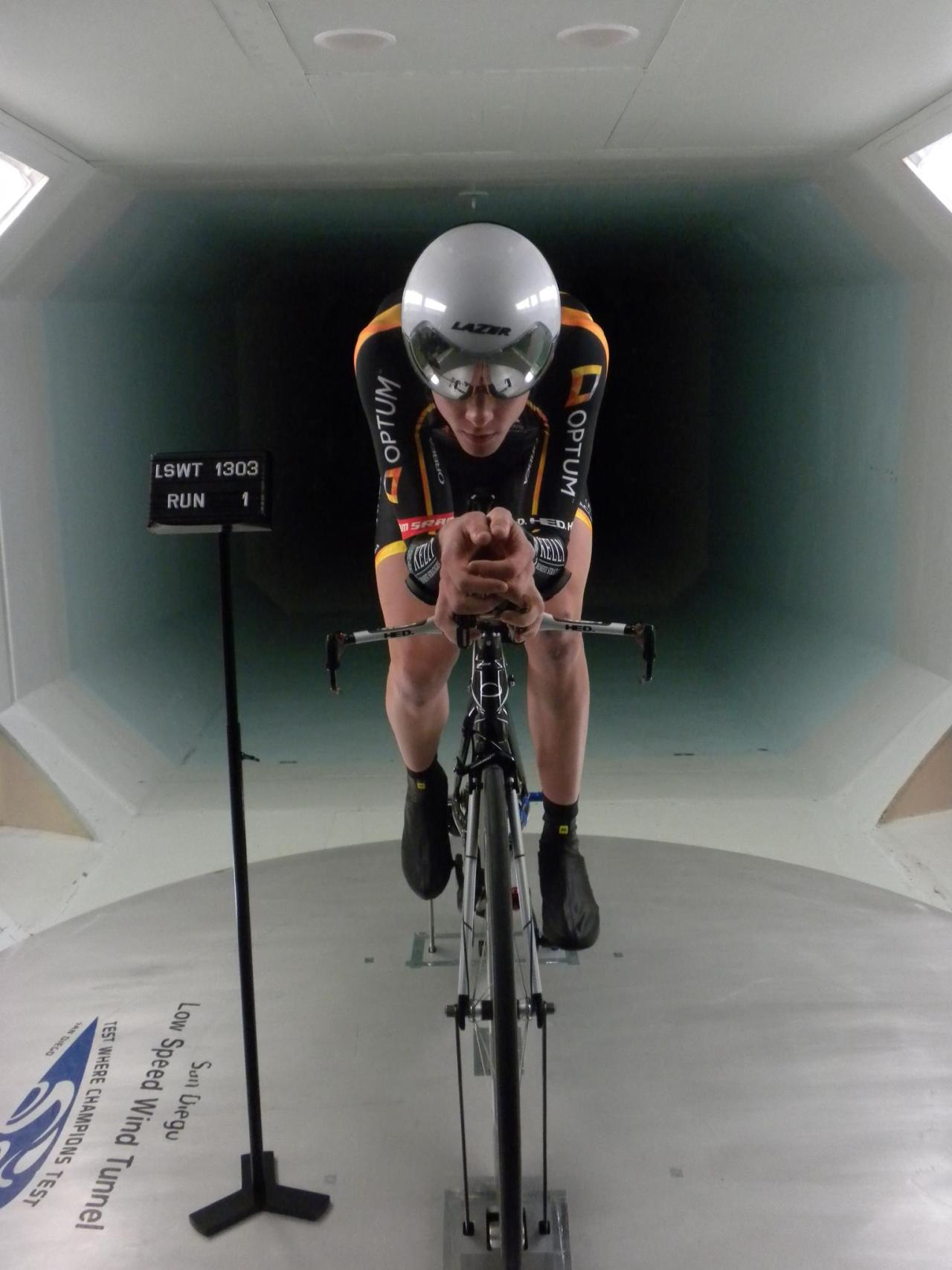
In no discipline of cycling is more emphasis placed on fluid dynamics than in the individual time trial. This event, a solo race against the clock, leaves riders no place to hide from the aerodynamic drag that makes up 70% or more of the resistance riders overcome when pedaling. Time trial bikes are designed for low drag and light weight over maneuverability, using airfoil-like shapes in the fork and frame to direct airflow around the bike and rider without separation, which creates an area of low pressure in the wake that increases drag. Riders maintain a position stretched out over the front wheel of the bike, with their arms close together. This position reduces the frontal area exposed to the flow, which is proportional to the drag a rider experiences.
Special helmets, some with strangely streamlined curves, are used to direct airflow over the rider’s head and straight along his or her back. Both helmets and skinsuits are starting to feature areas of dimpling or raised texturing. These function in much the same way as a golf ball; the texture causes the boundary layer, the thin layer of air near a surface, to become turbulent. A turbulent boundary layer is less susceptible to separating from the surface, ultimately leading to lower drag than would be observed if the boundary layer remained laminar. Wheels, skinsuits, gloves, shoe covers, and even the location of the brakes on the bike are all tweaked to reduce drag. In an event that can be decided by hundredths of a second between riders, every gram of drag counts. (Photo credits: Stefano Rellandini, POC Sports, Reuters, Paul Starkey, Louis Garneau)
FYFD is celebrating the Olympics by featuring the fluid dynamics of sports. Check out our previous posts on how the Olympic torch works, what makes a pool fast, the aerodynamics of archery, and the science of badminton.

London 2012: Badminton Physics
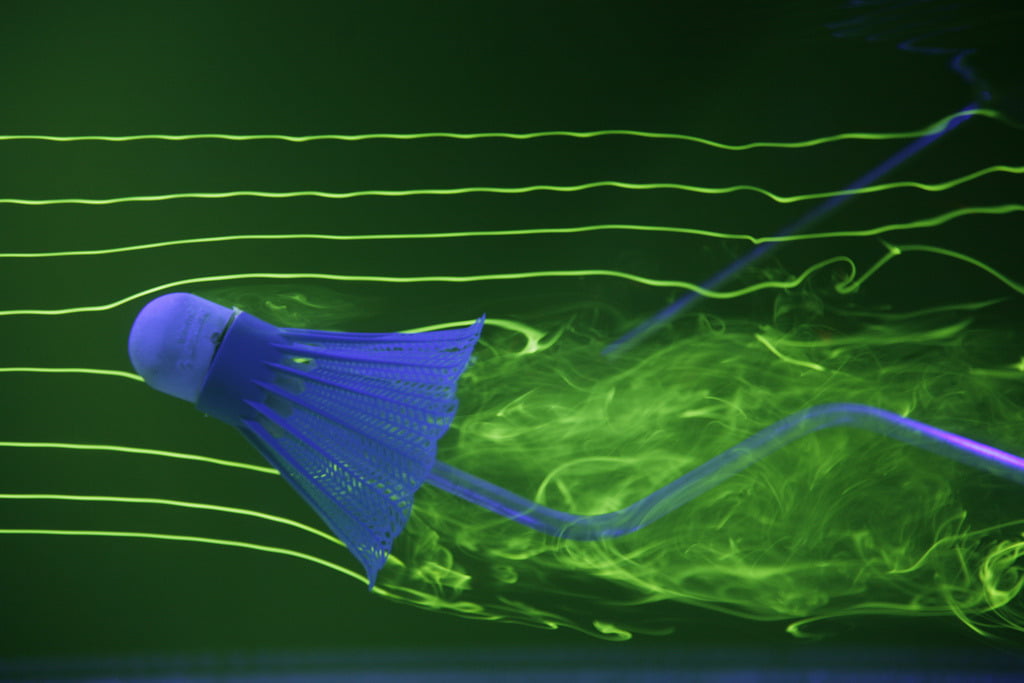
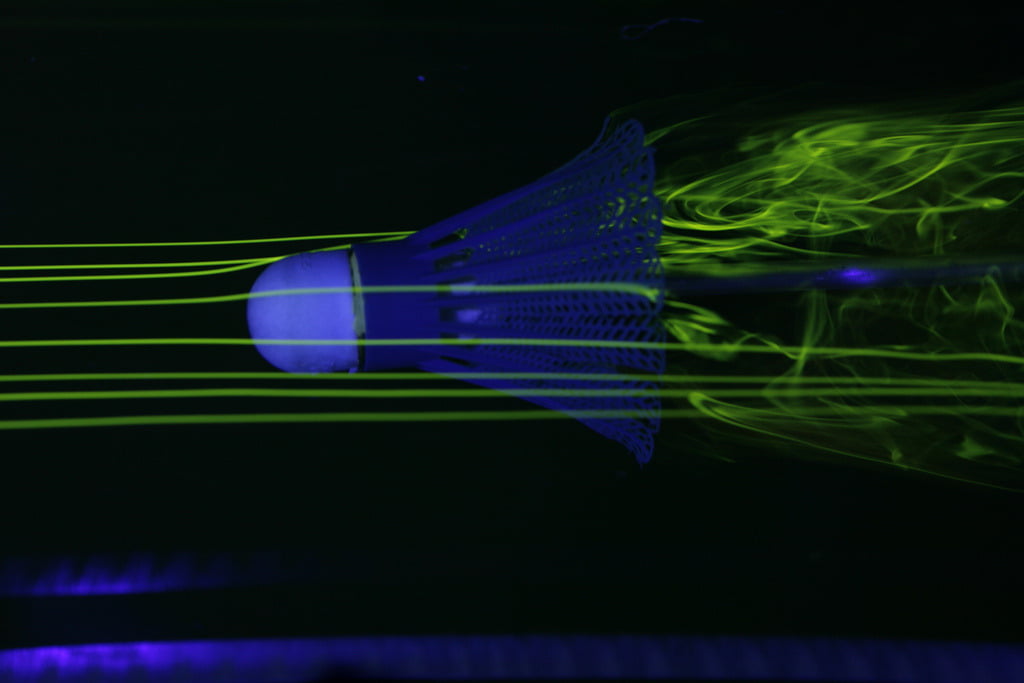
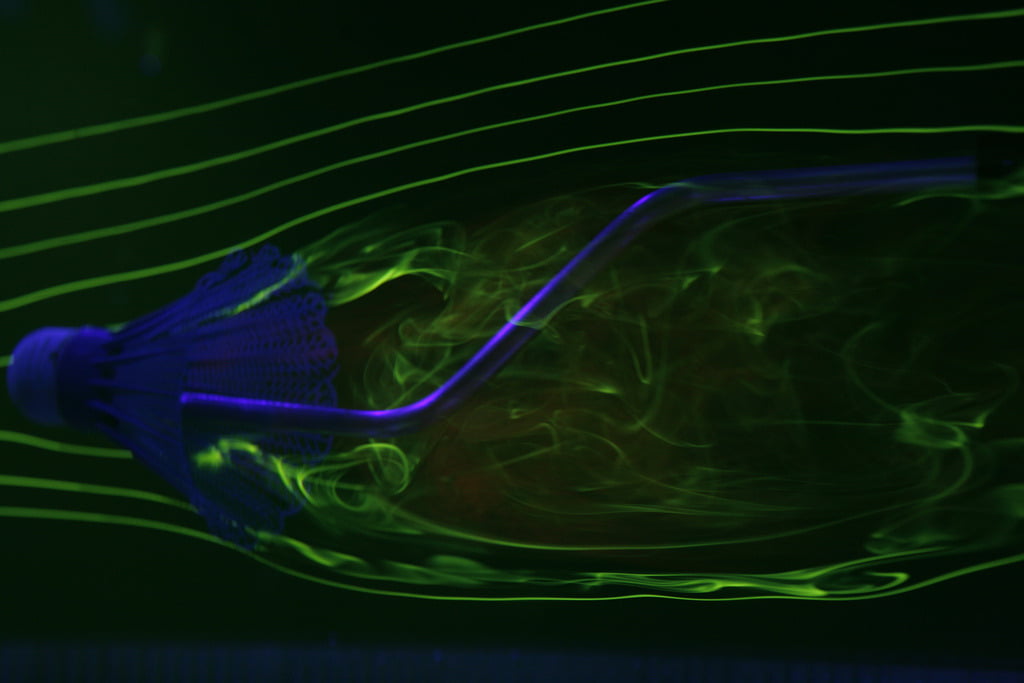
Unlike most racket sports, badminton uses a projectile that is nothing like a sphere. The unusual shape of the shuttlecock not only creates substantial drag in comparison to a ball but increases the complexity of its flight path. The heavy head of the shuttlecock creates a moment that stabilizes its flight, ensuring that the head always points in the direction of travel. The skirt, traditionally made of feathers though many today are plastic, is responsible for the aerodynamic forces that make the shuttlecock’s behavior so interesting.
Measuring the drag coefficient of the shuttlecock, modeling its trajectory and behavior in the four common badminton shots, and even attempting computational fluid dynamics of the shuttlecock are all on-going research problems in sports engineering. (Photo credit: Rob Bulmahn)
FYFD is celebrating the Olympics with the fluid dynamics of sports. Check out our previous posts on how the Olympic torch works, what makes a pool fast, and the aerodynamics of archery.
Reader Question: How Airfoils Produce Lift
doughboy3-deactivated20120305 asks:
I’m a Undergrad Aeronautical Engineering student. I’m curious as to your opinion as to how airfoils produce lift. I know the usual theory told in this situation. However my aerodynamics professor says that there are many things going on during the flow around an airfoil. I’m hoping to get a better idea of the different mechanisms responsible for lift.
There’s a common misconception of Bernoulli’s principle that’s often used to explain how an airfoil creates lift (which I assume is the “usual theory” to which you refer), and while there are many correct (or, perhaps, more correct) ways of explaining lift on an airfoil, I think the only opinions involved are as to which explanation is best. After all, opinions don’t keep a plane in the air, physics does!
I tackled the air-travels-farther-over-the-top misconception and presented one of my preferred ways of looking at the situation in a previous post; in short, the airfoil’s shape causes a downward deflection of the flow, which, by Newton’s 3rd law, indicates that the air has exerted an upward force on the airfoil. There’s a similar useful video from Cambridge on the topic here.
Another explanation I have heard used concerns circulation and its ability to produce lift (see the Kutta-Joukowski theorem for the math). In this case, it’s almost easier to think about lift on a cylinder instead of lift on a more complicated shape like an airfoil. If you spin a cylinder, you’ll find that the circulation around that object results in a force perpendicular to the flow direction. This is called the Magnus effect and, in addition to explaining why soccer balls sometimes curve strangely when kicked, has been used to steer rotor ships. One of my undergrad aero professors used to do a demonstration where he’d wrap a string around a long cardboard cylinder and demonstrate how, by pulling the string, the cylinder’s spinning produced lift, making the cylinder fly up off the lectern and attack the unsuspecting students.
An airfoil doesn’t spin, but its shape produces the same type of circulation in the flow field. Without delving into the mathematics, it’s actually possible through conformal mapping and the Joukowski transform to show that the potential flow field around a spinning cylinder is identical to that around a simple airfoil shape! Although that mathematical technique is not all that useful in a world where we can calculate the inviscid flow around complicated airfoils exactly, it’s still pretty stunning that we can analytically solve potential flow around (and thus estimate lift for) a host of airfoil shapes on the back of an envelope.
In short, your aerodynamics professor is right in saying that there are many things going on during the flow around an airfoil. If you get a roomful of aerodynamicists together and ask them to explain how airfoils generate lift, you would be faced with a lively discussion with about as many competing explanations as there are participants. As you learn more in your classes, you’ll gain a better intuitive feel for how it works and you’ll learn more of the nuances, which will help you understand why there is no one simple-to-understand explanation that we use!**
** Lest I confuse someone into thinking that aerodynamicists don’t know how airfoils produce lift, let me add that the argument here is over how best to explain the production of lift, not over how the lift is produced. We have the equations to describe the flow and we can solve them. We know that lift is there and why. We simply like to argue over how to explain it to people without all the math.
Cloud Streets from Space
Cloud streets flowing south across Bristol Bay hit the Shishaldin and Pavlof volcanoes, which part the air flow into distinctive swirls called von Karman vortex streets. As air flows around the volcano, a vortex is shed first on one side, then the other. Although the usual example for this type of flow is the wake of a cylinder, vortex streets can extend behind any non-aerodynamic body immersed in a flow. The same phenomenon is responsible for the singing of power lines in the wind. As astronaut Dan Burbank observes, “It’s classic aerodynamics, but on a thousands of miles scale.” (Photo credit: Dan Burbank, NASA)

Shark Wakes
Volumetric imaging of swimming spiny dogfish, a type of shark, shows that their distinctively asymmetric tails produce a set of dual-linked vortex rings with every half beat of their tail. The figure above shows data from the actual shark on the right (b,d,f) and a similarly shaped robotic tail on the left (a,c,e). The second row contains lateral views (c,d) and the bottom row contains dorsal views (e,f) of the vorticity isosurfaces measured. The robotic tail does not demonstrate the same double vortex structure, leading scientists to suspect that the shark may be actively stiffening its tail mid-stroke to control its wake. The finding could help engineers design aquatic robots whose morphing fins help it swim more efficiently. For more, see Wired.
Aircraft Contrails
[original media no longer available]
Under the right atmospheric conditions, condensation can form, even at low speeds, as moist air is accelerated over airplane wings. This acceleration causes a local drop in pressure and temperature, which can cause water vapor in the air to condense. The condensation can sometimes get pulled into the wingtip vortices shed off of the wings, tail, and ailerons of an aircraft, as in the video above, making the aerodynamics of the airplane visible to the naked eye.