Search results for: “aerodynamics”

  • Turbine Blade Separation

    [original media no longer available]

    Maintaining consistent air flow along the contours of an object is key to aerodynamic efficiency. When air flow separates or forms a recirculation zone, the drag increases and efficiency drops. On wind turbine blades, flow often separates on the root end of the blade near its attachment point. This behavior is apparent in the video above at 0:34. The tufts in the foreground on the turning blade flap and flutter with no clear pattern because the air flow has separated from the surface. In the subsequent clip, a line of vortex generators has been attached near the leading edge of the blade. These structures–also commonly seen on airplanes–trail vortices behind them, mixing the flow and generating a turbulent boundary layer which is better able to resist flow separation. The effect on the flow is clear from the tufts, most of which now point in a consistent direction with little to no fluttering, indicating that the air flow has remained attached. (Video credit: Smart Blade Gmbh/Technische Universität Berlin)

    (Source: /)
  • The Chelyabinsk Meteor

    The Chelyabinsk Meteor

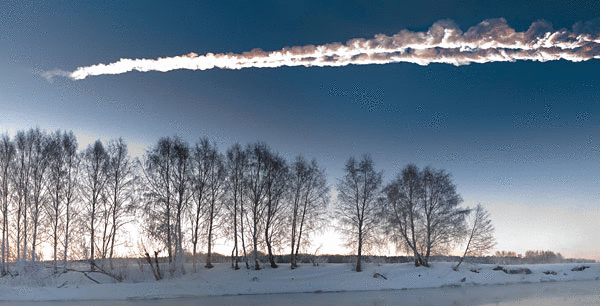
    In February 2013 a meteor streaked across the Russian sky and burst in midair near Chelyabinsk. A recent Physics Today article summarizes what scientists have pieced together about the meteor, from its origins to its demise. The whole article is well worth reading. Here’s a peek:

    The Chelyabinsk asteroid first felt the presence of Earth’s atmosphere when it was thousands of kilometers above the Pacific Ocean. For the next dozen minutes, the 10 000-ton rock fell swiftly, silently, and unseen, passing at a shallow angle through the rarefied exosphere where the molecular mean free path is much greater than the 20-m diameter of the rock. Collisions with molecules did nothing to slow the gravitational acceleration as it descended over China and Kazakhstan. When it crossed over the border into Russia at 3:20:20 UT and was 100 km above the ground, 99.99997% of the atmosphere was still beneath it.

    Because the asteroid was moving much faster than air molecules could get out of its way, the molecules began to pile up into a compressed layer of high-temperature plasma pushing a shock wave forward. Atmospheric density increases exponentially with depth, so as the asteroid plunged, the plasma layer thickened and its optical opacity rapidly increased. About one second later, at 95 km above the surface, it became bright enough to be seen from the ground. That was the first warning that something big was about to happen. #

    How often are scientific articles that gripping?! Kring and Boslough provide some excellent descriptions of the aerodynamics of the meteor and its airburst. Be sure to check it out. (Photo credit: M. Ahmetvaleev; paper credit: D. Kring and M. Boslough; via io9)

  • Frisbee Physics, Part 2

    Frisbee Physics, Part 2

    Yesterday we discussed some of the basic mechanics of a frisbee in flight. Although frisbees do generate lift similarly to a wing, they do have some unique features. You’ve probably noticed, for example, that the top surface of a frisbee has several raised concentric rings. These are not simply decoration! Instead the rings disrupt airflow at the surface of the frisbee. This actually creates a narrow region of separated flow, visible in region B on the left oil-flow image. Airflow reattaches to the frisbee in the image after the second black arc, and the boundary layer along region C remains turbulent and attached for the remaining length of the frisbee. Keeping the boundary layer attached over the top surface ensures low pressure so that the disk has plenty of lift and remains aerodynamically stable in flight. A smooth frisbee would be much harder to throw accurately because its flight would be very sensitive to angle of attack and likely to stall. (Image credits: J. Potts and W. Crowther; recommended papers by: V. Morrison and R. Lorentz)

  • Featured Video Play Icon

    When Turbulence Is Desirable

    One of the common themes in aerodynamics, especially in sports applications, is that tripping the flow to turbulence can decrease drag compared to maintaining laminar flow. This seems counterintuitive, but only because part of the story is missing. When a fluid flows around a complex shape, there are actually three options: laminar, turbulent, or separated flow. An object’s shape creates pressure forces on the surrounding fluid flow, in some cases causing an increasing, or unfavorable, pressure gradient. When this occurs, fluid, especially the slower-moving fluid near a surface, can struggle to continue flowing in the streamwise flow direction. Consider the video above, in which the flow moves from left to right. Near the surface a turbulent boundary layer is visible, where fluid motion is significantly slower and more random. Occasionally the flow even reverses direction and billows up off the surface. This is separation. Unlike laminar boundary layers, turbulent boundary layers can better resist and recover from flow separation. This is ultimately what makes them preferable when dealing with the aerodynamics of complex objects.  (Video credit: A. Hoque)

  • Sochi 2014: Link Round-up

    Sochi 2014: Link Round-up

    I’ve come across a lot of great links over the course of writing the #Sochi2014 series, and I want to highlight some of my favorites here. Be sure to check them out for some great behind-the-scenes looks at Olympic sport science and technology.

    (Photo credit: A. Bello/Getty Images)

  • Featured Video Play Icon

    Sochi 2014: Speed Skiing

    As FYFD wraps up coverage of #Sochi2014, let’s take a look at a winter sport not currently contested at the Olympics. This year’s Winter Games featured 12 new events. Speed skiing was not among them, though it was a demonstration sport in the 1992 Olympics. Like many of the sports in Sochi, speed skiing is gravity-driven, and friction and drag serve only to slow competitors. Speed skiing is about getting from the top of the course to the bottom, in a straight line, as fast as possible. Athletes reach velocities as high as 250 kph (155 mph), and aerodynamics are of the utmost concern. The skiers’ rubberized speed suits include airfoil-shaped fairings behind their calves that mold the airflow, and athletes wear giant aerodynamic helmets to smooth flow over their heads and shoulders. They spend their entire descent in an aerodynamic tuck, arms extended ahead of them like a cyclist in a time trial. It looks a pretty crazy ride. Would you like to see it added to the Olympics? (Video credit: R. Sill/University of Cambridge)

    FYFD is celebrating #Sochi2014 with a look at fluid dynamics in winter sports. Check out the previous poss on why ice is slippery, the aerodynamics of speedskating, and how lugers slide fast.

  • Sochi 2014: Curling

    Sochi 2014: Curling

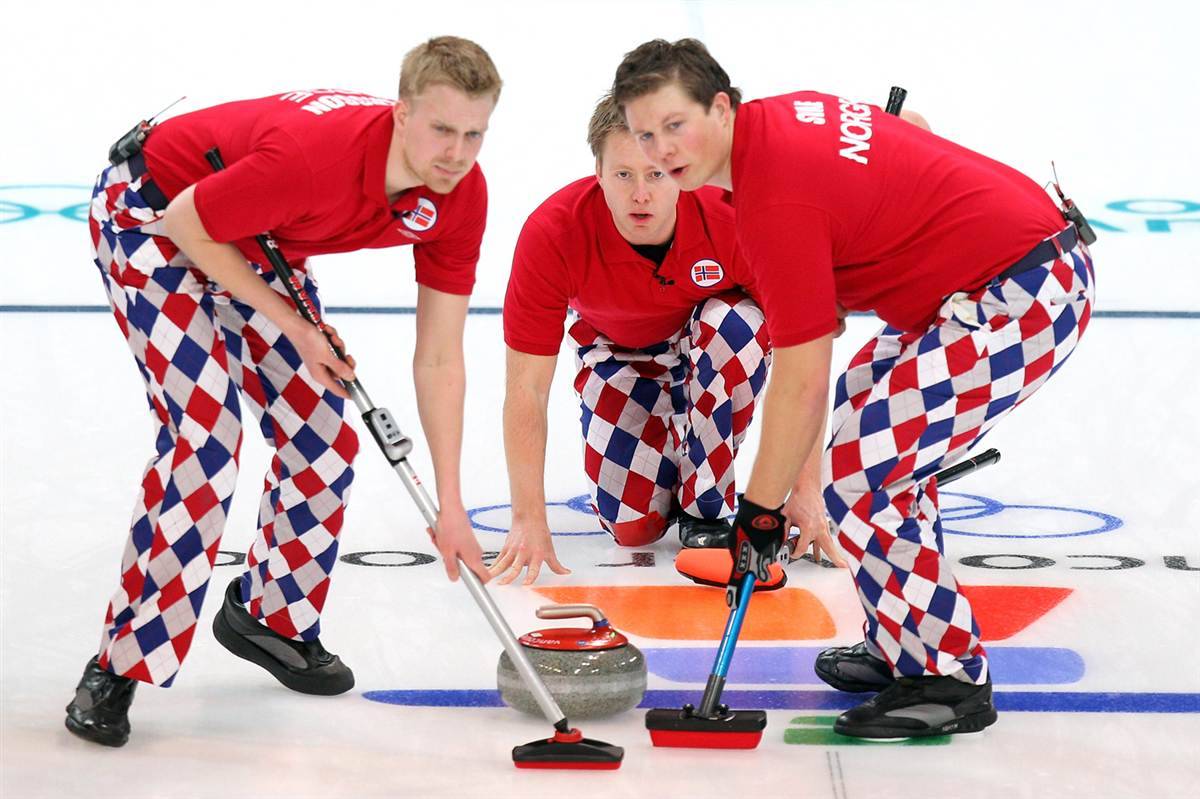
    Curling is rather unique among target-based sports because it allows athletes to alter the trajectory of their projectile after release. Curlers send 19 kg granite stones sliding across a pebbled ice surface at a target 28 meters away. On the way, teammates sweep the ice with natural or synthetic brushes. Sweeping the ice causes frictional heating, which lowers the local coefficient of friction and allows the stone to slide meters further than it would without sweeping. The bottom of the stone is concave, so the rock only contacts the ice along a narrow ring. One explanation for the stone’s tendency to curl in the direction it spins comes from this contact ring. Researchers suggest that the roughness of the leading edge cuts scratches into the ice which the trailing edge attempts to follow, causing the stone to move laterally, as illustrated over at Smarter Every Day. It’s important to note that the sweeping curlers do doesn’t directly guide the stone. In fact, by lowering the coefficient of friction the sweepers prevent the stone’s curling, and thus much of the skill of the sport is in knowing when, how, and how much to sweep. (Photo credit: C. Spencer/Getty Images)

    FYFD is celebrating by studying the fluid dynamics of the Games. Check out some of our previous posts including how to make artificial snow, the aerodynamics of bobsledding, and how ski jumpers fly further.

  • Sochi 2014: Bobsledding

    Sochi 2014: Bobsledding

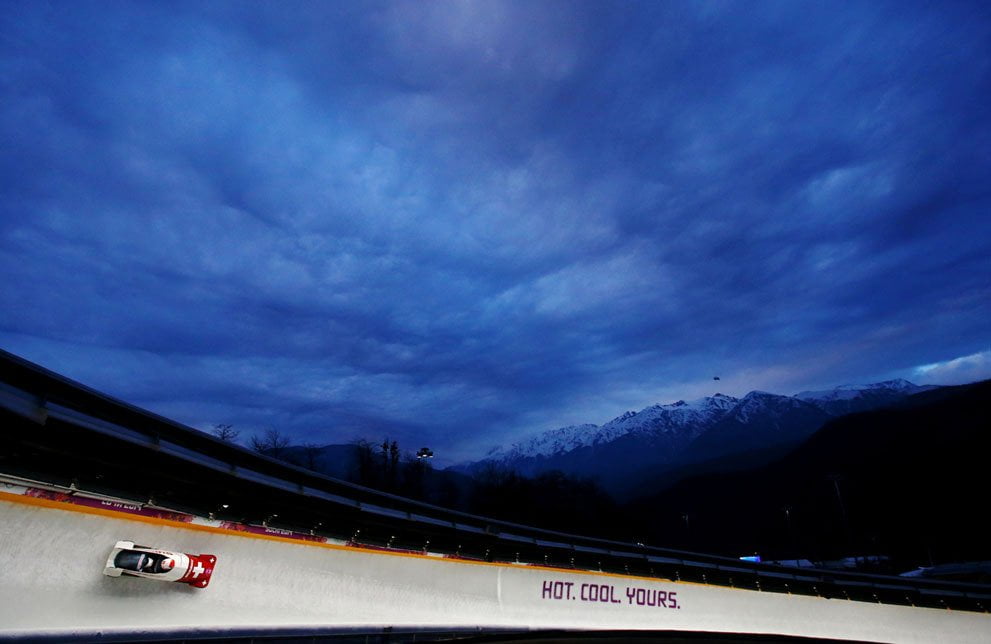
    Today bobsledding is an sport rife with modern technology and design techniques. In recent years, companies better known for their expertise in automobiles and Formula 1 racing have become players with BMW designing American sleds, McLaren making the UK sleds, and Ferrari providing for the Italian team. Like many winter gravity sports, contenders can be separated by as little as hundredths of a second. This makes aerodynamics a serious concern, but the variability of the sled’s position and orientation over a run makes realistically simulating the aerodynamics, either in a wind tunnel or computationally, extremely difficult. Additionally, the sport’s governing body restricts a sled’s dimensions, weight, shape, and other details; for example, bobsleds are not allowed to use vortex generators that would help maintain attached flow and reduce drag. Instead, designers try to shave drag elsewhere, in the shaping of the sled’s nose or by tweaking the back end of the sled to reduce the drag-inducing wake. Even the shape of the driver’s helmet is aerodynamically significant. (Image credits: Exa Corp, Getty Images, BMW)

    FYFD is celebrating #Sochi2014 by looking at fluid dynamics in winter sports. Check out our previous posts on how skiers glide, the US speedskating suit controversy, and why ice is slippery.

  • Sochi 2014: Downhill Skiing

    Sochi 2014: Downhill Skiing

    Like the athletes who compete on ice, skiers rely on a film of liquid beneath their skis to provide the low friction necessary to glide. The moisture results from the friction of the ski’s base and edges cutting into the snow, and, depending on the conditions of the snow, different surface treatments are recommended for the skis to help control and direct this lubricating film. Similarly, skiers uses various waxes on their skis to lower surface tension and provide additional lubrication. Fluid dynamics can also play a role in tactics for various ski-based events. In endurance events like cross-country skiing, drafting behind other skiers can help an athlete avoid drag and save energy. When drafting, cross-country skiers have lower heart rates. Drag and aerodynamics can also play a significant roles in alpine skiing, especially in speed events like the downhill or super G. In these events solo skiers reach speeds of 125 kph, where drag is a major factor in slowing their descent. Between turns smart skiers will tuck, decreasing their frontal area and reducing drag’s effects. Athletes use wind tunnel testing to dial in their tuck position for maximum effect, and, like speedskaters, skiers may also wear special aerodynamic suits. (Photo credits: F. Cofferini/AFP/Getty Images, C. Onerati; h/t to @YvesDubief)

  • Sochi 2014: Ski Jump, Part 2

    Sochi 2014: Ski Jump, Part 2

    Yesterday we talked about the technique ski jumpers use to fly farther. Generating lift without too much drag is the key to a good jump. But jumpers are subject to ever-changing wind conditions, and those can help or hurt them. Unlike most sports, in ski jumping a headwind is desirable. This is because the added relative air velocity increases the jumper’s lift and helps them fly farther. A tailwind, on the other hand, saps their speed. Since 2009, ski jumping competitions have included a wind compensation factor that tries to account for these effects. Wind velocity is measured at five points along the jumper’s flight path and the tangential (i.e. head- or tailwind) components are weighted and averaged. The weighting factors seem to be individual to each hill – not all hills are built with the same profile. This average tangential wind speed is then a linear variable in an equation for wind factor. The goal of the wind factor is as much to make the competition run smoothly as it is to increase fairness. The trouble is that the wind speed effect is non-linear; in other words, a headwind does not help a jumper as much as a tailwind can hurt them. In one simulation study, researchers found a 3 m/s headwind carried jumpers 17.4 m further while a tailwind of the same magnitude shortened the jump by 29.1 m. The wind differences in competition may not be as drastic, but truly evening the playing field may require a more complicated compensation system. (Photo credit: B. Martin/Sports Illustrated)

    FYFD is celebrating the Games with a look at fluid dynamics in the Winter Olympics. Check out our previous posts on the aerodynamics of speed skatingwhy ice is slippery and how lugers slide so fast.