Category: Research

  • “Immersion”

    “Immersion”

    Some seabirds, including gannets and boobies, feed by plunge diving. From high in the air, they fold their wings and dive like darts into the water, impacting at speeds around 24 m/s to help them reach the depths where their prey swim. With their narrow beaks and necks, the critical moments in this feat come when the bird’s head is submerged but its body remains out of the water. At this point, the bird’s head is decelerating quickly and its body is still moving at full speed; if the neck cannot withstand this combination of forces, it will buckle.

    But plunge divers, it turns out, have a secret weapon that helps them handle impact: their head shape. A study of water entry dynamics using 3D-printed models of birds’ heads found that plunge divers have a shape that increases the amount of time it takes to enter the water. The impact forces stretch out over that longer period of contact, which also stretches out the time it takes for the bird to reach its maximum deceleration. The end result? That extended contact time protects birds from unsafe levels of deceleration, just like a crumple-zone in a crashing car keeps its occupants from experiencing the worst decelerations. (Image credit: K. Zhou/BPOTY; research credit: S. Sharker et al.; via Colossal)

  • Slushy Snow Affects Antarctic Ice Melt

    Slushy Snow Affects Antarctic Ice Melt

    More than a tenth of Antarctica’s ice projects out over the sea; this ice shelf preserves glacial ice that would otherwise fall into the Southern Ocean and raise global sea levels. But austral summers eat away at the ice, leaving meltwater collected in ponds (visible above in bright blue) and in harder-to-spot slush. Researchers taught a machine-learning algorithm to identify slush and ponds in satellite images, then used the algorithm to analyze nine years’ worth of imagery.

    The group found that slush makes up about 57% of the overall meltwater. It is also darker than pure snow, absorbing more sunlight and leading to more melting. Many climate models currently neglect slush, and the authors warn that, without it, models will underestimate how much the ice is melting and predict that the ice is more stable than it truly is. (Image credit: Copernicus Sentinel/R. Dell; research credit: R. Dell et al.; via Physics Today)

  • Peering Inside Viscous Fingering

    Peering Inside Viscous Fingering

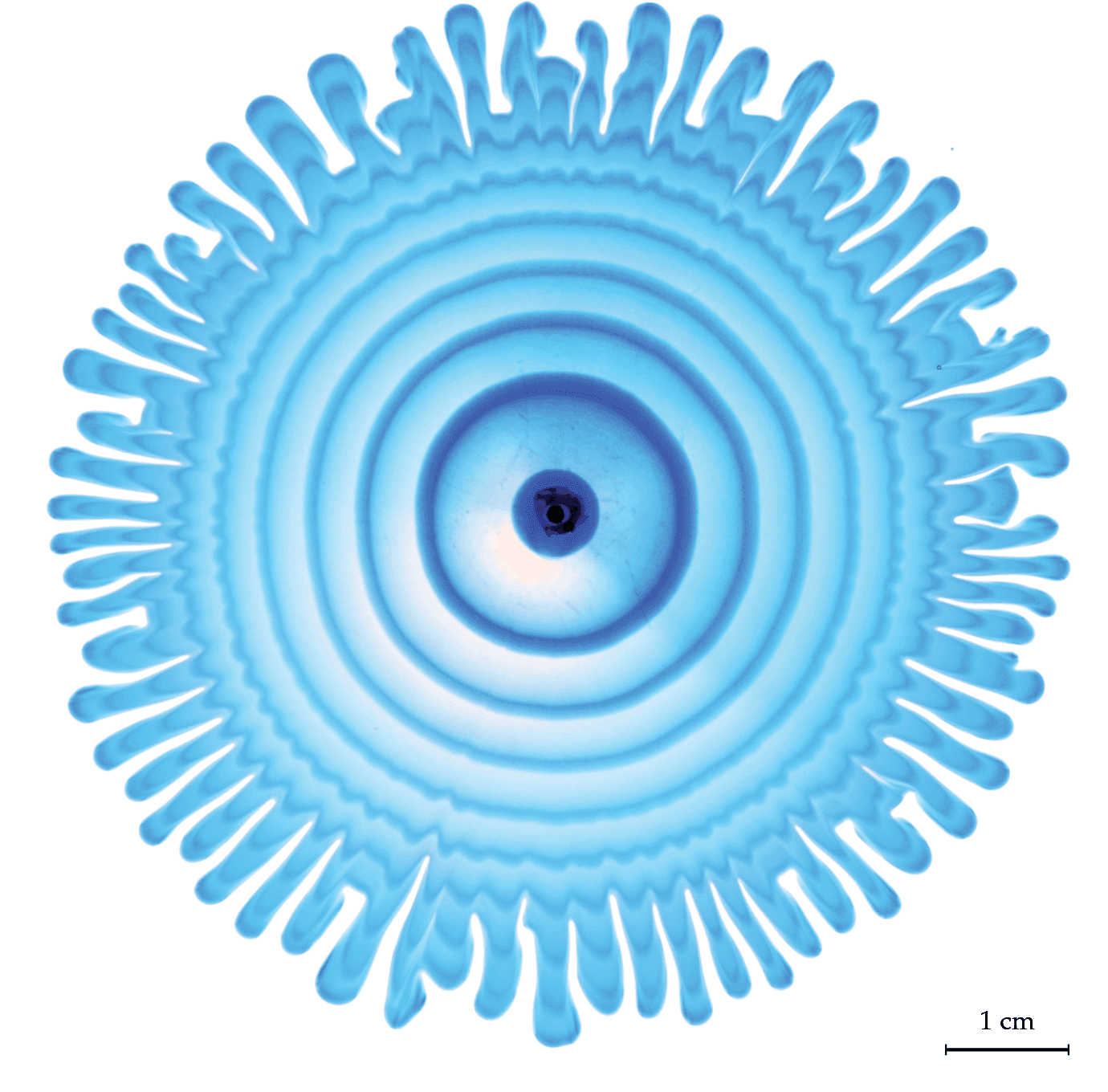
    Viscous fingers form when a low-viscosity fluid is pumped into a narrow, viscous-fluid-filled gap. The branching pattern that forms depends on the ratio of the two viscosities, among other factors. To better understand what goes on inside these fingers, researchers carefully alternated injecting dyed and undyed fluid. This creates a pattern of concentric rings that deform as the fingers spread.

    In this particular study, the initial fluid and injected fluids are miscible, meaning that they can mix into one another. In modeling their experiments, the team found that this mixing created stratification — i.e., layers of fluids with different densities — in the narrow gap between their plates. The stratification’s effects were large enough that the model required a correction term for them; that’s a bit surprising because we’d usually expect that the tiny third-dimension of the gap would be too small to matter! (Image and research credit: S. Gowan et al.)

  • Underground Convection Thaws Permafrost Faster

    Underground Convection Thaws Permafrost Faster

    In recent years, Arctic permafrost has thawed at a surprisingly fast pace. Much of that is, of course, due to the rapid warming caused by climate change. But some of that phenomenon lives underground, where water’s unusual properties cause convection in gaps between rocks, sediment, and soil.

    Water is densest not as ice but as water. This is why ice cubes float in your glass. Water’s densest form is actually a liquid at 4 degrees Celsius. For water-logged Arctic soils, this means that the densest layer is not at the frozen depth but at a higher, shallower depth. This places a dense liquid-infused layer over a lighter one, a recipe for unstable convection.

    Illustration of underground convection and permafrost thaw. On the left: temperature and density of the water in Arctic soil varies with depth. The temperature decreases with depth, but because water is densest at 4 degrees Celsius, the density is greatest at a shallower depth than the freezing interface. As a result of this unstable configuration (dense water over less dense water), convection can occur (right side).
    Illustration of underground convection and permafrost thaw. On the left: temperature and density of the water in Arctic soil varies with depth. The temperature gets colder the deeper you go, but because water is densest at 4 degrees Celsius, the density is greatest at a shallower depth than the freezing interface. As a result of this unstable configuration (dense water over less dense water), convection can occur (right).

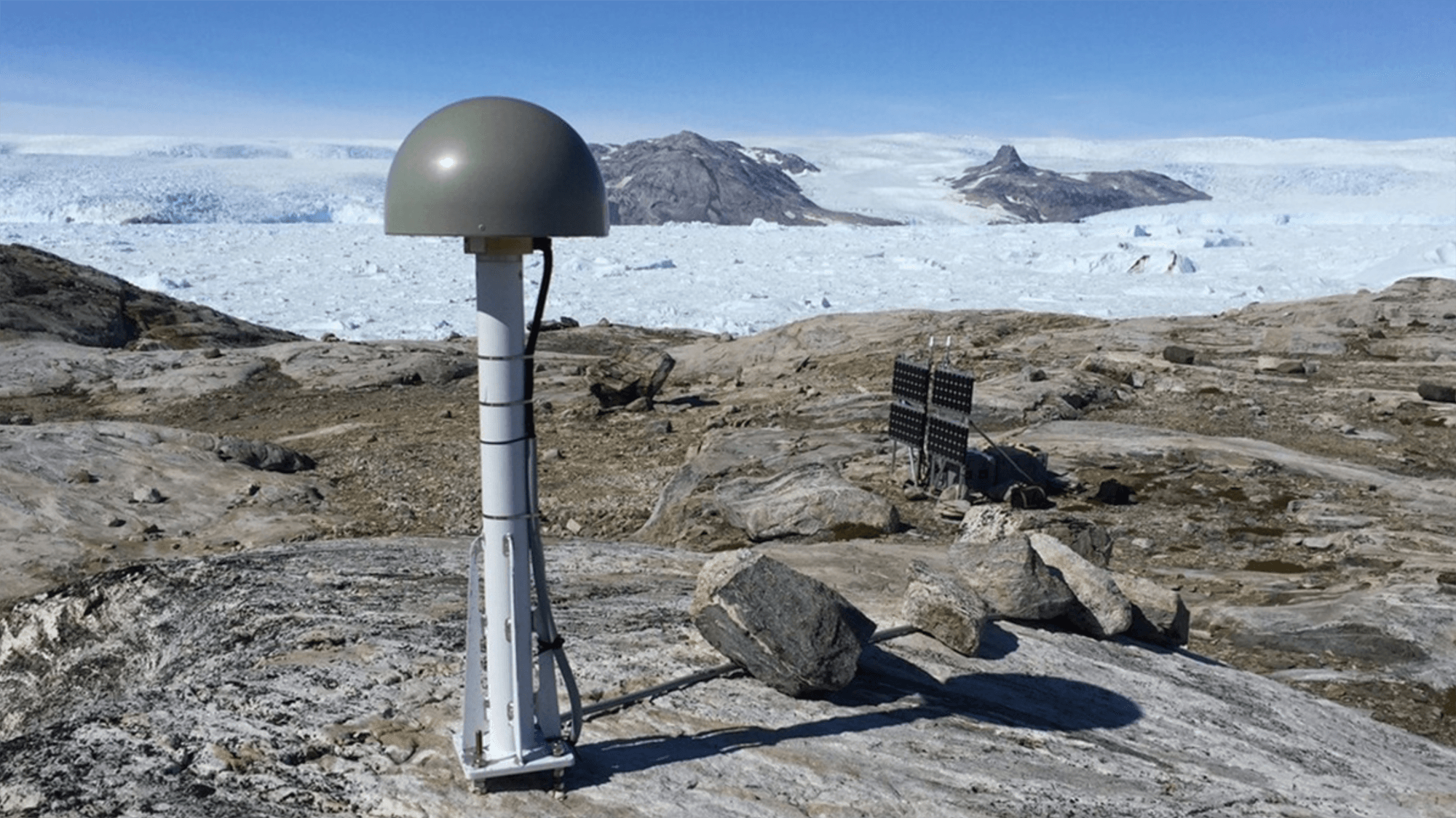
    In a recent numerical simulation, researchers found that this underground convection caused permafrost to thaw much more quickly than it would due to heat conduction alone. In fact, the effects appeared in as little as one month, so in a single summer, this convection could have a big effect on the thaw depth. (Image credit: top – Florence D., figure – M. Magnani et al.; research credit: M. Magnani et al.)

  • Pterosaur Tail Vanes

    Pterosaur Tail Vanes

    Among vertebrates, pterosaurs were the first to achieve powered flight. Early pterosaurs have tail vanes — similar in appearance to the frills seen on some lizards — but later species lost this feature. Whether the tail vanes helped in flight or served a display purpose is an open question among paleontologists. One group, in a recent pre-print, studied the vanes’ fossilized interior structure and found a cross-linked lattice that provided internal tension to the vanes. That means the vanes could potentially be held stiff, even in the face of aerodynamic forces that would cause untensioned surfaces to flutter. The result suggests that the tail vanes could have helped early fliers steer, even if evolution later moved that function (along with display) to other parts of the body. (Image credit: Sviatoslav-SciFi; research credit: N. Jagielska et al.; via jshoer)

  • Jamming Soft Grains

    Jamming Soft Grains

    Hard granular materials — sand, gravel, glass beads, and so on — can flow, but, in narrow regions or under large forces, they can also jam up, essentially turning into a solid. Soft particles can also flow and jam, but do so under different conditions than hard particles. One group of researchers used a custom-built rheometer to measure jamming in soft particles like the hydrogel beads pictured here. They found that they could extend existing models for jamming in hard particles, but they had to rescale the mathematics to account for the way soft particles change their shape under pressure. (Image credit: Girl with red hat; research credit: F. Tapia et al.; via APS Physics)

  • Water Suspected Beneath Mars

    Water Suspected Beneath Mars

    The surface features of Mars — crossed by river deltas and sedimentary deposits — indicate a watery past. Where that water went after the planet lost its atmosphere 3 – 4 billion years ago is an open question. But a new study suggests that quite a bit of that water moved underground rather than escaping to space.

    The research team analyzed seismic data from the Mars InSight Lander. Marsquakes and meteor strikes on the Red Planet send seismic waves through the planet’s interior. The waves’ speed and other characteristics change as they pass through different materials, and by comparing different waves picked up from the same originating source, scientists can back out what the waves passed through on the way to the detector. In this case, the team concluded that the data best fit a layer of water-filled fractured igneous rock 11.5 – 20 kilometers below the surface. They estimate that the water trapped in this subsurface layer is enough to cover the surface of the planet in a 1 – 2 kilometer deep ocean. (Image credit: NASA/JPL-Caltech; research credit: V. Wright et al.; via Physics World)

  • Shaped Splashes

    Shaped Splashes

    When a raindrop hits a leaf, it spreads out into a rimmed sheet that breaks up into droplets. These tiny drops can carry dust, spores, and even pathogens as they fly off. But many leaves aren’t smooth-edged; instead they have serrations or teeth. How does that affect a splash? That’s the question at the heart of today’s study.

    A water drop hits a star-shaped pillar and breaks up.
    A water drop hits a star-shaped pillar and breaks up.

    To simplify from a leaf’s shape, the team studied water dropping onto star-shaped pillars. As seen above and below, the pillar’s edge shaped the splash sheet, with the sheet extending further in the edge’s troughs. This asymmetry extends into the rim also, concentrating the liquid — and the subsequent spray of droplets — along lines that extend from the edge’s troughs and peaks.

    A viscous water-glycerol drop hits a star-shaped pillar, spreads, and breaks into droplets.
    A viscous water-glycerol drop hits a star-shaped pillar, spreads, and breaks into droplets.

    The team found that, in addition to sending drops along a preferred direction, the shaped edge made the droplets larger and faster than a smooth edge did. (Image and research credit: T. Bauer and T. Gilet)

  • Catching Krill With Bubble Nets

    Catching Krill With Bubble Nets

    On their own and in groups, some humpback whales enclose their prey in bubbly columns before feeding. The whales build these bubble nets intentionally, swimming in a ring at a constant speed while producing bursts of air from their blowhole. After observing hundreds of bubble nets created by dozens of whales, researchers concluded that whales actively tune the nets, using more rings, closer bubble spacing, or deeper extents to suit their needs. Once they’ve completed the net, whales lunge up through the center, mouth open, collecting their food.

    In their study, the team found that building bubble nets is no more energy intensive for whales than typical lunge-feeding. However, the prey concentration in a bubble net means that hunting there nabs more food per lunge. The authors argue that the way humpback whales build and use bubble nets qualifies them as tool users on par with many fellow mammals, as well as some birds, fish, and insects. (Image credit: C. Le Duc; research credit: A. Szabo et al.; via Gizmodo)

  • Synchronizing Cilia

    Synchronizing Cilia

    Just like human swimmers, microswimmers have to coordinate their motion to swim. But unlike humans, swimmers like the freshwater alga Chlamydomonas reinhardtii doesn’t have a brain to help it synchronize its cilia. To investigate how these microswimmers manage their stroke, researchers built a biorobot with mechanically linked segments that mimic the alga’s swimming once a motor sets the robot vibrating.

    When the robot's base is allowed to rotate, the cilia synchronize in the freestyle-like R-mode.
    When the robot’s base is allowed to rotate, the cilia synchronize in the freestyle-like R-mode.
    When allowed to move forward and back, the biorobot's cilia synchronize in the X-mode, which resembles the breaststroke.
    When allowed to move along an axis, the biorobot’s cilia synchronize in the X-mode, which resembles the breaststroke.

    The researchers found two strokes that mirrored the real-life alga. In one, allowing the robot’s base to rotate produced a freestyle-like stroke they called R-mode. The other came from allowing the robot’s base to move forward and backward, which created a breaststroke-like X-mode. In the wild, only the X-mode provides helpful motion, but, oddly enough, the researchers found this mode was the most energy intensive. (Image credit: top – J. Larson, others – Y. Xia et al.; research credit: Y. Xia et al.; via APS Physics)