Category: Research

  • Ember Bursts Spread Wildfires

    Ember Bursts Spread Wildfires

    In a wildfire, a burst of embers lofted upward can travel far, starting a new spot fire when they land. Although large ember bursts only happen occasionally, researchers found that these events — with orders of magnitude more embers than usual — play an outsized role in wildfire spread. In their experiments, researchers observed a bonfire with high-speed cameras to track ember bursts, and they also collected fallen embers from around their fire. They found large (>1 mm) embers could travel much further than current fire models predicted, carried by rare but powerful updrafts that coincided with large bursts. Their work indicates that wildfire models need a better way to simulate these kinds of events that are far from the fire’s baseline state but which occur often enough and with enough impact that they can spread fires. (Image credit: C. Cook; research credit: A. Peterson and T. Banerjee; via Physics World)

  • Seeking Mars’ Past

    Seeking Mars’ Past

    Although Mars is quite dry and inhospitable today, our rovers continue to search for evidence of a past Mars that could have sustained life. A recent study suggests that, at least in Gale Crater, the opportunities for life to flourish may have been short-lived. In particular, the team looked at carbonates found by the Curiosity rover. These minerals contain varying amounts of carbon and oxygen isotopes that can hint at the conditions the carbonates formed under. The team found a high proportion of heavier isotopes, which suggest one of two possible formation paths. In the first, Gale Crater underwent wet-dry cycles that alternated between more- and less-habitable conditions for life. The second possibility is a cryogenic past, where most of the local water was locked in ice, and life would have had to survive — if possible — in small pockets of extremely salty water. Neither possibility is a great one for the kinds of life we’re accustomed to. (Image credit: NASA; research credit: D. Burtt et al.; via Gizmodo)

  • Featured Video Play Icon

    Non-Newtonian Raindrops

    Fluids like air and water are called Newtonian because their viscosity does not vary with the force that’s applied to them. But many common fluids — almost everything in your fridge or bathroom drawer, for example — are non-Newtonian, meaning that their viscosity changes depending on how they’re deformed.

    Non-Newtonian droplets can behave very differently than Newtonian ones, as this video demonstrates. Here, their fluid of choice is water with varying amounts of silica particles added. Depending on how many silica particles are in the water, the behavior of an impacting drop varies from liquid-like to completely solid and everything in between. Why such a great variation? It all has to do with how quickly the droplet tries to deform and whether the particles within it can move in that amount of time. Whenever they can’t, they jam together and behave like a solid. (Image, video, and research credit: S. Arora and M. Driscoll)

  • Hello, STEVE

    Hello, STEVE

    A purple glow arcs across the night sky. Just another aurora, or is it? First described in 2018, this is a STEVE — Strong Thermal Emission Velocity Enhancement. (Yes, the name “Steve” came first and the acronym came later.) Scientists still aren’t entirely sure how to classify this glowing phenomenon. Although it looks similar to an aurora, its color spectrum is continuous between 400 and 700 nanometers; classic auroras, in contrast, have a discrete spectrum dependent on which atmospheric molecules are getting stimulated by the incoming solar wind. Scientists have noticed that STEVE appears before midnight and is accompanied by a fast 5.5 km/s westward ion flow. A dawnside equivalent with an eastward ion flow was reported just this year.

    With newly identified phenomena like this, the research papers are fast and furious as the scientific community searches for consensus on exactly what STEVE is and how it’s formed. But this domain is not reserved for professional astronomers alone; citizen scientists were the first to identify STEVE and open projects like Aurorasaurus continue to provide valuable data and observations. (Image credit: K. Trinder/NASA; research credit: S. Nanjo et al.; via Gizmodo)

  • Blocking Bubbles

    Blocking Bubbles

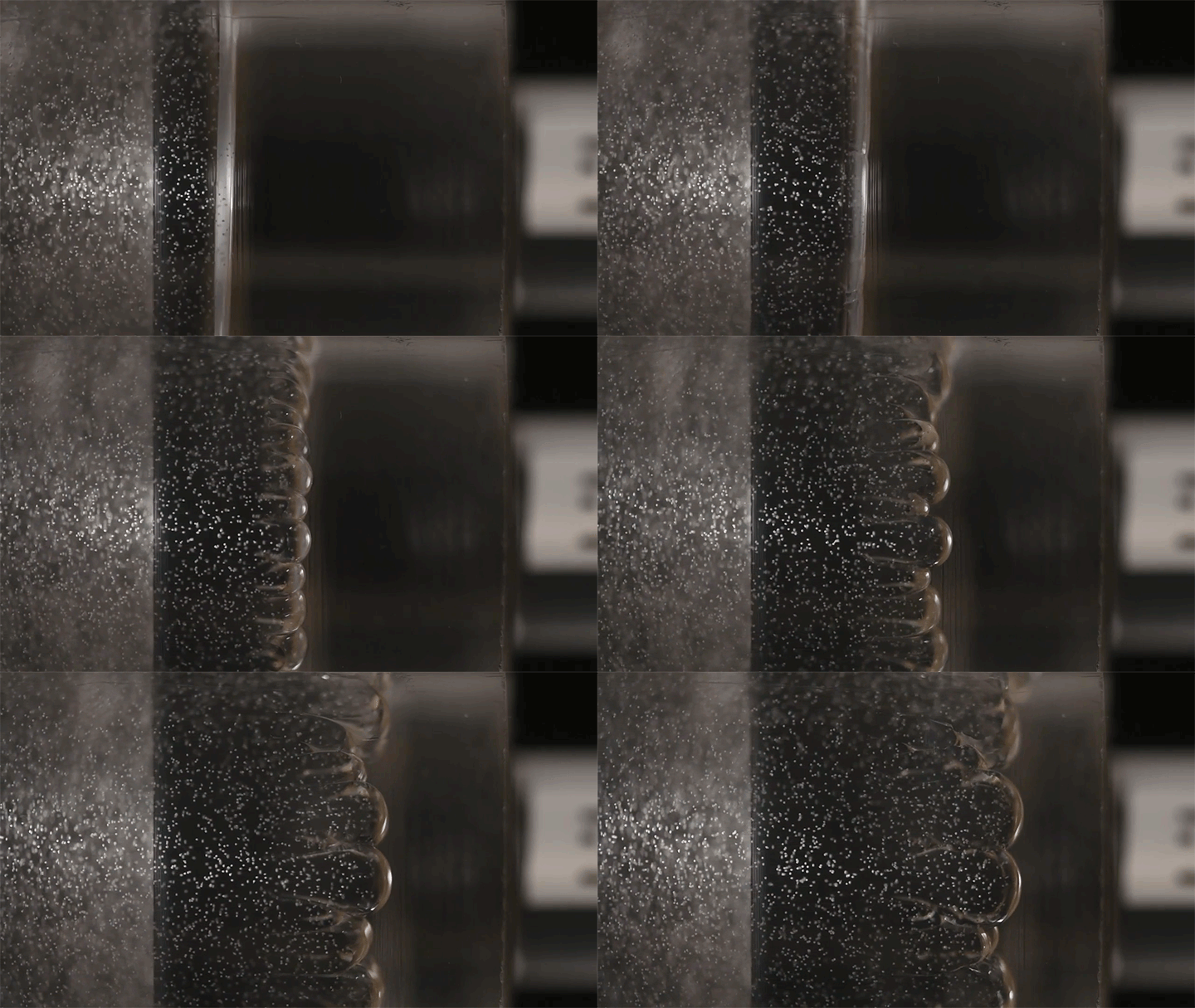
    Many industrial processes, including those producing aluminum and “green” hydrogen, use electrodes to speed up chemical reactions. Unfortunately, bubbles that form on the electrode reduce its efficiency anywhere from 10 to 25 percent by blocking parts of the electrode. The assumption has been that any area shadowed by bubbles is blocked, but a recent study shows that’s not the case. Instead, it’s only the electrode area in direct contact with the bubble that’s blocked.

    To show this, researchers looked at a smooth electrode where bubbles formed randomly (left) and a nanotextured one with many spots where bubbles could form (right). In the animation above, bubble shadows are highlighted with circles. There are clearly more bubbles on the nanotextured electrode, but it actually performs better than the smooth electrode because the bubble contact area is smaller. (Image and research credit: J. Lake et al.; via MIT News)

  • The Great Red Spot’s Cycle

    The Great Red Spot’s Cycle

    First spotted by humanity in 1664, Jupiter‘s Great Red Spot is a seemingly endless storm. Strictly speaking, there is debate as to whether observations prior to 1831 were of the same storm, but there’s no denying that the storm has raged unabated since regular observations began in the first half of the nineteenth century. Despite its longevity, the Great Red Spot is not unchanging. Overall, its major axis is shrinking, making the storm more circular over time. The storm also has a 90-day cycle in which its size, shape, and brightness vary, as seen below. Researchers note that the changes are relatively subtle — at least to the eye — but now that they’ve been identified, it may be possible to use amateur astronomers’ data to track these variations more closely. (Image credits: GRS – K. Gill/NASA, snapshots – A. Simon et al.; research credit: A. Simon et al.; via Gizmodo)

    Over a 90 day cycle, Jupiter's Great Red Spot oscillates in size, shape, and other characteristics.
    Over a 90 day cycle, Jupiter’s Great Red Spot oscillates in size, shape, and other characteristics.
  • Self-Cleaning With Salt Critters

    Self-Cleaning With Salt Critters

    Even freshwater contains trace salts and minerals that cause scaly buildups as they evaporate. Getting rid of the scale usually requires toxic chemicals and/or lots of scrubbing, neither of which are desirable at the industrial level. At the same time, we’re extremely limited in the amount of freshwater that we have available; only about 1% of Earth’s water is liquid and fresh. If we could use salt water in more industrial processes, that would preserve freshwater for drinking and agriculture. But how do we tackle the scaly buildup?

    (A) On microtextured surfaces, salt from evaporating drops can work its way into the gaps, destroying the superhydrophobicity of the surface. (B) In contrast, nanotextured surfaces give the salt nowhere to adhere, resulting in "salt critters" that grow upward and detach.
    (A) On microtextured surfaces, salt from evaporating drops can work its way into the gaps, destroying the superhydrophobicity of the surface. (B) In contrast, nanotextured surfaces give the salt nowhere to adhere, resulting in “salt critters” that grow upward and detach.

    Enter “salt critters.” Researchers found that when salt water evaporated from microtextured surfaces designed to shed water, salt would eventually build up in the gaps, breaking the hydrophobic effect and allowing scale to build up. In contrast, a nanotextured surface left nowhere for the salt to adhere. On these surfaces, evaporating salt water built jellyfish-like salt critters that rose from the surface and, eventually, broke off and rolled away, leaving the surface pristine. (Image credit: S. McBride; research credit: S. McBride et al.; via Physics Today)

  • Waves Break Up Floating Rafts

    Waves Break Up Floating Rafts

    Small particles can float on a liquid, held together as a raft through capillary action. But those rafts — like the tea skin below — break up when waves jostle them. In this study, researchers looked at how standing waves broke up a raft of graphite powder. Although the raft’s break-up resembles fields of sea ice breaking apart, the researchers found that different mechanisms were responsible. In their experiment, waves pushed and pulled horizontally at the raft, causing it to fracture. But that push-and-pull is negligible in sea ice, where sheets instead break from the up-and-down motion of waves vertically bending the ice. Nevertheless, the new insights are valuable for various biofilms and some ice floes. (Image and research credit: L. Saddier et al.; via APS Physics)

    The skin atop a cup of tea breaks up into polygons after stirring with a spoon.
    The skin atop a cup of tea breaks up into polygons after stirring with a spoon. Although the effect resembles sea ice breakup, the specific wave mechanism differs.
  • Breaking in Rogue Seas

    Breaking in Rogue Seas

    Many models for forecasting ocean waves simplify the physics by assuming that waves are essentially two-dimensional, like a long breaker heading toward shore. But in the open ocean, waves often come from more than one direction; crossing seas are a good example. When waves from different directions combine, a recent study shows, the resulting wave can grow far larger and steeper than expected. These monstrous rogue waves are especially dangerous for offshore infrastructure like oil rigs and wind turbines, which must be built to withstand rare but extreme waves. (Image credit: O. Мороз; research credit: M. McAllister et al.; via Gizmodo)

  • “Immersion”

    “Immersion”

    Some seabirds, including gannets and boobies, feed by plunge diving. From high in the air, they fold their wings and dive like darts into the water, impacting at speeds around 24 m/s to help them reach the depths where their prey swim. With their narrow beaks and necks, the critical moments in this feat come when the bird’s head is submerged but its body remains out of the water. At this point, the bird’s head is decelerating quickly and its body is still moving at full speed; if the neck cannot withstand this combination of forces, it will buckle.

    But plunge divers, it turns out, have a secret weapon that helps them handle impact: their head shape. A study of water entry dynamics using 3D-printed models of birds’ heads found that plunge divers have a shape that increases the amount of time it takes to enter the water. The impact forces stretch out over that longer period of contact, which also stretches out the time it takes for the bird to reach its maximum deceleration. The end result? That extended contact time protects birds from unsafe levels of deceleration, just like a crumple-zone in a crashing car keeps its occupants from experiencing the worst decelerations. (Image credit: K. Zhou/BPOTY; research credit: S. Sharker et al.; via Colossal)