Category: Research

  • Flow Behind Viscous Fingers

    Flow Behind Viscous Fingers

    Nature is full of branching patterns: trees, lighting, rivers, and more. In fluid dynamics, our prototypical branching pattern is the Saffman-Taylor instability, created when a less viscous fluid is injected into a more viscous one in an confined space. Most attention in this problem has gone to the branching interface where the two fluids meet, but recently, a team has examined the flow away from the fingers by alternately injecting dyed and undyed fluid to visualize what goes on. That’s what we see here. Notice how the central dye rings, far from the branching fingers, still appear circular. Yet, even a few centimeters away from the fingers, the dye is starting to show ripples that correspond to the fingers. That’s an indication that the pressure gradient generated at the tips of the fingers is pretty far-reaching! (Image and research credit: S. Gowen et al.)

    Fediverse Reactions
  • Tracking Meltwater Through Flex

    Tracking Meltwater Through Flex

    Greenland’s ice sheet holds enough water to raise global sea levels by several meters. Each year meltwater from the sheet percolates through the ice, filling hidden pools and crevasses on its way to draining into the sea. Monitoring this journey directly is virtually impossible; too much goes on deep below the surface and the ice sheet is a precarious place for scientists to operate. So, instead, they’re monitoring the bedrock nearby.

    Researchers used a network of Global Navigation Satellite System (GNSS) stations like the one above to track how the ground shifted and flexed as meltwater collected and moved. They found that the bedrock moved as much as 5 millimeters during the height of the summer melt. How quickly the ground relaxed back to its normal state depended on where the water went and how quickly it moved. Their results indicate that the water’s journey is not a short one: meltwater spends months collecting in subterranean pools on its way to the ocean — something that current climate models don’t account for. Overall, the team’s results indicate that there’s much more hidden meltwater than models predict and it spends a few months under the ice on its way to the sea. (Image credit: T. Nylen; research credit: J. Ran et al.; via Eos)

    Fediverse Reactions
  • Swimming Like a Ray

    Swimming Like a Ray

    Manta rays are amazing and efficient swimmers — a necessity for any large animal that survives on tiny plankton. Researchers have built a new soft robot inspired by swimming mantas. Like its biological inspiration, the robot flaps its pectoral fins much as bird flaps its wings; this motion creates vortices that push water behind the robot, propelling it forward. For a downstroke, air inflates the robot’s body cavity, pushing the fins downward. When that air is released, its fins snap back up. With this simple and energy efficient stroke, researchers are able to control the robot’s swimming speed and depth, allowing it to maneuver around obstacles. Flapping faster helps the robot surface, and slower flapping allows it to sink. (Living manta rays also sink if they slow down.) Check out the robot in action below. (Image credit: J. Lanoy; video and research credit: H. Qing et al.; via Ars Technica)

  • Why Icy Giants Have Strange Magnetic Fields

    Why Icy Giants Have Strange Magnetic Fields

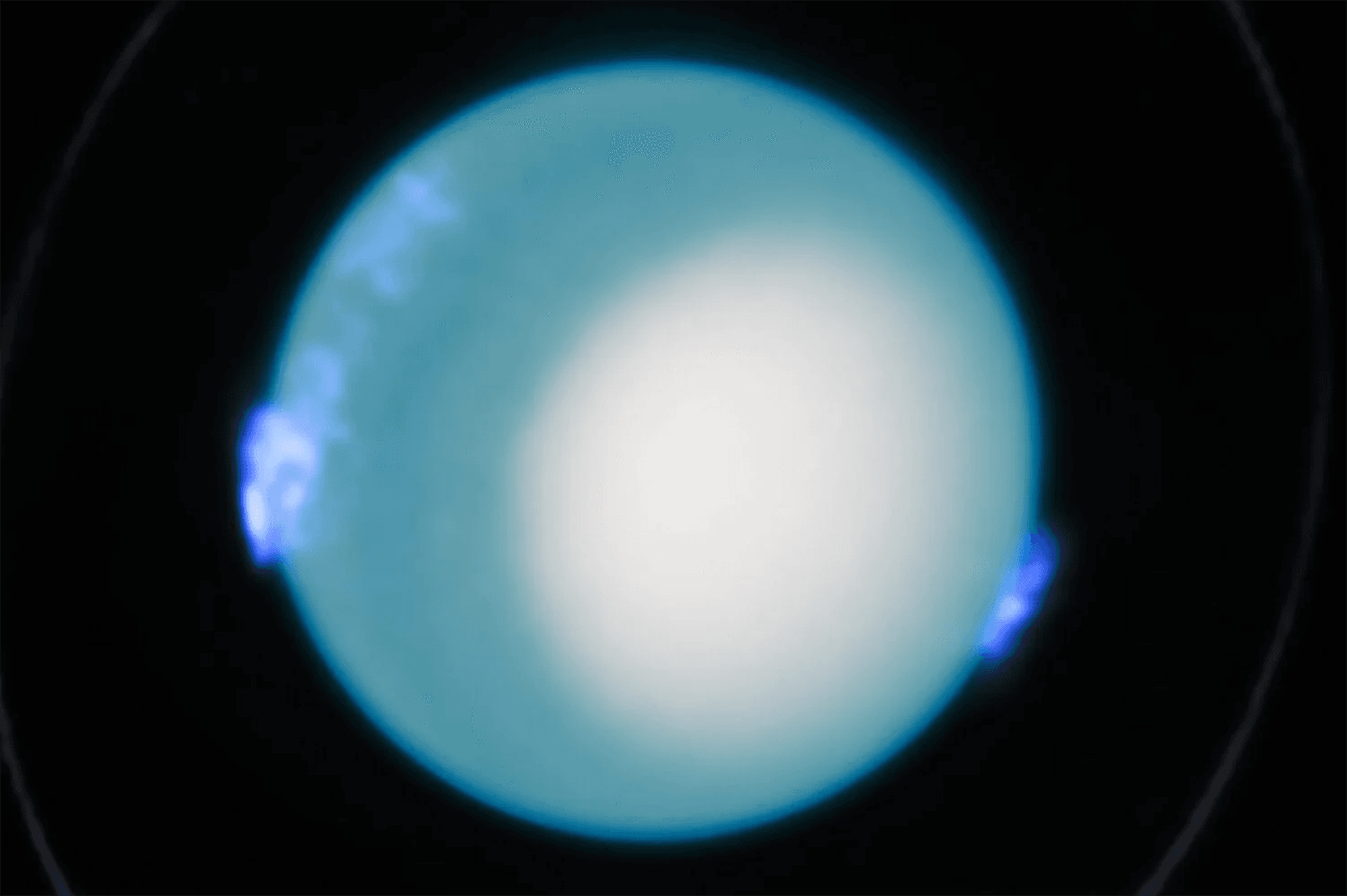
    When Voyager 2 visited Uranus and Neptune, scientists were puzzled by the icy giants’ disorderly magnetic fields. Contrary to expectations, neither planet had a well-defined north and south magnetic pole, indicating that the planets’ thick, icy interiors must not convect the way Earth’s mantle does. Years later, other researchers suggested that the icy giants’ magnetic fields could come from a single thin, convecting layer in the planet, but how that would look remained unclear. Now a scientist thinks he has an answer.

    When simulating a mixture of water, methane, and ammonia under icy giant temperature and pressure conditions, he saw the chemicals split themselves into two layers — a water-hydrogen mix capable of convection and a hydrocarbon-rich, stagnant lower layer. Such phase separation, he argues, matches both the icy giants’ gravitational fields and their odd magnetic fields. To test whether the model holds up, we’ll need another spacecraft — one equipped with a Doppler imager — to visit Uranus and/or Neptune to measure the predicted layers firsthand. (Image credit: NASA; research credit: B. Militzer; via Physics World)

    Fediverse Reactions
  • Tracking Coastal Sediment Loss

    Tracking Coastal Sediment Loss

    Shorelines rely on an influx of sediment to counter what’s lost to erosion by waves and currents. But tracking that sediment flux is challenging in coastal regions where salt, waves, and storms batter delicate instruments. Instead, researchers have turned to remote sensing through high-resolution satellites like Landsat to monitor these areas. Researchers built an algorithm to analyze coastal imagery, validated with local sediment measurements; once built, they deployed it in a free tool that lets anyone build a 40-year timeline of a coastal area’s sediment history.

    Looking at thousands of sites around the world, the team found coastal sediment is on the decline, especially along sandy and muddy coastlines. Where has the sediment gone? It’s likely that human-built infrastructure — both on coasts and upstream along rivers — is disrupting the natural flow of sediments that would replenish these regions. (Image credit: NASA; research credit: W. Teng et al.; via Eos)

  • Tracking Tonga’s Boom

    Tracking Tonga’s Boom

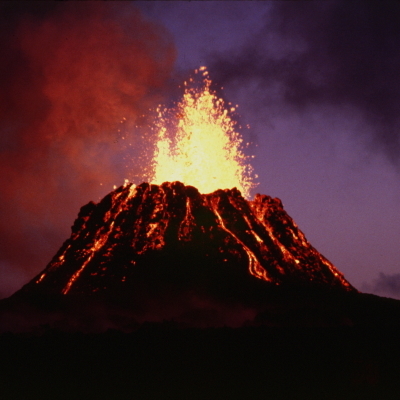
    When the Hunga Tonga-Hunga Ha’apai volcano erupted in January 2022, its effects were felt — and heard — thousands of kilometers away. A new study analyzes crowdsourced data (largely from Aotearoa New Zealand) to estimate the audible impact of the eruption. The researchers found that the volume, arrival time, and nature of the rolling rumble reported by survey takers correlated well with seismic measurements. But humans provided data that monitoring equipment couldn’t. For example, reports of shaking buildings and rattling windows let researchers estimate the shock wave‘s overpressure far from the volcano. The team suggests that acting quickly to collect human impressions of rare events like this one can add valuable data that’s otherwise overlooked. (Image credit: NASA; research credit: M. Clive et al.; via Gizmodo)

  • A New Mantle Viscosity Shift

    A New Mantle Viscosity Shift

    The rough picture of Earth’s interior — a crust, mantle, and core — is well-known, but the details of its inner structure are more difficult to pin down. A recent study analyzed seismic wave data with a machine learning algorithm to identify regions of the mantle where waves slowed down. These shifts in seismic wave speed occur in areas where the mantle’s viscosity changes; a higher viscosity makes waves travel slower.

    The team found seismic wave speed shifts at depths of 400 and 650 kilometers, corresponding to known viscosity changes. But they found shifts at 1050 and 1500 kilometers, as well — the first time anyone has shown a global viscosity shift at those depths. Their analysis suggests a higher viscosity in this mid-mantle transition zone, which could affect how tectonic plates, which rely on these slow mantle flows, move. (Image credit: NASA; research credit: K. O’Farrell and Y. Wang; via Eos)

  • Holding Steady

    Holding Steady

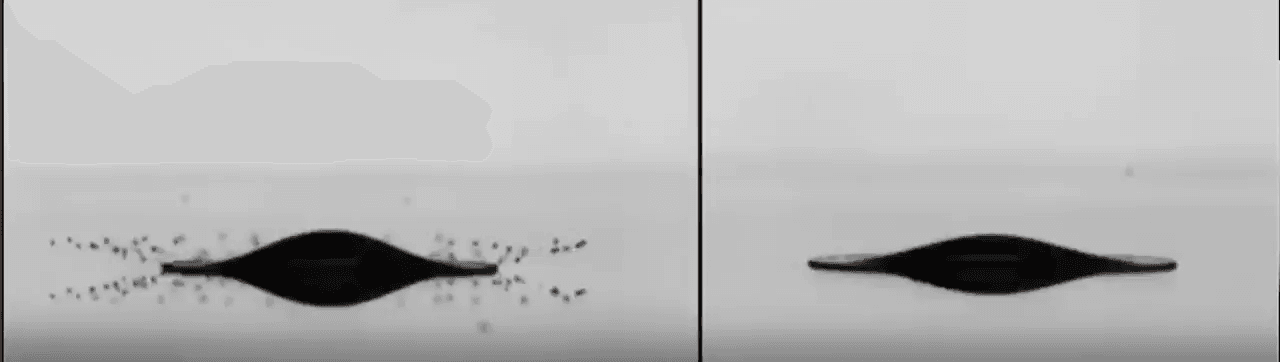
    Before a mammalian cell divides, the spindle — a protein structure — divides the cell’s genetic material in two. As it does, the cytoplasm inside the cell forms a toroidal flow (below, left). Researchers wondered how the spindle manages to stay in place with this flow; the spindle sits just where the flow diverges, a spot that seems ripe for unstable shifts in position. But, contrary to expectations, their analysis showed that — although a smaller spindle would be unstable in that spot — the protein spindle is large enough that its size distorts the cell’s flow and creates a pressure that moves it back into place if it shifts. (Image credit: top – ColiN00B, illustration – W. Liao and E. Lauga; research credit: W. Liao and E. Lauga; via APS Physics)

    Left: illustration of the toroidal flow near the spindle (purple) in a cell. Right: schematic of flow near the spindle's fixed point.
    Left: illustration of the toroidal flow near the spindle (purple) in a cell. Right: schematic of flow near the spindle’s fixed point.
    Fediverse Reactions
  • Tracking Ice Floes

    Tracking Ice Floes

    To understand why some sea ice melts and other sea ice survives, researchers tracked millions of floes over decades. This herculean undertaking combined satellite data, weather reports, and buoy data into a database covering nearly 20 years of data. With all of that information, the team could track the changes to specific pieces of ice rather than lumping data into overall averages.

    They found that an ice floe’s fate depended strongly on the route it took: ice that slipped from its starting region into warmer, more southern regions was likely to melt. They also saw region-specific effects, like that thick sea ice was more likely to melt in the East Siberian Sea’s summer, possibly due to warmer currents. The comprehensive, fine-grained analyses possible with this ice-tracking technique offer a chance to understand why some Arctic regions are more vulnerable to warming than others. (Image credit: D. Cantelli; research credit: P. Taylor et al.; via Eos)

  • Dry Plants Warn Away Moths

    Dry Plants Warn Away Moths

    Drought-stressed plants let out ultrasonic distress cries that moths use to avoid plants that can’t support their offspring. In ideal circumstances, a plant is constantly pulling water up from the soil, through its roots, and out its leaves through transpiration. This creates a strong negative pressure — varying from 2 to 17 atmospheres’ worth — inside the plant’s xylem. If there’s not enough water to keep the plant’s inner flow going, cavitation occurs — essentially a tiny vacuum bubble opens in the xylem. That cavitation isn’t silent; it creates a click at ultrasonic frequencies above human hearing. But just because we don’t hear it doesn’t mean that sound goes unheard.

    In fact, recent research suggests that, not only do moths hear the plant’s cavitation cries, female moths will avoid laying eggs on a healthy plant that sounds like it’s cavitating. Evolutionarily, this makes sense. Hatchlings rely on their birth plant for food and habitat; if an adult moth picks a dying, drought-stressed plant, its offspring won’t survive. It pays to be sensitive to the plant’s signs of distress. (Image credit: Khalil; research credit: R. Seltzer et al.; via NYTimes)

    Fediverse Reactions